
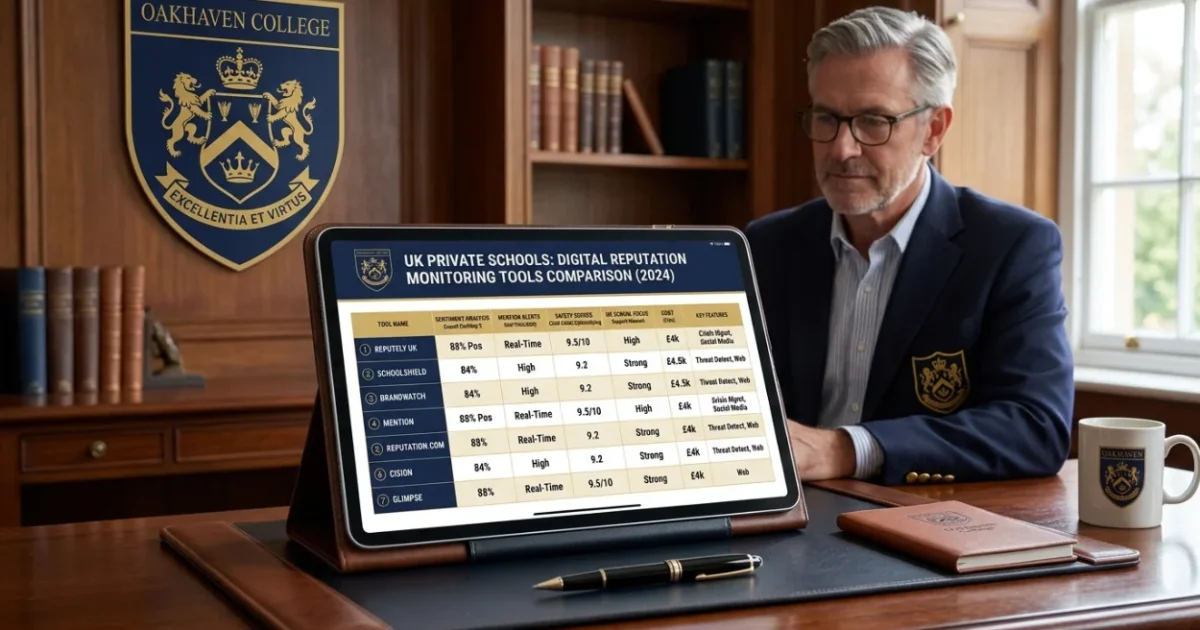
Reputation management strategies differ based on the type of reputation signals they monitor, the speed of analysis they provide, and the depth of search visibility insights they generate.
Online reputation control methods are evaluated through their ability to monitor entity credibility, sentiment distribution, search ranking influence, and changes within search ecosystems.
Why do private schools use reputation monitoring tools instead of manual searches?
Reputation monitoring tools provide structured data collection, continuous observation, and automated reporting that manual searches cannot replicate consistently. Reputation management for private schools operates within dynamic search ecosystems where reviews, directory listings, news articles, and social discussions continuously change. Monitoring tools collect these signals across multiple sources and organise them into measurable insights. Search engines interpret reputation signals through relationships between authoritative information, user-generated content, and digital trust indicators. Continuous monitoring therefore improves understanding of how search visibility evolves over time rather than offering isolated observations.
Manual searches remain useful for verifying individual search results but provide limited scalability. A manual review captures information at one point in time, whereas monitoring tools identify historical trends, sentiment changes, review growth, and fluctuations in entity credibility. This broader perspective enables more comprehensive evaluation of online reputation without relying on fragmented observations.
Which reputation monitoring tools provide the broadest search visibility analysis?
Different monitoring tools evaluate different categories of reputation signals because each platform specialises in specific information sources. Some tools concentrate on search engine rankings, while others prioritise reviews, media mentions, or social conversations. Comparing these capabilities explains why organisations frequently combine several monitoring approaches instead of depending on one platform.
How do monitoring tools differ?
Monitoring tools generally operate through different mechanisms:
- Track search engine rankings to identify changes affecting search ranking influence and SERP composition.
- Collect review platform data to measure sentiment distribution across verified review websites.
- Monitor media coverage to identify emerging reputation signals from authoritative publications.
- Analyse social conversations to evaluate public engagement and discussion trends.
- Detect directory changes that influence entity credibility through business listings.
- Compare competitor visibility using benchmark reporting and search performance analysis.
- Generate automated alerts when significant reputation changes occur across monitored platforms.
Each category contributes unique information regarding online reputation, making comparative analysis more valuable than relying on a single monitoring source.
How do search ranking monitoring tools compare with review monitoring platforms?
Search ranking monitoring tools evaluate visibility by measuring keyword performance, indexed content, and changes in SERP composition. Their primary function is identifying fluctuations that influence discoverability across search engines. Reputation management analyses these metrics because search ranking influence reflects how authoritative content competes within search ecosystems. Ranking tools therefore provide valuable visibility data but offer limited insight into the reasons behind reputation changes.
Review monitoring platforms evaluate reputation differently by measuring review frequency, sentiment distribution, average ratings, and response activity. These platforms explain how user-generated content contributes to entity credibility rather than overall search performance. Search engines evaluate reviews as one category of reputation signals alongside authoritative content, meaning review platforms provide contextual information that complements ranking analysis. Comparing both approaches demonstrates that visibility and sentiment represent different components of online reputation.

Combining ranking analysis with review monitoring creates a broader understanding of reputation performance. Search visibility explains where information appears, while review analysis explains how public sentiment contributes to trust signals. Together, these measurements provide a more complete evaluation of digital reputation.
Why do media monitoring tools contribute to reputation management?
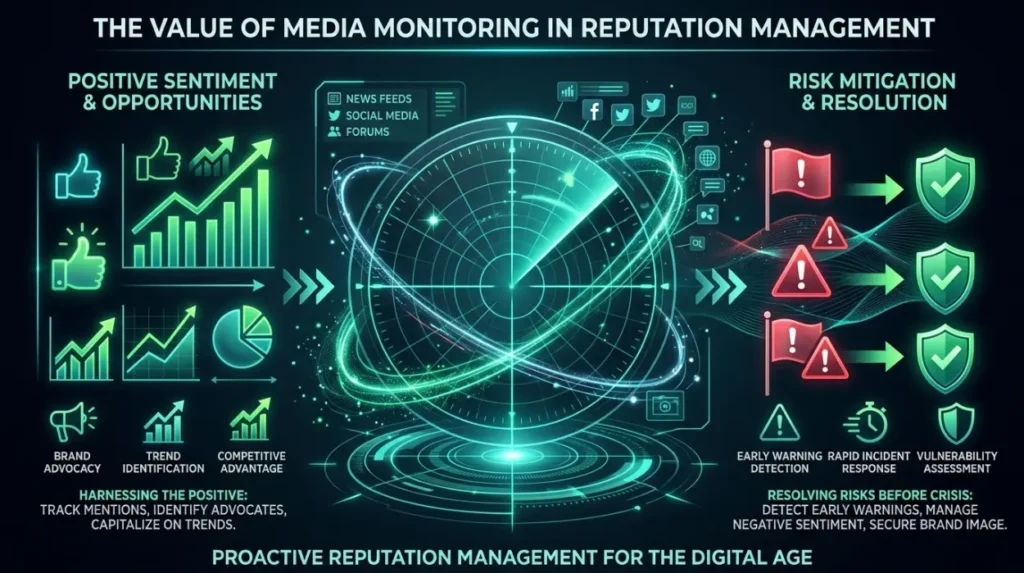
Media monitoring tools analyse references published across news websites, educational publications, blogs, and online magazines. Reputation management evaluates these references because editorial content frequently contributes strong authority signals within search ecosystems. Search engines interpret recognised publications as credible sources when assessing entity credibility and contextual relevance. Monitoring media coverage therefore improves understanding of how external information influences online reputation.
Media monitoring differs from review monitoring because editorial content follows different publication standards. News articles frequently remain indexed for extended periods, contributing long-term reputation signals that influence search visibility. Educational organisations therefore evaluate media references separately from customer reviews when analysing digital trust. This distinction improves reputation analysis by separating editorial authority from public opinion.
Search visibility also changes when authoritative publications reference educational organisations. These references strengthen semantic relationships between institutional expertise and recognised information sources. Monitoring these developments enables more accurate evaluation of long-term search ranking influence.
Which monitoring approach delivers the most comprehensive reputation analysis?
Comprehensive reputation analysis combines several monitoring methods because search engines evaluate multiple categories of information simultaneously. Reputation management compares search rankings, review platforms, directory listings, media coverage, social discussions, and website performance to understand complete reputation ecosystems. Individual monitoring tools explain isolated metrics, whereas integrated approaches reveal relationships between different reputation signals.
Search engines interpret interconnected information rather than independent data sources. Entity credibility strengthens when positive review sentiment aligns with authoritative media coverage, accurate directory information, and stable search visibility. Monitoring multiple categories therefore improves analytical accuracy by reducing information gaps. Comparative evaluation consistently demonstrates that integrated monitoring produces broader insight than isolated measurement.
Dive Deeper With Our Expert Guides:
How Do Google Results Decide Which Private Schools Parents Shortlist?
What Damages a Private School’s Reputation? 9 Triggers Ranked
How do social listening tools compare with search monitoring tools?
Social listening tools analyse conversations across social media platforms, forums, and public communities to identify emerging discussion trends and changes in sentiment distribution. Reputation management evaluates these conversations because they reflect public engagement before some information becomes widely indexed by search engines. Social listening measures discussion volume, recurring topics, audience reactions, and engagement patterns rather than search ranking influence. This provides early insight into developing reputation signals that may later affect broader digital perception.
Search monitoring tools focus on indexed content and search engine visibility rather than live conversations. They evaluate keyword rankings, SERP composition, featured results, and indexed webpages to explain how search engines interpret authority and relevance. Social listening therefore captures evolving public discussion, while search monitoring measures how reputation appears within search ecosystems. Comparing both approaches demonstrates that each contributes different analytical value, with stronger reputation assessments resulting from their combined use.
Which factors determine whether a monitoring tool is effective?
Monitoring effectiveness depends on the quality, scope, and reliability of the data collected rather than the number of available features. Reputation management tools operate by collecting information from multiple digital sources and transforming it into measurable insights. Search engines continuously reassess reputation signals, making comprehensive data coverage more valuable than isolated metrics. An effective monitoring platform therefore supports continuous evaluation instead of occasional reporting.
When comparing monitoring tools, several evaluation criteria consistently influence effectiveness:
- Measure search visibility across multiple search engines and indexed assets.
- Track review sentiment using structured analysis of verified review platforms.
- Identify media references from authoritative educational and news publications.
- Detect directory changes affecting entity credibility and information consistency.
- Compare historical trends to evaluate long-term reputation development.
- Generate timely alerts when significant reputation signals change.
- Integrate multiple information sources into unified analytical reporting.
These evaluation factors improve scalability because they reduce fragmented analysis and provide a broader understanding of digital reputation.
How do automated monitoring tools compare with manual reputation audits?
Automated monitoring tools provide continuous observation by collecting information at regular intervals without requiring repeated manual searches. Reputation management analyses these automated datasets to identify long-term trends in search visibility, review sentiment, and entity credibility. Automated systems also detect subtle changes that manual audits frequently overlook because they monitor larger datasets over extended periods. Their primary strength lies in scalability and consistency across multiple information sources.
Manual reputation audits provide detailed qualitative evaluation that automated systems cannot fully replicate. Human analysis interprets context, assesses nuance, and evaluates complex search results that require professional judgement. Manual reviews also verify data accuracy by identifying anomalies within automated reports. Comparing both methods demonstrates that automation improves efficiency, while manual analysis strengthens contextual understanding. Combining these approaches therefore produces a more balanced evaluation framework.
Which reputation monitoring strategy provides the most sustainable results?
Sustainable reputation monitoring operates through continuous measurement, comparative analysis, and regular evaluation of reputation signals across search ecosystems. Short-term monitoring identifies isolated changes but provides limited understanding of long-term search ranking influence. Continuous monitoring explains how search visibility evolves as search engines reassess authority, content indexing, review sentiment, and entity credibility. Reputation management therefore measures ongoing trends rather than isolated performance snapshots.
Integrated monitoring frameworks combine search visibility analysis, review monitoring, media observation, directory tracking, and social listening into a unified evaluation process. Each method contributes complementary information that strengthens overall reputation analysis. Search engines interpret these interconnected reputation signals collectively, making integrated monitoring more representative of how digital trust develops. Within broader evaluation of monitoring strategies, understanding Reputation Management Software vs Agency provides additional context when comparing different long-term reputation management approaches.
Monitoring the online reputation of UK private schools requires evaluating multiple categories of reputation signals rather than relying on a single information source. Search visibility, review sentiment, media coverage, directory consistency, social discussions, and authority signals each contribute distinct insights into how search engines interpret institutional credibility. Comparing monitoring tools demonstrates that every platform measures different aspects of digital reputation, making integrated analysis more comprehensive than isolated reporting.
Automated monitoring improves scalability and continuous observation, while manual analysis strengthens contextual interpretation and qualitative assessment. Together, these approaches provide a more complete understanding of entity credibility, search ranking influence, and sentiment distribution within search ecosystems. Effective reputation monitoring therefore depends on combining complementary analytical methods to evaluate how online perception develops over time.
How do UK private schools monitor their online reputation?
UK private schools monitor their online reputation by tracking search visibility, online reviews, news mentions, directory listings, and social media discussions. Reputation Management for Private Schools focuses on analysing these reputation signals to evaluate trust, credibility, and public perception across search ecosystems.
Which tools are commonly used to monitor a private school’s online reputation?
Common reputation monitoring tools include search ranking trackers, review monitoring platforms, media monitoring software, social listening tools, and directory management platforms. Each tool measures different reputation signals that contribute to search visibility and entity credibility.
Why is reputation monitoring important for private schools?
Reputation monitoring helps private schools identify changes in online perception before they significantly affect search visibility or parent confidence. Continuous monitoring also improves understanding of review sentiment, authority signals, and content indexing across search engine results.
Can reputation monitoring improve search engine visibility for private schools?
Reputation monitoring does not directly improve rankings, but it identifies issues that influence search visibility and digital trust. Monitoring review quality, content accuracy, and reputation signals supports informed reputation management decisions over time.
How often should a private school monitor its online reputation?
Online reputation should be monitored continuously because reviews, search results, media coverage, and directory information change regularly. Consistent monitoring enables faster identification of reputation trends and supports long-term Reputation Management for Private Schools strategies.