

Political reputation signals influence younger voters through search visibility, digital credibility, content relevance, and public sentiment across online platforms. These signals shape how political figures are interpreted before direct engagement with speeches, policies, or campaign materials.
Reputation management strategies differ based on the type of reputation signals being influenced, while online reputation control methods are evaluated through search engine interpretation, sentiment distribution, entity credibility, and long-term search ranking influence. Understanding these mechanisms provides a clearer basis for evaluating reputation management for politicians within modern digital ecosystems.
Which reputation signals have the greatest influence on younger voters?
Political reputation signals are measurable indicators that shape online perception through search engines, social platforms, news coverage, and authoritative digital sources. Search ecosystems interpret these signals as evidence of credibility, consistency, and public relevance rather than isolated pieces of content. Younger voters frequently encounter reputation signals before actively researching policies, making search results an influential stage in perception formation. Entity credibility develops when multiple trusted sources reinforce the same identity and public narrative. Search ranking influence increases when positive, relevant, and authoritative content consistently appears across multiple domains. Sentiment distribution also contributes by determining whether positive, neutral, or negative information dominates visible search results.
Search engines evaluate reputation through interconnected entities instead of isolated webpages. A politician’s name becomes associated with topics, organisations, policy discussions, interviews, media coverage, and public reactions. This semantic relationship creates stronger contextual understanding for search algorithms. Consistent entity associations strengthen search confidence, while conflicting or fragmented information reduces interpretability. Search visibility therefore depends on structured digital consistency rather than isolated optimisation efforts. Younger audiences often interpret this consistency as a sign of authenticity because search results reinforce similar contextual signals across multiple platforms.
How does search engine interpretation compare with social perception?
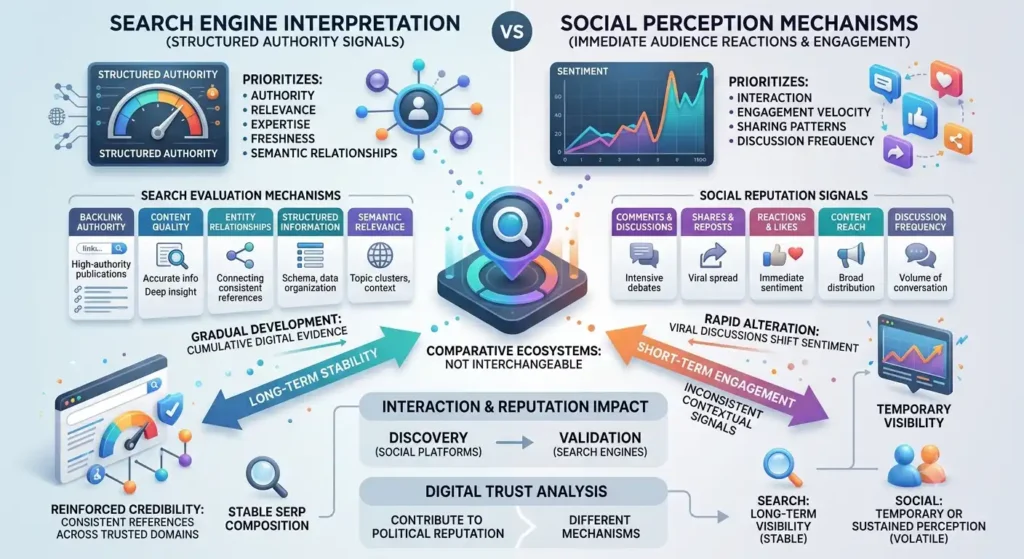
Search engine interpretation focuses on structured authority signals, whereas social perception reflects immediate audience reactions and engagement behaviour. Both systems contribute to political reputation, but they operate using different mechanisms. Search engines prioritise authority, relevance, expertise, freshness, and semantic relationships. Social platforms prioritise interaction, engagement velocity, sharing patterns, and discussion frequency. These distinct evaluation systems influence digital trust in different ways. Reputation management analysis therefore compares both ecosystems rather than treating them as interchangeable.
Search engine evaluation
Search engines analyse reputation signals using entity relationships, content quality, backlink authority, structured information, and semantic relevance. High-authority publications reinforce entity credibility because search algorithms recognise consistent references across trusted domains. Search ranking influence develops gradually through cumulative digital evidence rather than isolated events. Stable information architecture contributes to stronger SERP composition by organising reputation signals into coherent topical clusters. Search engines also interpret recurring themes to understand public identity more accurately. This creates long-term visibility that remains relatively stable when supported by authoritative content.
Social perception mechanisms
Social platforms interpret reputation through engagement patterns rather than structured authority. Comments, shares, reactions, discussion intensity, and content reach collectively influence perceived public sentiment. Viral discussions rapidly alter sentiment distribution without necessarily changing search ranking influence immediately. Short-term engagement creates rapid visibility but often produces inconsistent contextual signals over time. Younger voters frequently discover political discussions through social platforms before validating information using search engines. The interaction between both systems determines whether public perception becomes temporary or sustained.
How do proactive and reactive reputation management approaches compare?
Proactive reputation management operates by establishing consistent reputation signals before negative visibility develops, whereas reactive reputation management focuses on responding after reputational disruption becomes visible. Both approaches influence search ecosystems differently because timing affects search interpretation and content indexing. Comparing these approaches highlights differences in sustainability, scalability, and risk exposure. Search algorithms reward consistent authority development more effectively than sudden reputation correction. Long-term digital stability therefore depends on strategic continuity.
Proactive reputation management builds entity credibility through continuous publication of authoritative, policy-focused, and informative content. Search engines gradually recognise thematic expertise because consistent information strengthens semantic associations. Positive reputation signals accumulate across search ecosystems, reducing the relative visibility of isolated negative content. Content freshness also contributes by reinforcing topical authority over extended periods. This approach creates stronger search ranking influence because search algorithms identify sustained relevance. Reputation stability therefore becomes an outcome of cumulative digital consistency.
Reactive reputation management addresses existing negative search visibility through targeted interventions after reputational challenges emerge. The approach analyses SERP composition to identify dominant negative assets and evaluates response mechanisms. Reactive methods frequently require content suppression alongside content enhancement to rebalance visible reputation signals. Search engines continue indexing authoritative negative information when it remains relevant, limiting rapid reputation recovery. Reactive strategies therefore operate within existing search ecosystems rather than defining them from the beginning. Effectiveness depends on the authority and relevance of replacement content.
How does content enhancement compare with content suppression?
Content enhancement strengthens positive reputation signals through authoritative publication, whereas content suppression reduces the visibility of unfavourable search results by increasing the prominence of stronger competing assets. Both methods influence SERP composition, although they operate using different mechanisms. Search engines prioritise relevance and authority rather than strategic intent, making both approaches dependent on content quality. Evaluating these methods requires analysis of sustainability, scalability, and search interpretation. Their effectiveness varies according to existing digital authority.
Content enhancement
Content enhancement is the process of expanding high-quality, authoritative digital assets that reinforce entity credibility. It operates by publishing structured content across trusted platforms, increasing semantic relevance around positive and factual topics. Search engines interpret stronger topical clusters as signals of comprehensive authority. This gradually improves search ranking influence because authoritative assets compete naturally for visibility. Content enhancement strengthens long-term reputation resilience by expanding the overall information ecosystem. Search visibility improves through accumulated digital relevance rather than direct removal of existing material.
Content suppression
Content suppression operates by reducing the relative visibility of unfavourable search results through stronger competing assets instead of deleting indexed information. Search engines continue ranking authoritative negative content when relevance remains high, making suppression dependent on competitive content quality. Effective suppression requires consistent publication across multiple authoritative sources to influence SERP composition. This method changes information prominence rather than altering search engine indexing rules. Long-term sustainability depends on continuous content development because search rankings evolve as new information emerges. Suppression therefore functions as a competitive visibility strategy rather than a deletion mechanism.
Which digital platforms contribute most to political reputation signals?
Digital platforms contribute differently because search engines assign distinct authority values to each information source. Official websites establish primary entity information, while news publications provide independent credibility signals. Social platforms reflect audience interaction, whereas knowledge-based resources reinforce structured entity relationships. Younger voters frequently encounter multiple platform types before forming an overall perception. Evaluating these platforms explains how reputation signals become interconnected across digital ecosystems. Platform diversity strengthens semantic consistency when information remains aligned.
Official websites provide controlled factual information that search engines recognise as primary entity references. Structured content, policy documentation, biographies, and verified statements strengthen entity credibility because they establish authoritative baseline information. Search algorithms compare external references against these official resources to improve contextual understanding. Consistent updates reinforce freshness signals without altering historical information. Strong website architecture also improves internal semantic relationships. This creates a foundation for broader reputation management evaluation.
Independent news publications influence reputation through editorial authority and search trust. Search engines frequently prioritise established publishers because editorial standards strengthen information reliability. Positive and negative coverage both contribute to sentiment distribution depending on topic prominence and publication authority. Editorial independence increases perceived credibility among younger audiences because search ecosystems recognise external validation differently from self-published material. Search visibility therefore reflects a combination of official and independent reputation signals. Balanced coverage contributes to stronger contextual interpretation.
Social platforms contribute engagement-based reputation signals that complement search visibility. Verified accounts strengthen authenticity signals, while interaction metrics demonstrate audience attention rather than factual authority. High engagement increases discoverability within platform ecosystems but does not automatically improve organic search ranking influence. Consistent messaging across social platforms and authoritative websites strengthens semantic alignment. Search engines increasingly interpret these connections when evaluating entity relationships. Cross-platform consistency therefore reinforces digital trust.
How does sentiment distribution affect political reputation?
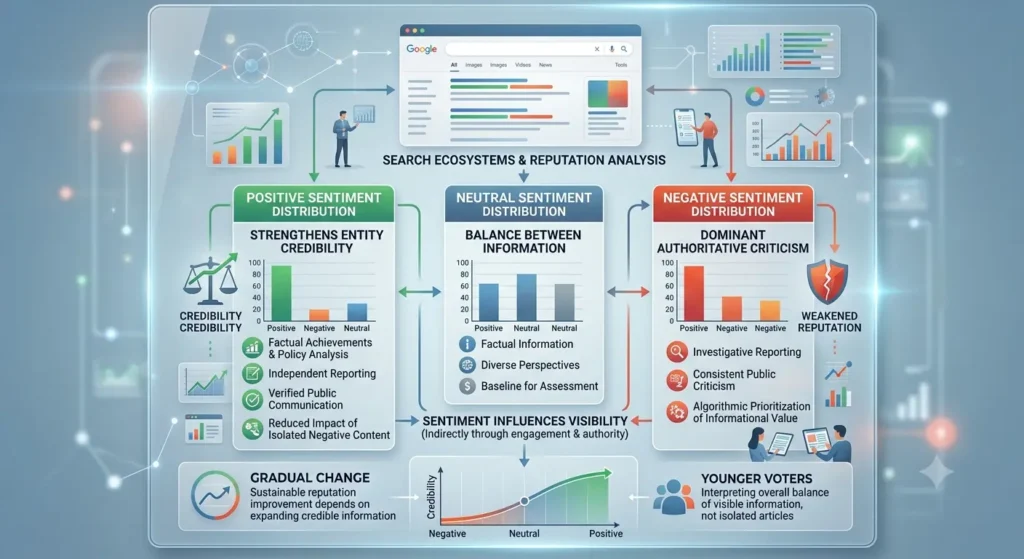
Sentiment distribution measures the balance between positive, neutral, and negative information appearing across digital search ecosystems. Search engines do not directly rank pages according to emotional tone, yet sentiment indirectly influences visibility through engagement, authority, and publication patterns. Reputation analysis evaluates sentiment distribution because dominant narratives affect search perception. Younger voters often interpret the overall balance of visible information rather than isolated articles. Search ecosystems therefore amplify recurring themes through cumulative visibility. Sentiment consistency becomes a measurable reputation indicator.
Positive sentiment distribution strengthens entity credibility when supported by authoritative information rather than promotional language. Independent reporting, factual achievements, policy analysis, and verified public communication collectively reinforce trust signals. Search engines interpret these signals through semantic consistency instead of emotional language. Positive visibility therefore develops from contextual relevance across multiple authoritative sources. Strong sentiment distribution also reduces the proportional impact of isolated negative content. Search ecosystems reward informational depth over repetitive promotional messaging.
Negative sentiment distribution becomes dominant when authoritative criticism consistently occupies prominent search positions. Search ranking influence remains stable for credible investigative reporting because search algorithms prioritise informational value. Reactive reputation management therefore analyses search visibility before selecting content enhancement or content suppression strategies. Sustainable reputation improvement depends on expanding credible information instead of relying on temporary visibility changes. Search engines continuously reassess authority using evolving digital evidence. Sentiment balance therefore changes gradually rather than instantly.
Which evaluation framework provides the clearest assessment of political reputation?
A structured evaluation framework compares measurable reputation indicators rather than isolated digital activities. Search ecosystems generate multiple signals that require systematic interpretation to determine overall entity credibility. Consistent evaluation also identifies changes in search ranking influence before reputational issues become entrenched. Analytical measurement produces more reliable insights than subjective observation. Political reputation therefore benefits from continuous assessment using defined criteria. Search visibility becomes easier to interpret when indicators remain consistent.
Dive Deeper With Our Expert Guides:
Monitoring Media Coverage to Identify Political Reputation Threats
Evaluating Reputation Recovery Challenges Following Political Controversies
A practical evaluation framework includes:
- Measure SERP composition by analysing the balance between official content, independent media, knowledge sources, and social profiles.
- Compare sentiment distribution across authoritative publications to identify dominant narratives.
- Evaluate entity credibility using semantic consistency between policy topics, biographies, interviews, and public references.
- Analyse search ranking influence by reviewing which authoritative domains consistently occupy prominent positions.
- Monitor content freshness to determine whether current information reinforces or weakens established reputation signals.
This framework evaluates reputation using observable search mechanisms rather than assumptions about public opinion. Search ecosystems continually reinterpret entity relationships based on new authoritative information. Consistent measurement therefore supports more accurate analysis of digital reputation development. Younger voters increasingly interact with search environments that prioritise contextual relevance over isolated messaging. Reputation evaluation benefits from understanding these interconnected ranking systems.
Political reputation signals influence younger voters through interconnected search visibility, entity credibility, sentiment distribution, and authoritative digital content. Search engines evaluate structured information differently from social platforms, creating distinct mechanisms that shape public perception across digital ecosystems.
Comparing proactive and reactive reputation management approaches demonstrates clear differences in sustainability, while analysing content enhancement against content suppression highlights contrasting methods of influencing SERP composition. Evaluating platform authority, semantic consistency, and search ranking influence provides a more accurate understanding of digital reputation than focusing on individual online activities. Long-term reputation analysis therefore depends on measuring interconnected reputation signals rather than isolated content performance.
For deeper insight, explore:
Digital Reputation Services for Politicians Seeking Stronger Voter Engagement
Answers to Key Questions
What is reputation management for politicians?
Reputation management for politicians is the process of monitoring, evaluating, and improving how a political figure is perceived across search engines, news coverage, and digital platforms. It focuses on strengthening credible online information and managing reputation signals over time.
How do search engines influence a politician’s online reputation?
Search engines rank content based on relevance, authority, and user intent, which shapes the information people see first. Strong reputation management helps improve the visibility of accurate, trustworthy content while supporting a balanced search presence.
What are the main reputation signals that affect politicians online?
Key reputation signals include search rankings, news coverage, public sentiment, authoritative backlinks, verified profiles, and consistent digital content. Together, these factors influence entity credibility and online trust.
Can reputation management improve voter perception online?
Reputation management can strengthen digital credibility by ensuring accurate and authoritative information appears prominently in search results. Consistent online reputation strategies also help maintain a balanced sentiment distribution across digital channels.