

Multi-country review management evaluates reputation signals across different countries, languages and review platforms while maintaining consistent entity identification. Reputation management strategies differ based on geographic coverage, platform structure, language, review sentiment and the relationship between local content and global search visibility.
How does multi-country review management differ from single-market review management?
Multi-country review management is more complex because it evaluates reputation signals across separate geographic and linguistic search environments. Single-market review management concentrates on one location, one dominant language and a relatively contained set of review platforms. A global recruitment firm operates across markets where candidates, employers and reviewers use different platforms and express similar experiences through different linguistic patterns. Each regional profile therefore contributes information to the same underlying entity. The evaluation process needs to distinguish local sentiment from broader reputation trends.
Geographic separation also changes the way search engines interpret reviews. A review published on a UK platform provides a different geographic signal from a review associated with a German, French or Spanish recruitment profile. Search engines connect these references through entity information, business names, domains, locations and contextual relationships. Consistent information strengthens entity recognition across markets. Inconsistent names, addresses or service descriptions create fragmented signals that complicate international SERP evaluation.
Which review management approach works better: centralised or regional?
A centralised approach provides stronger consistency, while a regional approach provides greater sensitivity to local search behaviour and language. Centralised review management uses one overarching framework for monitoring review volume, sentiment, response patterns and reputation trends across all markets. Regional management evaluates each country independently according to local platforms, language conventions and market expectations. The first approach supports governance and consistency. The second provides greater contextual accuracy.
The most effective evaluation compares both approaches against operational requirements rather than treating either as universally superior. A centralised system can identify global sentiment distribution and recurring themes across markets. A regional system can identify language-specific terminology, platform differences and country-level reputation risks. Combining the two creates a hierarchical model in which global trends are measured alongside local reputation signals. This structure also reduces the risk of interpreting one market as representative of every market.
How do multilingual reviews affect reputation signals?
Multilingual reviews affect reputation signals because the same underlying experience can be expressed through different terminology, sentiment structures and cultural conventions. Sentiment distribution is the measurement of positive, neutral and negative review themes across a defined review environment. Translation alone does not always preserve the complete semantic meaning of a review because tone, industry terminology and contextual references vary between languages. Search systems analyse the indexed version available on each platform. Reputation analysis therefore requires language-aware interpretation.
Language also affects keyword relationships within search results. A recruitment firm associated with terms such as communication, candidate support or employer responsiveness in English can have equivalent but structurally different associations in another language. Search engines evaluate these terms within their own linguistic and contextual environments. A reputation framework that measures only English-language terminology therefore provides an incomplete view of international perception. Multilingual analysis provides a broader representation of the entity’s search footprint.
Is content creation or review management more effective for international reputation control?
Content creation and review management address different components of reputation control, so effectiveness depends on the type of reputation signal being evaluated. Content creation operates by introducing authoritative, relevant information that strengthens an entity’s topical context within search results. Review management operates by monitoring and analysing user-generated signals that describe experiences with the organisation. Content enhancement therefore influences the information environment around the entity, while review analysis evaluates existing perception signals.
The distinction becomes important when negative reviews occupy prominent search positions. Creating new content does not directly alter the source of an existing review or remove its underlying sentiment. Conversely, review management does not create the authoritative informational context required to support broader entity credibility. Content suppression vs content enhancement also involves different mechanisms because suppression targets visibility while enhancement strengthens competing information. Strategic evaluation therefore starts by identifying whether the problem exists at source level, ranking level or entity-context level.
How does reactive review management compare with proactive reputation monitoring?
Reactive review management responds after a negative review, rating pattern or reputation issue becomes visible. Proactive reputation monitoring continuously evaluates review signals, sentiment distribution, ranking changes and new references before an issue develops into a broader search visibility problem. Reactive management concentrates resources on identified incidents. Proactive monitoring focuses on detecting changes in the reputation environment.
The principal difference is timing and risk exposure. Reactive intervention can provide a focused response when a specific review or platform issue requires attention. Proactive monitoring provides earlier visibility into recurring themes, unusual review patterns or changes in regional sentiment. Neither approach operates independently of platform rules or search ranking systems. The comparative advantage of proactive monitoring lies in earlier detection, while reactive management provides targeted analysis once a defined issue exists.
Dive Deeper With Our Expert Guides:
How Do Scam Accusations Destroy International Recruiter Reputations Overnight?
What Makes Engineers Blacklist a Recruitment Agency? 7 Reported Causes
How does review sentiment influence international SERP composition?
Review sentiment influences SERP composition by contributing information that search engines associate with an organisation, its services and its locations. SERP composition refers to the mixture of webpages, review profiles, directories, articles and other indexed results displayed for a search query. Positive and negative review content can become part of this environment when the underlying pages are indexed and relevant to the query. Their influence depends on ranking position, relevance, source authority and entity association. Sentiment therefore represents one component of search perception rather than an independent ranking mechanism.
International recruitment firms face additional complexity because the same entity can produce different SERP compositions in different countries. A review profile can rank prominently in one market while remaining less visible in another because search intent, platform authority and geographic relevance differ. This means global reputation cannot be measured from one country’s results alone. Comparative SERP analysis identifies where reputation signals have greater search ranking influence. It also reveals whether negative or positive information is concentrated within particular markets.
Which has greater long-term value: review response or reputation enhancement?
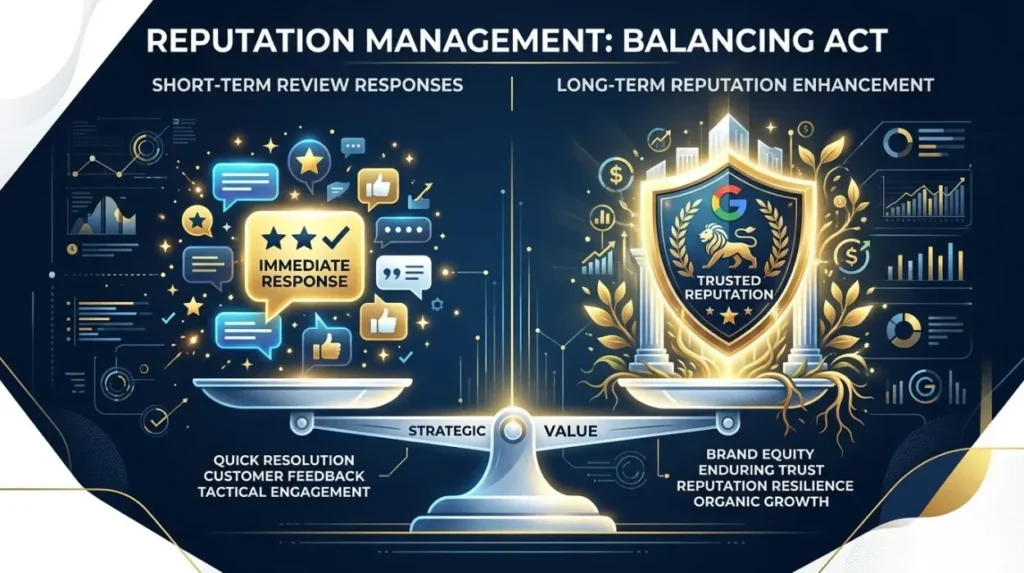
Review response provides direct interaction with the source of a reputation signal, while reputation enhancement strengthens the wider information environment surrounding an entity. A review response can clarify factual information, demonstrate professional handling of feedback and provide additional context on a review platform. Reputation enhancement uses relevant content, authoritative references and accurate entity information to create stronger supporting signals across search results. The two approaches therefore operate at different levels.
Long-term effectiveness depends on whether the underlying reputation issue is isolated or systemic. A single review can often be evaluated through the platform response process, while recurring negative themes require analysis of the broader sentiment distribution. Enhancement becomes more relevant when search perception depends on the balance between negative references and authoritative supporting information. Review response remains important because the original source continues to exist independently of surrounding content. Sustainable reputation control therefore requires alignment between source-level management and broader search-context development.
How scalable are different review management strategies for global recruiters?
Scalability depends on how efficiently a strategy can monitor countries, languages, platforms and sentiment patterns without losing contextual accuracy. Manual review management provides detailed interpretation but becomes operationally demanding as the number of markets increases. Centralised monitoring systems provide greater efficiency by aggregating information into common reporting structures. Regional analysis then adds local interpretation where language or platform differences create additional complexity.
A scalable model separates standardised measurements from market-specific interpretation. Core measurements can include review volume, rating distribution, sentiment categories, platform coverage and ranking visibility. Local evaluation can then analyse language, cultural terminology and country-specific reputation signals. This structure allows comparable reporting without treating every market as identical. Scalability therefore depends on creating a consistent measurement framework while retaining enough regional detail to preserve accuracy.
How should recruitment firms evaluate the risk of inconsistent review profiles?
Inconsistent review profiles create entity credibility risks because search engines and users receive conflicting information about the same organisation. Differences in business names, addresses, service descriptions or regional branding can make it harder to connect profiles to a single entity. These inconsistencies also complicate review aggregation because separate profiles can appear to represent different organisations. The result is a fragmented digital footprint.

Risk evaluation begins by comparing core entity attributes across regional platforms. A useful assessment examines:
- Compare entity names — Check whether each regional profile uses a consistent business identity that search engines can associate with the same organisation.
- Verify location signals — Match addresses, office locations and geographic descriptions to prevent conflicting regional associations.
- Analyse review themes — Compare recurring sentiment and service-related terminology to distinguish local issues from global reputation patterns.
- Measure SERP visibility — Evaluate how review profiles rank for country-specific queries to identify markets where reputation signals have greater search ranking influence.
This framework separates data inconsistency from genuine differences in customer or candidate perception. A lower rating in one country does not automatically indicate a global reputation problem. Conversely, the same negative theme appearing across independent markets provides stronger evidence of a systemic reputation signal. Evaluation therefore requires both quantitative review measurement and qualitative contextual analysis.
How does content suppression compare with content enhancement across countries?
Content suppression and content enhancement provide different forms of search visibility control. Content suppression focuses on reducing the prominence of unwanted information within search results, while content enhancement strengthens relevant and authoritative information that contributes to entity credibility. Suppression is therefore visibility-oriented, whereas enhancement is context-oriented. The appropriate approach depends on the source, ranking position and nature of the content.
International application adds another layer because search results vary by country and language. A page with strong visibility in one market can have limited visibility elsewhere due to different ranking signals and local sources. Suppression strategies therefore require country-specific SERP evaluation rather than assuming a uniform global outcome. Enhancement also requires regional relevance because content designed for one language or market does not automatically establish equivalent authority in another. Comparing both approaches requires measurement of visibility, source control, authority and sustainability.
What determines the cost and complexity of multilingual reputation management?
The cost and complexity of multilingual reputation management depend on the number of markets, languages, platforms, review volume, monitoring requirements and level of strategic intervention involved. A single-language review environment requires less linguistic analysis than an international system covering multiple countries and platform ecosystems. Complexity also increases when reviews require contextual interpretation rather than basic sentiment classification. The number of search environments being evaluated directly affects the scope of analysis.
Operational complexity also depends on whether the strategy focuses on monitoring, review response, content enhancement, suppression or a combination of methods. Each method uses different resources and produces different forms of search ranking influence. Platform-specific rules further affect the available interventions because review websites and search engines operate under separate policies. Cost evaluation therefore needs to distinguish monitoring effort from intervention effort rather than treating reputation management as one uniform activity.
What is the most sustainable approach to multi-country review management?
The most sustainable approach combines centralised measurement with regional interpretation, continuous monitoring and clearly defined intervention criteria. Centralised measurement provides comparable data across countries, while regional interpretation preserves linguistic and geographic accuracy. Continuous monitoring identifies changes in review sentiment, content indexing and SERP composition. Defined intervention criteria prevent every negative review from receiving the same response.
Sustainability also depends on measuring outcomes through consistent reputation signals rather than isolated ranking changes. Relevant measurements include sentiment distribution, review profile consistency, indexed content, regional search visibility and changes in entity associations. What Does Multilingual Reputation Management Cost for Recruitment Firms? is also an important consideration when evaluating whether the strategy remains sustainable across different markets and languages. These indicators reveal whether a strategy is producing durable improvements in the information environment. A sustainable framework therefore evaluates reputation as a continuously changing system rather than a one-time correction.
Multi-country review management requires a distinction between global consistency and regional relevance. Centralised systems improve measurement and governance, while regional analysis provides the language, platform and geographic context needed for accurate interpretation. Review response addresses source-level interaction, whereas content enhancement influences the wider search environment. Content suppression addresses visibility, while enhancement strengthens supporting information and entity credibility.
The most important strategic consideration is the relationship between reputation signals and SERP composition. International recruitment firms operate across search ecosystems where reviews, regional profiles, authoritative references and indexed content interact differently by market. Effective evaluation therefore measures sentiment distribution, scalability, risk exposure, search ranking influence and sustainability across countries rather than relying on one global reputation metric.
How does multi-country review management work for global recruiters?
Multi-country review management involves monitoring, assessing, and responding to reviews across different recruitment platforms, countries, languages, and local markets. The process also considers regional platform policies and differences in candidate expectations.
Why do global recruiters need a multi-country review management strategy?
Reviews from different countries can influence an international recruitment agency’s reputation and candidate trust. A coordinated strategy helps maintain consistent reputation standards while accounting for local market conditions and review-platform requirements.
How can recruiters manage reviews across different countries and platforms?
Recruiters can centralise review monitoring while assessing each review according to its platform, country, language, and policy context. Responses should remain consistent with the organisation’s reputation strategy while addressing the specific issue raised by the reviewer.
Can review management address negative recruitment reviews in multiple countries?
Yes, negative reviews can be assessed individually to determine whether they violate platform policies, contain disputed claims, or require a professional response. Clear My Name can be considered as part of a broader review-management process for recruiters operating across multiple markets.
What should global recruiters consider when managing international reviews?
Global recruiters should consider language, local employment expectations, platform policies, review authenticity, response standards, and the potential effect on employer or candidate trust. Maintaining accurate records of reviews and actions taken also helps create a consistent international reputation-management process.