

Project management recruitment matches organisations with project professionals through contract or permanent hiring structures, with each route using different employment and selection processes. Reputation management is the structured understanding of how digital information, reviews, content, and other reputation signals influence how a recruitment entity is interpreted across search ecosystems.
What Is Reputation Management for Project Management Recruiters?
Reputation management is the process of monitoring, analysing, and understanding information that influences how an entity is perceived online. For project management recruiters, this reputation is formed through recruitment content, contractor experiences, employer feedback, professional profiles, reviews, and third-party references. Online reputation refers to the cumulative digital information associated with an organisation, individual, or professional entity across indexed platforms. Search engines evaluate this information through signals related to relevance, authority, consistency, credibility, and user interaction. The resulting search visibility contributes to how users understand the entity before engaging with its recruitment information.
How Does Project Management Recruitment Work in 2026?
Project management recruitment works by matching candidates with roles according to skills, experience, availability, employment structure, and project requirements. Contract recruitment generally involves professionals being engaged for a defined period, project, or assignment, while permanent recruitment involves an ongoing employment relationship. These distinctions affect the type of information candidates search for when evaluating a recruitment agency. Search queries can include project management roles, contract project manager vacancies, permanent project management jobs, recruitment processes, salary information, and contractor experiences. The information available around these queries contributes to the broader digital footprint of a recruitment entity.
What Is Contract Project Management Recruitment?
Contract project management recruitment refers to the process of sourcing project professionals for temporary or defined assignments. Recruitment information commonly focuses on project duration, required expertise, availability, payment arrangements, and assignment conditions. Contractors also evaluate information about communication, onboarding, administrative processes, and previous professional experiences. These factors generate digital and review signals that become part of the wider reputation environment. Search engines index publicly available content and associate relevant information with entities and topics when the content demonstrates sufficient relevance and accessibility.
What Is Permanent Project Management Recruitment?
Permanent project management recruitment refers to sourcing professionals for ongoing employment positions within an organisation. The recruitment process generally focuses on qualifications, professional experience, cultural requirements, responsibilities, progression, and long-term employment conditions. Candidates researching permanent roles often examine information beyond the vacancy itself. They evaluate organisational descriptions, professional content, reviews, employment information, and external references. This creates a broader information environment in which recruitment-related content contributes to entity perception and search visibility.
How Do Contract and Permanent Recruitment Affect Online Reputation?
Contract and permanent recruitment affect online reputation through different information patterns generated by candidates, contractors, employees, and employers. Contract recruitment produces reputation signals connected with assignment management, communication, payment administration, and professional support. Permanent recruitment produces signals associated with employment expectations, recruitment communication, career progression, and organisational information. These signals can appear through reviews, discussion platforms, professional networks, articles, job pages, and other indexed content. Search engines process these information sources according to their relevance and relationship to particular entities and queries.
How Do Contractor Reviews Influence a Recruitment Agency’s Reputation?
Contractor reviews influence a recruitment agency’s reputation by creating publicly accessible signals about professional experiences associated with its recruitment activities. A review is an information signal that describes an individual’s interpretation of a specific interaction, service process, or employment-related experience. Search systems analyse review content in relation to entities, topics, language patterns, and surrounding information rather than treating every statement as an independent reputation verdict. Repeated themes across relevant sources create a broader information pattern that contributes to entity perception. This makes contractor feedback part of the digital footprint surrounding project management recruitment.

Contractor reviews also create semantic associations between a recruitment entity and specific topics. A review discussing communication, contract administration, project matching, payment processes, or candidate support introduces contextual terms connected to the entity. When these topics appear consistently across indexed sources, they provide additional information about the entity’s online representation. This does not mean that a single review determines search rankings. Instead, reviews form one category of reputation signal within a wider ecosystem containing structured information, editorial content, professional references, and other digital assets.
How Do Contractor Reviews Shape a PM Recruitment Agency’s Reputation?
How Do Contractor Reviews Shape a PM Recruitment Agency’s Reputation? Contractor reviews shape reputation by adding experience-based information to the digital footprint associated with a project management recruitment entity. Their influence depends on factors such as relevance, content quality, source context, entity association, and how consistently similar information appears across the wider search ecosystem. Positive, negative, or neutral language provides different sentiment signals, but search engines do not simply calculate reputation from a basic positive-versus-negative ratio. Instead, review information exists alongside other content that helps establish topical relevance and entity understanding. The resulting search environment determines what information users encounter when researching the recruitment agency.
How Do Search Engines Interpret Reputation Signals?
Search engines interpret reputation signals through systems designed to understand relevance, quality, relationships between entities, and the usefulness of indexed information. Reputation is not represented by one universal ranking factor or a single numerical score. Instead, search engines process multiple information sources that collectively establish context around an entity. These sources include website content, reviews, professional references, structured data, external publications, and other publicly accessible information. Search visibility therefore reflects the interaction between content relevance, authority, technical accessibility, query intent, and broader information signals.
What Role Does Content Indexing Play in Reputation?
Content indexing determines whether publicly available information becomes accessible to search systems for retrieval and evaluation. Indexed content contributes to an entity’s digital footprint when search engines identify a meaningful relationship between the content and the entity. Recruitment pages, articles, reviews, professional profiles, and external references can therefore become components of the searchable information environment. Consistent entity references help search systems establish relationships between names, services, topics, and professional activities. Content that remains inaccessible to indexing does not contribute to search visibility in the same way as indexed material.
How Does Content Influence Search Perception of Recruitment Agencies?

Content influences search perception by determining which information users encounter when they search for a recruitment entity or related topic. Informational pages explain recruitment processes, while job pages address specific employment queries and professional resources answer broader questions. Reviews introduce experience-based information, whereas external publications can provide additional context about an entity. The combined content environment creates a searchable representation of the recruitment organisation. Search perception therefore depends not only on individual pages but also on the relationship between different information sources.
Content consistency also affects entity understanding. Consistent terminology across recruitment pages, professional profiles, reviews, and external references helps establish clear relationships between the entity and its subject areas. Inconsistent names, descriptions, locations, services, or professional references create additional ambiguity for entity interpretation. A coherent digital footprint provides search systems with clearer contextual information. This relationship between content consistency and entity recognition forms part of the wider reputation ecosystem.
How Do Reviews Affect SERP Evaluation?
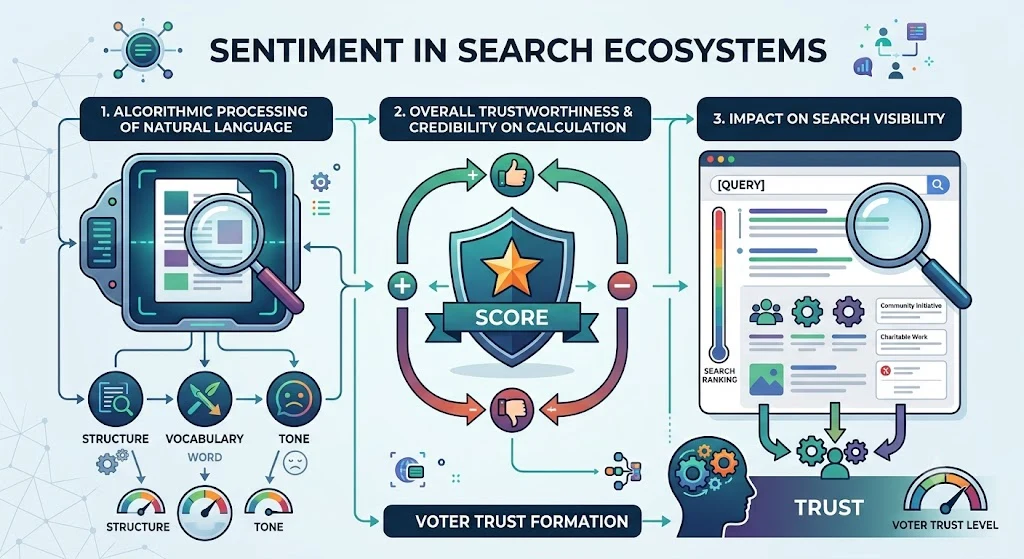
Reviews affect SERP evaluation by providing additional information about an entity and the experiences associated with it. Search engine results pages can display review content, review-derived features, third-party pages, and other reputation-related information depending on the query and available indexed sources. Review relevance depends on its connection to the searched entity and topic. Search systems also distinguish between the existence of information and its usefulness for a particular query. Consequently, reviews operate as one component of SERP evaluation rather than functioning as an isolated ranking mechanism.
Review language also introduces sentiment and topical signals. Terms relating to communication, reliability, payments, contracts, candidate experience, or professional support create semantic connections around a recruitment entity. These associations provide additional context when users search for related topics. However, sentiment interpretation does not mean that algorithms treat every subjective statement as verified fact. The source, context, relevance, and relationship between information and entity all contribute to how the content is understood within the search ecosystem.
How Do Authority and Trust Signals Develop Online?
Authority and trust signals develop through consistent, relevant, and attributable information distributed across credible digital sources. Authority refers to the strength of an entity’s recognised expertise or relevance within a particular subject area. Trust relates to the reliability and transparency of information and the context in which it is presented. For recruitment entities, these signals can emerge from professional content, authoritative references, accurate company information, industry publications, and consistent digital identities. Search engines use multiple systems to evaluate information quality and relationships rather than relying on a single reputation indicator.
Trust signals also depend on information accuracy and transparency. Clear descriptions of recruitment processes, employment structures, professional responsibilities, and organisational information reduce ambiguity for users and search systems. Accurate information establishes stronger relationships between an entity and its associated topics. Over time, these relationships contribute to a more structured digital footprint. Reputation therefore operates as an information system rather than simply as a collection of opinions.
How Does the Digital Footprint Affect Project Management Recruitment?
The digital footprint affects project management recruitment by shaping the information environment surrounding both recruiters and recruitment-related queries. A digital footprint includes indexed pages, professional profiles, reviews, publications, social references, job listings, and other online information associated with an entity. Candidates researching contract or permanent opportunities encounter this information before, during, and after the recruitment process. The breadth and consistency of available information influence what users can evaluate through search. This makes the digital footprint an important component of online credibility.
Different recruitment models also create different digital footprints. Contract recruitment generates information around temporary assignments, contractor relationships, and project-specific requirements. Permanent recruitment creates information around employment opportunities, organisational roles, and long-term career relationships. Each category produces distinct search queries and content patterns. Understanding these differences helps explain why reputation signals vary according to recruitment structure and audience intent.
Dive Deeper With Our Expert Guides:
How Do You Choose an Executive Search Firm? 9 Vetting Criteria
Top Executive Search Firms UK: 2026 League Table
How Does Online Credibility Develop for Recruitment Entities?
Online credibility develops through the accumulation of consistent information that establishes an entity’s identity, expertise, relevance, and professional context. Credibility is not created by a single page or isolated review. It develops through relationships between first-party content, third-party references, reviews, professional information, and other indexed sources. When these sources provide consistent contextual information, search systems gain stronger evidence about the entity and its subject areas. Users also gain a clearer basis for interpreting the entity’s online presence.
For project management recruitment, credibility is closely connected with accurate information about roles, recruitment processes, professional expectations, and employment structures. Contract and permanent recruitment pages answer different user intents and therefore require different contextual information. Reviews add experience-based signals, while authoritative resources add informational depth. Together, these components create a broader search ecosystem around the recruitment entity.
How Does Reputation Management Support Long-Term Search Understanding?
Reputation management supports long-term search understanding by analysing how information about an entity is created, indexed, connected, and interpreted across digital ecosystems. The process involves monitoring reputation signals, identifying information patterns, evaluating search visibility, and understanding relationships between content and entities. It also distinguishes temporary information events from persistent components of an entity’s digital footprint. This analytical approach prevents reputation from being treated as a single review score or isolated search result. Instead, reputation becomes an ongoing information structure that changes as new content enters the search ecosystem.
For recruitment entities, this structure includes contract recruitment information, permanent vacancies, contractor reviews, professional references, industry content, and other relevant digital assets. Each component contributes different contextual information to the overall entity representation. Search engines continuously process indexed information as users create new queries and publishers create new content. Reputation therefore remains dynamic rather than static.
Project management recruitment operates through distinct contract and permanent hiring structures, each producing different information patterns across search ecosystems. Reputation management is the analysis of how these information patterns influence digital footprint, entity perception, search visibility, and online credibility. Contractor reviews provide experience-based reputation signals, while recruitment pages, professional content, external references, and indexed resources provide additional context. Search engines evaluate these information sources through relevance, quality, authority, relationships, and query context rather than relying on one reputation measurement. Understanding these mechanisms explains how recruitment entities develop a searchable and continuously evolving online reputation.
What is project management recruitment?
Project management recruitment is the process of finding and selecting professionals for project management roles based on skills, experience, qualifications, and project requirements. It can involve either contract recruitment for defined assignments or permanent recruitment for ongoing employment.
What is the difference between contract and permanent project management recruitment?
Contract recruitment places project managers into temporary or fixed-term assignments, while permanent recruitment focuses on ongoing employment. The two routes differ in employment duration, recruitment requirements, and the type of information candidates assess.
How do contractor reviews affect a project management recruitment agency’s reputation?
Contractor reviews contribute experience-based information to a recruitment agency’s online reputation and digital footprint. Reviews discussing communication, contracts, payments, or candidate support can influence how users interpret the agency when researching it online.
How do reviews affect a recruitment agency’s search visibility?
Reviews can contribute to the information search engines associate with a recruitment agency, particularly when they are relevant to the entity and its services. They form one reputation signal alongside website content, professional references, external publications, and other indexed information.
How can project management recruiters build online credibility?
Online credibility develops through accurate, consistent, and relevant information across recruitment pages, professional profiles, reviews, and authoritative external sources. A clear digital footprint helps users and search systems understand the agency’s identity, expertise, and recruitment activities.