
Contractor reviews shape a PM recruitment agency’s reputation by adding experience-based information to the entity’s digital footprint, influencing how users interpret credibility, reliability, and professional conduct. Reputation management strategies differ based on whether the objective involves improving existing content, reducing the visibility of harmful information, or developing stronger reputation signals over time.
How Do Contractor Reviews Influence a PM Recruitment Agency’s Online Reputation?
Contractor reviews influence online reputation by introducing publicly available information about interactions between contractors and recruitment agencies. A review operates as an experience-based reputation signal containing information about communication, contract administration, payment processes, candidate support, or role expectations. Search engines process this information within the broader context of indexed pages and entity relationships rather than treating every review as an independent ranking factor. The effect on perception therefore depends on the relevance, visibility, source context, and consistency of the information. A concentrated pattern of reviews around one topic creates a stronger association between that topic and the recruitment entity.
The distinction between review sentiment and search visibility is important when evaluating reputation. Sentiment distribution describes the balance and characteristics of positive, negative, or neutral language within available feedback, while search visibility describes how easily users encounter that information through search results. A negative review with limited visibility has a different search impact from a highly visible review page that ranks for the agency’s name. Reputation analysis therefore evaluates both the content itself and its position within the SERP composition.
How Do Content Creation and Content Removal Compare for Reputation Management?
Content creation and content removal address reputation concerns through fundamentally different mechanisms. Content creation operates by adding relevant, accurate information that expands the entity’s digital footprint and provides additional contextual signals for search engines. Content removal operates by seeking the deletion of information from its original source when a legitimate removal route exists. Creation focuses on content enhancement, whereas removal focuses on eliminating a specific information asset. Their effectiveness therefore depends on whether the reputation issue originates from insufficient positive context or from a specific piece of harmful or inappropriate content.
Content creation has a broader application because it does not depend on a third party agreeing to remove existing material. It can establish authoritative pages around recruitment processes, contractor information, professional expertise, and relevant industry topics. However, newly created content requires indexing, relevance, authority, and competitive ranking conditions before it gains meaningful search visibility. Content removal can produce a direct change when successful because the original source no longer exists in its previous form. Its limitation is that removal depends on ownership, platform rules, legal grounds, or other applicable mechanisms.
How Does Content Enhancement Compare With Content Suppression?
Content enhancement and content suppression differ primarily in how they attempt to influence SERP composition. Content enhancement introduces or strengthens relevant assets that provide search engines with additional information about an entity. Content suppression focuses on reducing the visibility of unwanted results through stronger competing content, technical measures, or legitimate removal pathways. Suppression does not necessarily eliminate the underlying information, meaning the original page can remain accessible elsewhere. Enhancement therefore expands the information environment, while suppression attempts to alter which parts of that environment receive greater search visibility.
The distinction becomes significant when analysing reputation risk. Stronger content can improve entity credibility by providing authoritative information that addresses user intent directly. Suppression tactics can reduce exposure to specific search results but require continuous monitoring because search rankings change as new content is indexed. Content enhancement therefore has a broader informational function, while suppression has a narrower visibility-management function. Both approaches require measurement of SERP composition rather than relying only on changes in sentiment.
How Do Organic and Reactive Reputation Strategies Differ?
Organic reputation strategies build reputation signals continuously through relevant content, accurate information, professional references, and consistent digital assets. Reactive strategies respond to a specific reputation event after negative information becomes visible or attracts attention. Organic activity operates through long-term content development, whereas reactive activity focuses on addressing an identified issue. The two approaches therefore differ in timing, resource allocation, and risk exposure.
Organic strategies provide a wider foundation because content exists before a specific reputation event occurs. This creates an established digital footprint containing information about the entity, its activities, and its areas of expertise. Reactive strategies provide a more targeted response because they address an identifiable reputation problem. Their limitation is that action begins after the information has already entered the search ecosystem. A recruitment agency therefore has to evaluate whether existing digital assets provide sufficient contextual coverage when a reputation issue emerges.
Which Reputation Approach Has Greater Long-Term Search Impact?

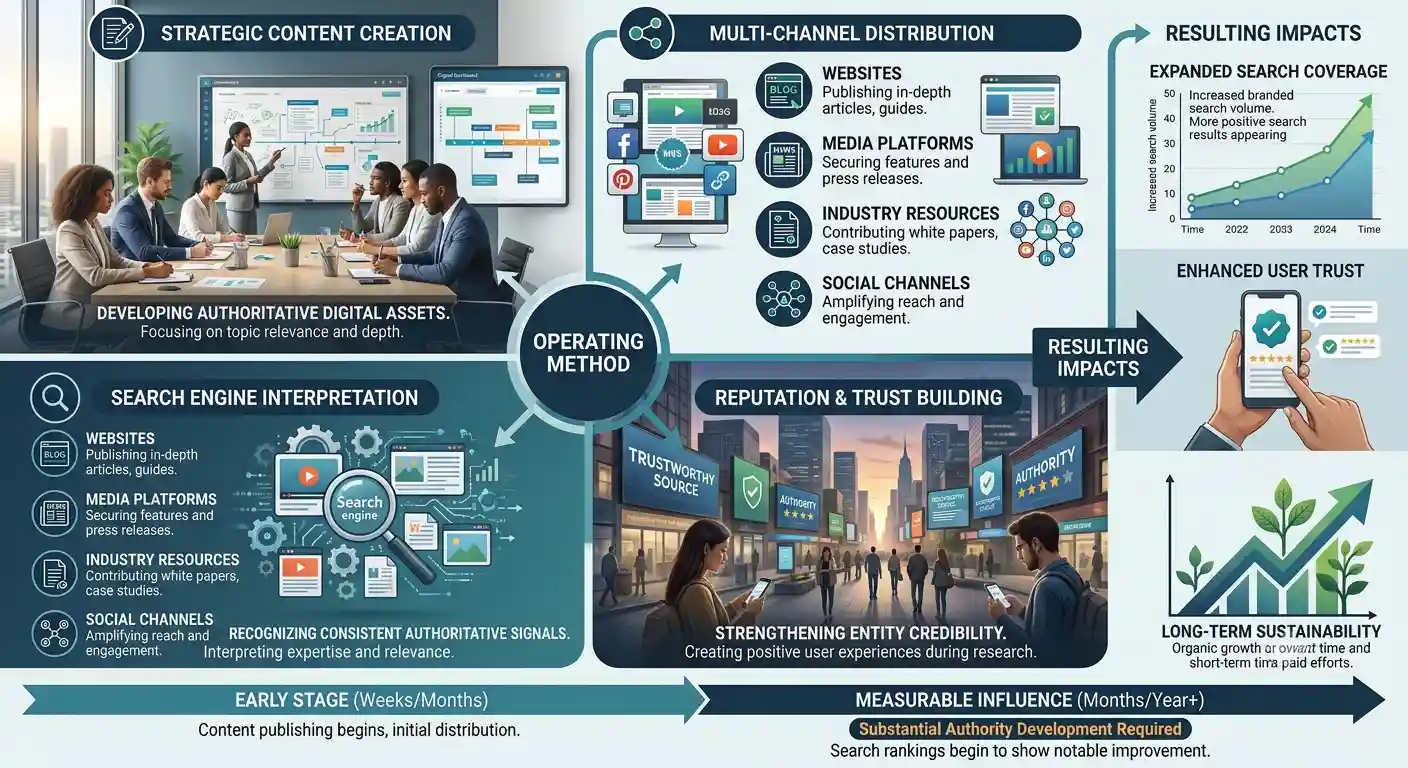
Long-term search impact depends on the quality, relevance, authority, and sustainability of the information being developed rather than on one reputation-management technique. Long-term content enhancement creates assets that continue to address relevant queries after publication. These assets can develop search visibility as they become indexed, referenced, and associated with relevant topics. Short-term suppression focuses on immediate visibility changes and therefore has a different measurement horizon. Evaluating long-term impact requires examining whether the strategy creates durable search assets rather than only measuring temporary ranking movement.
Search ranking influence also changes over time because SERPs are dynamic. New reviews, articles, forum discussions, job pages, professional references, and other indexed content can alter the composition of results associated with an entity. A strategy that produces one temporary ranking change therefore does not necessarily create lasting reputation control. Sustainable reputation management evaluates how well an approach continues to function as the information environment changes.
How Does Review Monitoring Compare With Review Response?
Review monitoring identifies and analyses new reputation signals, while review response introduces additional information into an existing conversation. Monitoring operates as a detection mechanism by tracking review volume, sentiment distribution, recurring topics, and changes in visibility. Response operates as a communication mechanism by addressing relevant issues through factual and contextually appropriate information. Monitoring therefore measures the reputation environment, whereas response contributes new information to that environment.

The effectiveness of response depends on relevance and consistency rather than response volume alone. A factual response that addresses the subject of a review creates clearer contextual information than a generic statement that does not address the underlying issue. Excessive or repetitive responses can also create additional content without adding meaningful information. Evaluation therefore considers whether the response improves clarity, addresses the relevant topic, and contributes useful information to the entity’s wider digital footprint.
How Does Sentiment Distribution Affect Reputation Analysis?
Sentiment distribution measures how positive, negative, and neutral themes are represented across available reputation content. It provides a structured way to analyse whether particular themes dominate the information associated with an entity. However, sentiment alone does not establish the factual accuracy or search importance of individual claims. A review with negative language can have limited search visibility, while a neutral article can rank prominently for an important branded query. Reputation analysis therefore combines sentiment distribution with source authority, relevance, indexing, and SERP position.
Topic-level sentiment provides additional analytical value because it identifies what the feedback is actually discussing. Contractor reviews relating to payment administration represent a different reputation signal from reviews concerning communication or project matching. Grouping feedback by topic helps distinguish isolated complaints from recurring themes. This produces a more precise assessment of reputation signals than calculating an overall positive or negative percentage.
How Do Short-Term and Long-Term Reputation Strategies Compare?
Short-term strategies focus on immediate changes to search visibility, review response, content updates, or specific reputation events. Long-term strategies focus on developing a stronger and more comprehensive digital footprint. Short-term activity is easier to connect with a particular reputation incident because its objective and timeframe are clearly defined. Long-term activity requires continuous content development, monitoring, indexing, and measurement. The two approaches therefore solve different parts of the reputation-management process.
Risk exposure also differs between the two timeframes. Short-term strategies face the risk of incomplete coverage because rapid action often addresses the visible problem without strengthening the wider information environment. Long-term strategies reduce this limitation by developing multiple relevant content assets and maintaining consistent entity information. However, long-term strategies require sustained monitoring because new reputation signals continue to enter the search ecosystem. Evaluation therefore considers both immediate visibility and future information resilience.
Dive Deeper With Our Expert Guides:
How Do Litigation and Press Stories Affect Executive Search Firm Selection?
Which Executive Search Firms Rank Highest on Google and Why?
How Do Reputation Strategies Affect SERP Composition?
Reputation strategies affect SERP composition by changing the information available for search engines to evaluate and rank. Creating authoritative pages introduces new potential ranking assets, while improving existing pages increases their relevance and contextual coverage. Removal strategies can change SERP composition when content is legitimately removed from its original source and subsequently disappears from search indexes. Suppression strategies attempt to increase the relative visibility of alternative content without necessarily eliminating the original result. These mechanisms produce different changes to the set of information users encounter.
SERP composition is particularly important for branded and reputation-related queries. Users searching for an agency name can encounter its website, reviews, professional profiles, job pages, third-party references, or other indexed sources. Each result contributes a different type of information to the entity’s search environment. A reputation strategy therefore requires analysis of the complete result set rather than focusing on one URL. Measuring changes across the first page and relevant query variations provides a clearer indication of how the search environment has changed.
How Should Reputation Management Effectiveness Be Evaluated?
Reputation management effectiveness is evaluated through measurable changes in visibility, content coverage, reputation signals, and entity credibility. A structured evaluation separates ranking outcomes from perception signals because these metrics describe different aspects of the search ecosystem. Search position measures visibility, while sentiment distribution measures the characteristics of available feedback. Indexed content measures information availability, while third-party references provide additional context about entity authority. Combining these measurements creates a more complete assessment framework.
A practical evaluation framework can examine four areas:
- Measure visibility by tracking branded queries, relevant non-branded queries, SERP positions, and changes in result composition over defined periods.
- Analyse sentiment by categorising review language into positive, negative, and neutral themes connected with specific contractor experiences.
- Evaluate content coverage by identifying whether authoritative pages address important recruitment topics, contractor concerns, and relevant search intents.
- Assess risk exposure by monitoring new reviews, third-party references, duplicate information, and emerging topics that alter the entity’s digital footprint.
This framework distinguishes actual search changes from assumptions about reputation improvement. It also provides a consistent basis for comparing content enhancement, suppression, removal, monitoring, and response strategies.
How Does a Reputation Audit Help Compare Different Strategies?
A reputation audit provides a structured assessment of existing reputation signals, search visibility, indexed content, review patterns, and SERP composition. It identifies which information assets currently influence the entity’s search environment and where gaps exist in topical or contextual coverage. This creates a baseline for comparing strategies before changes are implemented. An audit also separates issues requiring content enhancement from issues requiring monitoring, response, or legitimate removal consideration.
The value of an audit depends on the scope of information examined. Reviewing only the organisation’s website provides limited visibility into the wider reputation environment. A broader assessment considers branded search results, review platforms, third-party references, professional profiles, relevant content, and search-result patterns. This produces a more complete picture of entity credibility and search perception. Free reputation audit for your recruitment agency therefore represents an assessment concept rather than a reputation-management outcome itself.
What Factors Determine the Most Appropriate Reputation Management Approach?
The appropriate approach depends on the source, visibility, persistence, relevance, and nature of the reputation issue. Content enhancement fits situations where authoritative information is limited or existing content fails to address relevant search intent. Content removal relates to situations where a specific source contains information eligible for legitimate removal. Suppression focuses on search visibility when unwanted content remains accessible but alternative relevant content can compete within the SERP. Monitoring and response address active reputation signals that continue to develop through reviews and external references.
Scalability also differs between approaches. Content creation can be expanded across defined topics and search intents, while removal remains dependent on individual sources and applicable policies. Monitoring systems can operate continuously across review platforms and search queries, but they require consistent analysis to distinguish significant changes from routine fluctuations. A sustainable strategy therefore considers the volume of reputation signals, the number of relevant search queries, available content assets, and the persistence of the underlying issue.
Contractor reviews form one component of a PM recruitment agency’s wider reputation ecosystem, alongside website content, professional references, third-party publications, and other indexed information. Content enhancement, content suppression, removal, monitoring, and reactive response operate through different mechanisms and therefore produce different outcomes for search visibility, risk exposure, and sustainability. Short-term strategies address immediate reputation signals, while long-term strategies develop a broader digital footprint and stronger contextual coverage. Effective evaluation combines SERP composition, sentiment distribution, content indexing, entity credibility, and reputation-signal monitoring rather than relying on a single metric. The central consideration is how each approach changes the information environment surrounding the recruitment entity and how sustainably that change remains visible in search.
How do contractor reviews affect a PM recruitment agency’s reputation?
Contractor reviews can influence how potential contractors and clients perceive a PM recruitment agency’s reliability, communication and professionalism. Consistent positive feedback can support trust, while recurring negative reviews may raise concerns about the agency’s recruitment and contractor management practices.
Why are contractor reviews important for project management recruitment agencies?
Contractor reviews provide insights into the experiences of people who have worked through a project management recruitment agency. They can affect online reputation, candidate confidence and the agency’s perceived credibility.
Can negative contractor reviews affect recruitment for PM agencies?
Yes, negative contractor reviews may make prospective contractors more cautious about applying or accepting assignments through an agency. Their impact can depend on the review’s content, frequency, recency and how the agency responds.
How should a PM recruitment agency respond to negative contractor reviews?
A PM recruitment agency should respond professionally, acknowledge legitimate concerns and provide appropriate clarification without revealing confidential information. Consistent, constructive responses can demonstrate that contractor feedback is taken seriously.
Can contractor reviews be removed from search results?
Contractor reviews generally cannot simply be removed from search results because they are negative. Removal may be possible where content violates a platform’s review policies or applicable rules, while reputation management can also focus on improving the visibility of accurate and relevant information.