

Reputation influences which supply chain recruiters manufacturers brief by shaping the credibility, relevance and visibility of information encountered during recruiter evaluation. Manufacturers assess reviews, specialist content, professional references and search results as connected reputation signals before deciding which recruitment providers appear credible.
Reputation management strategies differ based on whether the objective is to improve existing information, address harmful content, strengthen search visibility or correct inaccurate reputation signals. Online reputation control methods are evaluated through their effectiveness, risk exposure, scalability and ability to produce sustainable changes in SERP composition.
How do manufacturers compare supply chain recruiters through reputation signals?
Manufacturers compare supply chain recruiters by evaluating the consistency and credibility of information available across search results and professional sources. A recruiter with specialist content, credible reviews and consistent business information provides a clearer entity representation than a recruiter whose online presence contains contradictory or incomplete information. Reputation signals therefore operate as evidence during the early research stage. Search visibility determines which evidence becomes accessible first, while source authority affects how that evidence is interpreted.
Reviews provide one of the most visible reputation signals because they contain direct assessments of previous recruitment experiences. Sentiment distribution gives manufacturers information about recurring perceptions relating to communication, candidate quality, industry knowledge and recruitment performance. A high rating alone does not establish strong reputation because review relevance, source credibility and content context also affect interpretation. SERP evaluation therefore compares the complete review environment rather than relying on a single numerical measure.
Third-party references provide another layer of comparison. Professional associations, industry publications, directories and independent websites can corroborate information presented by the recruitment business. Consistent references strengthen entity credibility because different sources reinforce the same professional identity and specialist positioning. Contradictory information creates an alternative signal that requires additional interpretation. Manufacturers therefore evaluate reputation through the relationship between owned content, independent references and visible search results.
Which reputation management approach works better: content creation or content removal?
Content creation and content removal address different reputation problems, so effectiveness depends on the underlying source and search objective. Content creation, or content enhancement, operates by increasing the amount of relevant and authoritative information available around an entity. Content removal operates by seeking the deletion or de-indexing of material where a valid policy, legal or platform-based mechanism applies. The two approaches therefore change different parts of the search ecosystem. Treating them as interchangeable reduces strategic precision.
Content enhancement has stronger relevance when the problem involves weak information coverage rather than content that qualifies for removal. Specialist pages about procurement recruitment, logistics hiring, supply chain planning and manufacturing recruitment can strengthen topical associations around the entity. These pages provide additional information for search engines to index and evaluate. Their impact depends on relevance, quality, authority and ranking competition. Content creation therefore supports long-term search visibility but does not guarantee displacement of established third-party results.
Content removal has a more direct effect on the availability of a specific source. Removing qualifying content eliminates that page or information from the relevant environment, reducing its ability to influence search perception. Its limitation is that removal requires a recognised basis, such as a platform policy violation, inaccurate information or applicable legal rights. Legitimate criticism does not automatically qualify for removal. Removal therefore offers stronger direct resolution for qualifying material but has narrower applicability than content enhancement.
Is content suppression more sustainable than reactive reputation management?
Content suppression is generally a longer-term search visibility strategy because it focuses on the relative prominence of unwanted content rather than responding to individual incidents. Suppression operates by strengthening relevant, authoritative content so that competing pages occupy more prominent positions within targeted SERPs. Reactive reputation management instead responds to specific reviews, articles or reputation events after they become visible. The two methods therefore differ in timing and operating model.
Reactive approaches are useful when a specific reputation issue requires immediate classification or intervention. A new negative review, inaccurate directory entry or damaging article can be assessed according to its legitimacy, visibility and potential impact. The limitation is that repeated reactive interventions create an incident-driven workflow. Each new result requires separate analysis and prioritisation. This model can become resource-intensive when the underlying search environment remains unchanged.
Organic suppression addresses the surrounding information ecosystem rather than one isolated result. Building authoritative content, strengthening internal topical relationships and developing credible external references increases the information available around the recruitment entity. Search engines then evaluate these competing pages according to their own ranking systems. The approach does not guarantee the removal of negative content. Its sustainability comes from strengthening the broader digital footprint rather than relying on repeated requests against individual sources.
How does search ranking influence which recruiters manufacturers trust?

Search ranking influences recruiter trust by controlling the order in which information becomes visible during online research. Search engines evaluate indexed pages using relevance, authority and other ranking signals, producing a SERP that determines the exposure of each source. A highly visible review therefore receives greater attention than an equivalent review positioned substantially lower in the results. Ranking position does not establish factual accuracy, but it changes the likelihood that users encounter particular information. Reputation analysis consequently treats visibility and credibility as related but separate variables.
Search ranking influence becomes more significant for branded searches. A manufacturer searching for a recruitment agency by name often encounters the organisation’s website alongside reviews, directories, social profiles and third-party publications. The composition of these results creates the immediate digital context for evaluating the entity. If authoritative information occupies strong positions, it provides greater context around the recruiter. If negative or contradictory content dominates visible positions, the search environment presents a different reputation profile.
Search visibility therefore requires measurement rather than assumption. Ranking positions, query associations, source types and content sentiment provide measurable indicators of SERP composition. Tracking these variables identifies whether reputation signals are becoming more balanced or whether one source continues to dominate perception. This measurement also separates ranking movement from changes in the underlying sentiment. A recruiter can therefore evaluate reputation through observable search behaviour rather than relying solely on internal assessments.
How do organic and reactive reputation strategies compare?
Organic reputation management builds reputation signals before individual reputation incidents become dominant, while reactive management responds after a visible issue emerges. Organic approaches focus on content enhancement, authoritative references, entity consistency and long-term search visibility. Reactive approaches focus on identifying, classifying and addressing specific negative or inaccurate content. The primary difference is therefore timing and scope rather than simply the type of activity involved.
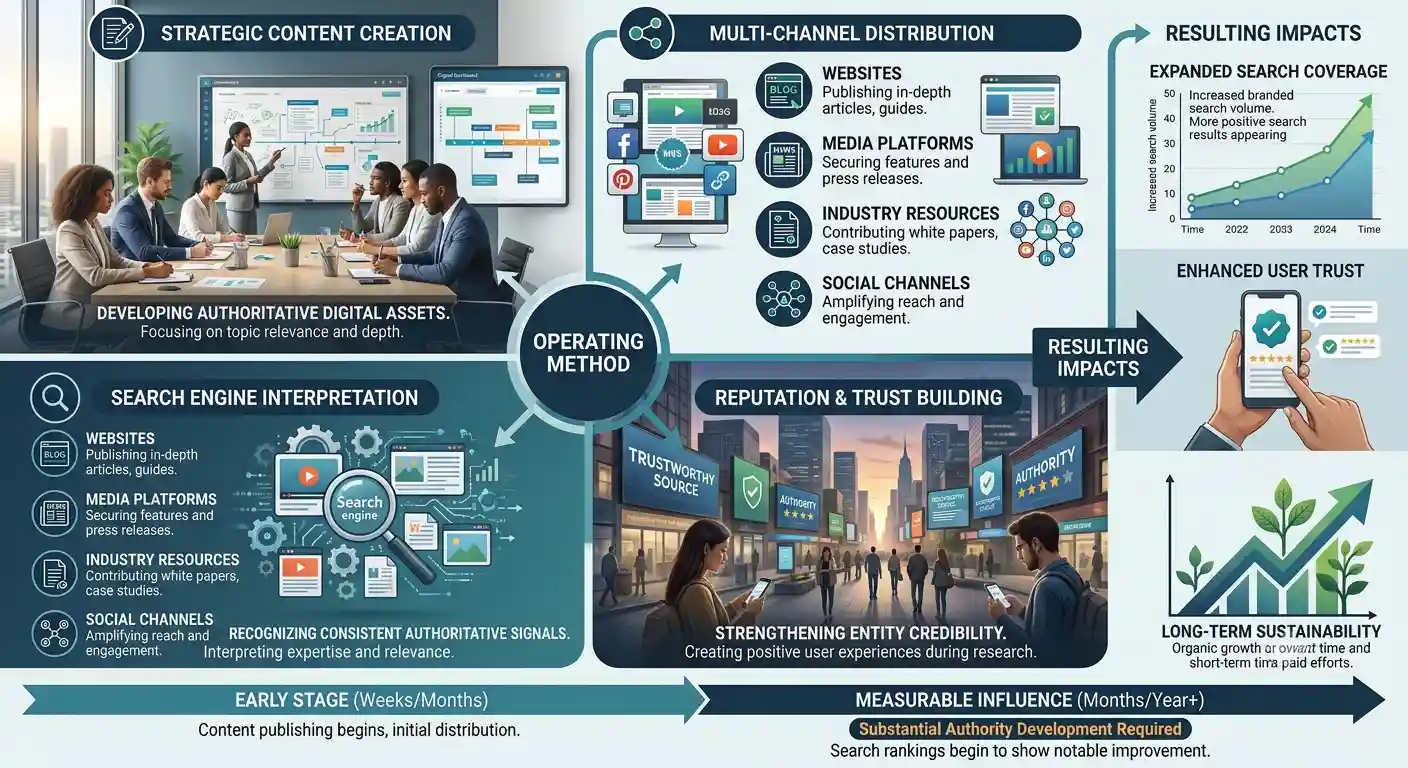
Organic strategies provide stronger scalability when a recruitment business operates across multiple specialist areas. A structured content ecosystem can cover procurement, logistics, supply chain management, manufacturing recruitment and related expertise. Each relevant page adds contextual information to the entity’s digital footprint. This approach creates a broader foundation for search visibility. Its limitation is that ranking improvements require competition against established sources and do not occur simply because additional content exists.
Reactive strategies provide greater precision for individual reputation threats. An inaccurate review or misleading directory entry can be isolated, evaluated and routed towards correction, removal or monitoring. This makes reactive management useful when the reputation issue is specific and identifiable. Its limitation is that it does not automatically strengthen the wider search environment. A recruitment business relying entirely on reactive responses remains exposed to future changes in reviews, content and ranking positions.
What is the difference between short-term and long-term reputation impact?
Short-term reputation management focuses on reducing the immediate visibility or impact of a specific reputation signal, while long-term management focuses on changing the broader information environment. A short-term intervention can involve correcting inaccurate business information, addressing qualifying content or responding to a visible review issue. Its effectiveness is measured through the immediate status and visibility of the targeted source. Long-term management measures the stability of the wider SERP and the consistency of reputation signals over time.
Short-term approaches provide faster diagnostic value because the problem is narrowly defined. A recruiter can identify the source, evaluate its legitimacy and determine its ranking position. This establishes whether the issue represents a genuine risk to entity perception. The limitation is that resolving one source does not necessarily change the overall reputation profile. Other reviews, directories and third-party pages continue contributing to the SERP.
Long-term approaches focus on building resilience. Consistent specialist content, accurate entity information, credible references and sustained monitoring create a stronger information ecosystem around the recruiter. These signals provide broader context when manufacturers conduct future searches. The strategy is more sustainable because it does not depend on resolving each reputation event independently. Its limitation is the need for continuous measurement as search results, competitors and content sources change.
Dive Deeper With Our Expert Guides:
How Do Individual Consultant Reviews Roll Up Into Agency Ratings?
How Does Consultant Behaviour Training Prevent Reputation-Damaging Reviews?
How can supply chain recruiters evaluate reputation management effectiveness?
Recruiters can evaluate reputation management effectiveness by measuring changes in search visibility, sentiment distribution, content prominence and entity consistency. These indicators provide direct evidence about the digital environment surrounding the recruitment entity. Measuring only the number of actions completed does not establish whether search perception changed. A stronger evaluation framework connects each intervention to a measurable reputation signal. This creates a distinction between activity and actual search impact.
A structured evaluation process can:
- Measure ranking positions — Compare branded and specialist search queries to identify changes in the visibility of reviews, authoritative pages and third-party content.
- Analyse sentiment distribution — Track recurring positive, neutral and negative themes across visible review sources to identify changes in reputation perception.
- Evaluate source authority — Compare the credibility and relevance of websites contributing information to the recruiter’s digital footprint.
- Track entity consistency — Check names, locations, specialist services and professional descriptions across indexed sources for contradictory information.
- Assess intervention sustainability — Monitor whether improvements remain visible after the initial content enhancement, correction or removal activity.
This framework also helps compare competing reputation approaches. If content enhancement increases authoritative visibility while reactive actions resolve isolated problems, the two methods produce different but complementary outcomes. Effectiveness therefore depends on the reputation objective being measured. A removal strategy can be highly effective for qualifying content while providing little benefit for weak overall search visibility. Content enhancement can improve information coverage while providing no direct solution for content that requires legitimate removal.
How scalable are different reputation management strategies for recruitment agencies?
Scalability depends on whether a reputation strategy can address multiple queries, entities and reputation signals without treating every issue as an isolated incident. Content enhancement provides strong scalability because one well-structured information asset can support multiple related searches. Specialist recruitment pages can establish semantic relationships between the recruiter and procurement, logistics, manufacturing and supply chain expertise. These relationships create broader topical coverage within the digital footprint. The limitation is that each content asset still competes within an independent ranking environment.
Reactive management is less scalable when every negative result requires separate assessment and intervention. Each source can involve different ownership, platform rules, factual circumstances and removal criteria. The workflow therefore expands as the number of reputation incidents increases. Reactive strategies remain valuable for high-risk content but become less efficient as a complete reputation model. Their strongest role is targeted intervention within a wider framework.
Monitoring provides a scalable control layer because automated or structured tracking can identify changes in rankings, reviews and indexed content. This allows reputation teams to prioritise issues according to visibility and potential impact. High-risk signals receive greater analytical attention while lower-risk changes remain monitored. Scalability therefore depends on prioritisation rather than attempting to intervene against every reputation signal. This approach creates a more controlled relationship between reputation risk and available resources.
How does reputation management risk differ between removal and suppression?
Removal carries higher procedural constraints because it requires a valid basis for changing the availability of content. A removal request that lacks supporting grounds can fail, while aggressive attempts to remove legitimate criticism create additional reputational and compliance risks. The mechanism therefore depends on accurate classification before action. This makes evidence collection and source evaluation essential components of the removal process.
Suppression carries a different form of risk because it relies on competitive search visibility rather than changing the original source. Search engines control ranking outcomes, so no suppression strategy guarantees a fixed SERP position. Algorithmic changes, new content and changes in source authority can alter the competitive environment. The method therefore requires ongoing measurement and content development. Its principal limitation is uncertainty in ranking behaviour rather than dependence on removal eligibility.
Content enhancement has comparatively lower intervention risk because it adds relevant information rather than attempting to alter another publisher’s content. Its effectiveness still depends on content quality, authority, indexing and search competition. The strategy therefore reduces direct intervention risk but requires longer-term investment in the digital footprint. Comparing risk across methods requires considering both procedural constraints and the sustainability of the resulting search environment.
When does reputation management become a cost consideration for niche recruitment agencies?
Reputation management becomes a cost consideration when the resources required to address reputation risks are evaluated against their visibility, commercial relevance and persistence. A niche recruitment agency operates within a specialised search environment where a small number of queries can represent a significant proportion of employer research. The commercial significance of a reputation signal therefore depends on its relationship to high-intent searches. Cost analysis needs to consider the number of priority queries, source complexity and intervention type rather than treating reputation management as a standard fixed activity.
Removal, suppression and content enhancement also create different resource requirements. Removal requires evidence gathering, source assessment and platform or legal processes. Suppression requires content development, authority building, monitoring and ongoing SERP analysis. Content enhancement requires research, production, optimisation and indexing support. The appropriate resource model therefore depends on the reputation problem rather than the service category alone.
For niche agencies, sustainability is particularly important because specialist search environments contain a defined set of commercial queries and reputation signals. A strategy that resolves one visible issue without strengthening the broader digital footprint creates recurring exposure. A strategy that improves search visibility across relevant specialist queries creates longer-term value but requires continued monitoring. This distinction provides the basis for evaluating reputation management cost in relation to scope, risk and expected search impact.
What strategy provides the strongest long-term reputation control for supply chain recruiters?
The strongest long-term approach combines proactive content enhancement, structured monitoring and targeted reactive intervention rather than relying on one mechanism. Content enhancement establishes authoritative information around specialist expertise, while monitoring identifies changes in rankings, reviews and third-party references. Reactive intervention then addresses individual sources that create material reputation risk. This combination separates prevention from incident response. It also creates a more resilient reputation system than a removal-only or response-only model.
A balanced strategy begins with entity and SERP evaluation. The recruiter first identifies which queries manufacturers use, which sources appear and which reputation signals dominate the visible results. Content gaps are then distinguished from inaccurate or removable content. This classification determines whether enhancement, suppression, correction, removal or monitoring represents the appropriate mechanism. The resulting strategy aligns intervention with the actual structure of the reputation problem.
Long-term control also depends on continuous measurement. Search engines update rankings, new reviews appear and third-party sources change their information over time. A static reputation strategy therefore loses accuracy as the digital environment evolves. Ongoing SERP evaluation identifies these changes and allows the strategy to be recalibrated. Reputation control is consequently better understood as an information-management system than as a one-time repair exercise.
Reputation influences which supply chain recruiters manufacturers brief because search results provide an information environment through which professional credibility is evaluated. Reviews, specialist content, third-party references, entity consistency and ranking positions combine to form reputation signals. The strongest evaluation therefore considers both what information exists and how prominently that information appears.
Content enhancement, removal, suppression and reactive intervention serve different purposes. Enhancement expands authoritative information, removal addresses qualifying sources directly, suppression changes relative search visibility and reactive management responds to specific reputation events. Each approach has different effectiveness, scalability, risk exposure and sustainability characteristics.
Organic reputation strategies provide a stronger foundation for long-term search visibility, while reactive methods provide precision when individual reputation risks emerge. A balanced framework combines both approaches and measures outcomes through SERP composition, sentiment distribution, source authority and entity consistency. For niche recruitment agencies, these strategic differences also determine the resources involved, making reputation management cost an important consideration when comparing long-term reputation approaches.
How does reputation influence which supply chain recruiters manufacturers brief?
Reputation influences recruiter selection by shaping how manufacturers assess credibility, specialist expertise and reliability. Strong search visibility, relevant reviews and consistent professional information provide clearer reputation signals during supplier evaluation.
What reputation signals do manufacturers look for in supply chain recruiters?
Manufacturers typically assess client reviews, specialist recruitment content, professional references, search results and the consistency of business information. These signals help establish whether a supply chain recruiter has relevant expertise and commercial credibility.
How does search visibility affect supply chain recruiter credibility?
Search visibility affects which information manufacturers encounter when researching a recruitment agency. Prominent, relevant and credible results strengthen the overall search perception of a supply chain recruiter.
Is content creation or content removal better for recruiter reputation?
The appropriate approach depends on the reputation problem being addressed. Content creation strengthens credible information and search relevance, while legitimate content removal addresses harmful or inaccurate material that meets applicable removal criteria.
What is reputation management for supply chain recruiters?
Reputation management for supply chain recruiters involves monitoring reviews, search results, online content and other reputation signals that influence manufacturer perception. The process focuses on improving credible information, addressing harmful content and maintaining consistent search visibility.