

Personal search visibility directly impacts career growth because search engines influence how professional identity is interpreted, verified, and evaluated online. Search results create reputation signals that affect credibility, authority, and trust across digital ecosystems.
Reputation management is the process of monitoring, defining, and maintaining how individuals are represented across digital environments. Online reputation refers to the collection of indexed information, entity associations, and perception signals that search systems use to evaluate credibility and relevance.
What is personal search visibility and why does it matter for career growth?
Personal search visibility is the degree to which information about an individual appears and ranks within search engine results pages (SERPs). Search visibility defines how easily employers, collaborators, institutions, and professional networks discover and evaluate an individual’s digital presence. In search ecosystems, visibility functions as a reputation signal because indexed content contributes to perceived authority and expertise. Search engines organise information into entities and relationships that influence ranking outcomes. A professional identity becomes measurable through content indexing, link associations, and behavioural signals. Career growth increasingly intersects with digital discoverability because search results shape first impressions before direct interaction occurs.
Search visibility affects career progression through the interpretation of trust and relevance signals. Search engines evaluate content quality, source authority, and entity consistency to determine ranking positions. Higher visibility strengthens perceived expertise when search results demonstrate coherent professional information. Low visibility or fragmented information weakens entity perception by creating uncertainty around identity and credibility. SERP evaluation occurs continuously as algorithms reassess content freshness and relevance. Career opportunities therefore become connected to how effectively digital information represents professional expertise.
How do search engines form professional reputation?
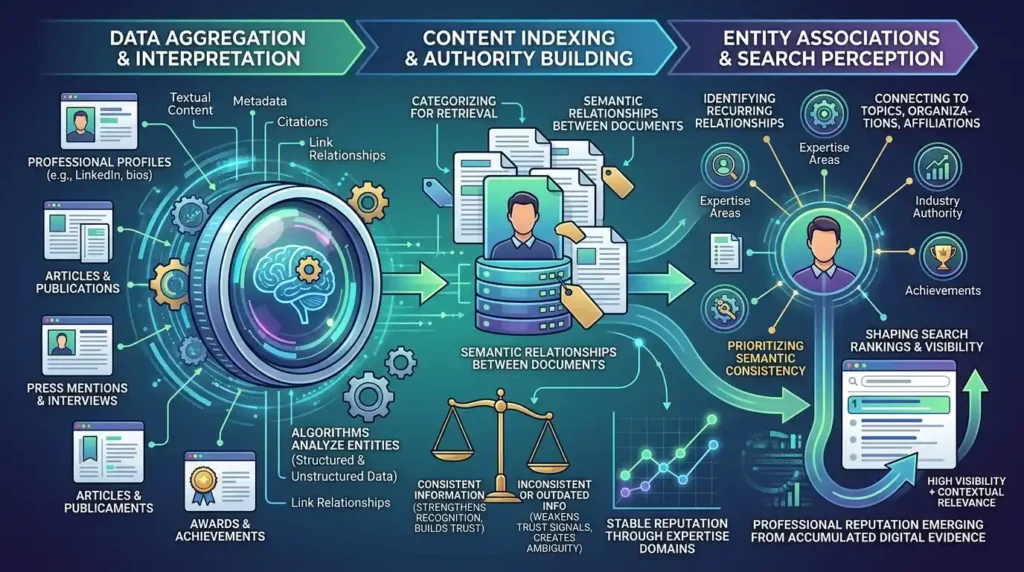
Search engines form professional reputation by aggregating, indexing, and interpreting information from multiple digital sources. Reputation within search ecosystems refers to the collective evaluation of authority, trust, and relevance associated with an entity. Algorithms analyse textual content, metadata, citations, and link relationships to construct entity understanding. Search systems use structured and unstructured data to define identity attributes. Each indexed source contributes to reputation signals that influence search rankings. Professional reputation therefore emerges from accumulated digital evidence rather than isolated content pieces.
How does content indexing influence reputation?
Content indexing is the process through which search engines store and categorise information for retrieval. Indexed profiles, articles, publications, interviews, and mentions contribute to digital identity formation. Search algorithms evaluate topical relevance and semantic relationships between documents. Consistent information strengthens entity recognition and reduces ambiguity. Inconsistent or outdated information weakens trust signals and complicates SERP evaluation. Reputation becomes increasingly stable when indexed content demonstrates expertise within a clearly defined knowledge domain.
How do entity associations shape perception?
Entity perception refers to how search engines connect individuals with topics, organisations, achievements, and expertise areas. Algorithms identify recurring relationships between entities to define relevance. Strong entity associations improve search visibility because search systems recognise subject authority. Weak associations create fragmented reputation signals that reduce interpretability. Search ecosystems prioritise semantic consistency when evaluating expertise. Professional reputation therefore depends on both visibility and contextual relevance.
How does digital footprint influence online credibility?
A digital footprint is the collection of information generated, published, or associated with an individual across online platforms. Digital footprints function as persistent records that search engines evaluate for credibility assessment. Every indexed document contributes to the broader reputation ecosystem. Search algorithms interpret footprint consistency as evidence of authenticity and expertise. Digital presence therefore extends beyond owned content into third-party references and citations. Career growth becomes connected to how comprehensively digital information reflects professional identity.
Online credibility refers to the perceived reliability and authority of digital information. Credibility emerges when search results demonstrate accuracy, consistency, and expertise. Search systems analyse content quality signals, authorship patterns, and source trustworthiness. Positive reputation signals strengthen confidence in professional identity. Contradictory information reduces trust by introducing uncertainty into entity evaluation. Credibility functions as a ranking-related factor because trustworthy content satisfies user expectations and search quality standards.
What role do SERPs play in shaping professional perception?
Search engine results pages act as reputation interfaces that organise and present information to users. SERPs define the sequence through which individuals encounter digital identities. Search visibility determines which information receives attention first during evaluation processes. Ranking positions influence perceived authority because users interpret higher-ranked results as more credible. Search systems therefore shape perception through information ordering and presentation. Professional identity becomes partially dependent on SERP structure and ranking dynamics.
SERP evaluation includes titles, descriptions, knowledge panels, images, and associated links. Each component contributes to perception by framing context around an entity. Search algorithms determine visibility based on relevance, authority, and user satisfaction metrics. Positive signals strengthen professional credibility within search ecosystems. Negative or outdated results alter entity perception by changing informational balance. Career-related decisions increasingly rely on the interpretation of SERP content.
How do authority and trust signals affect search visibility?
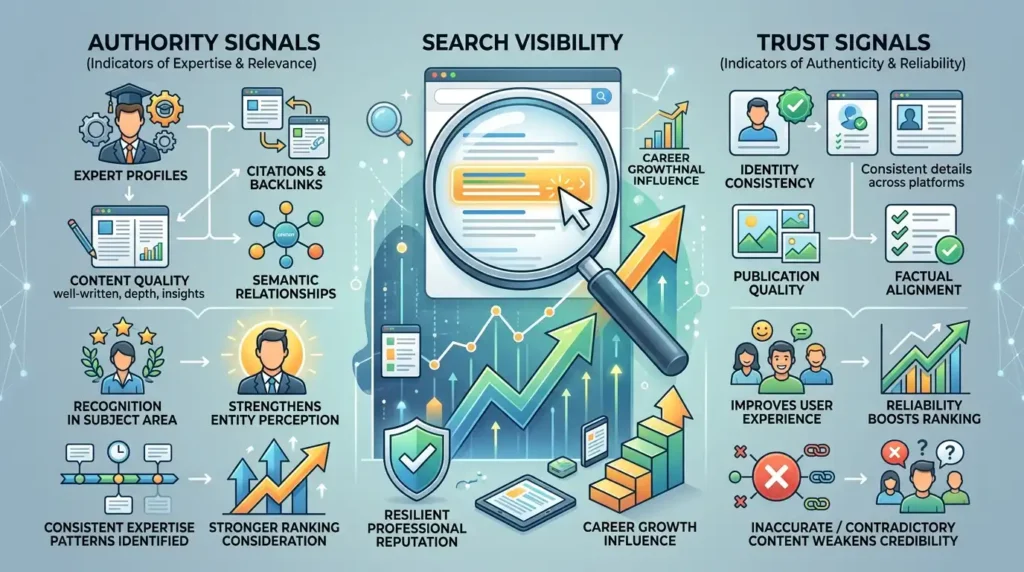
Authority signals are indicators that demonstrate expertise, relevance, and recognition within a subject area. Search engines evaluate authority using citations, backlinks, content quality, and semantic relationships. Authority strengthens entity perception because search systems identify consistent expertise patterns. High-authority information receives stronger ranking consideration during retrieval processes. Search visibility therefore increases when authority signals align across multiple sources. Professional reputation becomes more resilient when expertise is repeatedly validated.
Trust signals refer to indicators that confirm authenticity and reliability. Search systems analyse identity consistency, publication quality, and factual alignment to determine trustworthiness. Trust influences ranking because reliable information improves user experience. Inaccurate or contradictory content reduces trust signals and weakens credibility. Search ecosystems prioritise trustworthy entities to maintain result quality. Career growth becomes increasingly influenced by digital trust evaluation mechanisms.
How does content influence search perception?
Content influences search perception because algorithms interpret information to understand expertise and relevance. Search perception refers to the way users and systems interpret digital information associated with an entity. Content establishes thematic authority through repeated semantic relationships. Search engines analyse topics, context, and entity associations to evaluate informational value. Well-structured content strengthens reputation signals by demonstrating subject expertise. Search visibility improves when content aligns with recognised areas of authority.
Different content formats contribute differently to reputation systems. Professional profiles establish identity attributes, while publications demonstrate expertise. Interviews, presentations, and citations reinforce authority through external validation. Search algorithms combine these signals to build comprehensive entity understanding. Consistent thematic content strengthens semantic relevance across search ecosystems. Reputation therefore evolves through cumulative content interpretation rather than isolated publications.
How do review signals and sentiment interpretation affect reputation?
Review signals are measurable indicators derived from feedback, ratings, mentions, and public commentary. Search systems evaluate review signals to assess credibility and trustworthiness. Sentiment interpretation refers to the analysis of positive, neutral, or negative language associated with an entity. Algorithms use natural language processing to identify patterns of perception. Reputation signals emerge from aggregated sentiment rather than individual statements. Search visibility changes when sentiment trends influence trust evaluation.
Sentiment interpretation affects entity perception because search systems prioritise trustworthy information environments. Positive sentiment reinforces credibility when supported by authoritative sources. Negative sentiment influences search perception by altering contextual associations. Search algorithms evaluate relevance, source quality, and linguistic indicators during interpretation. Reputation therefore reflects both informational accuracy and collective perception. Search ecosystems continuously reassess sentiment as new content enters the index.
Why is reputation stability important in search ecosystems?
Reputation stability refers to the consistency of digital identity across time and platforms. Stable reputations strengthen trust because search engines detect reliable patterns of information. Search visibility benefits from consistent entity associations and authoritative content. Frequent inconsistencies reduce confidence in identity verification processes. Reputation systems prioritise stability because reliable entities improve search quality. Career growth becomes more predictable when digital representation remains coherent.
Long-term reputation depends on continuous content indexing and evaluation. Search systems regularly update rankings based on relevance and freshness signals. Reputation therefore exists as a dynamic process rather than a static state. Maintaining informational consistency supports stronger entity perception and authority recognition.
This analytical approach aligns with principles explored in:
Building a Personal Reputation Recovery and Protection Strategy, where reputation resilience is evaluated through long-term search ecosystem management. Search visibility remains closely linked to digital trust and information integrity.
How does online credibility affect future professional opportunities?
Online credibility influences future opportunities because digital information often forms the basis of professional evaluation. Search ecosystems define credibility through authority, trust, and relevance signals. Employers, institutions, and networks interpret indexed information during decision-making processes. Search visibility therefore extends beyond discoverability into reputation assessment. Professional identity becomes increasingly dependent on accurate and authoritative representation. Career growth intersects with search ecosystems through the continuous evaluation of digital trust.
Digital trust functions as an informational asset within modern search environments. Search algorithms prioritise reliable entities because trustworthy information improves user satisfaction. Strong reputation signals enhance visibility and reinforce credibility over time. Weak signals reduce confidence in professional expertise and relevance. Search ecosystems continuously evaluate digital identities through content indexing and semantic relationships. Understanding these mechanisms explains why search visibility remains central to professional reputation.
Dive Deeper With Our Expert Guides:
9 Digital Footprint Factors Affecting Personal Reputation
What Appears When Someone Searches Your Name Online
Personal search visibility influences career growth through the interaction of content indexing, reputation signals, entity perception, and search evaluation systems. Search engines define credibility by interpreting authority, trust, sentiment, and semantic relationships across digital environments. Professional reputation emerges from accumulated information rather than isolated content. SERP evaluation shapes perception by organising and ranking digital identities according to relevance and reliability. Digital footprints, online credibility, and reputation stability collectively determine search visibility. Understanding these mechanisms provides a clearer framework for analysing how professional identity exists within search ecosystems.
Answers to Key Questions
Why is online reputation important for individuals?
Online reputation affects how employers, clients, and professional networks perceive an individual. Search results, public content, and digital trust signals contribute to credibility and influence professional opportunities.
How do search engines impact personal reputation?
Search engines rank and display content based on relevance, authority, and trust signals. Positive, accurate, and authoritative content strengthens search visibility, while negative or outdated information can affect entity perception.
What factors influence an individual’s online reputation?
Online reputation is influenced by search results, social profiles, published content, reviews, and third-party mentions. Consistent and trustworthy information helps establish stronger digital credibility and authority.
How does Clear My Name approach reputation management for individuals?
Clear My Name focuses on reputation management for individuals by analysing search visibility, online mentions, and digital trust signals. The process evaluates how information contributes to overall online credibility and search perception.