
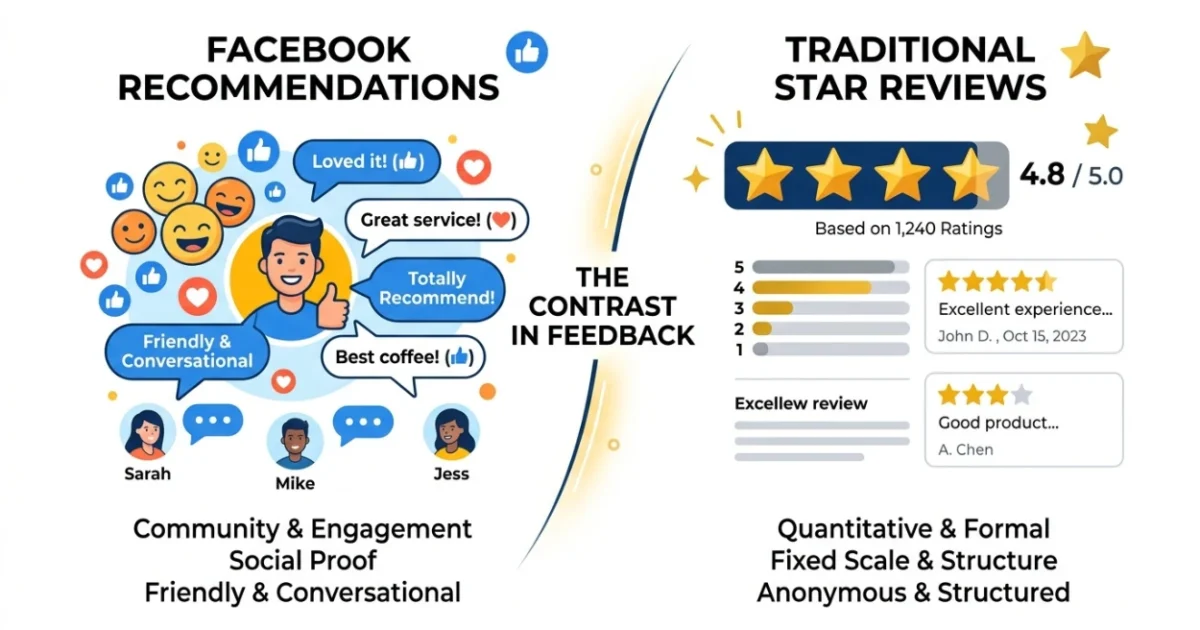
Facebook Recommendations and star reviews represent different reputation signals because they use separate evaluation systems to communicate user experiences. Reputation management is the process of analysing how online information influences digital perception, search visibility, and entity credibility across search ecosystems.
How Do Facebook Recommendations Differ From Star Reviews?
Facebook Recommendations differ from star reviews because they collect feedback through different structures and interpretation methods. Facebook Recommendations focus on written recommendations that describe whether a user suggests a business, while star reviews traditionally measure satisfaction through numerical ratings. Both systems contribute to online reputation, but they create different types of reputation signals within digital environments.
Online reputation refers to the collection of information, reviews, references, and user-generated content that influences how an entity is perceived online. Within search ecosystems, these signals contribute to how algorithms evaluate relevance, credibility, and authority. Written recommendations provide contextual information, while star ratings provide measurable sentiment indicators.
Facebook Recommendations operate through qualitative feedback. They analyse language patterns, topics, and user sentiment to create a broader understanding of customer experiences. Star reviews operate through numerical evaluation systems where ratings create a simplified measurement of satisfaction. These differences influence how platforms interpret content and how users evaluate reputation.
Both systems contribute to digital footprint development. A digital footprint is the collection of online information connected to an entity, including reviews, mentions, ratings, and interactions. The structure of this information affects how platforms understand brand identity and reputation signals.
How Are Facebook Recommendations Evaluated Within Reputation Systems?
Facebook Recommendations are evaluated through written content, user interactions, and sentiment patterns. The recommendation system analyses language-based feedback to identify themes connected to customer experience. These signals contribute to entity perception by providing additional context beyond numerical scores.
Content indexing plays an important role in how recommendation information becomes visible within online environments. Content indexing refers to the process through which search systems store, analyse, and organise digital information. Indexed recommendations create searchable reputation signals that influence how an entity is understood.
Algorithms interpret written recommendations by analysing relevance, context, and relationships between users, topics, and entities. A recommendation containing specific service-related information provides deeper contextual signals compared with a simple numerical rating. This difference demonstrates how content quality influences perception.
Facebook Recommendations also contribute to sentiment interpretation. Sentiment analysis evaluates whether online feedback expresses positive, neutral, or negative opinions. These patterns help platforms understand overall reputation direction and influence how users interpret available information.
How Do Star Reviews Influence Online Reputation Signals?
Star reviews influence online reputation signals through numerical scoring systems that simplify user feedback into measurable ratings. A star rating provides an immediate evaluation indicator that users recognise quickly. This structure creates a direct reputation signal based on aggregated user sentiment.
Star reviews contribute to SERP evaluation when platforms and search systems analyse reputation-related information. Search engines evaluate review signals alongside other authority and trust indicators to understand entity credibility. The numerical format allows algorithms to process satisfaction patterns efficiently.

The limitation of star reviews is reduced contextual depth. A high rating demonstrates positive sentiment but does not explain the reasons behind the evaluation. Written recommendations provide additional information that supports deeper understanding of customer experiences.
Star reviews remain valuable because they create measurable reputation indicators. They help users compare entities and allow platforms to evaluate overall sentiment distribution. Their influence depends on how review data connects with other reputation signals across digital environments.
Why Does Written Feedback Create Different Search Perception Than Ratings?
Written feedback creates different search perception because it contains semantic information that algorithms can analyse. Search systems evaluate language, topics, and relationships between words to understand the meaning behind online content. This process creates more detailed entity understanding compared with numerical signals alone.
Written recommendations contribute to semantic relevance because they describe specific experiences, services, and attributes. These details help search systems associate an entity with particular topics and user expectations. Content-based signals influence how information is interpreted within search ecosystems.
Numerical ratings provide measurement, while written feedback provides explanation. A rating indicates the level of satisfaction, but written content explains the factors influencing that satisfaction. Both signals work differently within reputation analysis.
The combination of qualitative and quantitative feedback creates a broader reputation profile. Algorithms evaluate multiple information sources to determine credibility, relevance, and trust. This demonstrates that reputation formation depends on interconnected signals rather than one individual metric.
How Do Algorithms Interpret Facebook Recommendations and Star Reviews?

Algorithms interpret Facebook Recommendations and star reviews by analysing structure, content, relevance, and user behaviour. Search systems evaluate reputation signals through automated processes that identify patterns within digital information. These evaluations influence content ranking dynamics and online visibility.
Facebook Recommendations provide semantic information because they contain natural language descriptions. Algorithms analyse these descriptions to understand topics, sentiment, and entity relationships. This process supports more detailed interpretation of online reputation.
Star reviews provide structured data because they follow a numerical format. Algorithms process these ratings as measurable indicators of satisfaction. This creates efficiency in reputation evaluation but provides limited contextual understanding.
Both systems influence entity perception through different mechanisms. Recommendations strengthen contextual understanding, while star reviews strengthen measurable sentiment evaluation. A complete reputation analysis considers how these signals interact within wider search ecosystems.
How Do Facebook Recommendations and Star Reviews Affect Digital Trust?
Facebook Recommendations and star reviews affect digital trust by providing evidence of public interaction and user experience. Trust signals are indicators that help platforms and users evaluate reliability, credibility, and reputation quality.
Recommendations create trust through detailed explanations and personal experiences. Their written format allows users and algorithms to understand specific qualities associated with an entity. This improves contextual evaluation within reputation systems.
Star reviews create trust through visible scoring patterns. Users quickly interpret ratings as indicators of general satisfaction. However, the absence of detailed information limits deeper analysis of why users formed those opinions.
Both review formats influence online credibility through different pathways. Recommendations contribute stronger contextual signals, while ratings contribute stronger measurement signals. Understanding these differences helps explain how digital reputation develops across platforms.
How Do Facebook Recommendations and Star Reviews Influence Search Visibility?
Facebook Recommendations and star reviews influence search visibility by contributing different types of reputation signals within digital ecosystems. Search visibility refers to how easily information connected to an entity appears across search platforms and online discovery environments. Review-related signals support algorithmic evaluation by providing evidence of user interaction, relevance, and credibility.
Facebook Recommendations influence visibility through contextual information contained within written feedback. Search systems analyse language patterns, topics, and references to understand the relationship between an entity and specific subjects. This semantic information strengthens entity perception by creating additional connections between a business, its services, and user experiences.
Star reviews influence visibility through structured rating data. Numerical ratings create measurable indicators that platforms use to evaluate overall sentiment patterns. Although ratings provide clear performance signals, they contain less contextual information for understanding specific attributes connected to reputation.
The impact of both systems depends on how algorithms combine review signals with other ranking factors. Search engines evaluate authority, relevance, content quality, and consistency when interpreting reputation information. This demonstrates that reviews function as one part of a wider reputation ecosystem.
How Do Review Signals Affect SERP Evaluation?
Review signals affect SERP evaluation by influencing how search systems understand credibility and user satisfaction. SERP evaluation is the process of analysing search engine results pages to determine the relevance, authority, and usefulness of available information. Reviews contribute additional data that supports this evaluation process.
Facebook Recommendations provide qualitative review signals that support semantic analysis. Written feedback creates associations between an entity and specific topics, allowing algorithms to understand context more effectively. This information influences how digital content is categorised and interpreted.
Star reviews provide quantitative review signals through rating structures. These signals allow platforms to measure overall sentiment distribution and compare reputation indicators. The numerical format creates efficient evaluation but provides limited explanation behind user opinions.
The difference between these review formats demonstrates how reputation systems analyse both meaning and measurement. Qualitative feedback explains user experiences, while quantitative ratings demonstrate overall sentiment levels. Together, they create a broader understanding of online credibility.
Why Do Businesses Need to Understand Different Review Formats?
Businesses need to understand different review formats because each format creates unique reputation signals that influence perception. Reputation analysis requires evaluating how information structures affect content interpretation, search visibility, and digital trust.
Written recommendations provide deeper insight into customer language and expectations. They reveal patterns connected to specific services, experiences, and qualities. This information contributes to stronger semantic understanding within online reputation systems.
Star reviews provide immediate reputation indicators through visible scores. They help users quickly assess general sentiment and compare entities. Their effectiveness depends on the overall rating pattern and the relationship between scores and supporting information.
Understanding these differences supports more accurate reputation evaluation. Analysing both recommendation content and star ratings creates a clearer picture of entity credibility and online perception.
How Do Facebook Recommendations Support Long-Term Reputation Development?
Facebook Recommendations support long-term reputation development by creating a continuous record of user-generated information. This information contributes to the digital footprint associated with an entity and provides ongoing reputation signals.
Long-term reputation development depends on consistency, relevance, and information quality. Written recommendations create searchable content that reflects user experiences and strengthens contextual understanding. This supports broader entity recognition within digital environments.
Star reviews also contribute to long-term reputation development by establishing measurable satisfaction patterns. Consistent ratings create historical reputation data that platforms can evaluate over time. Their value increases when supported by additional contextual information.
A sustainable reputation framework evaluates how different feedback formats interact. Understanding the relationship between recommendations, ratings, and search visibility provides insight into how online credibility develops.
How Can Facebook Recommendations Become a Strategic Reputation Asset?
Facebook Recommendations become a strategic reputation asset when they are evaluated as structured sources of digital trust information. A reputation asset is online information that contributes positively to entity understanding, credibility, and visibility.
Recommendations create value because they contain detailed language that reflects user experiences. This information supports semantic relationships between entities, topics, and services. The analysis of these relationships helps explain how recommendation content influences perception.
A strategic approach requires understanding how written feedback performs within wider reputation systems. Evaluating content quality, sentiment patterns, and visibility impact creates clearer insight into reputation performance.
The relationship between recommendations and conversion-focused reputation analysis is explained through Facebook Recommendations Conversion Asset, which examines how recommendation data can influence trust evaluation and digital perception.
What Factors Determine the Reputation Impact of Facebook Recommendations and Star Reviews?
The reputation impact of Facebook Recommendations and star reviews depends on several measurable factors within search ecosystems. These factors determine how information is interpreted, ranked, and connected with entity credibility.
Key evaluation factors include:
- Analyse content quality by reviewing the detail, relevance, and context within written recommendations.
- Measure sentiment distribution by evaluating positive, neutral, and negative feedback patterns.
- Evaluate consistency by comparing reputation signals across available digital platforms.
- Assess search visibility by analysing how review information contributes to online discovery.
These factors demonstrate that reputation impact depends on information structure rather than review quantity alone. Search systems evaluate the quality and relevance of signals when forming an understanding of an entity.
Facebook Recommendations and star reviews represent different forms of reputation signals within online ecosystems. Recommendations provide contextual information through written experiences, while star reviews provide measurable sentiment indicators through numerical ratings.
Both systems influence entity perception, digital footprint development, and search visibility through different mechanisms. Algorithms evaluate these signals alongside content indexing, authority indicators, and trust signals to understand online credibility.
Understanding the difference between recommendation-based feedback and rating-based feedback helps explain how reputation is formed and interpreted within search environments. Qualitative and quantitative review signals each contribute unique value to SERP evaluation and digital reputation analysis.
A complete reputation evaluation requires analysing how information is created, processed, and ranked. Facebook Recommendations and star reviews demonstrate that online reputation depends on interconnected signals that shape how entities are understood across digital platforms.
What is the difference between Facebook Recommendations and Star Reviews?
Facebook Recommendations allow users to recommend or not recommend a business and explain their experience in their own words. Star Reviews relied on a numerical rating, while Recommendations focus more on detailed customer feedback and context.
Why did Facebook replace Star Reviews with Recommendations?
Facebook introduced Recommendations to encourage more meaningful and authentic customer feedback instead of simple star ratings. Written recommendations help businesses and potential customers better understand real experiences and improve trust.
Do Facebook Recommendations affect a business’s online reputation?
Yes, Facebook Recommendations can significantly influence a business’s online reputation because potential customers often read them before making decisions. Consistent positive recommendations can build credibility, while negative feedback can impact customer trust.
Can businesses remove negative Facebook Recommendations?
Businesses generally cannot remove negative Facebook Recommendations unless they violate Facebook’s Community Standards. Companies like Clear My Name help businesses understand reputation management strategies and address harmful or policy-violating content when appropriate.
How can businesses improve their Facebook Recommendations?
Businesses can improve Facebook Recommendations by providing excellent customer service, encouraging satisfied customers to share honest feedback, and responding professionally to reviews. Maintaining active customer engagement and resolving issues promptly also helps strengthen online reputation over time.