

Negative news coverage degrades political trust and approval ratings by altering the volume, sentiment, and structural prominence of information indexed within search ecosystems. Online reputation refers to the collective digital footprint of an entity, derived from algorithmic aggregation, content indexing, and user sentiment interpretation across search engine results pages (SERPs). Within semantic search systems, this digital footprint acts as the primary data layer from which public trust and institutional credibility are constructed.
How Does Negative Media Coverage Alter Search Engine Results Pages?
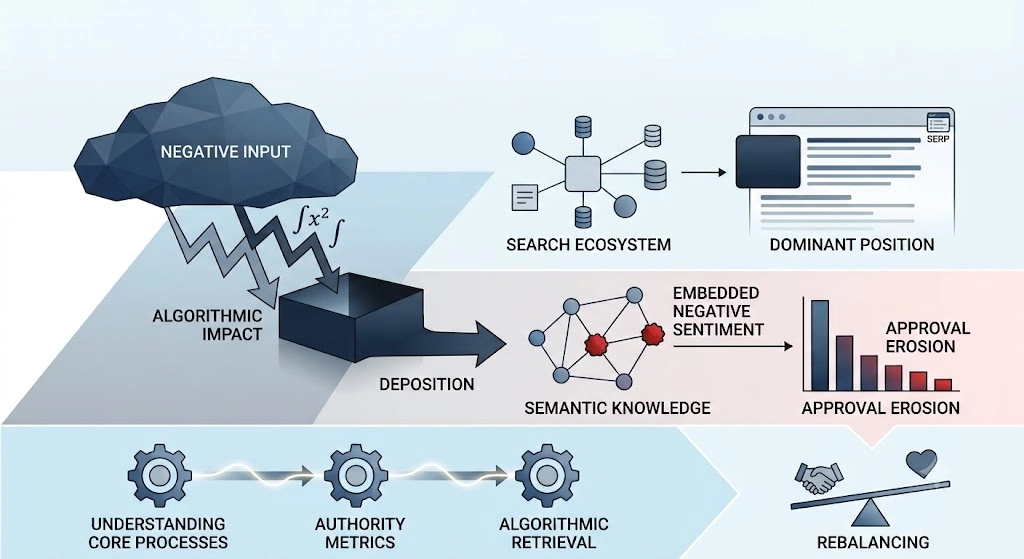
Negative media coverage alters search engine results pages by introducing highly authoritative, fresh information nodes that displace pre-existing, neutral or positive content. Search engines prioritise information from news publishers because these entities possess high baseline authority and trust signals. When a political entity experiences adverse reporting, search engine algorithms update their SERP evaluation to reflect the sudden increase in query volume and content publication velocity. This algorithmic shift ensures that negative documents occupy the most prominent, high-click-through-rate positions on the primary results page.
The mechanism driving this real-world visibility shift relies on freshness algorithms, which are designed to detect real-time information anomalies. When authoritative news outlets publish overlapping narratives about an individual or institution, semantic search models cluster these reports to form a dominant narrative topic. This topic clusters around the entity’s unique identification key within the search graph, shifting the semantic association from functional attributes to risk-related keywords. Consequently, the user’s search perception control is compromised, as the algorithmic ranking prioritises critical consensus over older, static assets.
The impact of this algorithmic recalibration extends beyond immediate search visibility to fundamentally shift entity perception. Because search engine algorithms view high-authority press domains as definitive primary sources, the sentiment embedded in these articles dictates the foundational trust scores assigned to the entity. As long as these high-authority documents remain active and linked within the broader web ecosystem, they form a persistent layer of the digital footprint. This persistent visibility ensures that any user querying the entity name is immediately exposed to the negative sentiment, depressing approval metrics over extended durations.
Why Do Search Engine Algorithms Prioritise Negative News Formats?
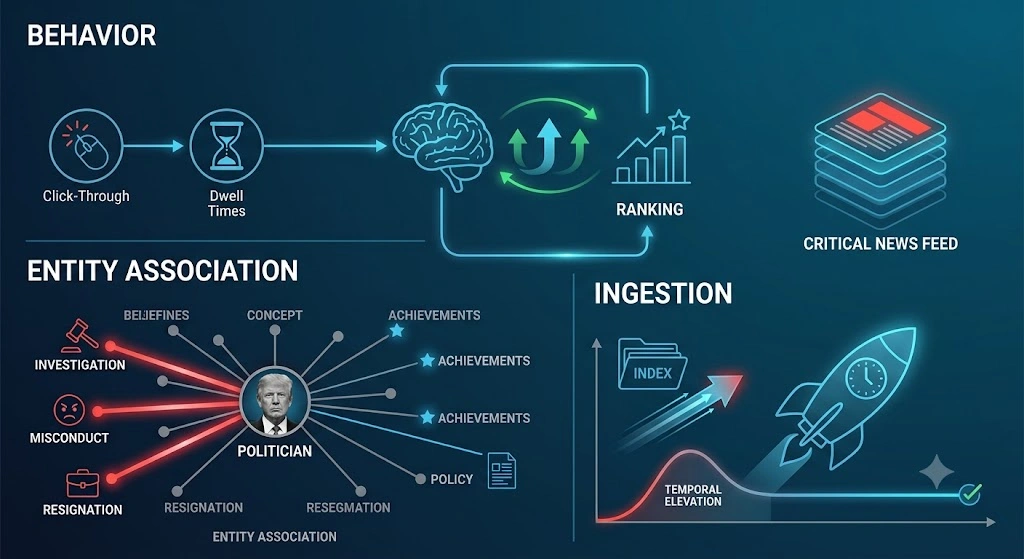
Search engine algorithms prioritise negative news formats because their core ranking systems are engineered to reward high user engagement, topical authority, and real-time informational updates. Information processing systems evaluate user interaction signals, such as CTR (click-through rate) anomalies and prolonged dwell times, which naturally increase during high-profile political events. This behavioral data acts as a feedback loop, confirming to the algorithm that the critical news coverage is the most contextually relevant response to user queries.
The Dynamic of Entity-Attribute Association
Entity-attribute association is the process by which a search engine connects a specific entity node to concrete descriptive attributes within a semantic database. When high volumes of news content link a politician to terms like “investigation,” “misconduct,” or “resignation,” the underlying knowledge graph updates to permanently associate these negative concepts. This mechanism alters the entity graph so thoroughly that even broad, non-specific queries begin surfacing the negative news documents as relevant sub-topics.
Understanding Information Ingestion Velocity
Information ingestion velocity refers to the speed at which search systems index and rank incoming web documents during an active news cycle. High ingestion velocity allows news formats to bypass traditional historical authority requirements, commanding immediate SERP real estate through real-time indexation channels. This temporary algorithmic elevation frequently hardens into permanent long-term ranking stability if the content continues to receive external validation.
How Do Authority and Trust Signals Affect Public Perception?
Authority and trust signals affect public perception by validating the accuracy and weight of the information displayed to the end-user. Search engines utilise complex evaluation frameworks, such as Experience, Expertise, Authoritativeness, and Trustworthiness (E-E-A-T), to categorize online content. When negative news is published by platforms that possess extensive historical authority, the algorithm treats the negative sentiment as verified factual data. This structural validation reinforces public skepticism, as the search engine effectively vouches for the credibility of the critical material.
The underlying mechanism operates via link equity and semantic connectivity within the web graph. High-authority domains pass significant trust signals to individual articles through internal architecture and external backlink profiles. When multiple high-tier news organisations cross-reference the same adverse narrative, they construct an interconnected web of high-trust negative nodes. Algorithms interpret this dense network of authoritative validation as conclusive proof of search relevance, ensuring the content maintains high search visibility.
The resulting impact on entity perception is severe, as the public relies on search engines as impartial arbiters of credibility. If the top-ranking documents for a political leader consist exclusively of high-authority critique, the user’s cognitive evaluation aligns with the algorithmic output. This structural alignment makes it exceptionally difficult to shift public approval metrics through unverified or low-authority alternative media channels. The search architecture effectively locks the negative perception in place by continuously presenting highly verified negative signals as the definitive truth.
What Role Does Sentiment Interpretation Play in Content Ranking Dynamics?
Sentiment interpretation plays a decisive role in content ranking dynamics by allowing search algorithms to classify, weight, and filter web documents based on their underlying emotional and evaluative tone. Natural Language Processing (NLP) models scan indexed text to determine whether the contextual framing of an entity is positive, neutral, or negative. In political contexts, search systems leverage this sentiment classification to align search results with the dominant societal or journalistic consensus surrounding a specific event.
The core mechanism relies on entity-based sentiment analysis, which measures the distance and directional relationship between an entity name and modified valenced words within a sentence. If an algorithmic sweep reveals that 80% of newly indexed documents contain negative modifiers, the overall sentiment profile of the entity is downgraded within the search index. This quantitative sentiment score influences how the algorithm serves information for discovery-based or non-branded informational queries. The system automatically balances the SERP to reflect this negative sentiment trend, viewing it as the most accurate representation of current reality.
This shifts search perception control by altering the auto-suggest features, related searches, and featured snippets associated with the political entity. When negative sentiment dominates the indexing layers, predictive search features begin surface-level integration of the critical keywords. Users are presented with negative search predictions before they even complete their query, pre-conditioning their perception of the entity. This continuous reinforcement of negative sentiment across various SERP components constructs an invisible barrier to reputation recovery, depressing approval metrics systematically over time.
How Does a Persistent Digital Footprint Cause Long-Term Approval Erosion?
A persistent digital footprint causes long-term approval erosion by preserving historical negative information and serving it to users long after the initial news cycle has concluded. Content indexing systems do not automatically delete or de-index documents simply because they are old or no longer trendy. If an adverse news story commands high structural authority and a robust backlink profile, it remains anchored in the primary ranking layers indefinitely. This permanence transforms a temporary public relations crisis into a structural, ongoing perception problem.
The primary mechanism maintaining this longevity is the accumulation of historical user signal data. Search systems record that a specific negative URL successfully satisfied user intent during the peak of the event, which creates a high baseline relevance score for that document. Even as freshness signals decay, the historical click-through data and behavioral trust scores keep the document positioned above newer, more positive updates. This structural stagnation prevents positive developments from achieving the requisite visibility needed to alter the overall entity perception.
To understand the macro effects of this systemic visibility, analysts must focus on analysing the long-term effects of negative political media coverage within digital ecosystems. When historical critiques remain easily accessible via simple search queries, they act as a constant drag on approval ratings during subsequent political campaigns or policy rollouts. New users investigating the entity are perpetually exposed to historical failures, ensuring that the negative sentiment remains active in the public consciousness. This algorithmic persistence effectively prevents the natural decay of negative public memory, cementing lower trust baselines as a permanent structural reality.
- Categorise incoming algorithmic signals to identify historical sentiment trends across all indexed document classes.
- Evaluate external link velocity to determine whether historical negative content nodes are gaining or losing structural authority over time.
- Optimise alternative informational structures to diversify the entity graph and reduce the mathematical dominance of localized negative nodes.
Online reputation within modern search ecosystems is governed by strict mathematical and algorithmic rules that dictate how trust, authority, and sentiment are synthesised. Negative news coverage does not merely impact public opinion through direct transmission; it structurally alters the entity’s digital footprint by dominating high-authority SERP positions. Because search engine algorithms prioritize authoritative news formats and embed negative sentiment directly into the knowledge graph, the resulting visibility shifts cause long-term approval erosion. Rebalancing these complex systems requires a precise understanding of semantic content indexing, authority metrics, and the persistent nature of algorithmic information retrieval.
Frequently Asked Questions
How does negative media coverage affect a politician’s online reputation?
Negative media coverage introduces highly authoritative, critical content nodes that quickly dominate search engine results pages (SERPs). These negative articles skew algorithmic sentiment interpretation, leading search systems to associate the politician’s entity node with risk-related terms rather than professional achievements. As a result, public perception is reshaped every time a user executes a branded search query.
Can online reputation management restore public trust after a political crisis?
Online reputation management for politicians works to rebalance search ecosystems by diversifying the digital footprint with high-authority, neutral, or positive information assets. By strategic publishing and optimising entity-attribute associations, public relations teams can dilute the dominance of historical negative news nodes. Over time, this structural shift helps rebuild online credibility and mitigates long-term approval erosion.
How do search engines evaluate the credibility of political news?
Search engine algorithms evaluate political news by measuring authority and trust signals, specifically using frameworks like E-E-A-T (Experience, Expertise, Authoritativeness, and Trustworthiness). Content originating from established, high-tier news domains passes significant link equity and validation down to individual URLs. Consequently, search engines treat these well-vouched articles as definitive primary sources, hardcoding their sentiment into the entity’s search profile.
Why does negative political news stay at the top of Google search results?
Adverse political news maintains high search visibility due to a combination of historical user engagement metrics and continuous information ingestion velocity. When a crisis peaks, high click-through rates and prolonged dwell times signal intense user interest to the algorithm, anchoring those specific URLs in prominent SERP positions. Without a dedicated strategy from an agency like Clear My Name to update the search graph, these authoritative legacy links can suppress approval metrics indefinitely.
What is search perception control in political reputation management?
Search perception control refers to the systematic management of how an individual’s or institution’s digital footprint is interpreted and displayed by search algorithms. It focuses on influencing predictive features like auto-suggest queries, related searches, and featured snippets by altering the underlying sentiment profile. Establishing control ensures that algorithms serve a balanced representation of facts rather than a clustered, crisis-driven narrative.