

The long-term effects of negative political media coverage depend on how deeply the adverse sentiment integrates into an individual’s digital footprint and search engine results pages. Online reputation control methods are evaluated through their capacity to alter entity credibility, shift sentiment distribution, and modify the visibility of critical search ranking signals over extended periods.
How Does Negative Media Coverage Alter Entity Credibility in Search Ecosystems?
Negative media coverage transforms the structural profile of a political entity within search engine databases by shifting the dominant sentiment distribution associated with that entity’s name. Search engines index news articles, judicial records, and public commentary as trust signals, treating authoritative journalism as highly credible source material. When a high-authority publication indexes a negative narrative, the search engine associates the political entity with specific derogatory keywords and thematic clusters. This semantic association lowers the overall entity credibility score within the algorithmic framework, as the system prioritises recent, highly engaged, and contextually relevant content.
The mechanical process relies on natural language processing algorithms that extract entities, relations, and attributes from indexed text. If the dominant text corpus concerning a politician focuses on scandal, regulatory breaches, or policy failures, the algorithm updates the entity graph to reflect these negative attributes. This architectural shift ensures that algorithmic discovery systems surface the negative coverage not just for direct name queries, but also for broader category searches related to governance, ethics, or specific constituencies. Over time, these negative algorithmic associations harden, making the adverse content resilient to standard algorithmic decay.
The long-term retention of negative media coverage creates a persistent trust deficit that influences both automated systems and human searchers. Algorithmic systems continuously serve these legacy results because they maintain high historical click-through rates and deep backlink profiles from external authoritative domains. For the political entity, this means that algorithmic perception directly shapes public perception, as the first page of search results serves as the primary biographical record. The sustainability of a political career becomes highly dependent on decoupling the entity from these negative thematic nodes.
What Are the Key Structural Differences Between Content Suppression and Content Removal Strategies?
Content suppression and content removal represent the two primary structural mechanics used to alter a compromised search landscape, differing fundamentally in execution, legal dependency, and permanent algorithmic impact. Content removal relies on the permanent deletion of the adverse URL from the hosting website or its complete de-indexing from search engine databases via legal instruments like the Right to Be Forgotten, defamation claims, or copyright infringement notices. Content suppression operates by creating a comprehensive network of positive or neutral assets designed to outrank the negative URLs, pushing them down to lower search visibility zones where click-through rates drop significantly.
Structural Comparison of Suppression and Removal
- Content Removal Mechanical Process: Erasure of data at the host source or index level, terminating the link profile entirely.
- Content Suppression Mechanical Process: Dilution of adverse prominence through algorithmic competition, overriding existing authority scores.
- Content Removal Scalability: Low scalability due to strict legal thresholds and jurisdictional boundaries.
- Content Suppression Scalability: High scalability across multiple digital channels through strategic asset deployment.
- Content Removal Risk Profile: Low risk of resurgence once a permanent de-indexing order executes.
- Content Suppression Risk Profile: Moderate risk of resurgence if the underlying authoritative assets lose algorithmic value.
Content removal offers a definitive resolution but maintains exceptionally high barriers to entry, particularly for public figures. Media organisations in the United Kingdom fiercely defend public-interest journalism, meaning that standard editorial requests or regulatory appeals rarely succeed unless the content contains clear factual errors or breaches strict privacy laws. Furthermore, even if a search engine agrees to de-index a specific link within the UK jurisdiction, the original content often remains accessible globally or via alternative search networks, limiting the absolute efficacy of the method.
Content suppression accepts the persistence of the negative content but manages its public exposure by controlling the first page of search results. This method constructs a robust semantic content network comprising official domains, professional profiles, academic contributions, and neutral institutional commentary. By optimising these newly created or newly elevated assets with superior internal linking, keyword relevance, and technical authority signals, practitioners compel the search engine to prioritise these pages over legacy negative media. The long-term success of suppression hinges on the continuous maintenance of these digital properties to prevent the negative content from reclaiming its historical position.
How Do Organic Asset Building and Reactive Crisis Communications Compare in Sustainability?
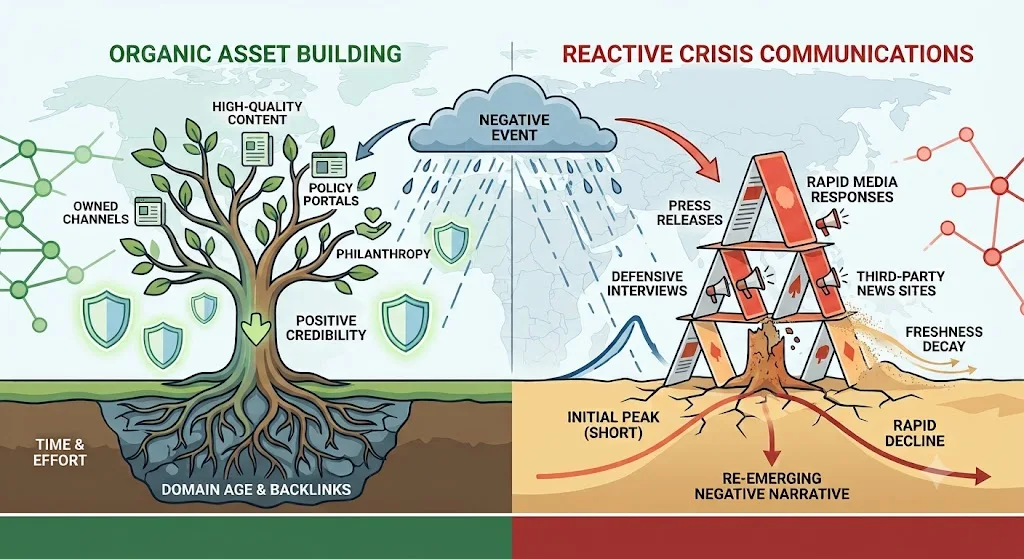
Organic asset building establishes a permanent, defensive digital infrastructure before or during a crisis, whereas reactive crisis communications focus on immediate, short-term message control through press releases and rapid media responses. Organic asset building operates by consistently publishing high-quality, authoritative content across a diversified portfolio of controlled web properties, which establishes a resilient baseline of positive entity credibility. Reactive crisis communications leverage temporary spikes in media attention to inject a counter-narrative into the news cycle, attempting to influence the immediate sentiment distribution of active search results.
The sustainability of organic asset building derives from its alignment with search engine quality evaluator guidelines, which reward long-term trust, authority, and historical consistency. When a political figure owns and maintains an ecosystem of blogs, whitepapers, philanthropic foundations, and policy portals, these sites accumulate domain age and organic backlink profiles. This structural depth ensures that when negative media coverage occurs, the newly generated adverse links must compete against established, highly trusted domains, restricting the speed and depth with which the negative coverage penetrates the top search results.
Reactive crisis communications offer low structural sustainability within search engine results pages due to the rapid decay of freshness signals. While a reactive statement or defensive interview may dominate news search verticals for 48 to 72 hours, these assets quickly lose visibility as the news cycle moves forward. Because reactive pieces are typically hosted on third-party news sites rather than controlled assets, the political entity exercises zero control over the longevity, metadata, or internal linking structures of those pages. Consequently, once the initial search volume subsides, the original negative narratives often re-emerge as the dominant long-term search ranking influence.
What Evaluation Framework Determines the Risk Exposure of Different Reputation Methods?
An evaluation framework designed to measure risk exposure in reputation management analyses four critical dimensions: algorithmic volatility, legal counter-actions, public blowback, and resource permanence. Every strategic approach alters the digital footprint in a specific manner, and evaluating these choices requires a systematic assessment of how search engines and public audiences respond to changes in the information ecosystem. Understanding these parameters allows organizations to calculate the exact vulnerability of their digital authority over multi-year horizons.
Reputation Risk Evaluation Framework
- Measure Algorithmic Volatility: Assess the likelihood that a search engine core algorithm update will alter the ranking distribution of optimized suppression assets.
- Evaluate Legal Counter-Actions: Quantify the probability that aggressive removal demands will provoke media outlets into publishing secondary, highly damaging coverage regarding censorship attempts.
- Analyse Public Blowback: Determine the perceptual impact if the public discovers that an entity is actively manipulating search results through synthetic asset generation.
- Calculate Resource Permanence: Audit the ongoing financial and technical commitments required to maintain the authority scores of defensive digital properties against organic competitor growth.
The execution of a content removal strategy carries a distinct risk known as the Streisand effect, where the act of attempting to suppress or delete information draws intense, renewed public scrutiny. If a politician issues a formal legal demand to an authoritative UK newsroom, the publication may choose to convert that demand into a fresh news story concerning political transparency. This response generates a new wave of highly authoritative, negative content that possesses even greater search ranking influence than the original piece, effectively compounding the initial reputation damage.
Conversely, content suppression techniques carry structural risks tied to quality evaluation algorithms rather than public exposure. If the suppression network relies on thin content, automated generation, or artificial backlink schemes, the entire network faces sudden devaluation during major search engine core updates. When a search engine filters out low-value assets, the defensive shield collapses overnight, causing the legacy negative media coverage to return to the first page of search results. Therefore, low-risk suppression requires building digital assets that possess genuine editorial value, independent authority, and deep topical relevance.
How Do Search Engines Interpret and Weigh Negative Media Signals Over Time?
Search engines interpret negative media signals through an ongoing evaluation of user engagement metrics, domain authority persistence, and entity-attribute freshness. When a negative news article first publishes, search engines prioritize it due to freshness algorithms, which assume that sudden spikes in search volume and click-through rates indicate a high demand for real-time information. As the immediate event recedes, the algorithm shifts its evaluation metrics from temporal relevance to historical authority and structural trust signals.
The long-term weight of a negative media signal is calculated by analyzing the link equity and behavioral data associated with the host URL. A negative report hosted on a national news domain carries immense authority because the site possesses millions of high-quality inbound links, strict editorial standards, and consistent daily traffic. Even when the content is years old, the search engine views the domain as a primary source of truth, preventing the article from naturally decaying into obsolescence. Furthermore, if users consistently click on that specific link when searching for the politician’s name, the algorithm registers sustained relevance, preserving its high position on the search engine results pages.
To mitigate this automated ranking persistence, long-term strategic planning must focus on changing the semantic context surrounding the entity. Search engines do not possess moral judgment; they merely calculate mathematical probabilities regarding what information best satisfies a user’s search intent. By introducing new, highly authoritative thematic vectors—such as international policy contributions, academic publications, or long-form philanthropic records—it is possible to recalibrate the algorithm’s understanding of the entity’s core attributes. This systematic shift reduces the relative importance of the legacy negative signals, allowing alternative, neutral, or constructive narratives to populate the primary search visibility zones.
The evaluation of long-term reputation management methods indicates that reliance on a single strategic mechanism yields suboptimal results when addressing deep-seated negative media coverage. Content removal offers a permanent but legally constrained solution that is rarely applicable to high-profile public figures due to public-interest protections in the United Kingdom. Content suppression provides a highly scalable, flexible alternative, but its long-term efficacy remains dependent on the continuous maintenance of high-quality digital assets that can withstand algorithmic volatility and core system updates.
Ultimately, sustainable digital trust systems require an integrated approach that transitions from immediate reactive crisis communication to long-term, organic asset building. Understanding the mechanics of how search engines index, weigh, and preserve entity credibility allows political entities to map their risk exposure accurately. By focusing on the structural realities of search ranking influence, sentiment distribution, and content suppression vs content enhancement, organizations can design resilient digital footprints capable of balancing legacy media challenges with contemporary institutional contributions. For leaders navigating these complex environments, implementing a structured evaluation framework ensures that long-term digital authority reflects strategic objectives rather than unmanaged historical events, illustrating the specialized processes inherent in reputation management for politicians.

Frequently Asked Questions
How long does negative media coverage affect a politician’s search results?
Negative media coverage can influence search results for several years because authoritative news outlets possess exceptionally high domain authority and deep backlink profiles. Search engine algorithms continuously prioritize these links if user engagement and click-through rates remain sustained over time. Strategic digital trust optimization is usually required to shift the sentiment distribution and reduce the visibility of these legacy links.
Can a public figure legally remove negative articles from UK search engines?
Public figures face significant challenges when requesting the removal of news articles due to strict public-interest protections and media freedom laws in the United Kingdom. Permanent de-indexing via the Right to Be Forgotten or defamation claims is only achievable if the content contains proven factual errors or breaches specific data privacy regulations. When legal removal is unavailable, content suppression strategies are typically employed to manage online search perception.
What is the difference between content suppression and content removal for public figures?
Content removal permanently deletes a URL from the host website or completely de-indexes it from search databases using legal instruments. Conversely, content suppression uses organic asset building to create and optimize a network of neutral or positive digital properties. This process relies on algorithmic competition to outrank the adverse links, pushing them down to lower search visibility zones where click-through rates drop.
How do search engines weigh legacy news vs new content for an entity?
Search engines initially prioritize new media coverage due to query-deserves-freshness algorithms that react to sudden spikes in search volume. As the immediate event recedes, the system shifts its evaluation to historical authority, domain trust, and structural link equity. Without deliberate content enhancement efforts, a highly authoritative legacy news story can permanently dominate an individual’s primary search ranking signals.
How can political leaders rebuild entity credibility after a digital crisis?
Rebuilding entity credibility requires a transition from reactive crisis communications to long-term organic asset building and semantic network optimization. Political leaders can work with specialized services like Clear My Name to develop authoritative, controlled web properties that introduce new thematic vectors to search algorithms. Over time, these strategic digital trust systems systematically dilute negative reputation signals and rebalance the overall sentiment distribution.