

Online reputation refers to the digital consensus of an entity’s character, credibility, and history as constructed by algorithmic aggregation and public content within search ecosystems. When an individual’s name is processed through a search engine, the resulting data retrieval does not merely present isolated documents; it builds a structured narrative that serves as a proxy for real-world identity. This digital proxy directly dictates how external observers evaluate trustworthiness, authority, and risk before any physical interaction occurs.
In modern information systems, search results function as the primary definitive record for personal and corporate validation. Search engines use complex information retrieval frameworks to match queries with indexed documents, evaluating the structural relevance and perceived authority of data assets. Consequently, what appears on the search engine results page (SERP) is the direct consequence of how algorithmic systems interpret, categorise, and rank the digital footprint left by or associated with an individual.
How Do Search Engines Construct Personal Search Results?
Search engines construct personal search results by discovering, indexing, and evaluating digital assets that map directly to an individual as a unique entity. This process relies heavily on entity resolution, a data-management stage where algorithms determine whether different pieces of web data relate to the same person. The system analyses unique identifiers such as professional titles, geographical locations, academic history, and corporate affiliations to link disparate URLs to a single identity graph.
Once the algorithmic framework connects the data points to the specific entity, it evaluates content indexing signals to determine the arrangement of the SERP. The system prioritises web pages that display high levels of topical authority, structural integrity, and explicit naming conventions within the URL, title tags, and headings. Social media profiles, corporate biographies, and public registries frequently secure top positions because search engines recognise these platforms as highly authoritative sources for identity verification.
The final arrangement of these results relies on ongoing algorithmic calculations regarding relevance and user engagement signals. If search users consistently interact with a specific link when searching a name, the engine interprets this behavior as a signal of intent satisfaction, thereby reinforcing that link’s visibility. Therefore, the search engine does not evaluate the moral or subjective quality of the information, but rather calculates the statistical probability that a specific document correctly represents the entity being queried.
What Role Do Authority and Trust Signals Play in Search Visibility?
Authority and trust signals determine the stability, ranking prominence, and persistence of specific links within an individual’s search landscape. Search engines operate on sophisticated quality evaluation frameworks, such as Google’s Experience, Expertise, Authoritativeness, and Trustworthiness (E-E-A-T) guidelines, to assess the validity of indexed material. Within search ecosystems, trust acts as the primary metric, meaning that content hosted on domains with established institutional credibility automatically supersedes unverified, user-generated content.
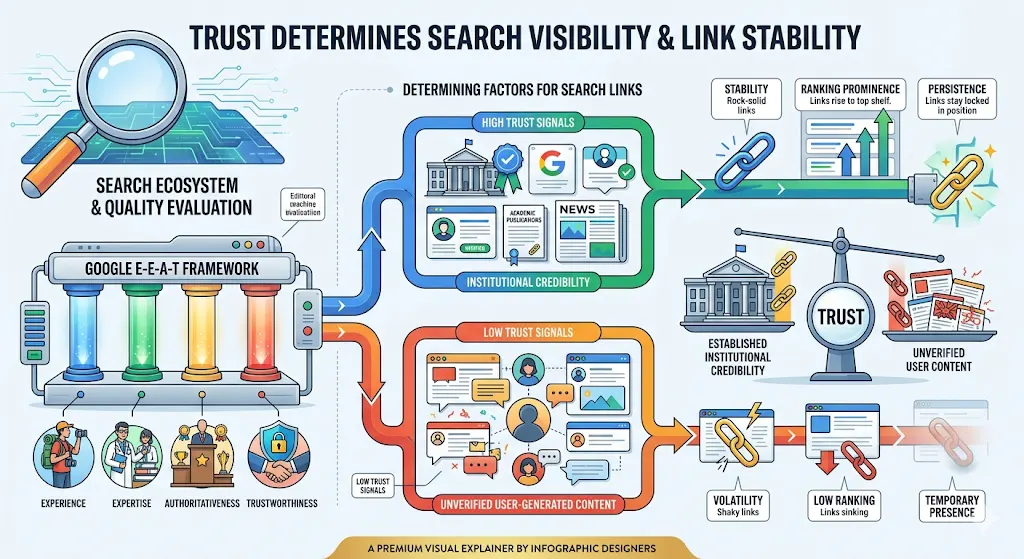
The mechanism governing this hierarchy relies on link equity and domain authority. A publication on a national news outlet, a government registry, or an accredited academic database carries substantial algorithmic weight due to the extensive backlink profile and historical trustworthiness of the host domain. When these high-authority platforms publish content containing an individual’s name, the search engine indexes the material as a primary reputation signal that directly influences entity perception.
Lower-authority assets, such as personal blogs, obscure forum contributions, or minor digital directories, fail to compete with these institutional domains because they lack the necessary structural validation. This disparity explains why historical or outdated public records from trusted domains often maintain permanent visibility on the first page of results, even if newer, conflicting information exists elsewhere. The algorithmic preference for verified authority ensures that trust signals remain the primary driver of information hierarchy in search visibility.
How Do Algorithmic Systems Interpret Sentiment and Review Signals?
Algorithmic systems interpret sentiment and review signals by applying natural language processing (NLP) and machine learning models to the text surrounding an entity’s name. These computational frameworks break down phrases into semantic tokens to evaluate the emotional and contextual polarity of user-generated content, professional reviews, and digital commentary. Through this analysis, search engines extract qualitative sentiment from unstructured text, transforming public feedback into structured reputation data.
The mechanism operates by identifying semantic clusters and entities associated with risk, customer dissatisfaction, or professional misconduct. When an individual or their associated business receives a concentration of third-party reviews, algorithms monitor the volume, frequency, and lexical patterns of those entries. A sudden influx of negative terminology triggers algorithmic alerts that can alter how the search engine displays summary snippets, knowledge panels, and review extensions directly on the SERP.
Furthermore, prominent review platforms possess high intrinsic search visibility, meaning their internal data feeds directly into the primary SERP evaluation. Search engines synthesise these signals to assess the overall risk profile of the entity, often adjusting the visibility of specific links based on the prevailing sentiment trend. This automatic data processing creates a feedback loop where sentiment directly alters content indexing prominence, ensuring that public perception aligns closely with algorithmic ranking outputs.
How Do Negative Search Results Influence Professional Opportunities?
How negative search results influence professional opportunities is defined by the systematic risk aversion embedded within corporate recruitment, institutional vetting, and commercial procurement processes. When decision-makers encounter adverse information during a standard background search, the digital asset serves as a primary risk indicator that influences institutional perception. This algorithmic and manual evaluation alters the trajectory of professional advancement before any formal interview or validation takes place.
The underlying mechanism operates through the following structured channels within the digital ecosystem:
- Reduces candidate viability metrics during preliminary digital vetting. Corporate compliance algorithms and human resource professionals filter out candidates whose named search queries return legal notices, regulatory reprimands, or severe public controversy.
- Diminishes institutional trust during capital acquisition or partnership evaluations. Financial institutions and venture partners cross-reference executive names against compliance databases and public SERPs to calculate liability thresholds before approving credit lines or investment terms.
- Degrades professional authority within peer and client networks. Prospective clients searching for specialised consultants or legal representatives select alternative options if the primary search results contain unverified allegations, poor sentiment signals, or historical disputes.
- Triggers automated compliance filters within global background screening software. Automated risk-management tools scrape the indexable web for negative keywords linked to an individual’s name, generating negative risk scores that halt application progression.
The persistence of these adverse links forces a continuous devaluation of personal brand equity. Because search engine algorithms prioritise engagement and authority, negative assets from prominent domains remain visible indefinitely, continuously exerting downward pressure on professional viability. Consequently, the systemic layout of information on the SERP directly controls economic and professional mobility within the modern market.
How Does a Digital Footprint Affect Long-Term Entity Perception?
A digital footprint affects long-term entity perception by acting as a permanent, searchable archive that shapes the historical consensus of an individual’s identity. Every piece of indexable data—ranging from corporate registries and historical press releases to social media comments and digital images—contributes to a cumulative record. Over time, search engines synthesise this data archive to construct semantic relationships, defining the permanent context in which an entity is understood by automated systems and human researchers alike.
The primary mechanism governing long-term perception is the permanence of digital indexing. Unlike traditional media, which naturally fades from public consciousness, digital content remains accessible as long as the hosting domain is maintained and crawled by search spiders. If an individual fails to manage the composition of this archive, historical data points continue to dictate current search visibility, regardless of whether the information reflects the individual’s present professional status or personal character.
Moreover, as search engines evolve toward semantic search models, they increasingly focus on understanding the connections between entities rather than merely matching keywords. This means that a digital footprint creates an interlocking web of associations that defines an individual’s institutional category, professional associations, and past liabilities. Once these semantic bonds are codified within a search engine’s database, altering the established entity perception requires a comprehensive, sustained introduction of new, highly authoritative digital assets.
Summary of Search Perception Metrics
The following structural matrix defines the primary technical components that search engines calculate when rendering an individual’s online reputation landscape:
| Technical Component | Core Mechanism | Direct Impact on SERP Perception |
| Entity Resolution | Cross-references unique biographical identifiers across multiple domains. | Groups disparate links into a singular, unified identity graph for the individual. |
| Domain Authority | Measures the backlink equity and trustworthiness of hosting platforms. | Determines the permanent ranking height and stability of specific search results. |
| Sentiment Extraction | Employs natural language processing to evaluate textual polarity. | Translates public commentary and reviews into structured risk indicators. |
| Semantic Association | Establishes permanent contextual links between distinct entities. | Defines the long-term industry categorisation and professional alignment of the individual. |
The architecture of an online reputation is entirely dependent on the structural dynamics of search engine ecosystems. What appears when an individual’s name is searched is the calculated output of entity resolution, trust evaluation, and sentiment analysis. These automated processes create a digital proxy that dictates professional visibility, economic access, and long-term institutional trust. Because search systems prioritise domain authority and established data relationships, a digital footprint remains the definitive standard for public and corporate evaluation, making the understanding of search mechanics essential for navigating modern professional landscapes.
Anchor text used for MOFU: How negative search results influence professional opportunities
Frequently Asked Questions
What appears when someone searches my name online?
When someone searches your name, Google displays indexed pages, social profiles, news articles, and review listings that form your online reputation. Reputation Management services help analyse and improve what appears, while Clear My Name focuses specifically on removing harmful content from search results.
How do negative search results affect job opportunities?
Negative search results can reduce hiring chances because recruiters often review candidate search profiles before interviews. Research shows that harmful content lowers perceived credibility and may disqualify candidates during initial screening stages.
Can I remove negative information from Google search results?
Yes, you can remove negative information by requesting deletion from the source website or using legal removal pathways. Clear My Name specialises in negotiating removals and submitting removal requests to search engines for eligible content.
How long does negative content stay visible in search results?
Negative content remains visible until it is removed from the source website or deindexed by search engines, which can take months or years without intervention. Reputation Management strategies accelerate deindexing through content suppression and negative signal reduction.
What is the difference between reputation management and name removal services?
Reputation Management focuses on improving overall search perception through content creation and signal optimisation, while name removal services focus on eliminating harmful content. Clear My Name combines both approaches by removing negative results and deploying positive content to improve search visibility.