

Off-topic and irrelevant reviews can distort a rating by introducing feedback that does not accurately represent the experience associated with a business, product or service. Reputation management is the process of understanding, monitoring and influencing how an entity is represented across digital information systems, while online reputation refers to the collective perception created by content, reviews, rankings and other reputation signals.
How Do Off-Topic Reviews Affect Your Overall Rating?
Off-topic reviews affect an overall rating by adding signals that are unrelated to the experience the review platform is designed to measure. A rating represents an aggregated interpretation of individual review scores, so irrelevant contributions can alter the numerical result even when they provide no meaningful evidence about service quality. Review systems process ratings as structured information alongside written content, reviewer activity and other contextual signals. When unrelated feedback becomes part of the review dataset, the resulting score becomes less representative of the entity being evaluated. This creates a distinction between the numerical rating and the actual relevance of the underlying review evidence.
Online reputation refers to the information environment through which an entity is evaluated across search engines and digital platforms. Reviews form part of this environment because they provide publicly accessible signals about customer experiences and perceived quality. An off-topic review introduces information that belongs outside the defined subject of the review profile. The resulting reputation signal therefore contains information with weaker topical relevance. This affects how users interpret the rating because the visible score no longer represents a consistent category of experience.
Why Does Review Relevance Matter to Reputation Signals?
Review relevance matters because reputation signals gain meaning from their relationship to the entity, service and experience being evaluated. A relevant review describes an interaction that falls within the expected scope of the business or service. An irrelevant review introduces information associated with a different subject, transaction, person or issue. Search ecosystems evaluate content through contextual relationships, meaning relevance helps determine whether information contributes useful evidence about an entity. Review relevance therefore forms part of the wider credibility structure surrounding online reputation.
Content indexing also depends on how information is associated with identifiable entities and topics. Search engines organise indexed information through relationships between entities, concepts, keywords and sources. Reviews can contribute to these relationships when their content clearly relates to the entity receiving the review. Off-topic content weakens topical consistency because its subject does not align with the entity or service being evaluated. This distinction becomes important when users encounter reviews through search results rather than directly through a review platform.
How Do Search Engines Interpret Review Content?
Search engines interpret review content by analysing textual relevance, entities, context, sentiment and relationships between pieces of information. A review is not simply a numerical score; its written content provides additional information about the subject being discussed. Natural language processing helps systems identify topics, entities and sentiment within review text. These signals contribute to the broader understanding of what a page or profile represents. Search algorithms then evaluate this information alongside authority, relevance and other ranking factors.
Sentiment interpretation also depends on the context in which an opinion is expressed. A negative statement about an unrelated issue does not provide the same evidential value as negative feedback about the actual service being reviewed. For example, criticism concerning a business’s parking availability has a different topical relationship from criticism concerning the quality of the service itself. Both statements contain negative sentiment, but their relevance to the entity’s core service differs. Reputation analysis therefore requires separation between sentiment strength and topical relevance.
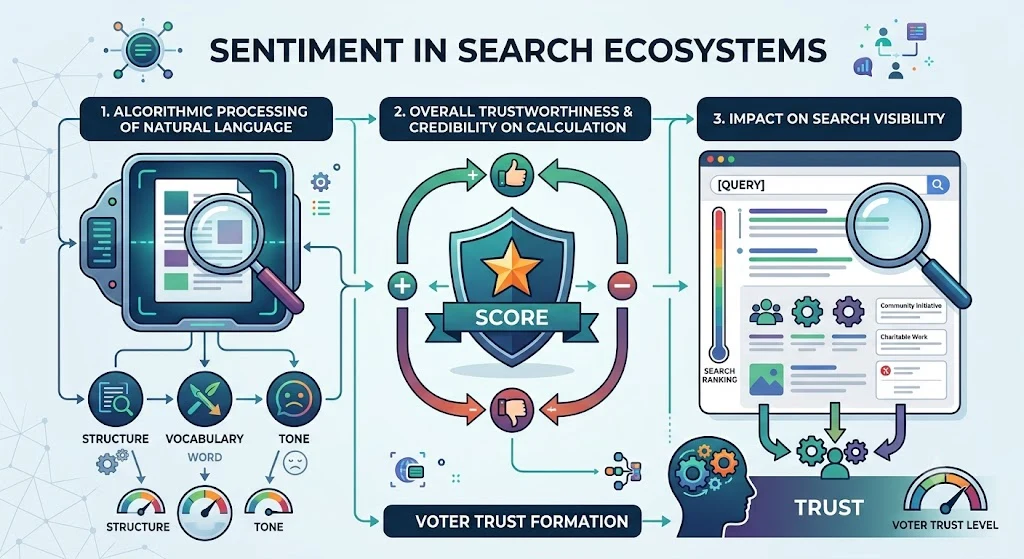
Can Irrelevant Reviews Lower a Business Rating?

Irrelevant reviews can lower a rating when their numerical scores are included in the aggregate calculation. The effect depends on the number of reviews, the existing rating distribution and the score assigned by the irrelevant review. A single low score has a measurable mathematical effect because aggregate ratings combine individual review values. The reputational significance of that change depends on the existing review profile and the visibility of the rating. The numerical effect therefore operates independently from whether the written review provides useful evidence about the business.
Rating systems represent structured reputation signals rather than complete measures of organisational quality. A high rating generally indicates a positive pattern within the available review data, while a lower rating indicates a different aggregate pattern. When irrelevant reviews enter the dataset, the mathematical representation becomes less closely aligned with the intended subject. This creates a distinction between rating accuracy and rating visibility. Users then interpret the visible number without necessarily understanding the relevance of every underlying contribution.
How Do Reviews Influence Search Perception?
Reviews influence search perception by providing publicly visible evidence that users associate with an entity. Search perception refers to the way an entity is understood when users encounter information about it through search results, review platforms and other digital sources. A review profile containing consistent and relevant information provides a clearer representation of the entity. A profile containing unrelated or contradictory information introduces additional interpretative complexity. This complexity affects how users evaluate credibility when comparing search results.
Search engine results pages, or SERPs, bring different reputation signals together in a single information environment. Users can encounter review scores, review excerpts, business information, articles, social profiles and other indexed content during the same search journey. Each result contributes to the overall perception of the entity. Review content therefore operates as part of a wider reputation ecosystem rather than as an isolated numerical measurement. The relevance and consistency of that content influence how clearly the entity is represented across the SERP.
What Is the Difference Between a Negative Review and an Irrelevant Review?
A negative review expresses dissatisfaction with a relevant experience, while an irrelevant review discusses an issue outside the legitimate scope of the review profile. The distinction is based on topical relevance rather than sentiment. A negative review can still provide useful information when it concerns the service, transaction or experience associated with the entity. An irrelevant review lacks that connection even when its language appears credible or detailed. Reputation analysis therefore separates the question of whether content is negative from whether it is relevant.
This distinction is important because negative sentiment alone does not establish that a review is inappropriate. Review ecosystems require mechanisms for distinguishing legitimate criticism from content that does not relate to the subject being reviewed. Relevance provides one of the key contextual dimensions in this evaluation. A review can therefore be negative and relevant, positive and irrelevant, or both negative and irrelevant. These categories produce different implications for reputation signals and content evaluation.
How Does Review Content Affect Entity Perception?
Review content affects entity perception by connecting descriptive information and sentiment with an identifiable business or organisation. Entity perception refers to the way search systems and users understand an entity based on the information associated with it. Consistent reviews reinforce a coherent representation of the entity, while unrelated content introduces additional associations. These associations can influence how users interpret the entity when reviewing search results. The effect becomes more significant when review content is highly visible or repeatedly encountered.
Authority and trust signals also operate within this broader entity framework. Search systems evaluate information according to factors such as relevance, source quality, consistency and contextual relationships. Reviews represent one type of user-generated information within this ecosystem. Their influence depends on how they relate to the entity and how they appear alongside other authoritative sources. A reputation profile therefore gains strength from informational consistency rather than from rating volume alone.
Dive Deeper With Our Expert Guides:
Why Duplicate Business Listings Split and Bury Your Reviews
How Extortion Scams Use Negative Google Reviews as Leverage
Why Can Off-Topic Reviews Create Reputation Risk?
Off-topic reviews create reputation risk because they introduce information that can alter both numerical ratings and qualitative perception. Reputation risk refers to the possibility that inaccurate, misleading or poorly contextualised information changes how an entity is evaluated. An irrelevant review can affect the visible rating while simultaneously introducing unrelated terminology into the entity’s information environment. Search users can encounter this information without knowing that it falls outside the intended subject of the review profile. The resulting perception can therefore differ from the evidence represented by relevant reviews.
Content ranking dynamics increase the importance of visibility within this process. A review that appears prominently in a platform profile, search result or review excerpt receives greater exposure than content that remains difficult to find. Visibility does not establish factual accuracy, but it determines how frequently users encounter a particular reputation signal. This creates a relationship between content relevance, indexing and search perception. Reputation analysis consequently considers both what information says and how prominently that information is presented.
How Are Policy-Violating and Irrelevant Reviews Evaluated?
Policy-violating and irrelevant reviews are evaluated through the rules established by the platform hosting the review content. Review policies define the types of contributions considered relevant, authentic and appropriate for a particular review ecosystem. These policies create an evaluation framework for distinguishing legitimate feedback from content that falls outside permitted subject matter. Relevance is therefore assessed within the specific rules governing the review platform. The interpretation of a review depends on its content, context and relationship to the entity being reviewed.
Understanding off-topic and policy-violating reviews requires separating platform policy from general disagreement with a review. A review does not become irrelevant simply because it is negative or critical. The relevant question is whether the content addresses an experience or subject that falls within the platform’s defined review purpose. This distinction supports more accurate reputation analysis because it prevents legitimate criticism from being confused with unrelated content. Policy evaluation therefore forms part of the wider system through which review credibility is assessed.
How Does Review Relevance Support Accurate Online Reputation?
Review relevance supports accurate online reputation by ensuring that reputation signals remain connected to the subject they represent. Online reputation refers to the cumulative digital information through which users and search systems evaluate an entity. Relevant reviews contribute evidence that relates directly to the expected experience, while irrelevant reviews introduce information outside that boundary. Maintaining topical consistency therefore improves the informational clarity of the review profile. The result is a reputation signal that more accurately reflects the subject being evaluated.
Search perception depends on the quality and consistency of the information available to users. A review profile is one component of this information system, alongside websites, business listings, news content, social profiles and other indexed sources. When these sources consistently describe the same entity, search engines and users receive a clearer information pattern. When unrelated content becomes prominent, the pattern becomes less precise. Review relevance consequently forms part of the broader relationship between content quality, entity understanding and digital credibility.
What Does This Mean for Search Reputation?
Search reputation is the overall perception created when users encounter an entity across search results and connected digital platforms. Off-topic and irrelevant reviews can influence this reputation by changing visible ratings, introducing unrelated sentiment and affecting the information associated with the entity. Their impact is not limited to the review platform because review content can become part of wider search visibility. Search engines process indexed information in relation to entities, topics and contextual signals. Reputation therefore develops through the interaction of multiple sources rather than through a single rating alone.
The central principle is that relevance determines the informational value of a reputation signal. A rating becomes more meaningful when the reviews supporting it relate directly to the experience being measured. Search visibility then determines how widely those signals are encountered, while authority and consistency influence their interpretation. Understanding these relationships provides a clearer framework for analysing online credibility. Off-topic reviews are therefore important because they affect both the numerical representation of reputation and the context in which that reputation is interpreted.
Off-topic and irrelevant reviews can distort ratings by introducing information that does not accurately represent the experience associated with an entity. Their influence extends beyond numerical scores because review content contributes to sentiment interpretation, entity perception, content indexing and search visibility. Reputation management is therefore closely connected to understanding how information is created, categorised and interpreted within digital ecosystems. Relevant review signals provide clearer evidence about an entity, while unrelated content introduces additional noise into the reputation system. Evaluating review relevance alongside rating patterns, authority signals and SERP visibility provides a more accurate understanding of online reputation.
Can off-topic reviews lower your Google rating?
Yes. An off-topic review can lower a Google rating when its score is included in the overall review calculation, even when the written content does not relate to the business or service being reviewed.
What makes a Google review irrelevant?
A Google review is irrelevant when it discusses an issue, person, transaction or subject outside the legitimate scope of the business being reviewed. Relevance depends on whether the content relates to the experience the review profile is intended to measure.
Do irrelevant reviews affect online reputation?
Yes. Irrelevant reviews can affect online reputation by changing visible ratings, introducing unrelated sentiment and adding inconsistent information to an entity’s digital reputation signals.
Can you report an off-topic Google review?
An off-topic review can be reported when it violates the applicable review content policies. The platform evaluates the review based on its content, context and compliance with its policies rather than simply because the review is negative.
How do irrelevant reviews affect search perception?
Irrelevant reviews can influence search perception by adding unrelated ratings, sentiment and content associations to an entity. When review information becomes visible in search results or review profiles, users can interpret it as part of the entity’s overall reputation.