

Duplicate business listings can split reviews across multiple Google Business Profiles, weakening the review signals associated with the correct business entity. When search engines interpret these listings as separate or conflicting entities, review volume, relevance, authority and sentiment become distributed across different profiles.
Reputation management is the process of analysing and influencing how information about an entity is represented across digital and search ecosystems. Online reputation refers to the collective perception created by reviews, business information, published content, authority signals and other digital references associated with an entity. Duplicate listings affect this system because they fragment information that search engines use to evaluate business credibility and relevance.
Why Do Duplicate Business Listings Split Google Reviews?
Duplicate business listings split Google reviews because each listing can function as a separate business entity within Google’s local search system. When customers leave reviews against different profiles representing the same business, the review signals become distributed rather than consolidated around one recognised entity. This creates a fragmented reputation structure in which review volume, sentiment and engagement appear across separate listing records.
A business listing contains identity information such as the business name, address, telephone number, category and location. These attributes help search engines establish relationships between a business and its digital references. When duplicate listings contain overlapping but inconsistent information, entity recognition becomes less coherent. Reviews attached to each profile then contribute to different listing-level signals rather than forming one concentrated reputation signal.
Review distribution also affects how users interpret credibility. A business with 200 reviews on one profile presents a different search signal from a business with 100 reviews divided between two profiles, even when both sets of reviews relate to the same organisation. The fragmentation changes the visible evidence available to users and search systems. Duplicate listings therefore create an information-structure problem rather than simply a review-count problem.
How Does Google Interpret Duplicate Business Listings?
Google interprets business listings through entity information, relevance, location, prominence and other local search signals. A listing represents an entity within Google’s local search ecosystem, while associated reviews provide additional information about customer experiences with that entity. When two listings represent the same business, the system has to determine whether they are genuinely separate entities or duplicate records.
Entity perception depends on relationships between business information and external references. Matching names, addresses, telephone numbers, websites and categories provide evidence that different references relate to the same organisation. Conflicting information introduces ambiguity into this relationship. The resulting entity structure influences how business information and reputation signals are connected.
Duplicate records therefore affect more than the appearance of a Google Business Profile. They can influence how reviews, business attributes and local relevance are associated with the underlying entity. If the system treats duplicate listings independently, the signals attached to one profile do not automatically strengthen another profile. This explains why duplicate listings can create fragmented reputation evidence.
How Do Duplicate Listings Affect Search Visibility?
Duplicate listings can weaken search visibility by dividing relevance and reputation signals between competing business profiles. Search visibility refers to how prominently an entity or its associated content appears for relevant queries. When multiple listings compete to represent the same business, the search ecosystem receives fragmented signals about which profile provides the strongest representation.
Local search evaluation considers the relationship between a query, geographic relevance, business information and prominence. A duplicate listing introduces another record into this evaluation process. If the records contain similar information, they compete for recognition while distributing supporting evidence. If the records contain inconsistent information, the problem extends to entity clarity and information accuracy.

This fragmentation can also affect the visible review profile presented to users. One listing may rank for a query while another contains a larger review history. The profile receiving visibility therefore does not necessarily display the strongest available reputation evidence. The result is a mismatch between the total reputation information available and the reputation information visible in the SERP.
Why Does Review Distribution Matter for Online Reputation?
Review distribution matters because reviews function as reputation signals that communicate customer sentiment, experience and perceived business quality. Search engines process review content alongside business information and other local signals when evaluating an entity. Users also interpret review quantity, recency, rating patterns and written sentiment when assessing credibility. Fragmented reviews therefore reduce the concentration of evidence surrounding the business.
A consolidated review profile creates a clearer information structure. Reviews associated with the correct entity contribute to one visible reputation history rather than being separated between competing records. This makes sentiment patterns easier to interpret and gives users a more complete representation of customer feedback. Review consolidation therefore has an information-quality dimension as well as a visibility dimension.
The distribution of reviews also affects historical reputation signals. A profile containing older reviews may appear weaker if recent customer feedback is attached to another duplicate listing. The business then has multiple reputation timelines instead of one coherent history. Search evaluation becomes more complex because different profiles provide different portions of the available evidence.
How Does Sentiment Influence Duplicate Listing Evaluation?
Sentiment influences duplicate listing evaluation by adding qualitative information to quantitative review signals. A review profile is not defined only by its star rating or total number of reviews. Written feedback contains language that describes customer experiences, satisfaction, dissatisfaction, service quality and recurring themes. Search systems can analyse textual information as part of their broader understanding of a business entity.
When reviews are distributed across duplicate listings, sentiment information becomes fragmented as well. One listing can contain predominantly positive reviews while another contains a mixture of positive and negative feedback. Viewing either profile independently provides an incomplete representation of the overall review environment. This affects both user perception and the interpretation of reputation signals.
Sentiment fragmentation also makes reputation analysis less precise. A business may appear to have inconsistent customer feedback when the apparent inconsistency actually results from reviews being divided between profiles. Consolidating information around the correct entity creates a more accurate representation of the available sentiment evidence. The objective is not to alter genuine customer opinions but to improve the structural accuracy of how those opinions are associated with the business.
What Role Does Entity Recognition Play in Review Consolidation?
Entity recognition establishes which digital references represent the same real-world business. Search engines use identifiable attributes and relationships to distinguish one organisation from another. These relationships connect business listings, websites, directories, reviews and other references to an entity. Accurate entity recognition therefore provides the foundation for coherent reputation signals.
Duplicate listings create ambiguity when two records contain sufficient information to appear independently identifiable while actually referring to the same organisation. Variations in business names, addresses, categories or telephone numbers increase this ambiguity. Even minor differences can affect how references are associated within the search ecosystem. Entity consistency therefore forms an important part of digital reputation management.
A clear entity structure also improves the interpretation of reviews. When reviews are attached to the correct business record, they become part of a more coherent reputation profile. This creates stronger contextual relationships between customer feedback and the business entity. Entity recognition consequently connects review management with broader search visibility and reputation evaluation.
Dive Deeper With Our Expert Guides:
How Extortion Scams Use Negative Google Reviews as Leverage
Why Star Ratings Show Up in Google Search but Not Always Yours
Can Duplicate Listings Bury Positive Reviews?
Duplicate listings can make positive reviews less visible by placing them on a profile that receives limited search exposure. A review does not have equal practical visibility simply because it exists within Google’s review database. The listing displaying the review must itself appear prominently enough for users to encounter the associated reputation evidence.
This creates an important distinction between review existence and review visibility. A business can possess positive customer feedback while still presenting a weaker visible reputation if that feedback is distributed across poorly positioned or duplicate profiles. Search visibility determines which portion of the review history users encounter first. Reputation signals therefore depend on both content and the visibility of the entity carrying that content.
The same principle applies to negative reviews. A duplicate listing can isolate negative feedback from the primary profile, but it can also isolate positive feedback. The objective of accurate listing management is not to selectively hide sentiment. It is to establish a correct entity structure so that genuine reputation information is represented consistently.
How Does Content Indexing Affect Duplicate Listing Reputation?
Content indexing determines whether information associated with a listing is available for retrieval and ranking within search systems. Reviews, business information and associated pages exist within a broader indexed information environment. When duplicate listings create separate records, each record can develop its own search presence and associated content signals.
Indexing does not mean that every piece of information receives equal ranking visibility. Search engines evaluate indexed information according to relevance, authority, query context and other ranking factors. A duplicate listing with fewer supporting signals can remain indexed while receiving limited visibility. Its associated reviews therefore exist but contribute less to the reputation information encountered through prominent search results.
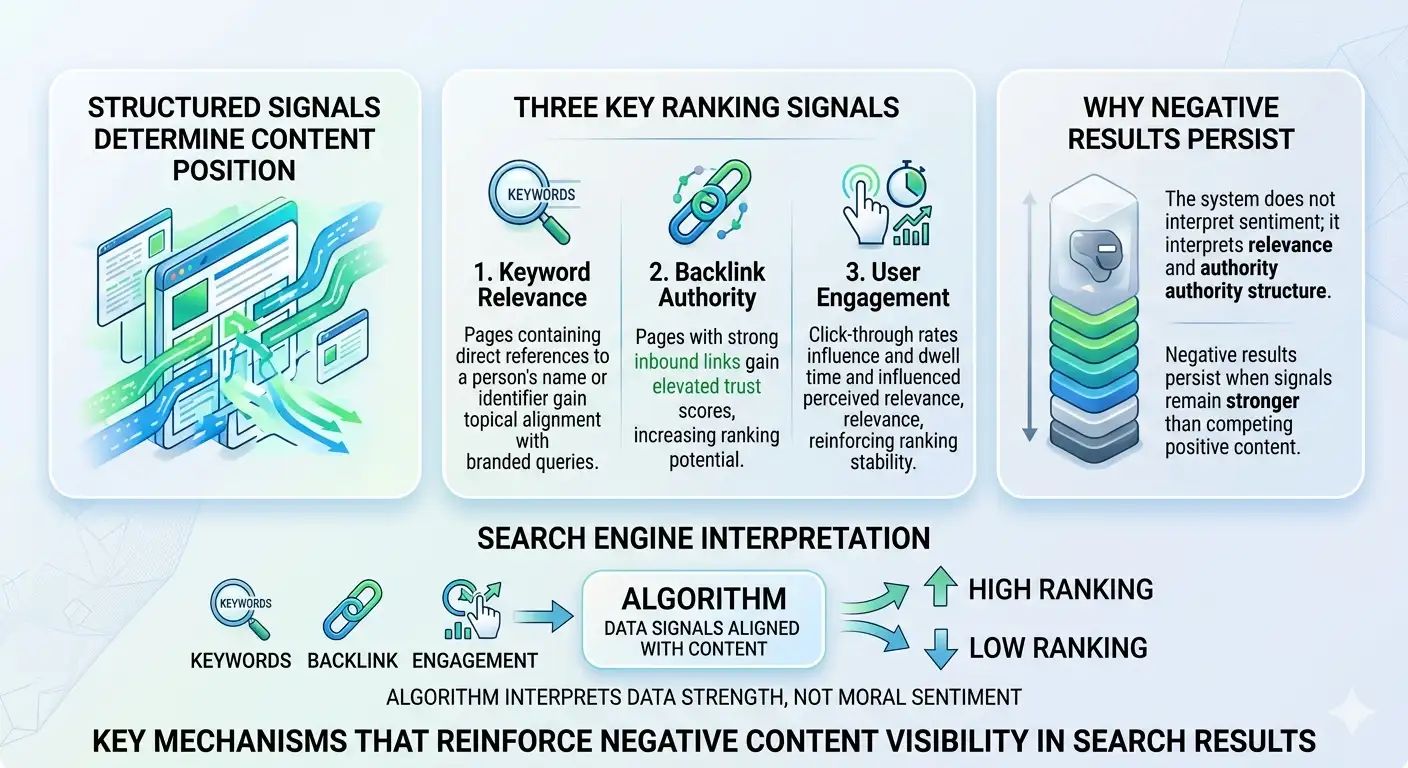
This distinction explains why duplicate listing problems cannot be understood solely through database presence. The relevant question is how the information is connected, indexed, evaluated and surfaced. Search perception is shaped by the content users encounter, not simply by the total amount of information stored within a search ecosystem.
How Can Businesses Consolidate Reputation Signals Across Listings?
Businesses can consolidate reputation signals by establishing which listing accurately represents the underlying entity and ensuring that business information remains consistent. The process begins with identifying duplicate records and comparing their names, addresses, categories, websites, contact details and review histories. This establishes whether the records represent the same entity or genuinely separate businesses.
The next stage involves evaluating how each listing contributes to search visibility and reputation. A profile with stronger authority or a more complete review history provides different signals from a recently created duplicate profile. Analysing these differences helps establish which record provides the most accurate representation of the entity. The evaluation therefore connects listing structure with broader SERP performance.
Where appropriate, Merging Duplicate Listings provides a way to consolidate information around the correct business entity rather than maintaining competing records. The purpose is structural accuracy: connecting legitimate reviews and business information with the entity they actually describe. Consolidation also reduces the fragmentation created when multiple profiles compete to represent one organisation.
What Happens When Duplicate Listings Remain Unresolved?
Unresolved duplicate listings can continue fragmenting business information and reputation signals across the search ecosystem. Each additional listing creates another potential source of inconsistent business information, review distribution and entity ambiguity. The longer this structure remains, the more difficult it becomes to establish which profile provides the authoritative representation.
Duplicate records can also create ongoing monitoring complexity. Businesses need to track reviews, ratings, information changes and customer interactions across separate profiles rather than one coherent listing. This increases the possibility of outdated information remaining visible. It also makes reputation analysis less efficient because the available evidence is distributed across multiple records.
The impact extends to search perception because users encounter whichever listing appears for their query. If that listing contains incomplete information or a limited review history, the visible reputation does not accurately represent the full business record. Resolving duplication therefore supports information consistency, entity clarity and more coherent reputation signals.
How Does Listing Accuracy Support Long-Term Online Reputation?
Listing accuracy supports long-term online reputation by creating a consistent foundation for business information and review signals. A digital footprint contains interconnected references that search engines use to understand an entity. When these references identify the same business consistently, entity relationships become easier to interpret. Accurate listing information therefore strengthens the structural foundation of reputation.
Long-term reputation also depends on maintaining consistency as business information changes. Changes to addresses, operating names, websites, categories or locations can create new opportunities for duplicate records or conflicting information. Monitoring these changes helps preserve a coherent entity structure. This protects the continuity of reputation signals as the business develops.
The underlying principle is that online reputation is partly an information architecture problem. Reviews provide sentiment evidence, business listings provide entity information, and search results determine visibility. When these components remain connected to the correct entity, users and search systems receive a clearer representation of the business. Reputation management therefore begins with understanding how information is structured before evaluating how it is perceived.
Duplicate business listings can split and bury reviews because they fragment the entity structure through which search engines and users interpret reputation. Reviews attached to separate profiles do not automatically create one consolidated reputation signal. Instead, review volume, sentiment, history and supporting business information can become distributed across competing records.
Search visibility depends on more than the existence of positive reviews. Entity recognition, listing accuracy, content indexing, local relevance, authority and review signals influence which reputation information becomes visible. Duplicate listings introduce structural ambiguity that can prevent the full review history from appearing through the most relevant business profile.
Understanding this system explains why duplicate listing management is fundamentally connected to online reputation. Accurate entity relationships create a clearer foundation for review signals, while consolidated business information reduces fragmentation across the search ecosystem. The result is a more coherent representation of genuine customer feedback and professional credibility.
Why do duplicate Google Business listings split reviews?
Duplicate Google Business listings can distribute reviews across separate profiles representing the same business. This fragments review volume, sentiment signals and customer feedback instead of consolidating them around one recognised business entity.
Can duplicate business listings affect Google review visibility?
Yes, duplicate listings can affect review visibility because reviews attached to different profiles are not presented through one consolidated listing. A profile with fewer reviews can appear in search while stronger review evidence remains attached to another duplicate.
How do duplicate listings affect a business’s online reputation?
Duplicate listings can weaken online reputation signals by creating inconsistent business information and fragmented review histories. This can make it harder for search engines and users to establish a clear representation of the business entity.
Can Google merge duplicate business listings?
Google provides processes for addressing duplicate Business Profiles when multiple listings represent the same business. The appropriate action depends on factors such as business identity, location, listing status and the information associated with each profile.
How can businesses consolidate Google Reviews from duplicate listings?
Businesses can first identify which listings represent the same entity and determine which profile contains the most accurate business information and review history. Where the applicable Google process permits consolidation, resolving duplicate listings can help create a more coherent review profile and strengthen reputation signals.