

Old social media posts can threaten political candidacies because historical content remains searchable, indexable, and open to interpretation long after publication.
Reputation management is the process of analysing and influencing how information affects an individual’s perceived credibility, while online reputation refers to the collection of digital signals users and search systems associate with that person.
Why do old social media posts affect political reputations?
Old social media posts affect political reputations because published content forms part of a candidate’s persistent digital footprint. A digital footprint is the collection of online information connected to an individual through social platforms, websites, publications, profiles, comments, and other indexed sources. Search engines can continue displaying historical content when it remains publicly accessible and relevant to a person’s name or associated queries. Users then evaluate that content within the wider context of the candidate’s current public identity. Historical posts therefore remain part of the information environment surrounding political reputation.
The significance of an old post depends on its visibility, context, authorship, subject matter, and relationship to the candidate’s current public identity. A post that appears prominently for a candidate’s name query receives greater exposure than content buried beyond the most visible search results. Search ranking dynamics determine which historical information users encounter first. Content that receives links, engagement, references, or continued search relevance can retain visibility over time. Reputation analysis therefore considers both the existence of old content and its current position within the search ecosystem.
How do search engines interpret historical political content?
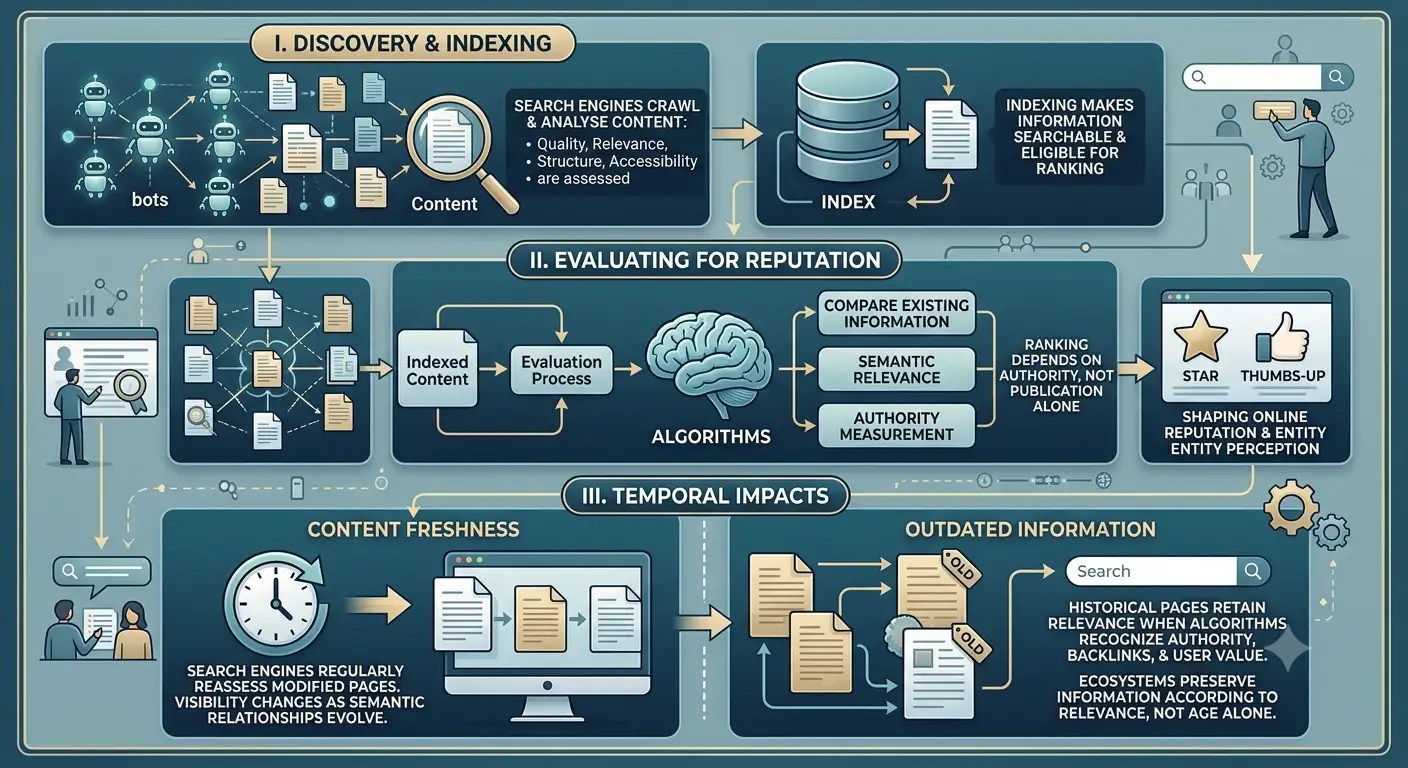
Search engines interpret historical political content through relevance, context, authority, indexing, and relationships between entities and documents. A social media post is treated as a document associated with an account, name, topic, or other identifiable information. Search systems then evaluate whether that document satisfies a particular query. The age of content is only one factor within this process. Historical information remains discoverable when its relevance and indexing status continue to support search visibility.
Entity perception is particularly important for political candidates because search systems connect information with identifiable people and organisations. An entity is a distinct person, organisation, place, or concept represented within a search ecosystem. When an old post is clearly connected to a candidate’s account, the association between the content and the individual becomes stronger. When contextual information is incomplete, users rather than algorithms often supply the interpretation themselves. Accurate entity information therefore influences how historical content is understood.
What makes an old social media post a reputation risk?
An old social media post becomes a reputation risk when its content creates a negative association with an individual’s current public identity and receives meaningful visibility. Risk analysis considers the relationship between the post, the candidate, the search query, and the audience interpreting the information. A historical statement can acquire renewed relevance when a person enters public life because political candidacy increases scrutiny of an existing digital footprint. The content itself does not automatically determine reputation impact. Visibility, context, credibility, and interpretation collectively determine its significance.
Reputation signals are indicators that influence how an individual is perceived across digital environments. These signals include social profiles, publications, reviews, media references, professional information, public statements, and other indexed material. Political candidates have a particularly complex reputation environment because personal and public information frequently coexist. Search users evaluate these signals as part of a broader perception of credibility. A single historical source can therefore gain significance when it appears alongside other reputation signals.
How does content indexing keep old posts visible?
Content indexing allows search engines to store and retrieve information from publicly accessible pages and profiles. When a social media page or post is indexed, its information enters a search system’s database and becomes eligible for retrieval against relevant queries. Indexing does not guarantee a high ranking, but it creates the technical basis for search visibility. An old post can therefore remain part of search results without requiring recent publication. Monitoring indexing status provides a clearer understanding of whether historical content remains searchable.
Indexing also differs from ranking. Indexing determines whether information is included within a search engine’s searchable collection, while ranking determines its position when a user performs a query. A post can remain indexed while receiving little practical visibility because it ranks below more relevant results. Conversely, authoritative or highly relevant content can receive prominent placement. SERP evaluation therefore needs to examine both whether historical posts are indexed and how prominently they appear.
Why does search visibility matter more than the age of a post?
Search visibility matters because users generally encounter the most prominent results before less visible information. The age of a post does not automatically remove it from consideration when the content remains relevant to a person’s name or political identity. A post published years earlier can therefore receive attention if it ranks prominently for current searches. Search visibility provides the measurable connection between historical content and present-day reputation exposure. This makes ranking position an important component of reputation analysis.
SERP evaluation measures the composition of search engine results pages for specific queries. It identifies which sources appear, where they rank, what information they present, and how they relate to the searched entity. For political candidates, this evaluation extends beyond simple name searches to include combinations involving professional roles, political positions, organisations, and public activities. Different queries produce different search environments. Reputation analysis therefore requires a query-specific understanding of historical content visibility.
How do users interpret old political posts in search results?

Users interpret old political posts by combining the content itself with surrounding contextual information. Search snippets, publication dates, account information, headlines, profile descriptions, and neighbouring results all influence how a document is understood. A historical post displayed without sufficient context creates greater room for interpretation. A clearly dated and accurately attributed post provides stronger contextual information. User perception therefore depends on both the content and the surrounding SERP environment.
Sentiment interpretation also influences reputation assessment. Sentiment refers to the positive, neutral, or negative orientation associated with information about an entity. Political content can contain statements that users interpret differently depending on the subject, language, date, and current political context. Search engines do not simply assign a complete reputation score based on one post. Instead, users and systems process individual documents alongside other available signals. A meaningful reputation assessment therefore examines sentiment distribution across the wider digital footprint.
How do authority and trust signals influence historical content?
Authority and trust signals influence how users assess the credibility and significance of information connected with a political candidate. Authority refers to the recognised strength or credibility of a source within its subject area, while trust signals provide evidence supporting the reliability of information or an entity relationship. Established publications, recognised organisations, official profiles, and authoritative websites can carry stronger contextual weight than unidentified sources. These differences affect how users interpret information presented in search results. Reputation analysis therefore evaluates the source as well as the content.
Trust signals also contribute to entity credibility. Entity credibility is the degree to which available information consistently supports a reliable representation of a person or organisation. A candidate with consistent professional information across authoritative sources has a more defined digital identity. Historical social content then exists within a broader information environment rather than as an isolated document. Evaluating this environment provides a more accurate understanding of how old posts influence public perception.
Can deleted social media posts still affect online reputation?
Deleted social media posts can continue affecting online reputation when copies, screenshots, quoted references, cached information, or independent publications remain available elsewhere. Deleting the original source removes one location but does not automatically remove every reference created from that content. Search engines also process information from independent websites and platforms. Reputation analysis therefore examines the broader digital footprint rather than relying exclusively on the status of the original post. This distinction is important when assessing historical content.
The persistence of references also demonstrates why content indexing matters. A historical statement can appear through a secondary publication even after the original social media post becomes unavailable. Search visibility then depends on the secondary source’s relevance, authority, and ranking position. Removing one source therefore does not necessarily change the complete SERP composition. A comprehensive evaluation tracks the information ecosystem surrounding the original content.
Dive Deeper With Our Expert Guides:
Why Campaign Staff Scandals Reflect on the Candidate
How Voting-Record Fact-Checks Shape Candidate Credibility
How do old social media posts influence political campaign credibility?
Old social media posts influence campaign credibility by contributing historical evidence that users compare with a candidate’s current public identity. Credibility is assessed through consistency between statements, affiliations, professional information, public positions, and other available reputation signals. When historical content appears inconsistent with current messaging, users can perceive a gap between past and present information. The search ecosystem makes this comparison easier because historical documents can remain accessible. Political reputation therefore develops through accumulated digital information rather than recent campaign material alone.
This process is particularly relevant during periods of increased public scrutiny. Political candidacy generates searches from voters, journalists, organisations, opponents, and other interested audiences. Search demand increases the practical importance of existing digital information because a wider audience evaluates the candidate’s online footprint. SERP composition then becomes part of the broader credibility assessment. Historical content receives greater significance when it appears within these high-intent searches.
What role does reputation management play in evaluating old social media posts?
Reputation management provides a structured framework for analysing how historical information affects search visibility, entity perception, and online credibility. The process begins by identifying publicly visible content associated with the individual and classifying it according to relevance, source, date, sentiment, and entity relationship. Analysts then evaluate whether the information remains indexed and where it appears for relevant searches. This creates a distinction between content that exists and content that creates measurable search exposure. The result is a more precise assessment of reputation risk.
For political figures, reputation management also involves analysing the relationship between personal content and public identity. Auditing old social media posts before announcing a candidacy represents a preventative approach because it evaluates historical information before search demand increases. The audit examines content ownership, visibility, indexing, contextual relevance, and potential perception implications. This creates a structured record of the existing digital footprint. Preventative analysis therefore provides a clearer understanding of the reputation environment before a campaign begins.
Is auditing old social media content more effective before or after a campaign starts?
Auditing old social media content before a campaign starts provides stronger visibility into the existing reputation environment because it identifies historical information before public scrutiny intensifies. A pre-candidacy audit maps the candidate’s digital footprint and establishes a baseline for search visibility. This includes identifying social posts, profiles, references, images, comments, publications, and other indexed material. The baseline then provides evidence for understanding which information has genuine search relevance. Timing therefore affects the amount of information available for assessment before political attention increases.
Post-campaign monitoring serves a different function by evaluating how search behaviour changes after candidacy becomes public. Increased search activity can alter which pages receive attention and which queries generate visibility. New articles, discussions, social references, and political commentary can also expand the digital footprint. Continuous SERP evaluation therefore complements an initial audit. The two approaches address different stages of reputation development.
How should political candidates evaluate their digital footprint?
Political candidates can evaluate their digital footprint through a structured review of indexed content, search visibility, entity relationships, sentiment, authority, and contextual consistency. The evaluation begins with identifying the complete range of publicly accessible information associated with the candidate’s name. Each source is then assessed according to relevance, ownership, visibility, and potential influence on entity perception. This process distinguishes high-visibility reputation signals from information with limited search exposure. It also establishes a measurable baseline for future monitoring.
A practical evaluation framework includes:
- Audit historical social profiles and posts to identify publicly accessible content associated with the candidate’s name.
- Classify each item according to date, subject, authorship, sentiment, and relationship to the current public identity.
- Measure search visibility by recording where historical content appears for relevant name and political queries.
- Evaluate authority and trust signals by comparing the credibility and contextual strength of sources appearing in the SERP.
- Monitor content indexing and ranking changes to identify new reputation signals entering the search environment.
This framework treats reputation as a measurable information system rather than a collection of isolated posts. It also separates content existence from practical search exposure. Such distinction is essential when determining which historical information actually influences online perception.
Why does the digital footprint matter throughout a political career?
The digital footprint matters throughout a political career because search ecosystems continuously accumulate, index, and rank information about public figures. A candidate’s online identity changes as new interviews, articles, social posts, professional references, and public statements are published. These additions become part of the entity’s wider information environment. Search engines then process the growing collection of documents against future queries. Reputation therefore develops dynamically rather than remaining fixed after a single campaign.
Long-term monitoring provides a mechanism for measuring these changes. It identifies newly indexed content, ranking shifts, changes in search visibility, and alterations in sentiment distribution. This allows reputation analysis to distinguish temporary fluctuations from persistent changes in search perception. Consistent monitoring also maintains awareness of how historical information interacts with new content. The digital footprint consequently becomes an ongoing component of political reputation evaluation.
Old social media posts threaten political candidacies when historical content remains visible, relevant, and attributable to a candidate’s digital identity. Search engines index and rank this information within SERPs, while users interpret it alongside reputation signals, authority indicators, sentiment, and current public information.
The key distinction is between content existence and search visibility. A historical post can remain online without significant exposure, while a highly visible result can receive substantial attention despite its age. Entity perception, content indexing, ranking dynamics, and contextual credibility therefore provide the primary mechanisms for evaluating historical political content.
A structured digital-footprint audit establishes which information is visible, how it is attributed, and what reputation signals surround it. Reviewing historical social content before public scrutiny increases provides a clearer understanding of the existing search environment. Ongoing SERP evaluation then measures how that environment changes as a political identity develops.
How can old social media posts affect a political candidacy?
Old social media posts can resurface during a political campaign and influence how voters, journalists, and opponents perceive a candidate. Offensive, controversial, or misleading content may create reputational risks even when it was posted years earlier.
Can deleted social media posts still affect a political campaign?
Yes, deleted posts may remain accessible through screenshots, archives, reposts, or cached copies. Removing the original post does not necessarily remove every online copy or prevent it from resurfacing in search results.
What social media content should political candidates review before an election?
Candidates should review old posts, comments, photographs, videos, tagged content, and public interactions across their social media accounts. Particular attention should be given to material that could be misunderstood, taken out of context, or conflict with their current public position.
How can candidates manage harmful old social media content?
Candidates can audit their online presence, remove content they control where appropriate, request removal of content that violates platform policies, and monitor search results for resurfacing material. Professional reputation management can also help identify and address persistent online content.
Can Clear My Name help with old social media posts affecting a political candidate?
Clear My Name focuses on managing unwanted online content and search visibility that may contribute to reputational concerns. The appropriate approach depends on whether the content can be removed, de-indexed, corrected, or addressed through broader online reputation management.