
Reputation management is the process of understanding how digital information shapes trust, credibility, and visibility across search ecosystems.
Online reputation refers to the collection of indexed content, reputation signals, and authority indicators that influence how healthcare providers are evaluated before patients make contact.
What Influences How Patients Choose Healthcare Providers Online?
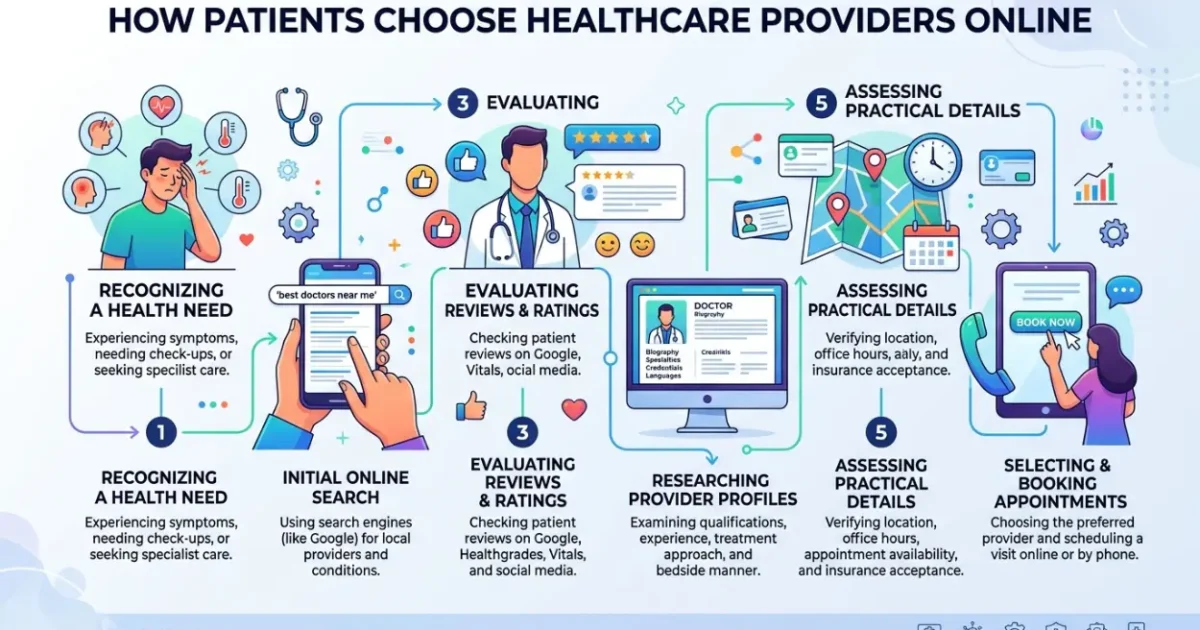
Patients choose healthcare providers online by evaluating publicly available information presented through search engine results pages (SERPs), healthcare directories, review platforms, professional profiles, and medical websites. Search engines organise this information according to relevance, authority, content quality, and entity relationships rather than simple publication dates. The resulting search visibility influences how professional credibility is interpreted before any appointment is arranged.
Entity perception develops as search engines analyse connections between doctors, healthcare organisations, medical specialities, patient reviews, and authoritative publications. Consistent information across these sources strengthens semantic relationships that help algorithms recognise professional expertise. Strong entity recognition improves the organisation of healthcare information, creating a clearer representation of medical professionals within search ecosystems.
Patients rarely rely upon a single source of information. Search engines present multiple reputation signals simultaneously, allowing users to compare qualifications, experience, patient feedback, and professional recognition across different platforms. This combination of indexed information contributes to informed healthcare decision-making while shaping online credibility through algorithmic evaluation.
How Do Search Engines Interpret Trust Signals for Healthcare Providers?
Search engines interpret trust signals by analysing authoritative medical information, professional consistency, review credibility, and recognised healthcare entities. These signals help algorithms determine how healthcare providers are represented across search results.
Trust signals originate from professional registrations, healthcare organisations, verified practice information, authoritative medical publications, patient reviews, educational resources, and recognised healthcare directories. Search systems compare these resources to establish consistent entity relationships before evaluating search visibility. Reliable information across multiple trusted sources strengthens digital credibility because algorithms identify factual consistency and contextual relevance.
Authority Signals Define Medical Credibility
Authority signals refer to information that demonstrates recognised expertise within healthcare search ecosystems. Professional qualifications, accredited memberships, peer-reviewed publications, medical conference participation, and verified healthcare profiles all contribute to stronger authority recognition.
Search engines evaluate these signals collectively rather than independently. Consistent references from trusted healthcare organisations strengthen entity perception because algorithms recognise recurring evidence of professional expertise. This process improves search visibility by reinforcing reliable semantic relationships across indexed resources.
Information Consistency Strengthens Entity Recognition
Information consistency is the uniform presentation of names, qualifications, practice locations, specialities, and professional affiliations across digital platforms. Search systems compare these details continuously to verify that indexed resources represent the same healthcare provider.
Consistent identity information reduces ambiguity during content indexing. Improved entity recognition enables search engines to organise medical information more accurately, strengthening reputation signals and presenting healthcare providers more reliably within relevant search results.

Why Do Search Results Shape Patient Perception Before Appointments?
Search results shape patient perception because they provide immediate access to publicly indexed healthcare information before direct communication occurs. Search engine results pages organise available resources according to authority, relevance, and user intent, making them an important source of early evaluation.
SERP evaluation extends beyond rankings alone. Search engines present practice websites, healthcare directories, review platforms, professional biographies, educational content, news references, and frequently asked questions that collectively define digital credibility. Patients interpret these visible resources together, forming perceptions through the overall quality and consistency of available information.
Search visibility therefore functions as an informational gateway rather than a promotional tool. High-quality indexed content allows search engines to establish stronger contextual relationships between healthcare providers, medical expertise, and recognised professional entities. This structured presentation contributes to greater confidence in the accuracy of available information.
What Creates a Healthcare Provider’s Digital Footprint?
A healthcare provider’s digital footprint is the complete collection of publicly indexed information associated with their professional identity. It includes every searchable resource that contributes to entity perception within search ecosystems.
Digital footprints consist of practice websites, healthcare directories, patient reviews, professional biographies, medical publications, educational articles, interviews, conference participation, accreditation records, and organisational profiles. Each indexed asset contributes additional reputation signals that search engines evaluate when organising healthcare information.
Search ecosystems continuously analyse relationships between these resources. Algorithms determine whether documents describe the same healthcare professional, compare topical relevance, and identify consistent patterns of expertise. Strong semantic relationships improve online credibility because search systems recognise an organised network of trustworthy information.
Content Indexing Organises Medical Information
Content indexing refers to the process through which search engines discover, analyse, and store publicly accessible information. Indexed medical resources become eligible for retrieval whenever users search for healthcare professionals or medical services.
Accurate indexing depends upon structured information, technical accessibility, and factual consistency. Search systems use these elements to understand qualifications, healthcare specialities, organisational affiliations, and professional expertise. Better indexing therefore improves search visibility by enabling more precise information retrieval.
Semantic Relationships Improve Healthcare Search Accuracy
Semantic relationships connect healthcare providers with recognised medical concepts, organisations, treatments, and professional expertise. Search engines evaluate these contextual associations to understand how indexed resources relate to one another.
Healthcare professionals consistently associated with recognised medical fields develop stronger semantic relevance within those knowledge areas. These relationships improve entity perception because algorithms interpret expertise through accumulated contextual evidence rather than isolated keywords.
How Do Patient Reviews Influence Online Credibility?
Patient reviews influence online credibility by contributing additional reputation signals that search engines evaluate alongside authoritative medical information. Reviews provide publicly available feedback that supports broader interpretations of healthcare quality and patient experience.
Search systems evaluate review content through sentiment interpretation, contextual relevance, review authenticity, and source reliability. Rather than measuring positive or negative language alone, algorithms analyse recurring themes, factual consistency, and relationships between reviews and other indexed information. This broader evaluation contributes to more balanced entity perception across search ecosystems.
Review platforms also strengthen digital footprints because they introduce independent information sources that complement professional profiles and practice websites. Together, these resources expand the contextual understanding of healthcare providers while improving semantic relationships recognised during SERP evaluation.
Dive Deeper With Our Expert Guides:
Why Online Reviews Matter for Doctors and Dentists
How Is Patient Feedback Interpreted Within Search Ecosystems?
Patient feedback is interpreted through contextual analysis rather than individual opinions. Search engines evaluate review language, publication consistency, source credibility, and semantic relationships to determine how patient feedback contributes to overall entity perception.
Algorithms compare review content with authoritative healthcare information instead of analysing reviews in isolation. Consistent themes across verified platforms strengthen reputation signals because search systems identify recurring patterns supported by trusted sources. This process enables search engines to distinguish reliable information from isolated or inconsistent content.
Review sentiment also contributes to SERP evaluation by providing additional contextual evidence. Search engines assess whether patient experiences align with recognised healthcare expertise, professional profiles, and organisational information. Strong alignment improves online credibility because reputation signals remain consistent across multiple indexed resources.
Why Does Authority Matter More Than Visibility Alone?
Authority matters more than visibility because search engines prioritise trustworthy information when determining rankings and entity credibility. Visibility determines whether information appears in search results, while authority influences how confidently search systems interpret that information.
Authoritative healthcare resources include accredited medical organisations, recognised professional bodies, verified practice information, peer-reviewed publications, and established healthcare directories. These sources provide stronger reputation signals because they reinforce factual accuracy and recognised expertise. Search algorithms evaluate these relationships continuously to improve information quality within SERPs.
Visibility without authority provides limited contextual value. High-ranking content supported by weak credibility signals contributes less to entity recognition than authoritative resources connected through verified relationships. Consequently, authority forms the foundation upon which sustainable search visibility develops.
How Does Content Shape Healthcare Reputation Online?
Content shapes healthcare reputation by providing structured information that search engines use to understand professional expertise, healthcare services, and organisational relationships. Every indexed document contributes contextual evidence that strengthens or weakens entity perception.
Professional biographies, educational resources, healthcare guidance, practice information, media references, and medical publications each provide different forms of reputation signals. Search systems analyse these resources collectively, identifying semantic relationships that improve contextual understanding. Strong informational quality supports more accurate SERP evaluation because algorithms recognise reliable expertise.
Content freshness also influences interpretation. Updated healthcare information reflects ongoing professional activity and enables search engines to reassess relevance alongside historical authority. Fresh information complements established credibility rather than replacing previously recognised expertise, creating a balanced digital footprint over time.
Which Information Sources Most Influence Patient Decisions?
Patient decisions are influenced by information sources that demonstrate credibility, consistency, and recognised authority across search ecosystems. Search engines organise these resources to present a comprehensive overview of healthcare providers before appointments are considered.
The most influential sources include:
- Review verified patient feedback because authenticated reviews contribute additional reputation signals that complement professional information.
- Compare healthcare directories to evaluate qualifications, practice details, and recognised professional affiliations across multiple trusted platforms.
- Assess official practice websites because structured information strengthens entity recognition and provides authoritative contextual details.
- Evaluate professional publications because educational content, interviews, and recognised medical contributions reinforce online credibility.
Each source contributes unique contextual evidence that strengthens semantic relationships within search ecosystems. Search engines interpret these resources collectively, improving entity perception through balanced informational analysis rather than isolated documents.
Patients choose healthcare providers online through a combination of search visibility, reputation signals, authority indicators, and contextual information organised by search engines. Search ecosystems evaluate professional credibility by analysing indexed content, entity relationships, review interpretation, and recognised healthcare sources rather than relying on a single ranking factor.
Digital footprints develop through consistent professional information, authoritative publications, verified profiles, and patient feedback that collectively strengthen online credibility. These interconnected resources enable search engines to organise healthcare information more accurately while improving the interpretation of medical expertise across search engine results pages.
Understanding how search systems evaluate patient reviews, authority signals, content indexing, and entity perception provides a clearer explanation of how healthcare reputations develop within digital environments. Further analysis of Managing Patient Reviews Without Violating Medical Ethics expands on the role of ethical review management in maintaining trust while supporting accurate online reputation signals.
How do patients choose healthcare providers online?
Patients typically compare search engine results, healthcare directories, patient reviews, professional qualifications, and practice websites before selecting a healthcare provider. These reputation signals help shape trust and influence online decision-making.
Why are patient reviews important when choosing a doctor?
Patient reviews provide additional information about patient experiences, communication, and healthcare services. Search engines evaluate review signals alongside authoritative medical information to strengthen entity credibility and influence search visibility.
How do search engines rank healthcare providers?
Search engines rank healthcare providers by analysing content quality, authority signals, relevance, content indexing, and consistent professional information. Verified profiles, trusted healthcare directories, and accurate practice details all contribute to stronger search visibility.
What is Reputation management for doctors?
Reputation management for doctors focuses on improving online credibility by maintaining accurate professional information, strengthening reputation signals, and supporting better search visibility. Organisations such as Clear My Name recognise that consistent and authoritative digital information helps search engines interpret medical expertise more effectively.
What information do patients trust most before booking a medical appointment?
Patients often trust verified patient reviews, official practice websites, healthcare directories, professional qualifications, and recognised medical affiliations. Together, these sources create a balanced digital footprint that supports informed healthcare decisions and strengthens online credibility.