

Tax lawyers lose potential clients when weak online credibility reduces trust signals across search results, reviews, and professional content. Reputation management is the process of monitoring and shaping how an individual or organisation is represented across digital environments, while online reputation refers to the collective perception created by indexed information.
What is online reputation for tax lawyers?
Online reputation is the digital representation of a tax lawyer’s credibility, expertise, and professional identity across searchable platforms. It refers to how information about a legal professional is discovered, interpreted, and connected within search ecosystems. Search engines evaluate indexed pages, professional profiles, reviews, publications, and other reputation signals when organising results for relevant queries. The resulting search landscape forms part of the entity perception associated with the lawyer or legal practice. Online reputation therefore extends beyond a single website because multiple information sources contribute to the overall digital footprint.
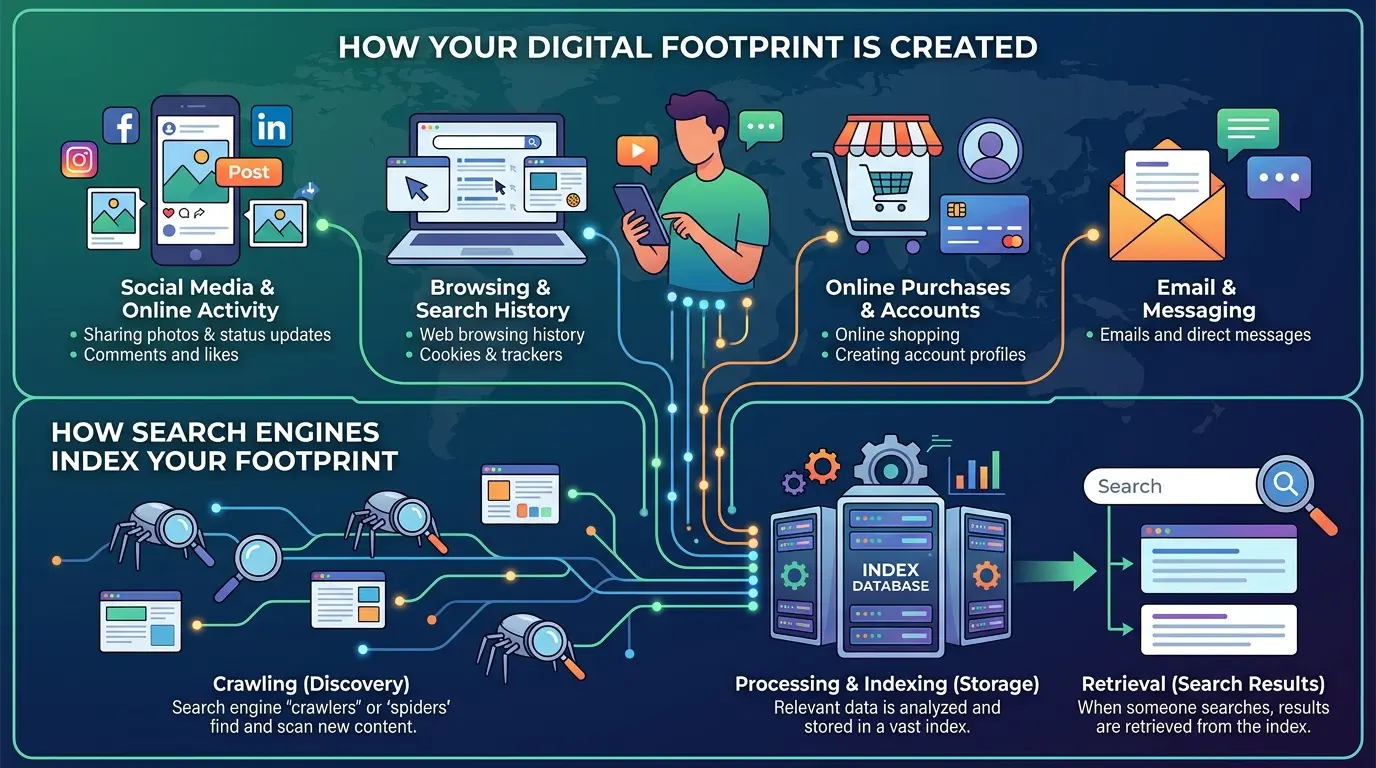
A tax lawyer’s digital footprint consists of the indexed information associated with their professional entity. This includes website pages, biographies, legal directories, published articles, professional profiles, reviews, interviews, and other publicly accessible references. Each source contributes information that search systems process as part of the wider entity context. Consistency between these sources helps search engines understand whether different references relate to the same professional entity. Contradictory, incomplete, or outdated information creates a less coherent representation of professional credibility.
How does search visibility influence client perception of tax lawyers?
Search visibility influences client perception by determining which information appears when people investigate a legal professional online. Search engine results pages (SERPs) organise indexed content according to relevance, quality, authority, context, and other ranking signals. The visible composition of a SERP therefore affects the information available for evaluation before direct contact takes place. Pages that accurately explain expertise and professional credentials provide stronger informational context than fragmented or poorly maintained references. Search visibility consequently forms part of the wider reputation environment surrounding a tax lawyer.
Ranking position also affects how information is encountered during research. A search query relating to tax law can return professional pages, legal publications, reviews, directory profiles, and other sources with different levels of contextual relevance. Search engines evaluate these documents independently while also connecting them through entities, topics, links, and textual relationships. The resulting SERP gives users a structured collection of information from which they form an assessment. Weak visibility across authoritative sources therefore reduces the amount of reliable context available to support professional credibility.
How do search engines interpret credibility signals?
Search engines interpret credibility through combinations of relevance, authority, consistency, content quality, and entity relationships rather than through one universal reputation score. Reputation signals refer to observable digital indicators that help establish what an entity represents and how relevant that entity is to a particular query. These signals exist across content, links, structured information, professional references, reviews, and other indexed sources. Algorithms process these signals to determine relationships between queries, entities, documents, and topics. Search evaluation therefore operates as a system of interconnected signals rather than a single credibility measurement.
Authority signals provide contextual evidence about the reliability and expertise associated with a professional entity. A detailed author profile, relevant legal content, consistent professional information, and references from credible sources create identifiable relationships between expertise and subject matter. Content indexing makes these relationships available for algorithmic evaluation because searchable information must first enter the search engine’s index. Authority therefore depends partly on the existence, quality, relevance, and accessibility of supporting information. A sparse digital footprint limits the available evidence through which entity perception is established.
How do reviews affect the online reputation of tax lawyers?
Reviews influence online reputation by supplying publicly visible information about perceived service quality, professionalism, communication, and client experience. Review signals consist of textual feedback, ratings, frequency, recency, consistency, and the broader context in which reviews appear. Search systems process review content as part of the information available around an entity, while users interpret the language and patterns independently. Sentiment interpretation identifies whether review language expresses positive, negative, or neutral evaluations. Reviews therefore operate as reputation signals within both search ecosystems and human decision-making processes.
Review content also contributes semantic information about the services associated with a legal professional. Repeated references to specific characteristics can reinforce associations between an entity and particular service attributes. However, reviews do not operate independently from other information sources. Users compare reviews with professional websites, legal profiles, published content, and other references when evaluating credibility. A consistent information environment creates stronger contextual alignment than a digital footprint containing conflicting descriptions and unexplained gaps.
How does content influence the perceived credibility of tax lawyers?
Content influences perceived credibility by defining the information available about professional expertise, subject knowledge, and service relevance. Professional content refers to indexed material that explains a lawyer’s knowledge, legal topics, qualifications, publications, and areas of practice. Search engines analyse this content to establish relationships between entities, concepts, queries, and topics. Users then encounter those relationships through search results and page content. Content therefore functions as both an informational resource and a reputation signal.
Topical relevance is particularly important because expertise is evaluated through the depth and consistency of information surrounding a subject. A website containing precise explanations of tax law concepts creates a stronger topical context than a website containing only generic service descriptions. Well-structured content also helps search engines distinguish between different legal entities and understand their areas of expertise. Internal relationships between related pages reinforce the semantic structure of the site. Content quality therefore contributes to both search visibility and the clarity of entity perception.
How does a digital footprint shape a tax lawyer’s professional identity?

A digital footprint shapes professional identity by aggregating the information that search engines and users can discover about an entity. It includes owned content, third-party references, profiles, reviews, publications, directory entries, and other indexed material. Each component provides contextual information about the lawyer’s professional identity. Search engines connect these references through names, organisations, subjects, locations, credentials, and other entity attributes. The combined footprint establishes a searchable representation that extends beyond any individual webpage.
Consistency is a central property of a coherent digital footprint. Professional names, qualifications, areas of expertise, practice information, and other factual attributes need to maintain logical relationships across relevant sources. Inconsistent information introduces ambiguity into entity identification and user interpretation. Search systems evaluate individual documents, but entity understanding depends on relationships between documents and information sources. A coherent footprint therefore gives both algorithms and users a clearer basis for interpreting professional identity.
Why does weak online credibility reduce trust in search results?
Weak online credibility reduces trust when search results provide insufficient authoritative context for evaluating a professional entity. Trust in search results is influenced by the quality, relevance, consistency, and source diversity of available information. A search landscape dominated by incomplete profiles, outdated information, weakly relevant pages, or unresolved negative references provides limited evidence for professional assessment. Users interpret this information within the context of their search intent rather than relying on one isolated ranking signal. The perceived reliability of the overall SERP consequently depends on the information ecosystem surrounding the entity.
Information gaps also affect interpretation because absence of authoritative context leaves fewer sources capable of explaining expertise. Search engines cannot use information that has not been created, indexed, or associated with the relevant entity. This makes content coverage an important component of digital reputation. Accurate professional information distributed across relevant authoritative contexts provides clearer signals about the entity. Weak coverage creates a less developed search representation and reduces the informational basis for credibility assessment.
How do authority and trust signals interact in legal search?
Authority and trust signals interact by providing different but connected forms of evidence about an entity. Authority relates to demonstrated expertise, relevance, recognition, and topical depth, while trust relates to the perceived reliability and consistency of available information. Search engines evaluate these characteristics through multiple signals rather than assigning authority from one isolated document. Professional publications, expert content, credible references, consistent profiles, and relevant reviews contribute different types of contextual evidence. Their combined presence strengthens the semantic relationship between the lawyer, legal expertise, and relevant search queries.
The interaction between these signals also affects how content is interpreted. A highly specialised article gains contextual significance when its author identity, professional information, and surrounding content clearly establish relevant expertise. Similarly, a professional profile gains stronger topical meaning when it connects consistently with relevant publications and authoritative references. Entity perception develops through these relationships rather than through isolated claims of expertise. Search evaluation therefore depends on the structure and coherence of the broader information environment.
How does content ranking affect reputation perception?
Content ranking affects reputation perception because ranking determines which indexed information receives greater visibility within a SERP. Search engines order documents according to systems designed to satisfy query intent and assess relevance, quality, authority, and other factors. Higher visibility increases the probability that users encounter particular information during research. Lower visibility does not remove information from the index; it changes its position within the search landscape. Reputation perception therefore reflects both the existence of information and its relative visibility.
Ranking dynamics also create a relationship between content relevance and reputation exposure. A highly relevant professional article can provide useful context when it ranks for an appropriate query, while unrelated or low-quality pages contribute less useful information. Search systems continually evaluate indexed documents in relation to queries and broader information signals. This means reputation perception remains connected to the changing composition of search results. The digital footprint is therefore an evolving information system rather than a fixed profile.
Dive Deeper With Our Expert Guides:
Why Patent and IP Attorneys Are Rarely Found in Local Searches
How Workers’ Compensation Lawyers Get Judged by Injured Clients Online
What is the relationship between online credibility and search reputation?
Online credibility and search reputation are closely related because credibility describes perceived reliability while search reputation describes how that perception is represented across searchable information. Search reputation refers to the reputation signals associated with an entity within search ecosystems, including indexed content, reviews, authority references, and entity relationships. Online credibility forms part of this system by influencing how users interpret available information. Search engines organise information algorithmically, while users evaluate the resulting information according to their own search intent. The two processes interact through the content and signals visible in SERPs.
Understanding this relationship requires separating reputation from individual rankings. A single ranking position does not represent the complete reputation of a tax lawyer because reputation emerges from a collection of information sources. Similarly, one review does not define the entire entity perception associated with a professional. Search reputation is better understood as an interconnected information environment containing content, references, reviews, profiles, and authority signals. This perspective explains why digital credibility depends on the consistency and semantic relationships across the broader footprint.
How can credibility-building be understood within legal search ecosystems?
Credibility-building can be understood as the development of consistent, relevant, and authoritative information around a professional entity. It involves establishing clear relationships between expertise, professional identity, subject matter, and supporting information across indexed sources. Credibility-Building Strategies for Tax and Financial Law Practices describe this process at a more practical consideration level, while the underlying informational concept remains the construction of coherent reputation signals. Search engines process these signals as part of entity and content evaluation. Users then encounter the resulting information through relevant searches and SERPs.
The semantic structure of credibility-building begins with accurate entity information and expands through relevant topical content and trustworthy references. Professional expertise becomes easier to interpret when content consistently connects the entity with appropriate legal subjects. Supporting references strengthen the contextual relationship between professional identity and expertise. Reviews add another layer by expressing user-generated perceptions of professional performance. Together, these elements form an information environment in which online credibility becomes more comprehensible to both search systems and users.
What are the main factors that determine a tax lawyer’s search reputation?
A tax lawyer’s search reputation is determined by the interaction of entity information, content, reviews, authority, search visibility, and digital footprint consistency. These factors operate together rather than independently because search systems evaluate relationships between documents, entities, queries, and topics. Content provides topical information, reviews provide experiential signals, and authoritative references provide contextual validation. Professional profiles and consistent factual information help establish entity identity. The resulting search environment determines how clearly the professional entity is represented when relevant queries are performed.
The central principle is information coherence. Search reputation becomes easier to interpret when indexed sources communicate consistent professional identity, relevant expertise, and credible contextual information. Content ranking determines which parts of that information ecosystem receive greater visibility, while reviews and authority signals influence interpretation. Entity perception therefore emerges from the cumulative structure of the digital footprint rather than from a single page or isolated signal. Understanding these relationships provides the foundation for analysing online credibility within legal search ecosystems.
Online credibility is a measurable part of the information environment surrounding a tax lawyer, although it does not exist as one universal search-engine score. Reputation management is the broader process of understanding and managing digital reputation signals, while search reputation concerns how those signals appear and interact within searchable ecosystems. Content indexing, SERP evaluation, reviews, authority signals, entity relationships, and ranking dynamics all contribute to the resulting digital footprint. Weak online credibility therefore reflects gaps or inconsistencies in the information available for professional evaluation. Understanding these mechanisms provides a clearer framework for analysing how reputation is formed, interpreted, and represented in search.
How does online credibility affect tax lawyers?
Online credibility influences how potential clients interpret a tax lawyer’s expertise, professionalism, and reliability before making contact. Search results, professional profiles, reviews, and published legal content collectively contribute to online reputation and entity perception.
What damages a tax lawyer’s online reputation?
Inconsistent professional information, negative reviews, outdated profiles, weak legal content, and limited authoritative references can weaken a tax lawyer’s digital reputation. These factors can reduce the quality and clarity of reputation signals across search results.
Do online reviews affect a tax lawyer’s credibility?
Yes, online reviews contribute to reputation signals by providing information about client experiences, professionalism, communication, and service quality. Search users often evaluate review patterns alongside professional websites and other authoritative sources.
How do search results affect a tax lawyer’s reputation?
Search results shape reputation by determining which information users encounter when researching a tax lawyer. Strongly relevant and authoritative content provides clearer context, while fragmented or outdated information can create a weaker online credibility profile.
What is reputation management for lawyers?
Reputation management for lawyers involves monitoring and understanding how professional information, reviews, content, and other reputation signals appear across digital platforms and search engines. It focuses on maintaining a consistent and accurate digital footprint that supports clear entity perception.