

Negative reviews are addressed by understanding how review systems, search engines, and reputation signals interact to influence public perception and search visibility. Improving online ratings depends on consistent reputation management practices that strengthen trust signals, encourage balanced feedback, and maintain accurate digital information.
Reputation management is the structured process of monitoring, analysing, and influencing how information about an entity is created, interpreted, and ranked across digital platforms. Online reputation refers to the collective perception formed through reviews, search engine results, published content, and user-generated information within search ecosystems. Negative reviews represent one component of a broader reputation framework that search engines evaluate alongside authority signals, content quality, and entity consistency. Understanding these systems explains why some businesses maintain strong visibility despite criticism while others experience declining search performance.
What are negative reviews within online reputation management?
Negative reviews are publicly available opinions that express dissatisfaction with a product, service, organisation, or experience. Within search ecosystems, they serve as reputation signals that shape entity perception and influence search visibility. Search engines treat reviews as structured information rather than isolated opinions, allowing review patterns to factor into overall SERP evaluation. Individual reviews rarely define an online reputation independently because algorithms interpret them alongside broader trust indicators. The overall context, frequency, consistency, and freshness of reviews provide a more comprehensive representation of credibility.
Negative review data contributes to content indexing because review platforms continuously publish new information that search engines discover and evaluate. Rating distributions, review frequency, reviewer credibility, and textual sentiment all create measurable signals within reputation analysis. Search engines combine these indicators with website authority, business information consistency, and external references to establish confidence in an entity. This interconnected evaluation explains why reputation is determined by cumulative evidence instead of isolated comments.
How do search engines interpret review signals?
Search engines interpret review signals by analysing structured review data, sentiment patterns, and content quality to understand trust and relevance. Reviews form one layer of a wider entity evaluation model that supports ranking systems and search visibility. Algorithms analyse both numerical ratings and written language to determine whether review content provides useful, authentic, and consistent information. The interpretation process extends beyond positive or negative wording because contextual relationships also influence reputation signals.
How is review sentiment analysed?
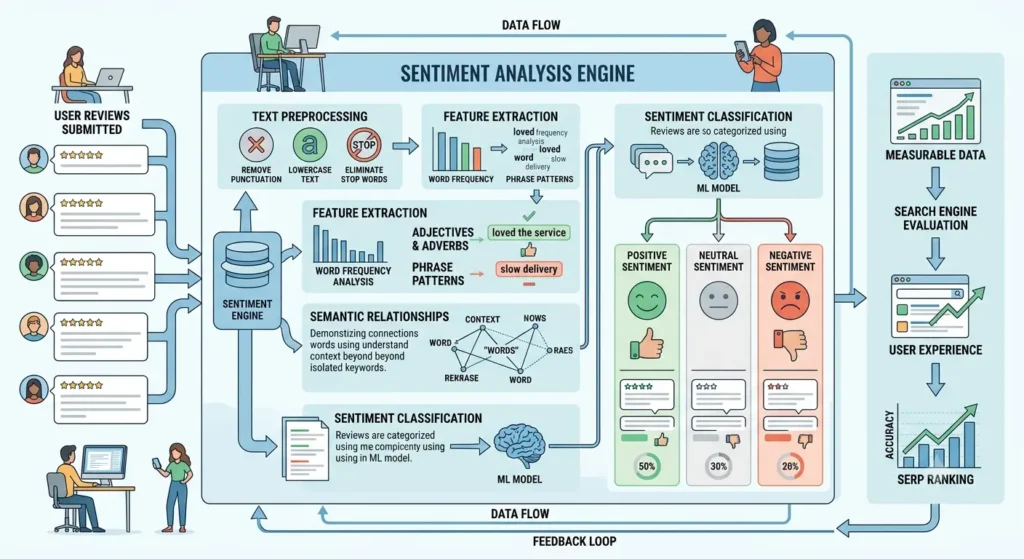
Review sentiment analysis identifies the emotional direction and informational value of review content using natural language processing. Positive, neutral, and negative expressions become measurable data that supports entity perception across indexed platforms. Search engines evaluate repeated terminology, descriptive language, and topic consistency to distinguish meaningful feedback from repetitive or low-quality content. Semantic relationships between words improve the understanding of customer experience without relying exclusively on star ratings. This process strengthens the accuracy of SERP evaluation by incorporating contextual meaning rather than isolated keywords.
Why does review authenticity matter?
Authenticity defines the credibility of reputation signals within search ecosystems. Verified reviews, consistent reviewer behaviour, and natural language patterns contribute stronger trust indicators than duplicated or manipulated content. Search engines evaluate behavioural signals alongside textual analysis to identify suspicious review activity. Reliable review ecosystems strengthen content indexing because authentic information improves search quality. Genuine review collections therefore contribute to stable entity perception over time.
Why do negative reviews influence search visibility?
Negative reviews influence search visibility because they affect trust signals that search engines use when evaluating entity quality and credibility. Reputation data contributes to ranking systems alongside content relevance, authority, and user engagement. A balanced review profile demonstrates authenticity because natural reputation patterns include both positive and critical feedback. Search engines therefore analyse review distribution instead of rewarding only perfect ratings.
Review platforms often appear prominently within search engine results pages, increasing the visibility of public feedback. When review pages receive frequent updates, search engines revisit and re-index that content, allowing recent reputation signals to influence SERP evaluation. Consistent negative sentiment across multiple trusted sources creates stronger entity associations than isolated criticism on a single platform. This interconnected indexing process demonstrates how review content contributes to broader online reputation rather than existing independently.
How does responding to negative reviews improve online ratings?
Responding to negative reviews improves online ratings by contributing fresh, relevant content that demonstrates active reputation management and transparent communication. Public responses become indexed content that influences entity perception alongside the original review. Search engines recognise updated review pages as dynamic information sources, increasing opportunities for content indexing and contextual evaluation. Well-structured responses therefore contribute additional reputation signals without altering the original review.
Responses also improve information completeness because they provide clarification, factual explanations, and visible engagement. Readers evaluating search results often interpret balanced discussions as indicators of organisational transparency rather than indicators of unresolved problems. Search ecosystems reward comprehensive information because complete content supports more accurate entity understanding. Consistent response behaviour, therefore, strengthens overall online credibility while maintaining factual integrity.
What factors improve online ratings over time?
Online ratings improve over time through consistent accumulation of authentic customer feedback, accurate business information, and continuous reputation monitoring. Search ecosystems evaluate trends rather than isolated events, making long-term consistency an important component of entity perception. Ratings develop through ongoing interactions that generate new review signals and updated content. Fresh information continuously reshapes search evaluation as new evidence enters indexed platforms.
The following mechanisms contribute to sustainable rating improvement:
- Encourage authentic feedback by increasing the volume of genuine customer reviews, allowing balanced reputation signals to outweigh isolated negative sentiment.
- Maintain accurate business information by ensuring consistent contact details, opening hours, and organisational data across indexed platforms, strengthening entity consistency.
- Respond consistently by publishing factual replies that increase content freshness and provide additional contextual information for search engines.
- Monitor review trends by analysing recurring themes that define long-term sentiment patterns instead of isolated opinions.
- Update digital content by publishing accurate information that reinforces trust signals across multiple indexed sources.
Each mechanism contributes to cumulative reputation improvement because search engines evaluate evolving evidence rather than static information.
What role does digital footprint play in online reputation?
A digital footprint refers to the complete collection of information associated with an entity across search ecosystems. Reviews form one component of this footprint alongside websites, directories, social profiles, articles, multimedia content, and public references. Search engines aggregate these sources to create a comprehensive representation of identity and credibility. Digital footprints therefore define the informational context within which reputation signals are interpreted.
Content consistency strengthens entity perception because matching information across multiple sources reduces ambiguity. Contradictory information weakens confidence by introducing uncertainty into content indexing and SERP evaluation. Search algorithms compare structured data, textual references, and entity relationships to establish reliable associations. A coherent digital footprint therefore supports stronger online credibility through information accuracy rather than promotional messaging.
How do authority and trust signals affect reputation?
Authority and trust signals define the confidence that search engines assign to an entity during ranking evaluation. Reputation systems rely on multiple evidence sources instead of individual content items. Reviews, citations, structured data, backlinks, topical relevance, and content quality combine to establish trust within search ecosystems. Strong authority emerges from consistent informational accuracy across interconnected sources.
Trust signals also influence user perception because search results displaying reliable information create stronger expectations of credibility. Review quality, publication consistency, and transparent organisational information reinforce entity relationships within indexed databases. Search engines analyse these relationships continuously as new content enters their indexing systems. Authority therefore develops through cumulative informational consistency instead of isolated optimisation techniques.
What is entity perception?
Entity perception refers to the structured understanding that search engines develop about a person, organisation, or topic based on indexed information. This understanding depends on semantic relationships between reviews, websites, citations, and authoritative references. Consistent information strengthens entity confidence because algorithms identify repeated factual associations across multiple sources. Reputation signals therefore contribute directly to how search systems define an entity within knowledge structures.
How do search engine results pages shape public perception?

Search engine results pages shape public perception because they organise the information users encounter during initial evaluation. SERPs prioritise indexed content according to relevance, authority, freshness, and reputation signals. Review platforms, business profiles, websites, and informational content collectively establish the first layer of entity perception. Visibility therefore influences credibility by determining which information receives immediate attention.
Search engines continuously refine ranking systems to present accurate and trustworthy results. Reputation-related content receives ongoing evaluation through content indexing, sentiment analysis, structured data interpretation, and authority assessment. This dynamic process explains why search visibility evolves as new information becomes available. Public perception consequently reflects the current state of indexed reputation signals rather than historical information alone.
How does content influence reputation in search ecosystems?
Content influences reputation by providing searchable evidence that defines entity characteristics, expertise, and trustworthiness. Search ecosystems evaluate published information according to topical relevance, semantic completeness, authority, and consistency. Every indexed page contributes additional context that helps algorithms interpret entity relationships. Content therefore becomes an essential component of reputation management through information quality rather than promotional language.
Semantic consistency strengthens reputation because related content reinforces shared concepts across indexed sources. Accurate definitions, factual explanations, and comprehensive topical coverage improve search engine understanding of entity expertise. High-quality informational content also reduces ambiguity by expanding the contextual relationships surrounding an entity. This cumulative process supports stronger online credibility through structured information architecture.
Dive Deeper With Our Expert Guides:
Fix Bad Reviews on Google, Yelp, and Facebook Step by Step
Get More Positive Google Reviews for Your Business Easily
Handling negative reviews involves understanding how review content functions as part of broader reputation systems rather than treating individual comments as isolated events. Online reputation is defined by interconnected reputation signals that include reviews, authority indicators, digital footprint consistency, content indexing, and entity perception across search ecosystems. Search engines evaluate these elements collectively to determine search visibility and SERP evaluation.
Improving online ratings results from strengthening authentic reputation signals, maintaining accurate digital information, responding consistently, and supporting long-term informational consistency. Reputation management therefore represents an ongoing analytical process in which search engines interpret credibility through structured evidence, semantic relationships, and continuously updated content rather than isolated opinions alone.
Answers to Key Questions
What is negative review management?
Negative Review Management is the process of monitoring, responding to, and analysing negative online reviews to protect an organisation’s digital reputation. Clear My Name explains that effective review management focuses on transparency, accurate communication, and long-term reputation improvement rather than removing criticism.
How do negative reviews affect search rankings?
Negative reviews contribute to reputation signals that search engines evaluate alongside relevance, authority, and user trust. A consistent pattern of poor reviews can influence online visibility and affect how users perceive a business in search results.
Can responding to negative reviews improve online ratings?
Yes, thoughtful and factual responses help demonstrate active reputation management and improve public perception. Consistent engagement also adds fresh content that supports a balanced online reputation over time.
Why is it important to monitor online reviews regularly?
Regular monitoring helps identify recurring customer concerns, detect reputation trends, and maintain accurate business information across review platforms. Ongoing review analysis supports informed decisions that strengthen digital credibility.