

Reputation management strategies differ based on whether the objective is to improve comparison-site visibility, strengthen review signals or address inaccurate information. Online reputation control methods are evaluated through their effect on search visibility, reputation signals, entity credibility and the resulting SERP composition.
Which factors have the strongest influence on B2B comparison-site rankings?
Profile relevance, review quality, category alignment and platform-specific ranking factors have the strongest influence on B2B comparison-site rankings. A comparison-site ranking is the position assigned to a business within a platform’s category, search results or comparison structure. The platform evaluates available information according to its own ranking system, which differs from search-engine algorithms. Profile completeness and accurate categorisation establish the entity’s relevance within the platform’s information architecture. Reviews and engagement-related signals then provide additional evidence about the entity’s reputation.
Search ranking influence operates at two distinct levels. The first level is the platform’s internal ranking system, which determines how businesses are ordered within its own interface. The second level is external search visibility, where search engines determine whether the comparison page itself appears for relevant queries. Improving a profile does not automatically improve its position in Google, because these systems evaluate different signals. Effective analysis therefore separates platform ranking from search-engine ranking before measuring outcomes.
Is content enhancement more effective than content suppression?
Content enhancement is more effective for strengthening an entity’s informational context, while content suppression addresses specific problematic information. Content enhancement operates by improving descriptions, service information, profile completeness and other relevant content associated with a business. Suppression operates by reducing the prominence or accessibility of inappropriate information through legitimate platform or source-level mechanisms. The approaches therefore solve different reputation problems rather than competing for the same objective.
Content enhancement provides greater scalability when a business has incomplete or poorly structured information across comparison platforms. A single improvement to a profile can clarify services, categories and entity relationships within that platform. Content suppression has narrower application because it targets an identified piece of information or source. Its effectiveness depends on whether the platform or publisher provides an appropriate mechanism for addressing the content. The distinction between content suppression vs content enhancement therefore depends on the underlying reputation risk.
How do reviews affect ranking and reputation signals?
Reviews affect ranking and reputation signals by providing structured and unstructured evidence about customer experiences. A review signal includes ratings, written feedback, review volume, recency and sentiment-related information where a platform incorporates these factors into its evaluation system. The exact weighting of each factor differs between platforms, so review quantity alone does not establish ranking performance. Written reviews also provide contextual information that users interpret when evaluating supplier credibility. Sentiment distribution therefore contributes to both platform reputation and user perception.
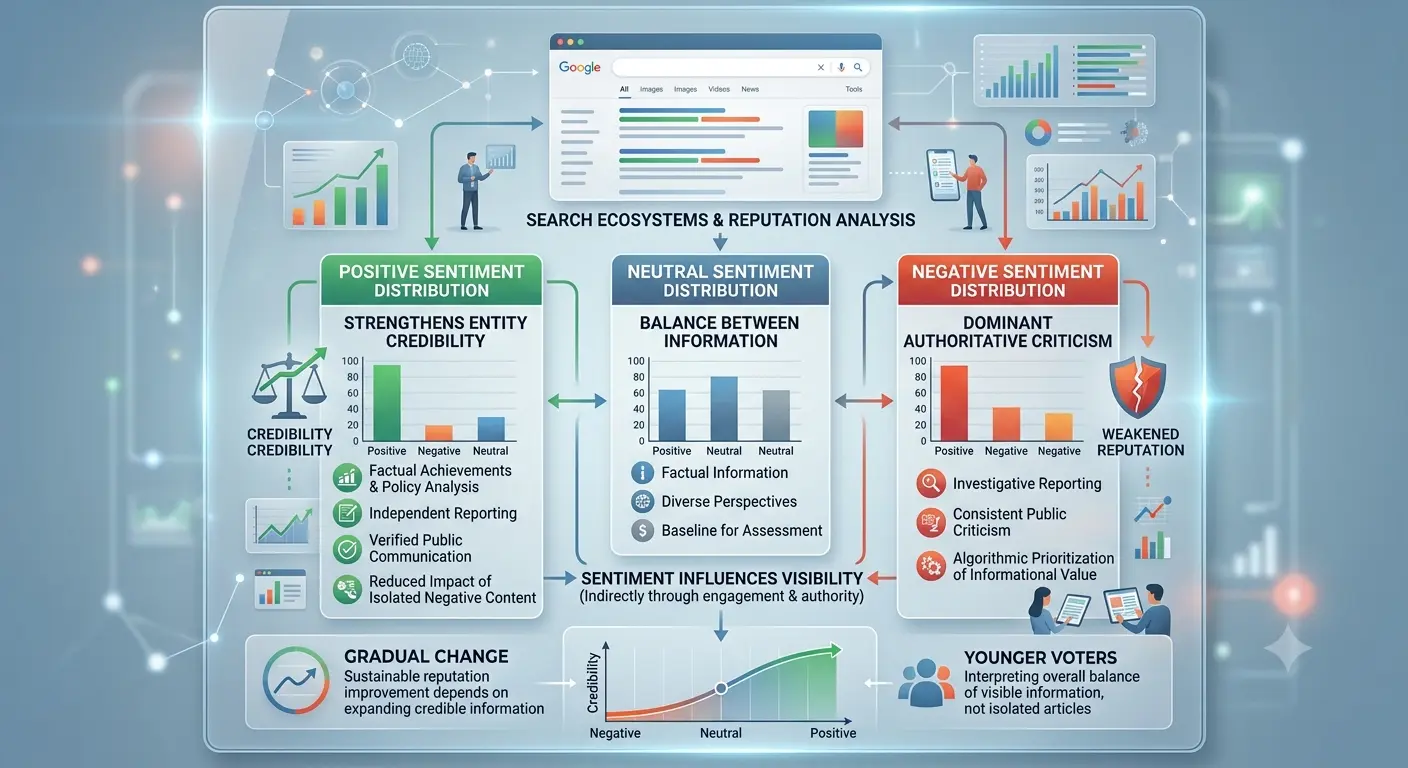
Review management operates differently from review generation. Management involves monitoring existing feedback, identifying recurring themes and ensuring responses remain accurate and professionally relevant. Generating artificial reviews or manipulating sentiment undermines information integrity and introduces reputational and platform-policy risks. Authentic review acquisition provides a more sustainable information base because the underlying feedback reflects actual customer experiences. Evaluation therefore focuses on the quality and consistency of review signals rather than simply increasing numerical volume.
How does profile optimisation compare with review management?

Profile optimisation strengthens the informational foundation of a comparison-site presence, while review management strengthens experiential reputation signals. Profile optimisation operates through accurate business descriptions, relevant categories, complete service information and consistent entity data. Review management operates through monitoring customer feedback, analysing sentiment and responding appropriately to legitimate reviews. The first establishes what the business is and does, while the second provides evidence about how customers perceive their experience. Both contribute to entity credibility through different mechanisms.
Profile optimisation often provides stronger control because businesses directly manage much of the information contained within their own profiles. Review content has less direct control because it originates from external users and is governed by platform policies. This creates a key limitation of review-focused strategies: reputation signals depend partly on external participation. Profile optimisation also has limitations because accurate information does not guarantee prominent placement within a competitive category. A comparative strategy therefore evaluates informational control alongside external reputation factors.
How do organic and reactive approaches differ on comparison sites?
Organic approaches build reputation and visibility progressively through accurate information, authentic reviews and consistent digital presence. Reactive approaches respond to defined problems such as inaccurate profiles, negative reviews, incorrect categorisation or sudden ranking changes. Organic activity creates a broader information foundation, while reactive activity addresses specific reputation risks. The two approaches differ primarily in timing, scope and control. A complete evaluation considers how each approach affects both immediate visibility and long-term sustainability.
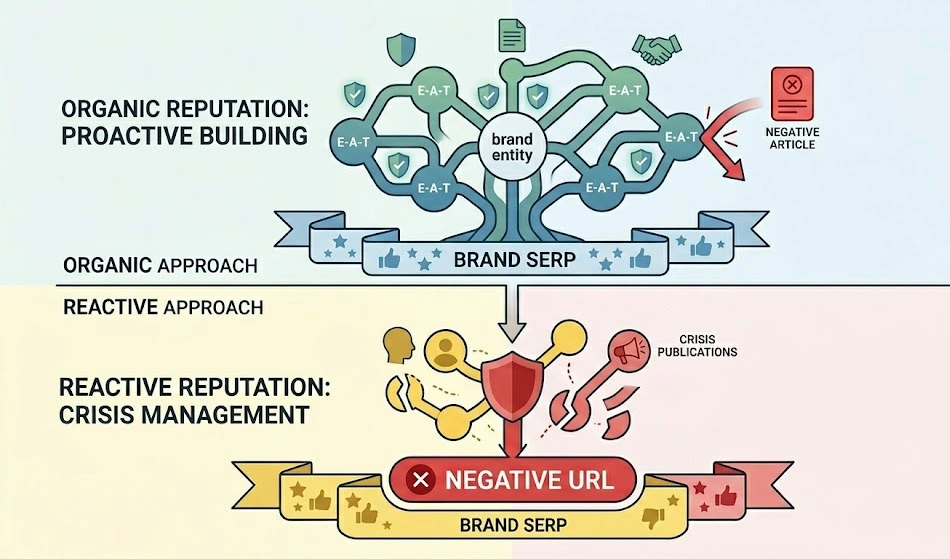
Organic reputation development has greater sustainability because it strengthens the underlying information environment rather than depending entirely on individual interventions. Reactive management provides greater immediacy when a specific problem requires attention. However, reactive action without broader profile optimisation leaves structural weaknesses unresolved. Conversely, organic optimisation without monitoring can fail to identify emerging reputation risks. The strongest analytical framework therefore treats organic and reactive methods as complementary mechanisms.
Which approach provides better short-term ranking improvements?
Targeted profile corrections and platform-specific optimisation provide the clearest short-term opportunities when a ranking problem results from inaccurate or incomplete information. A correction can directly address category mismatch, missing service information or inconsistent business details. The platform then processes the updated information according to its own ranking system. This creates a measurable connection between the intervention and the affected profile. However, short-term ranking movement remains dependent on platform evaluation and competitive conditions.
Long-term ranking improvement requires broader reputation signals and sustained informational relevance. A profile with accurate information still competes against entities with stronger reviews, authority and platform engagement signals. Continuous optimisation therefore creates a more durable basis for visibility than a one-time correction. Short-term interventions are useful for defined technical or informational issues, while long-term strategies address the wider competitive environment. Comparing the two requires separating immediate ranking movement from sustainable search visibility.
How does content suppression influence SERP composition?
Content suppression influences SERP composition by reducing the prominence or availability of a specific information source where a valid suppression mechanism applies. SERP composition refers to the distribution of result types, entities and sources appearing for a particular search query. Removing or suppressing one result changes the available information environment, but it does not determine which replacement result appears. Search engines independently recalculate rankings and retrieve alternative documents. Suppression therefore changes one component of the SERP rather than providing direct control over the complete results page.
Content enhancement addresses the other side of this equation by strengthening relevant alternative information. Publishing accurate content, improving authoritative profiles and developing useful resources increases the amount of information available for search engines to evaluate. This creates a broader information environment around the business entity. The combination of suppression and enhancement therefore addresses both negative visibility and insufficient positive context. A reputation strategy that relies exclusively on suppression lacks the content foundation required for sustainable SERP influence.
Dive Deeper With Our Expert Guides:
Insulating Company Reputation From Founder and Executive Controversy
Backing Up ESG and Sustainability Claims to Avoid Greenwashing Backlash
How does entity consistency affect B2B comparison rankings?
Entity consistency improves informational clarity by ensuring that business identity and attributes remain aligned across digital sources. Entity consistency refers to the agreement of core information such as business name, services, category, location and professional description across relevant platforms. Search systems use these relationships to understand whether information belongs to the same business entity. Comparison platforms also rely on structured information when organising profiles and categories. Contradictory data introduces ambiguity within this entity framework.
Consistency also affects user trust because buyers cross-check information between comparison sites and company-owned resources. A mismatch in service descriptions or business identity creates additional verification work during supplier research. Accurate and consistent information reduces this friction by providing a coherent representation across sources. The effect is not limited to ranking because entity clarity also contributes to credibility and perception. Reputation analysis therefore measures consistency as both a search signal and an informational trust factor.
How does authority influence comparison-site visibility?
Authority influences comparison-site visibility through the credibility and topical relevance of the source publishing or representing the business. A high-authority comparison platform has stronger visibility potential than an unrelated or weakly established directory because its pages possess greater search relevance within particular topics. Authority is not equivalent to popularity; it reflects the informational strength and contextual relevance associated with a source. Search engines evaluate these factors when determining which comparison pages appear in SERPs. Platform authority therefore affects the visibility of the comparison environment surrounding an entity.
Business-level authority also develops through consistent evidence across digital sources. Relevant publications, professional references, high-quality profiles and detailed expertise information provide contextual signals around an entity. These signals help create a stronger information network rather than relying on one isolated profile. However, authority does not override platform-specific ranking rules. A business still needs relevant categories, accurate profile information and credible reviews to compete effectively within the comparison platform itself.
How scalable are different reputation management methods?
Content optimisation is generally more scalable than source-level suppression because one structured information system can support multiple queries and platforms. A well-organised profile framework can be adapted across relevant comparison sites while maintaining consistent entity information. Review monitoring also scales through systematic collection and sentiment analysis, although the underlying reviews remain externally generated. Suppression is less scalable because each problematic source requires individual assessment and an applicable intervention mechanism. Scalability therefore depends on whether the strategy operates at the information-system level or source level.
A scalable approach also requires standardised measurement. Businesses can track profile completeness, category positioning, review sentiment, ranking movement and source visibility across a defined set of platforms. Standardised metrics make it easier to identify recurring weaknesses and compare changes over time. This creates an operational framework for reputation management rather than isolated manual actions. Scalability improves when the same analytical process applies across multiple entities, platforms and search queries.
What risks affect B2B comparison-site ranking strategies?
The principal risks involve inaccurate information, artificial review activity, platform-policy violations and overreliance on ranking assumptions. Inaccurate profile information can weaken entity consistency and reduce the clarity of the business’s digital footprint. Artificial reviews create integrity concerns and can result in platform action when detected. Over-optimisation can also produce descriptions that prioritise keywords without providing useful information to users. Risk evaluation therefore considers information quality alongside ranking objectives.
Another risk involves treating comparison-site rankings as permanent assets. Platform algorithms change, competitors update profiles and review distributions evolve over time. A ranking achieved under one set of conditions can therefore change without any modification to the business profile. Sustainable reputation management accounts for this volatility through monitoring rather than assuming permanent ranking control. Risk mitigation requires continuous evaluation of platform visibility, reputation signals and SERP composition.
How can businesses measure whether comparison-site optimisation is effective?
Businesses can measure effectiveness through ranking position, profile visibility, review sentiment, profile completeness and changes in relevant search-result exposure. Ranking position measures where the business appears within the platform’s own category or search system. Profile visibility measures whether users encounter the profile for commercially relevant searches. Review sentiment analyses the distribution and context of positive, neutral and negative feedback. These metrics provide distinct evidence rather than reducing reputation performance to one number.
A structured measurement framework can follow four actions:
- Record platform rankings by tracking the business position for defined category and service searches at consistent intervals.
- Analyse profile completeness by checking service descriptions, categories, business information and other platform-specific fields.
- Measure review sentiment by evaluating rating patterns, written feedback and recurring customer themes without relying solely on aggregate scores.
- Compare SERP visibility by monitoring whether comparison pages appear for relevant search queries and how their positions change over time.
These measurements separate platform performance from broader search visibility. A profile can improve internally while its comparison page remains unchanged in Google. Conversely, a comparison page can gain search visibility while the business’s internal platform position remains stable. Effective evaluation therefore measures both systems independently.
Is long-term reputation management more sustainable than one-time optimisation?
Long-term reputation management is more sustainable because comparison-site visibility depends on information that changes continuously. New reviews alter sentiment distribution, competitors update profiles and platforms revise ranking criteria. A one-time optimisation establishes an initial information structure but does not account for future changes. Ongoing monitoring identifies these changes and provides a basis for further optimisation. Sustainability therefore comes from maintaining informational accuracy rather than completing a single optimisation task.
Long-term management also reduces dependence on one reputation signal. A business supported by accurate profiles, authentic reviews, consistent entity information and relevant external references has a broader reputation foundation. If one signal changes, the overall information environment retains additional sources of evidence. This creates greater resilience than relying entirely on review volume or a single comparison ranking. Sustainability is therefore measured through the stability and diversity of reputation signals over time.
Which strategy best balances effectiveness, risk and sustainability?
A balanced strategy combines profile optimisation, authentic review management, source-level correction and ongoing monitoring. Profile optimisation establishes accurate entity information, while legitimate review management develops experiential reputation signals. Source-level intervention addresses specific inaccuracies or inappropriate content where applicable. Monitoring then measures ranking movement, sentiment distribution and search visibility across the relevant ecosystem. This combination distributes risk rather than relying on one mechanism.
The appropriate balance depends on the underlying reputation problem. A profile-data issue requires a different intervention from a negative review pattern or weak comparison-site visibility. Content enhancement provides broader scalability, while suppression provides targeted control over defined sources. Organic development supports sustainability, while reactive intervention addresses immediate risks. Strategy selection therefore depends on diagnosis, measurable objectives and the characteristics of the platform being evaluated.
How should businesses evaluate their B2B comparison-site strategy?
Businesses should evaluate their strategy according to four dimensions: effectiveness, scalability, risk exposure and sustainability. Effectiveness measures whether ranking and visibility objectives are being achieved. Scalability examines whether the process can operate across multiple platforms and information sources without disproportionate effort. Risk exposure measures the potential consequences of inaccurate information, artificial reputation activity or dependence on platform-specific mechanisms. Sustainability evaluates whether improvements remain supported as reviews, rankings and search systems change.
The most reliable evaluation framework connects each intervention to a defined reputation signal. Profile optimisation relates to entity consistency and relevance, review management relates to sentiment distribution, content enhancement relates to search visibility and source-level intervention relates to content suppression. This mapping makes strategic decisions more transparent. It also prevents unrelated metrics from being interpreted as evidence of success. A comparison-site strategy becomes more measurable when every action has a corresponding mechanism and outcome.
What is the most effective way to influence B2B comparison-site visibility?
The most effective approach combines accurate entity information, platform-specific optimisation, authentic reputation signals and continuous measurement. No single tactic guarantees a higher position because comparison platforms and search engines control their respective ranking systems. Profile relevance establishes the foundation, reviews provide experiential evidence and external authority strengthens contextual credibility. Monitoring then identifies changes in ranking and search perception. The result is an integrated strategy rather than an isolated ranking tactic.
The central distinction is between influencing information and controlling rankings. Businesses can influence the accuracy, completeness and quality of information associated with their entity, but ranking positions remain determined by independent platform and search algorithms. This distinction creates realistic expectations and reduces strategic risk. A sustainable approach therefore prioritises information quality, reputation signal strength and entity clarity while measuring ranking outcomes over time.
Rank Higher on B2B Comparison Sites represents the decision-stage continuation of this analysis, where comparison-site optimisation moves from evaluation of mechanisms towards implementation considerations. The underlying principles remain the same: strengthen relevant information, maintain authentic reputation signals, improve entity consistency and measure changes in visibility systematically.
How can businesses improve their ranking on B2B comparison and review sites?
Businesses can improve their ranking by maintaining accurate company information, encouraging genuine customer reviews, and responding professionally to feedback. Consistent service quality and positive review activity can strengthen visibility across B2B comparison platforms.
What factors influence rankings on B2B review sites?
B2B review site rankings may be influenced by review volume, review quality, recency, customer engagement, company information, and platform-specific ranking criteria. Each comparison and review site may use different signals to determine visibility.
How do customer reviews affect B2B comparison site rankings?
Customer reviews can influence how a business is perceived and may contribute to its visibility on B2B comparison platforms. Recent, authentic, and detailed reviews generally provide stronger evidence of customer experience than outdated or limited feedback.
Can responding to negative reviews improve a B2B company’s online reputation?
Responding to negative reviews can demonstrate accountability and provide context for prospective customers evaluating a business. Clear, professional responses may also help protect the company’s online reputation and support a more balanced review profile.
How can Clear My Name help businesses manage their presence on B2B review sites?
Clear My Name can assess how a business appears across B2B comparison and review platforms and identify reputation-related issues affecting search perception. Reviewing company information, customer feedback, and search visibility can help businesses develop a more consistent online presence.