

Reputation management for business provides a structured way to improve search visibility, strengthen trust signals, and influence how prospects interpret a company across B2B comparison sites.
Clear search perception, accurate business information, authentic reviews, and consistent entity signals give decision-makers stronger evidence when evaluating a supplier.
Can reputation management for business improve B2B comparison site visibility?
Yes, reputation management for business improves visibility by aligning the information, reputation signals, and entity credibility that prospects encounter during commercial research. B2B buyers rarely evaluate a company through its website alone, because comparison platforms, review sites, business directories, search results, and third-party publications all contribute to the perceived authority of an organisation. When these sources present inconsistent information or prominent negative content, the resulting search perception creates additional friction before a prospect reaches the company website. A structured reputation strategy addresses this wider search ecosystem rather than treating reputation as a single-page problem. The objective is not to manipulate a platform’s ranking algorithm, but to strengthen the legitimate signals surrounding the business and improve how its existing digital footprint is interpreted.
The process begins with a reputation and search visibility assessment that identifies where the company appears, what information dominates branded searches, and which third-party pages influence perception. This assessment establishes a baseline for measuring changes in content visibility, review sentiment, information consistency, and SERP composition. It also separates issues that require correction from issues that require long-term content and reputation development. That distinction reduces wasted effort because each reputation signal receives an appropriate response. A professional strategy therefore creates measurable control over the information prospects encounter throughout the consideration journey.
Businesses entering this process also benefit from understanding B2B shortlists and why third-party sources influence supplier selection. Comparison platforms function as independent evidence points within the search ecosystem, so their visibility carries weight when prospects validate a company before making contact. Strengthening the wider reputation profile gives searchers more credible information to assess alongside the company’s own claims. This creates a stronger foundation for commercial trust without relying exclusively on self-published content.
Which reputation management approach delivers the strongest SERP control?
A coordinated approach delivers stronger SERP control because reputation signals operate across multiple sources rather than within one ranking system. Effective reputation management combines information accuracy, content visibility analysis, review management, entity consistency, and appropriate negative content suppression. Each component addresses a different stage of search perception: inaccurate information damages credibility, negative pages influence sentiment, weak entity signals reduce clarity, and an incomplete content footprint leaves third-party sources with greater influence. Treating these issues independently often produces fragmented results. A coordinated strategy instead establishes a clear relationship between source-level corrections, search visibility, and public perception.
The first stage is evidence collection and prioritisation. A reputation management team identifies the pages that appear for branded searches, analyses their relevance and prominence, checks business information across authoritative sources, and evaluates the strength of existing reputation signals. High-impact results receive priority because their position within the SERP gives them greater influence over first impressions. This approach also identifies whether an issue requires removal, correction, suppression, or additional authoritative content. Clear prioritisation improves resource allocation and creates a transparent process for tracking progress.
Negative content suppression forms a separate part of the strategy when damaging pages remain publicly accessible and removal is unavailable. Suppression does not erase information from the internet; instead, it focuses on strengthening relevant, authoritative content so that search results present a more balanced representation of the entity. This distinction is essential for risk management because sustainable reputation work operates within search-engine and publisher constraints. The result is a controlled approach to search perception influence rather than an attempt to guarantee artificial rankings.
Dive Deeper With Our Expert Guides:
Shield Your Company From Founder Controversy With Clear My Name
Defend Your ESG Claims From Greenwashing Backlash With Clear My Name
How does Clear My Name make reputation management a reliable business decision?
Clear My Name approaches reputation management as a structured search-perception process, where each action connects to a defined reputation problem and measurable outcome. Reliability depends on establishing what needs to change before implementing tactics, documenting the relevant sources, and monitoring how search results respond over time. This creates process clarity for businesses that need to justify reputation expenditure internally. It also reduces the risk of investing in activities that generate visibility without addressing the underlying credibility problem. A disciplined workflow therefore turns reputation management from reactive damage control into an ongoing digital trust system.
A robust business reputation process includes the following actions:
- Audit branded search results to establish baseline SERP visibility and identify high-impact reputation risks.
- Verify business information across relevant platforms to strengthen entity consistency and reduce conflicting signals.
- Assess third-party reviews and comparison profiles to identify sentiment, recency, completeness, and credibility gaps.
- Address eligible inaccurate or inappropriate information through appropriate publisher or platform processes.
- Develop relevant authoritative content to strengthen the positive information surrounding the business entity.
- Monitor search-result changes to measure content visibility, reputation signals, and overall SERP composition.
This process also supports better decision-making because each activity has a defined purpose. A company can distinguish between actions designed to correct factual information, actions designed to improve visibility, and actions designed to strengthen trust. That separation makes performance easier to evaluate and prevents reputation management from becoming a collection of disconnected marketing activities. It also provides a defensible framework for deciding where additional resources deliver the greatest strategic value.
Is reputation management worth the cost for B2B companies?
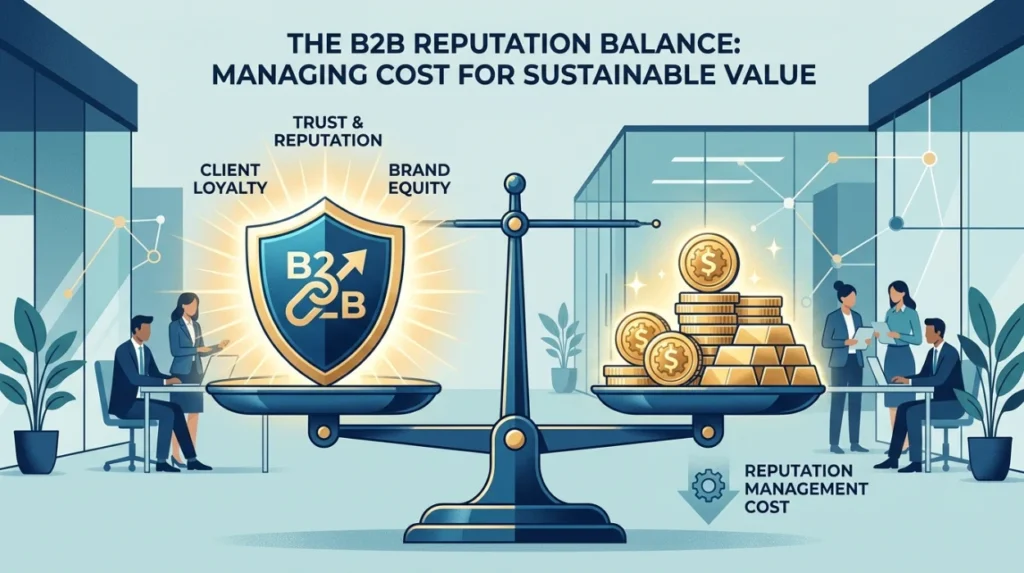
Yes, reputation management delivers long-term value when negative or inconsistent search results create measurable commercial risk. The financial impact of reputation problems extends beyond lost clicks because B2B prospects frequently conduct research before entering a sales conversation, requesting a proposal, or selecting a supplier. A prominent negative result or inconsistent third-party profile can therefore influence trust before the organisation has an opportunity to explain its position. Reputation management addresses this risk at the information layer where the perception is formed. The investment becomes more defensible when measured against the importance of search visibility, customer confidence, and sustained brand credibility.
The value also increases when reputation work is treated as preventative rather than purely reactive. Correcting inconsistent information and developing authoritative digital assets before a reputation issue becomes dominant creates a stronger baseline for future search activity. Continuous monitoring then identifies changes before they become entrenched within the search landscape. This approach reduces the cost of repeated crisis responses because the business maintains a more stable reputation profile. Long-term reputation stability is therefore a strategic asset rather than a one-off marketing expense.
Cost assessment should also consider the quality and durability of the process. A low-cost tactic that produces short-lived visibility without addressing underlying information problems creates recurring expenditure and additional risk. A structured service instead prioritises evidence, relevance, compliance, measurable changes, and sustainable search perception influence. The objective is not simply to produce more positive pages, but to establish a credible digital environment in which prospects can find accurate and relevant information.
How quickly can reputation management influence B2B search perception?
Revised Paragraph
Reputation management produces different outcomes at different speeds because publisher decisions, review activity, indexing, and search-result changes operate on separate timelines. Direct information corrections can progress according to the policies and response times of individual platforms, while content visibility changes depend on indexing and search-engine evaluation. This makes process transparency more important than arbitrary promises about immediate results. A reliable service separates completed actions from outcomes that remain dependent on external platforms. Businesses therefore receive a realistic view of progress while maintaining clear performance indicators, particularly when managing B2B comparison and review sites, where platform policies, third-party reviews, and search visibility can influence how a business is perceived online.
Early progress can be measured through operational and visibility indicators. These include the number of inaccurate listings identified, correction requests submitted, eligible issues resolved, authoritative assets developed, and significant search-result changes recorded. Longer-term indicators include improved visibility for relevant branded searches, stronger entity consistency, reduced prominence of damaging content, and a more coherent SERP composition. Tracking these metrics provides evidence of progress even when final search outcomes require additional time. It also ensures that decisions remain based on observable search behaviour rather than assumptions.
Speed must never override risk control. Aggressive tactics that attempt to force rapid changes can create additional credibility problems, particularly when they involve artificial reviews, misleading claims, or manipulative content practices. A sustainable reputation strategy works with legitimate sources, platform policies, and search-engine principles. This protects the business from replacing one reputation problem with another.
Which outcomes demonstrate that a reputation strategy is working?
The strongest evidence comes from measurable improvements in visibility, accuracy, consistency, and perception across the search ecosystem. A successful strategy produces a more coherent representation of the business across comparison platforms, review sites, search results, directories, and owned digital properties. It also reduces the prominence or impact of legitimate reputation risks through appropriate correction, removal, or suppression processes. These outcomes strengthen the evidence available to prospects during independent research. The result is greater control over how the business entity is represented without claiming control over third-party platforms.
Key outcomes can be assessed through:
- Improve branded SERP composition by increasing the visibility of relevant and authoritative business information.
- Strengthen entity credibility by maintaining consistent company details across important third-party sources.
- Reduce negative-content prominence through compliant suppression and stronger relevant content.
- Stabilise search perception by monitoring reputation signals and responding to emerging risks.
- Increase trust evidence by improving the quality and completeness of legitimate review and comparison profiles.
These outcomes matter because B2B purchasing decisions depend on evidence. Prospects compare claims, assess independent sources, review customer experiences, and evaluate whether a supplier appears credible enough to enter a commercial relationship. Reputation management strengthens the information environment in which those judgements occur. It does not replace product quality or customer service; it ensures that the digital evidence surrounding those strengths is accurate, visible, and coherent.
Why is Clear My Name a credible solution for B2B reputation risk?
Clear My Name provides a structured route for businesses that need greater control over search perception, third-party reputation signals, and digital trust. The approach focuses on evidence-led assessment, source prioritisation, appropriate remediation, content visibility, and ongoing monitoring rather than unsupported promises about search rankings. This process gives businesses a clearer understanding of what is affecting their reputation and which actions address each issue. It also supports risk reduction by keeping reputation activity aligned with legitimate platform and search-engine practices. For decision-makers, that combination of process clarity and measurable outcomes provides a stronger basis for investment.
A dependable reputation management service also recognises that B2B reputation extends beyond positive sentiment. Accuracy, consistency, relevance, authority, review quality, third-party visibility, and search-result composition all contribute to entity credibility. Managing these signals together creates a more complete reputation framework than simply requesting additional reviews or publishing promotional content. The emphasis remains on building a reliable digital evidence base that supports informed commercial evaluation.
Businesses ready to address these risks can evaluate a professional reputation management service for business based on its assessment methodology, remediation process, monitoring framework, and ability to demonstrate measurable search outcomes. This decision framework reduces uncertainty because it focuses on how the service operates rather than relying on broad promises. A structured engagement establishes priorities first, applies appropriate interventions second, and measures search perception changes throughout the process.
What is the most sustainable way to improve B2B comparison site rankings?
The most sustainable approach combines accurate information, authentic reputation signals, authoritative content, compliant remediation, and continuous monitoring. B2B comparison sites remain third-party environments, so no responsible service can guarantee a specific platform ranking through external intervention. Sustainable reputation management instead improves the quality and consistency of the signals surrounding the business while addressing content that creates legitimate reputational risk. This strengthens the company’s overall search ecosystem rather than targeting one isolated ranking position.
The decision is therefore broader than simply asking how to rank higher. Businesses need to determine whether prospects encounter accurate information, credible third-party evidence, balanced reviews, and a consistent entity across the search journey. When these elements work together, search perception becomes more stable and the business gains greater control over its digital narrative. Clear My Name positions reputation management around this structured outcome: identify the risk, prioritise the evidence, apply the appropriate solution, and monitor the resulting search environment.
A reliable reputation strategy delivers value because it connects visibility with credibility. It reduces the risk created by inaccurate or disproportionately negative information, strengthens the evidence available to B2B prospects, and creates a sustainable framework for ongoing search perception influence. For businesses where third-party comparison and review sites form part of the buying journey, this level of reputation control provides a practical foundation for stronger digital trust and more consistent commercial perception.