

Voter trust is measured by aggregating qualitative sentiment data and quantitative search visibility metrics to track shifts in entity credibility over time. Political reputation management strategies differ based on whether a campaign prioritises proactive digital footprint footprint optimization or reactive content suppression to manage public perception.
Why Does Measuring Voter Trust Require a Dual Analysis of Public Polling and Search Engine Results?
Measuring voter trust requires a dual approach because traditional polling captures self-reported intent at a single point in time, whereas search engine results reflect real-time, unprompted information-seeking behaviour. Traditional polling methods evaluate explicit sentiment distribution through structured questionnaires, providing a baseline for demographic support. Search engine results pages (SERPs) operate as a continuous feedback loop of implicit voter interest, where algorithmic rankings amplify specific narrative signals.
Search engine algorithms interpret high search volumes coupled with specific negative modifiers as indicators of rising public interest or concern. When a voter searches for a political candidate, the composition of the first page of results shapes their immediate perception of that candidate’s authority. Relying solely on polling data creates a strategic blind spot regarding the digital narrative. Combining polling insights with search visibility analysis allows campaign teams to observe not just what voters say to pollsters, but what information they actively consume online.
How Do Organic Content Enhancement and Reactive Content Suppression Strategies Compare in Impact?
Organic content enhancement is the systematic creation and distribution of high-authority, optimized assets designed to populate search results with positive or neutral information about an entity. This method operates by establishing a robust semantic network of interconnected digital properties, such as official websites, authoritative policy papers, and verified profiles. The mechanism relies on search engine preferences for comprehensive, structured data that directly answers user queries. Over the long term, content enhancement builds resilient search visibility that withstands sudden influxes of negative news by occupying high-ranking positions with stable, controlled assets.
Reactive content suppression operates by identifying legal, technical, or algorithmic mechanisms to de-index or demote harmful online material after it has appeared. This approach utilizes regulatory frameworks, copyright claims, or terms of service violations to remove content from search indexes entirely. While suppression provides immediate risk mitigation for specific reputational threats, its scalability is limited by legal boundaries and the speed of digital replication. A comparative analysis indicates that content enhancement offers sustainable entity credibility, whereas reactive suppression addresses immediate crisis points without altering the underlying sentiment distribution.
What Mechanisms Do Search Engines Use to Interpret Political Reputation Signals?
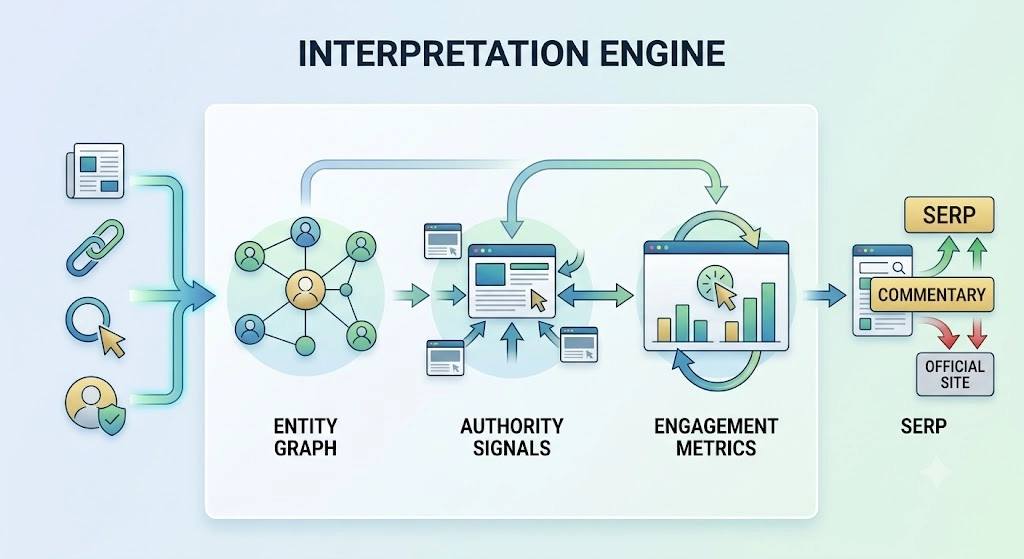
Search engines interpret political reputation signals through a combination of entity recognition, link equity analysis, and user engagement metrics. Entity recognition systems map relationships between people, organizations, and concepts within a digital knowledge graph. When authoritative news outlets frequently associate a politician’s name with specific policy topics, search algorithms update the entity’s profile to reflect these associations.
Link equity analysis evaluates the quality and quantity of inbound links directing to an entity’s digital properties. High-authority domains linking to a candidate’s platform serve as strong validation signals, increasing the search ranking influence of those properties. User engagement metrics, including click-through rates and dwell time on specific search results, signal to the algorithm whether the provided content satisfies the user’s intent. If users consistently bypass official campaign sites in favour of third-party commentary, search engines adjust the SERP composition to prioritize the third-party sources.
How Does Short-Term Crisis Management Differ From Long-Term Digital Footprint Optimisation?
Short-term crisis management focuses on immediate containment and narrative diversion during a sudden surge of negative public perception. This methodology deploys rapid-response content publishing, real-time social listening, and direct press counters to flood search ecosystems with alternative narratives. The primary objective is to alter the immediate sentiment distribution on highly visible channels during critical campaign windows. The limitation of this approach is its lack of structural sustainability, as temporary content waves often recede once public attention shifts, allowing original negative signals to resurface.
Long-term digital footprint optimisation establishes a permanent, authoritative online infrastructure capable of absorbing reputational shocks. This strategy constructs a dense network of verified digital assets, comprehensive biographical entries, and consistent topical authority across relevant political issues. Optimisation operates by aligning all digital properties with schema markup and structured data principles to ensure clear algorithmic interpretation. The process requires continuous investment over months or years, resulting in stable search rankings that resist algorithmic fluctuations and volatile public sentiment.
| Feature | Short-Term Crisis Management | Long-Term Digital Footprint Optimisation |
| Primary Focus | Immediate containment and narrative diversion | Permanent structural authority and resilience |
| Mechanism | Rapid-response publishing and press counters | Schema markup, structured data, network density |
| Search Impact | Temporary shift in immediate sentiment distribution | Stable ranking positions across core entity queries |
| Risk Profile | High exposure to narrative resurgence | Low exposure due to entrenched digital assets |
What Evaluation Framework Best Measures the Effectiveness of Reputation Control Methods?
An effective evaluation framework measures the performance of digital trust systems across quantitative visibility metrics and qualitative perception indicators. Campaigns must systematize their analytical processes to ensure data accuracy before drawing strategic conclusions.
Quantitative Visibility Metrics
- Track the percentage share of search results controlled by official or neutral assets across the first three pages of search results.
- Monitor fluctuations in search volume for negative keyword modifiers associated with the core political entity.
- Quantify the growth of high-authority inbound links directing to controlled digital properties to evaluate structural search ranking influence.
Qualitative Perception Indicators
- Categorise the sentiment distribution of top-ranking articles into positive, neutral, or negative classifications.
- Analyse the prominence of algorithmic features, such as “People Also Ask” boxes, to identify shifting voter concerns.
- Assess the stability of the entity’s position within major digital knowledge graphs to confirm long-term entity credibility.
How Do Campaign Life Cycles Influence the Selection of Trust Measurement Tools?
The selection of trust measurement tools shifts significantly between the pre-campaign phase and the active election period due to changing data volatility. During the pre-campaign phase, search volumes are stable, allowing for deep baseline assessments of entity credibility and sentiment distribution. Tools selected during this period focus on mapping the existing digital footprint, identifying structural vulnerabilities in search results, and benchmarking competitor authority. The analytical focus rests on long-term trends rather than daily fluctuations.
Once an active campaign begins, data volatility increases exponentially as news cycles accelerate and public interest peaks. Measurement tools must transition to real-time tracking of search visibility, immediate SERP composition changes, and rapid shifts in user query modifiers. The utility of long-term trend analysis declines in favour of hourly alert systems and instant sentiment tracking. Selecting the appropriate tool requires balancing the depth of historical data analysis needed before a campaign with the processing speed required during active voting windows.
What Structural Strategic Considerations Govern Political Trust Systems?
Political trust systems are governed by the interplay between algorithmic compliance, narrative consistency, and risk exposure. Every digital asset deployed by a campaign must adhere to strict technical search engine guidelines to maintain its ranking capability. Inconsistencies in biographical data or structural errors in web development dilute the authority signals sent to search engines, reducing overall visibility. Furthermore, strategic planning must account for the reality that complete control over digital narratives is structurally impossible due to the independent nature of journalistic publishing and user-generated content.
Campaigns must evaluate whether their digital infrastructure possesses the density required to withstand coordinated oppositional campaigns or sudden negative press. Prioritising resources toward building independent, authoritative platforms reduces dependence on third-party channels that are subject to rapid algorithmic changes. Strategic long-term success rests on treating digital perception as an asset that requires continuous maintenance rather than a temporary project executed only during election cycles.
To ensure comprehensive protection against digital volatility, organisations often integrate dedicated political trust and credibility management services into their broader operational frameworks.
Measuring and managing voter trust requires an analytical understanding of how search engine algorithms process reputation signals alongside traditional public polling. Proactive methods focused on long-term digital footprint optimisation offer the highest levels of scalability and sustainability by building structural resilience into search engine results. Conversely, reactive content suppression serves as a necessary but limited tool for immediate risk containment during active crises. Successful strategy relies on establishing a permanent framework of authoritative digital assets that maintain entity credibility regardless of shifting campaign dynamics.

Frequently Asked Questions
How do you measure voter trust in a political candidate?
Measuring voter trust involves analyzing public polling data alongside digital reputation signals, such as search engine visibility and sentiment distribution. By tracking changes in user query modifiers and the prominence of authoritative assets in search engine results pages (SERPs), campaign teams can quantify public perception. Clear My Name utilizes search perception analysis to monitor these shifts, providing an objective view of a candidate’s real-time entity credibility.
What is the role of reputation management for politicians during election campaigns?
Reputation management for politicians secures long-term digital footprint optimization to ensure authoritative, positive narrative assets outrank volatile or misleading content. This process relies on search engine optimization (SEO) techniques, structured data, and content enhancement to reinforce a politician’s policy authority. Implementing these strategic trust frameworks mitigates risk exposure from sudden media crises and stabilizes public perception during critical voting windows.
How do search engines interpret political reputation signals?
Search engines interpret political trust through semantic algorithms that analyze entity recognition, link equity, and user engagement metrics. When high-authority news platforms frequently associate a politician’s name with specific digital assets, search engines update the entity’s profile in their knowledge graphs. If voters consistently engage with verified candidate platforms, search algorithms adjust the SERP composition to prioritize those trusted sources.
Can online reputation control methods remove negative news from search results?
Online reputation control methods can suppress or demote negative material by deploying content suppression strategies or utilizing legal de-indexing frameworks like copyright or privacy regulations. However, long-term sustainability is achieved through proactive content enhancement, which populates search results with resilient, controlled digital properties. Clear My Name advises balancing immediate reactive suppression with continuous structural digital footprint optimization to protect entity credibility.
How does sentiment distribution affect voter perception online?
Sentiment distribution determines the ratio of positive, neutral, and negative information a voter encounters when researching a candidate on search engines. A SERP dominated by unverified or adversarial narratives weakens entity credibility and actively erodes voter trust before election campaigns. Managing this balance requires continuous monitoring of algorithmic features, such as “People Also Ask” boxes, to counter negative search ranking influence with authoritative resources.