

Online reputation refers to the collective digital footprint, algorithmic interpretations, and public perceptions that define an entity within search engine ecosystems. Within political landscapes, voter trust operates as a measurable currency that establishes algorithmic authority, dictates search visibility, and controls entity perception during critical electoral cycles.
How Does Search Visibility Form the Foundation of Voter Trust?
Search visibility defines the prominence and accessibility of an entity’s digital assets within Search Engine Results Pages (SERPs). In modern political communications, search visibility serves as the primary mechanism through which information is filtered, ranked, and presented to the electorate. When voters search for a candidate, political party, or policy initiative, the configuration of the first page of results establishes the baseline for public perception. Algorithms determine prominence based on relevance, user engagement metrics, and historical query data. High search visibility for authoritative, verified sources prevents the proliferation of unverified narratives and ensures that accurate entity data dominates the informational ecosystem.
The mechanism of search visibility operates through crawlability, indexing, and algorithmic sorting. Search engine spiders continuously parse web pages to map the relationships between political entities and specific topics, policies, or controversies. If an entity maintains a fragmented digital footprint, algorithms struggle to synthesize a cohesive entity profile, which reduces visibility for primary key phrases. Consequently, maintaining absolute control over first-party platforms ensures that search engines index precise data points. This indexing consistency directly influences whether an electorate encounters balanced analyses or heavily biased third-party commentary during standard search queries.
Search perception control relies entirely on the structural alignment of web assets with algorithmic preferences. When search engines evaluate a political entity, they measure the historical stability of the content associated with that entity’s name. Sudden spikes in negative sentiment or unverified news reports can alter the SERP layout, introducing elements like “People Also Ask” blocks or “Top Stories” carousels. These dynamic SERP features drastically alter user interaction patterns, often diverting traffic away from official communications. Therefore, search visibility is not merely a technical metric, but the foundational layer that dictates which information informs voter consciousness.
What Role Do Reputation Signals Play in Algorithmic Evaluation?
Reputation signals are quantifiable data points that search engine algorithms extract from digital content to evaluate the credibility, authority, and trustworthiness of an entity. Within search ecosystems, algorithms treat these signals as proxy measurements for offline public trust. Reputation signals include backlink profiles, digital mentions, historical domain authority, and sentiment metrics embedded within journalistic coverage. Algorithms continuously aggregate these signals to construct a trust score that determines how reliably an entity’s content ranks above competing narratives during high-stakes search events.
Inbound Link Analysis
Inbound links function as digital endorsements from independent domains to an entity’s primary web properties. Search engine algorithms evaluate the authority of the referring domain, the anchor text utilized, and the contextual relevance of the linking page. High-quality backlinks from academic institutions, government portals, and established news agencies signal to the algorithm that the entity possesses verified topical authority.
Semantic Mention Mapping
Semantic mention mapping involves the algorithmic tracking of an entity’s name across third-party platforms without the presence of direct hyperlinks. Search engines utilize natural language processing (NLP) to analyse the surrounding context, adjectives, and nouns associated with the political entity. This process determines whether the overall digital footprint skews toward positive, neutral, or negative sentiment.
Entity Co-occurrence
Entity co-occurrence refers to the frequency with which a political entity is mentioned alongside specific topics, legislative acts, or controversies within indexed web content. Algorithms use this data to establish thematic boundaries and determine relevance for complex categorical searches. Frequent association with transparent, reliable themes elevates the entity’s baseline trust score within the index.
How Do Authority and Trust Signals Influence SERP Evaluation?
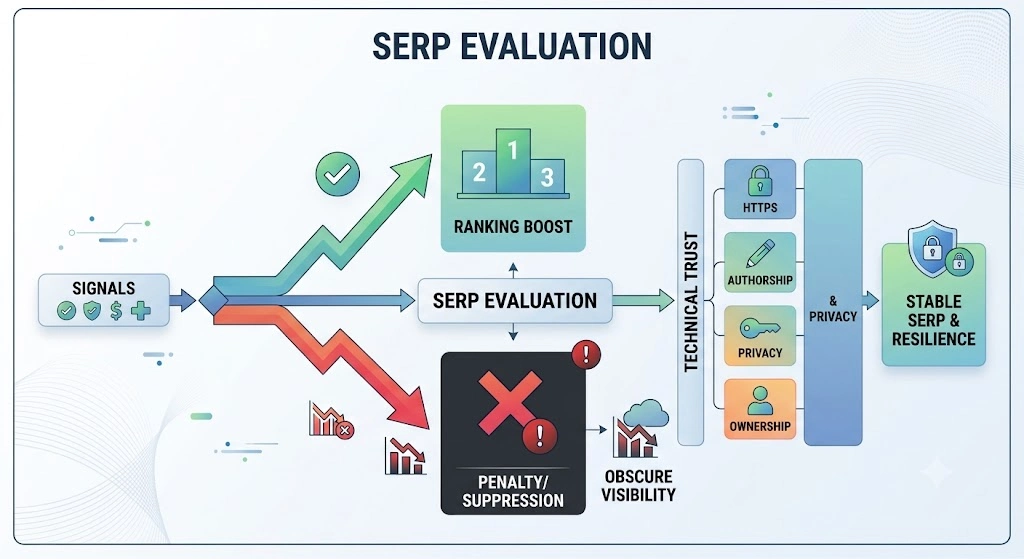
Authority and trust signals are the core metrics used during SERP evaluation to determine the reliability of information, particularly within fields that impact public welfare and societal infrastructure. Search engines apply rigorous standards to political content, categorizing it alongside financial and medical data due to its potential to influence democratic outcomes. Algorithms prioritize content generated by creators who demonstrate verified expertise, authoritativeness, and trustworthiness (E-A-T). During periods of intense political scrutiny, search engines actively suppress low-authority domains to safeguard the integrity of the information ecosystem.
The mechanism of authority evaluation relies heavily on the historical performance and structural transparency of a domain. Domains that consistently publish fact-checked, peer-reviewed, or official institutional data accumulate digital equity over time. When a political entity publishes policy positions on a high-authority domain, algorithms accelerate the content indexing process and assign higher baseline rankings. Conversely, domains with a history of publishing unsubstantiated claims or experiencing rapid fluctuations in content quality suffer algorithmic penalties, which restricts their visibility to obscure search queries.
Trust signals also extend to the technical architecture of the web properties representing an entity. Secure protocols, clear authorship markup, comprehensive privacy policies, and transparent ownership disclosures provide search engines with concrete verification parameters. When these technical signals align with positive sentiment across the wider web, the algorithm confirms the authenticity of the entity. This structural validation ensures that the primary SERP remains stable, resilient against malicious information campaigns, and aligned with the informational needs of the searcher.
How Does Content Indexing Shape Entity Perception?
Content indexing is the automated process by which search engines discover, parse, and store web data in a massive centralized database to fulfill future search queries. The manner in which an entity’s information is categorized within this index directly shapes entity perception by defining the contextual relationships associated with their name. If the indexed content primarily links a politician to legislative achievements, the algorithmic synthesis creates an authoritative profile. If the index contains a disproportionate volume of uncontradicted criticisms or legal disputes, the search engine constructs a problematic entity profile.
The process begins when search bots extract semantic data from new articles, blogs, and public records. Natural language processing models analyze the syntax to extract specific entity attributes, mapping out what the entity represents, their past declarations, and their public alignments. This conceptual mapping means that once information enters the index, it creates an algorithmic footprint that persists long after the initial news cycle concludes. Consequently, the historical configuration of the search index dictates the long-term baseline of public digital trust.
Furthermore, search engines prioritize the freshness and relevance of indexed content during active public discussions. When an event occurs, the algorithm temporarily adjusts its ranking criteria to favor real-time journalistic updates within the SERP layout. This algorithmic shift highlights the critical importance of continuous content optimization and proactive digital asset creation. Ensuring that accurate, contextual, and structurally sound content is continuously indexed enables an entity to maintain structural control over the narrative, preventing outdated or erroneous data from dominating the search perception landscape.
Why Is Sentiment Interpretation Vital During Electoral Cycles?
Sentiment interpretation within search ecosystems refers to the algorithmic classification of textual data as positive, negative, or neutral based on linguistic patterns and contextual modifiers. During electoral cycles, search engines utilize sentiment analysis to gauge the public consensus surrounding political figures and shifting policy platforms. This interpretative layer influences the composition of automated search suggestions, related queries, and the prioritization of news content within real-time ranking feeds. An entity experiencing a sustained influx of negative sentiment signals will face reduced visibility for positive self-published assets.
Algorithms achieve sentiment interpretation by breaking down sentences into component tokens and cross-referencing them with pre-defined semantic dictionaries. This mechanism evaluates the intensity of the vocabulary utilized in public forums, news commentaries, and digital publications. If an entity accumulates a dense cluster of negative associations, the algorithm adapts the SERP to reflect this shift, assuming that user intent seeks information regarding the unfolding controversy. Therefore, public perception becomes algorithmically reinforced; negative digital footprints generate negative search environments, which further shapes voter attitudes.
Managing sentiment interpretation requires an objective understanding of how digital content interacts with algorithmic filters. Entities must systematically develop a diverse network of digital assets that publish neutral, matter-of-fact analyses, structural overviews, and policy documentation. This structural equilibrium dilutes the impact of isolated negative sentiment spikes. By maintaining a highly professional, textually precise digital footprint, an entity optimizes its profile for semantic search engines, ensuring that the algorithmic evaluation remains stable, objective, and reflective of core institutional values rather than fleeting digital reactions.
How Can Political Entities Manage Their Digital Footprint Effectively?
Managing a digital footprint requires a systematic approach to content architecture, platform security, and semantic network design. Political entities must treat every digital publication, social media profile, and third-party mention as a core component of their broader algorithmic profile. To prevent narrative fragmentation, entities must implement structured data markup, serialize their official statements, and maintain rigorous oversight of all controlled digital domains. This technical discipline ensures that search engines can easily verify the authenticity of first-party data and prioritize it over unverified third-party commentary.
The deployment of schema markup represents a critical mechanism in digital footprint management. Schema markup provides search engine crawlers with explicit clues about the meaning of a page, converting unstructured text into structured entity profiles. By clearly defining relationships between the candidate, their political party, official manifestos, and scheduled public appearances, the entity directly guides the search engine’s semantic understanding. This reduces ambiguity within the index, minimizes the risk of algorithmic miscategorization, and stabilizes the presentation of knowledge panels on the primary SERP.
In addition to technical optimization, entities must implement continuous monitoring systems to evaluate changes in the wider information ecosystem. Tracking the emergence of new query variants, analyzing the sentiment of rising third-party domains, and evaluating the stability of core search terms allows for data-driven adjustments to content strategy. Understanding how to measure voter trust before and during election campaigns provides the exact analytical insights required to adapt to shifting search trends. Maintaining this proactive operational posture ensures that the digital footprint remains resilient against unexpected informational distortions, securing long-term authority within search ecosystems.
The intersection of search engine mechanics and political communication dictates that voter trust is fundamentally shaped by algorithmic processes. Search visibility, reputation signals, authority validation, and content indexing act as the core mechanisms that construct digital credibility within search ecosystems. Political entities cannot rely on traditional messaging alone; they must systematically manage their digital footprint to satisfy the rigorous standards of modern semantic search engines. By aligning technical architecture with algorithmic trust parameters, entities ensure that public perception remains grounded in verified, authoritative reality.

Frequently Asked Questions
What is online reputation management for politicians?
Online reputation management for politicians is the systematic practice of monitoring, shaping, and securing a political figure’s digital footprint across search engine ecosystems. This process involves optimizing authoritative first-party content and addressing negative search signals to ensure that public search results reflect accurate entity data. Clear My Name utilizes strategic content architecture and technical SEO to help political entities build long-term digital credibility and maintain search perception control.
How do search engines evaluate a politician’s digital trustworthiness?
Search engine algorithms assess a politician’s trust score by evaluating the authority, relevance, and semantic consensus of the content associated with their name. Algorithms look at reputation signals such as high-quality backlink profiles from journalistic news sites, schema markup, and the sentiment of third-party digital mentions. A stable and transparent digital profile helps ensure that search engines index verified information rather than uncorroborated commentary.
Why is search visibility critical during an election campaign?
Search visibility determines how prominently a candidate’s official policy platforms, manifestos, and statements appear when voters execute queries on SERPs. High visibility for verified web properties prevents fragmented or biased third-party narratives from dominating the first page of results during high-stakes voting cycles. Maintaining absolute prominence for official assets is a foundational component of effective reputation management for politicians.
How does negative sentiment online impact a political entity’s search results?
Persistent negative sentiment across digital publications can trigger algorithmic shifts that alter the structural layout of a candidate’s search engine results page. Search engines may deprioritize self-published content to surface dynamic features like “Top Stories” or “People Also Ask” blocks focused on emerging controversies. Implementing a proactive content strategy helps dilute these negative sentiment signals and maintains equilibrium within the search index.
How can a political candidate protect their digital footprint from misinformation?
Candidates can safeguard their digital footprint by deploying structured data markup, securing official web assets, and consistently publishing optimized, matter-of-fact policy documentation. This clear technical architecture reduces ambiguity for search engine crawlers, making it easier for algorithms to verify and rank authentic sources. Clear My Name assists political figures in structuring their online profiles to resist informational distortions and preserve institutional trust.