

Negative reviews or online defamation are addressed by identifying the source of harmful content, evaluating its accuracy, improving positive reputation signals, and strengthening the overall quality of information indexed by search engines. Recovery depends on how search ecosystems interpret credibility, relevance, authority, and user trust over time.
Reputation management is the systematic process of understanding, analysing, and influencing how information about an entity is interpreted across digital ecosystems. Online reputation refers to the collection of indexed content, reviews, mentions, and reputation signals that shape public perception within search engines and other online platforms. Search engines evaluate digital information through content indexing, authority assessment, sentiment analysis, and behavioural signals rather than personal opinion. As new information enters the search ecosystem, algorithms continuously reassess entity perception based on freshness, relevance, and trust indicators. Recovering from negative reviews or online defamation therefore involves understanding how search visibility evolves rather than focusing solely on individual pieces of content.
What is online reputation and how is it formed?
Online reputation is the measurable perception created by indexed digital information across search ecosystems. It represents the collective interpretation of reviews, articles, social discussions, business listings, directories, media coverage, and other publicly accessible content. Every indexed page contributes additional context that helps search engines define an entity’s identity and credibility. Reputation develops through continuous content discovery, indexing, and ranking rather than through isolated events. Search visibility therefore reflects accumulated reputation signals rather than a single publication.
Search engines organise information by analysing topical relevance, entity relationships, content quality, and source authority. Structured data, review content, citations, backlinks, and consistent identity information strengthen entity recognition during indexing. Algorithms compare information across multiple trusted sources before establishing confidence in factual relationships. This process creates a broader reputation profile that influences SERP evaluation. As content expands, search engines continuously refine their understanding of the entity.
How do negative reviews influence search perception?

Negative reviews influence search perception by contributing sentiment signals that become part of an entity’s overall reputation profile. Reviews provide searchable text that search engines analyse alongside other reputation indicators. Review frequency, recency, language quality, platform authority, and consistency all contribute to reputation evaluation. Search algorithms interpret reviews as one component within a larger ecosystem of evidence rather than as independent ranking factors. Their influence depends on the broader context surrounding the entity.
Review content also affects user behaviour after search results appear. Users evaluate ratings, review snippets, and visible sentiment before selecting search results. This behavioural interaction influences click distribution and perceived credibility across search listings. Positive and negative review patterns therefore contribute indirectly to search visibility through user engagement signals. Search perception emerges from both algorithmic interpretation and human evaluation occurring simultaneously.
What is online defamation within search ecosystems?
Online defamation refers to false statements published online that damage the reputation of an identifiable person, organisation, or entity. Within search ecosystems, defamatory content becomes discoverable after crawling and indexing, allowing search engines to display the information for relevant queries. Indexing does not validate factual accuracy because search engines primarily organise information rather than determine legal truth. Visibility, therefore, depends on ranking systems rather than editorial verification.
Search engines analyse authority, topical relevance, freshness, and content relationships when determining rankings. If defamatory material appears on authoritative domains, its visibility may remain high until competing reputation signals provide stronger contextual information or legal actions alter its availability. Search ecosystems continuously reassess indexed content as new information enters the index. Entity perception therefore evolves alongside changing information environments rather than remaining static.
How do search engines evaluate reputation signals?
Search engines evaluate reputation signals by analysing the consistency, authority, relevance, and credibility of indexed information associated with an entity. Reputation signals originate from reviews, citations, trusted publications, structured business information, backlinks, expert references, and content quality indicators. These signals collectively define entity perception within search systems. No single signal determines overall reputation because algorithms combine multiple evidence sources.
Content authority
Content authority refers to the perceived expertise and credibility demonstrated by the publishing source. Search engines analyse domain reputation, editorial quality, citation patterns, and topical expertise when assigning authority. Higher authority sources contribute stronger contextual signals during SERP evaluation. Authority therefore influences both ranking potential and reputation interpretation.
Information consistency
Information consistency refers to uniform identity details across digital platforms. Consistent names, descriptions, contact information, organisational details, and factual references improve entity recognition. Search engines resolve identity conflicts by comparing structured information across trusted sources. Consistency strengthens confidence in entity relationships and improves reputation clarity.
Sentiment interpretation
Sentiment interpretation analyses the emotional direction expressed within reviews, articles, discussions, and public commentary. Search algorithms identify linguistic patterns that indicate positive, neutral, or negative sentiment. Sentiment contributes contextual understanding rather than direct ranking value. Reputation develops through cumulative interpretation across numerous indexed documents.
How does content indexing affect online reputation?
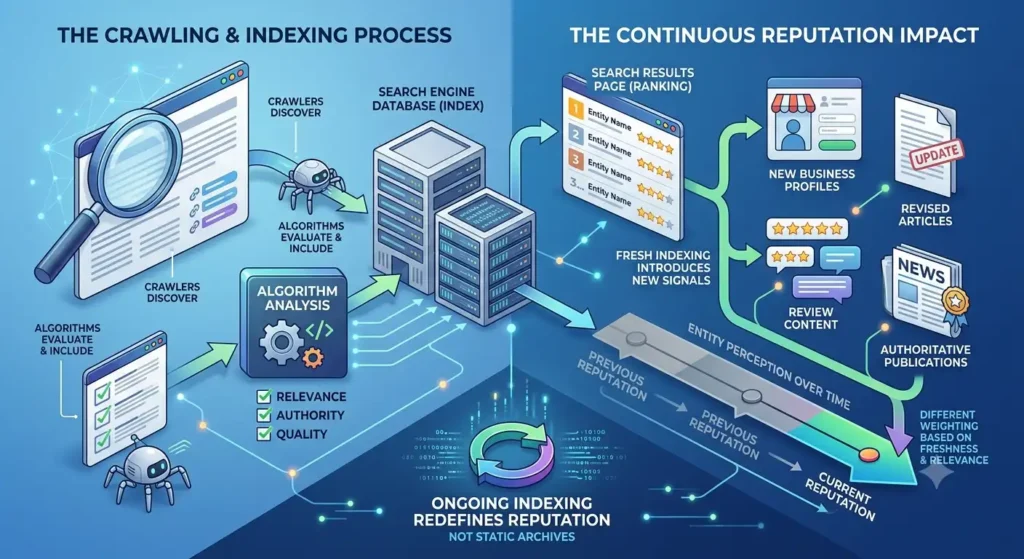
Content indexing determines which information becomes searchable within search engines. Crawlers discover webpages before algorithms analyse their relevance, authority, and quality for inclusion within the searchable index. Indexed information becomes eligible for ranking whenever related queries are performed. Reputation therefore depends on which content enters searchable databases rather than solely on publication itself.
Fresh indexing introduces new reputation signals that reshape entity perception over time. Updated articles, revised business profiles, authoritative publications, and additional review content provide new evidence that algorithms incorporate into ranking systems. Older information gradually receives different weighting depending on freshness, relevance, and competing content quality. Search ecosystems continuously redefine reputation through ongoing indexing processes rather than static archives.
Why does search visibility change after negative information appears?
Search visibility changes because search engines constantly reassess indexed content based on evolving relevance and authority signals. Newly published negative material introduces additional context that algorithms evaluate alongside existing information. If the content receives strong authority signals, user engagement, or extensive referencing, its ranking position becomes more competitive. Visibility therefore reflects comparative information quality rather than chronological publication alone.
Search rankings remain dynamic because indexing introduces continual updates across the web. New publications, revised pages, improved structured data, and enhanced topical authority all contribute additional ranking signals. Algorithms compare competing documents against current search intent before determining visibility. Reputation therefore changes whenever search ecosystems discover stronger or weaker contextual evidence surrounding an entity.
Within discussions of search visibility, concepts such as:
Negative Online Content Suppression Services naturally relate to understanding how competing content influences indexed results rather than replacing or deleting information.
What is the relationship between digital footprint and reputation?
A digital footprint is the complete collection of online information connected to an identifiable entity. It includes websites, news articles, reviews, directories, social profiles, academic publications, multimedia content, legal records, and archived webpages. Search engines analyse this footprint to establish comprehensive entity understanding. Every indexed element contributes contextual signals that influence overall perception.
Digital footprints expand continuously as new information becomes publicly available. Search algorithms evaluate relationships between existing and newly indexed content to refine entity definitions. Larger digital footprints generally provide richer contextual evidence, enabling more accurate reputation assessment. Reputation therefore reflects the cumulative structure of the digital footprint rather than isolated documents.
How do authority and trust signals influence credibility?
Authority and trust signals define how confidently search engines interpret the reliability of digital information. These signals originate from recognised publishers, editorial standards, factual consistency, expert citations, secure websites, structured data, and established topical expertise. Search systems combine these indicators when evaluating entity credibility. Trust emerges through repeated evidence across multiple authoritative sources.
Authority also affects information interpretation during SERP evaluation. High-authority sources frequently establish foundational entity relationships that lower-authority sources reinforce or expand. Algorithms compare corroborating information across independent publishers before strengthening confidence in factual associations. This layered evaluation improves overall search reliability while shaping online credibility.
How can accurate information strengthen reputation over time?
Accurate information strengthens reputation by providing consistent, authoritative, and verifiable evidence across search ecosystems. Search engines continuously evaluate factual consistency between indexed documents, structured data, and recognised sources. Strong informational alignment improves entity clarity during indexing and ranking. Consistent evidence reduces ambiguity within search interpretation.
A structured approach improves the long-term quality of reputation signals:
- Publish authoritative information by creating factually accurate content that expands entity understanding across trusted sources.
- Maintain information consistency by aligning organisational details, descriptions, and structured data throughout indexed platforms.
- Improve content relevance by updating existing information to reflect current facts and maintain topical accuracy.
- Strengthen topical authority by expanding comprehensive content that demonstrates expertise within defined subject areas.
Each action contributes measurable contextual evidence that search algorithms incorporate into ongoing reputation evaluation.
How do SERPs shape public perception?
Search engine results pages (SERPs) organise information according to algorithmic relevance, authority, and search intent. Users frequently form initial impressions by evaluating titles, descriptions, review ratings, knowledge panels, images, and featured results displayed on the first page. SERPs therefore function as structured information environments that influence perception before individual webpages are visited.
Search engines prioritise information that best satisfies user intent according to quality evaluation systems. High-ranking content receives greater visibility, increasing its influence on reputation interpretation. Lower-ranked content remains accessible but contributes less prominently to initial perception. SERP evaluation therefore plays a central role in defining digital trust and online credibility.
Dive Deeper With Our Expert Guides:
How to Delete Negative Information About You Online
Clean Up Your Online Presence and Protect Your Privacy
Recovering from negative reviews or online defamation begins with understanding how search ecosystems organise, interpret, and rank information. Online reputation develops through the interaction of content indexing, authority assessment, sentiment interpretation, entity recognition, and search visibility rather than through individual publications alone. Search engines continuously reassess digital information as new evidence becomes available, refining entity perception over time.
A strong online reputation reflects a consistent digital footprint supported by authoritative information, accurate indexing, trustworthy reputation signals, and credible content relationships. Understanding these mechanisms provides a clearer framework for analysing how reputation evolves within modern search ecosystems and how search visibility shapes public perception.
Answers to Key Questions
What are Negative Online Content Suppression Services?
Negative Online Content Suppression Services refer to strategies that reduce the visibility of harmful or outdated online content by strengthening the presence of accurate, authoritative information in search results. The focus is on improving search visibility rather than deleting existing content.
How long does it take to suppress negative online content in search results?
The timeframe depends on factors such as content indexing, search engine crawling, competition, and the authority of existing pages. Search engines update rankings continuously, so changes in search visibility develop over time rather than instantly.
Can negative online content be removed from Google?
Not all negative content can be removed from search engines. If content violates legal or platform policies, removal may be possible; otherwise, improving the visibility of accurate and relevant content is a common reputation management approach.
How do Negative Online Content Suppression Services improve online reputation?
Negative Online Content Suppression Services strengthen positive reputation signals by increasing the prominence of authoritative and relevant content in search results. This process helps search engines build a more balanced understanding of an entity’s online reputation and credibility.