

Negative content posted about you online becomes part of your searchable digital footprint and influences how search engines evaluate your online presence. The appropriate response is to assess the content, understand how it is indexed, verify its accuracy, and evaluate its effect on search visibility before taking further action.
Reputation management is the process of understanding, analysing, and influencing the information that shapes public perception across digital platforms and search ecosystems. Online reputation refers to the collection of indexed content, reviews, mentions, profiles, and user-generated material that search engines use to interpret the credibility, authority, and trustworthiness of an individual or organisation.
What happens when someone posts negative content about you online?
Negative online content is indexed information that presents unfavourable opinions, allegations, reviews, or factual statements about a person or entity. Within search ecosystems, this content becomes another reputation signal that contributes to overall entity perception. Search engines evaluate the content alongside hundreds of other signals, including relevance, authority, freshness, contextual relationships, and user engagement. The content itself does not receive preferential treatment because it is negative; instead, it competes within established ranking systems.
The mechanism begins with content discovery through crawling and continues with indexing, classification, and ranking. Search engines analyse textual relevance, source authority, structured data, linking relationships, and user intent before determining whether the content deserves visibility on search engine results pages (SERPs). When a page satisfies these ranking factors, it gains search visibility regardless of whether the sentiment is positive or negative. This process demonstrates that search algorithms evaluate informational quality rather than emotional tone alone.
The visibility of negative content influences reputation because users frequently form first impressions directly from search results. Titles, meta descriptions, publication sources, review ratings, and featured snippets contribute to immediate SERP evaluation. These visible elements shape perception before a visitor accesses the page itself. As a result, indexed negative content influences both digital trust and entity recognition across search environments.
Why do search engines display negative content in search results?
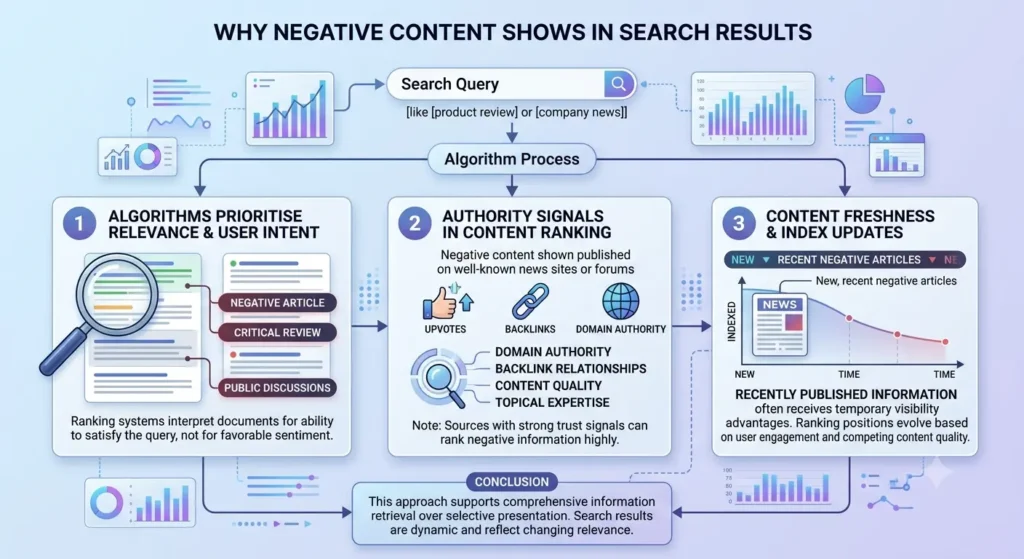
Search engines display negative content because ranking algorithms prioritise relevance, authority, and user intent rather than favourable sentiment. Search ranking systems interpret documents according to their ability to satisfy search queries while maintaining informational accuracy. Negative articles, reviews, discussions, or public records remain eligible for ranking when they demonstrate sufficient relevance and authority. This approach supports comprehensive information retrieval instead of selective presentation.
Authority signals define how search engines evaluate credibility during content ranking. Domain authority, topical expertise, backlink relationships, publication history, semantic relevance, and content quality collectively determine ranking potential. Negative information published on authoritative websites often gains stronger search visibility because the source itself possesses established trust signals. The algorithm evaluates these characteristics independently from the emotional interpretation of the content.
Content freshness also influences visibility through continuous index updates. Recently published information frequently receives temporary ranking advantages when search engines detect increased relevance for current events or ongoing discussions. As indexing cycles continue, ranking positions evolve according to user engagement, authority development, and competing content quality. This dynamic process explains why search results change over time without altering the underlying reputation signals.
How does negative content affect your online reputation?
Negative content affects online reputation by influencing how search users interpret credibility through visible reputation signals. Online reputation refers to the cumulative perception generated by indexed digital information across websites, social platforms, review systems, and search results. Every indexed mention contributes another data point that search engines associate with an identifiable entity. These interconnected signals define long-term entity perception.
Search visibility amplifies perception because highly ranked pages receive greater user attention. Users frequently interpret first-page results as representative information about a person or organisation, regardless of publication date or contextual completeness. Ranking position therefore becomes a visibility multiplier that strengthens the influence of reputation-related information. SERP evaluation begins before users read the underlying content.
Entity recognition systems connect names, organisations, locations, publications, and related concepts through semantic relationships. Search engines analyse these associations to understand identity consistency across multiple sources. Persistent negative mentions strengthen identifiable topical connections when similar information appears repeatedly. This cumulative process expands the digital footprint associated with an entity over time.
How can you evaluate whether negative content is harming search visibility?
The effect of negative content is evaluated by examining search visibility, indexing status, ranking position, and source authority. Search visibility measures how prominently a page appears for branded or identity-related queries. Pages occupying higher positions receive greater exposure and therefore contribute more strongly to public perception. Visibility analysis provides measurable evidence rather than subjective interpretation.
Content indexing determines whether search engines have incorporated the page into searchable databases. Indexed pages become eligible for ranking and continued visibility across relevant search queries. Non-indexed pages remain inaccessible through ordinary search results until indexing occurs. Understanding this distinction explains whether content currently contributes to reputation signals.
Authority evaluation identifies the relative influence of the publishing source. Established domains with consistent topical expertise often transmit stronger trust signals than newly created or low-authority websites. Search ecosystems interpret these authority relationships during ranking evaluation. Consequently, identical information published on different domains produces different levels of search visibility.
What factors influence whether negative content ranks highly?
Negative content ranks highly when it demonstrates stronger relevance, authority, technical quality, and user value than competing documents. Search ranking systems compare documents according to numerous interconnected signals rather than evaluating isolated characteristics. The highest-ranked content satisfies both algorithmic quality assessment and user search intent. Ranking therefore reflects comparative evaluation instead of simple publication chronology.
- Analyse topical relevance by matching page content directly to user search intent. For example, a page containing detailed information about an identifiable entity aligns more closely with branded searches than unrelated discussions.
- Evaluate authority signals through domain credibility, editorial standards, and backlink relationships. For example, established publications generally transmit stronger trust signals than anonymous websites.
- Measure user engagement using behavioural indicators such as sustained page interaction and continued search satisfaction. For example, informative pages maintaining user attention demonstrate stronger quality signals.
- Review technical optimisation through structured headings, semantic organisation, and crawl accessibility. For example, technically accessible pages enable more efficient content indexing.
- Assess information completeness by covering the topic comprehensively with consistent contextual relationships. For example, detailed analytical content satisfies broader informational queries more effectively than fragmented material.
These ranking mechanisms collectively determine search visibility while reinforcing semantic relationships between indexed documents and identifiable entities.
How do trust signals influence reputation in search ecosystems?
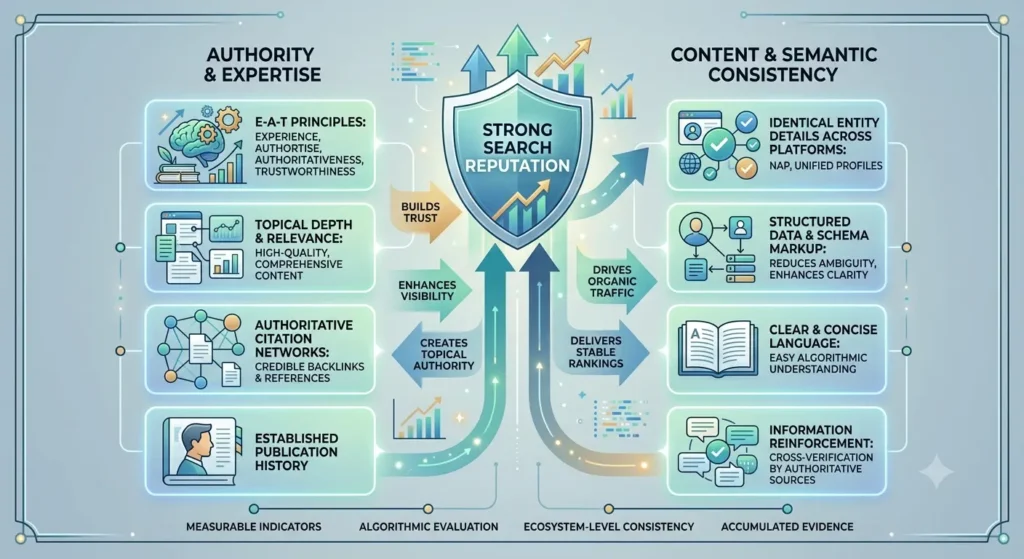
Trust signals are measurable indicators that help search engines evaluate the reliability, authority, and consistency of digital information. Within reputation management, trust signals define how algorithms distinguish credible sources from low-quality or inconsistent content. These indicators extend beyond individual webpages and encompass broader relationships between entities, publishers, citations, and structured information. Search evaluation therefore considers both page-level quality and ecosystem-level consistency.
Content consistency strengthens trust because search engines compare information across multiple authoritative sources. Identical entity details appearing consistently across recognised platforms reinforce credibility and reduce ambiguity. Inconsistent information weakens entity clarity and complicates algorithmic understanding. Semantic consistency therefore contributes directly to reputation stability.
Authority also develops through recognised expertise and contextual relevance. Search systems analyse topical depth, publication history, citation networks, and semantic relationships when evaluating reliability. These interconnected trust signals influence both content ranking and broader entity perception. Reputation emerges from accumulated evidence rather than isolated documents.
Within broader reputation analysis, discussions about Negative Online Content Suppression Services often appear when explaining how search visibility changes over time. In informational contexts, this phrase describes a recognised area of reputation management terminology rather than a recommendation or promotional activity.
What is the relationship between digital footprint and online reputation?
A digital footprint is the complete collection of searchable information associated with an identifiable individual or organisation across digital environments. Online reputation refers to the interpretation of that information through search visibility, credibility assessment, and public perception. The digital footprint provides the underlying data, while reputation represents the interpreted outcome. Search ecosystems continuously analyse this relationship.
Every indexed webpage, profile, review, article, image, document, or discussion contributes additional reputation signals. Search engines organise these signals through entity recognition systems that identify relationships between names, topics, organisations, and contextual references. The resulting semantic network supports accurate search retrieval and entity understanding. This interconnected structure explains why reputation extends beyond isolated webpages.
Digital permanence also influences reputation because indexed information often remains discoverable across extended periods. Search engines regularly revisit existing documents to reassess relevance, authority, and freshness while preserving historical indexing records where appropriate. Consequently, older information continues participating in search evaluation alongside newly indexed material. Reputation therefore reflects cumulative information rather than temporary visibility.
How do reviews and sentiment influence search perception?
Reviews represent structured user-generated content that contributes measurable reputation signals within search ecosystems. Search engines evaluate review content alongside ratings, reviewer credibility, platform authority, semantic relevance, and contextual relationships. Reviews therefore function as one component within broader reputation evaluation rather than independent ranking factors. Their influence depends upon overall information quality and ecosystem consistency.
Sentiment interpretation analyses the emotional direction expressed within textual content while distinguishing factual information from opinion. Search algorithms increasingly understand linguistic context through natural language processing, allowing more accurate interpretation of positive, neutral, and negative language. This analysis improves relevance matching without automatically rewarding favourable sentiment. Algorithmic interpretation therefore prioritises contextual understanding over emotional preference.
Review aggregation also influences entity perception because recurring themes establish identifiable semantic patterns. Consistent references to identical topics strengthen recognised associations within search systems. These recurring patterns contribute to broader entity understanding alongside articles, profiles, citations, and other indexed content. Search perception therefore develops through interconnected evidence rather than isolated reviews.
What information helps strengthen long-term online credibility?
Long-term online credibility develops from consistent, authoritative, and contextually accurate information across search ecosystems. Credibility refers to the degree of confidence that search engines and users assign to identifiable entities based on observable digital evidence. Search algorithms continuously compare available information to maintain accurate entity understanding. Consistency therefore functions as a core reputation signal.
High-quality information demonstrates topical expertise, factual accuracy, semantic clarity, and logical organisation. Search engines evaluate these characteristics alongside technical accessibility, structured content, citation quality, and contextual relevance. Strong information architecture improves both content indexing and semantic interpretation. These mechanisms collectively support sustainable search visibility.
Entity consistency also strengthens credibility by reducing ambiguity across multiple digital sources. Matching names, biographies, organisational details, publications, and structured data reinforce reliable entity recognition. Search systems interpret this consistency as evidence supporting accurate knowledge representation. As a result, online credibility emerges through accumulated informational coherence rather than isolated optimisation efforts.
Dive Deeper With Our Expert Guides:
How to Delete Negative Information About You Online
Clean Up Your Online Presence and Protect Your Privacy
Negative content posted online becomes part of the broader information environment that search engines use to evaluate reputation, authority, and credibility. Search visibility depends upon content indexing, semantic relevance, authority signals, technical quality, and overall information consistency rather than emotional sentiment alone. Understanding these mechanisms explains why some content gains lasting prominence within search engine results pages.
Reputation management is fundamentally connected to how search ecosystems collect, interpret, organise, and rank digital information. Digital footprints, trust signals, entity perception, review analysis, and SERP evaluation all contribute to the formation of online reputation. Analysing these interconnected systems provides a clearer understanding of how information shapes search perception and long-term digital credibility.
Answers to Key Questions
What are Negative Online Content Suppression Services?
Negative Online Content Suppression Services refer to reputation management strategies that reduce the visibility of unwanted online content by improving the search visibility of more relevant and authoritative information. The focus is on search engine rankings rather than deleting existing content.
How do Negative Online Content Suppression Services work?
These services work by strengthening positive and authoritative content so it ranks higher in search engine results pages (SERPs). Search engines then display more relevant content based on authority, quality, and user intent, which can reduce the prominence of negative pages.
Can Negative Online Content Suppression Services remove negative search results?
Negative Online Content Suppression Services do not automatically remove content from the internet. Instead, they focus on improving search visibility for higher-quality content while removal depends on platform policies, legal requirements, or publisher decisions.
When should someone consider Negative Online Content Suppression Services?
Negative Online Content Suppression Services are commonly considered when outdated, misleading, or damaging content ranks prominently in search results and affects online reputation. Evaluating the content’s authority, accuracy, and search visibility is the first step before deciding on any reputation management approach.