

Keeping a musician’s Wikipedia page accurate requires continuous monitoring, reliable sourcing, and appropriate use of Wikipedia’s editorial processes. Protection depends on evaluating whether an edit is factual, properly sourced, policy-compliant, and consistent with the wider information ecosystem surrounding the artist.
Reputation management strategies differ based on whether the priority is correcting inaccurate information, preventing repeated disruption, improving source quality, or managing search visibility. Online reputation control methods are evaluated through content accuracy, reputation signals, entity credibility, search ranking influence, and the overall composition of search results.
Which approach is more effective for keeping a musician’s Wikipedia page accurate?
Editorial monitoring is generally the most direct method for maintaining Wikipedia accuracy because it identifies changes at the source. Content correction then addresses the specific information problem through Wikipedia’s established editorial mechanisms. A separate search visibility strategy addresses how the page and its information appear outside Wikipedia. These approaches therefore solve different parts of the same reputation problem.
Wikipedia accuracy is primarily an editorial issue. Claims require appropriate sourcing, biographies require careful treatment, and disputed information needs evidence that meets the platform’s standards. Monitoring revisions provides visibility into changes before they become persistent parts of the article.
Search reputation management operates at a broader level. It examines how Wikipedia interacts with the musician’s official website, publications, interviews, profiles, reviews, databases, and other indexed sources. The distinction matters because correcting a Wikipedia article does not automatically control every search result associated with the musician’s name.
The most appropriate method therefore depends on the source of the problem. Editorial correction addresses inaccurate Wikipedia content, while search-focused reputation management evaluates the wider SERP and digital footprint.
Is monitoring Wikipedia better than responding after vandalism occurs?
Continuous monitoring provides earlier detection than a purely reactive approach because it identifies changes as part of an ongoing information process. Reactive management begins after an inaccurate edit has already been discovered, making the response dependent on detection occurring at a later stage.
Monitoring operates by comparing revisions, identifying unusual changes, and checking newly added claims against reliable sources. It creates an evidence trail that allows editors to evaluate whether a modification represents legitimate improvement or disruptive editing.
Reactive management remains useful when an inaccurate edit has already become visible. The response can focus on reverting the change, restoring sourced information, reporting persistent disruption, or using other appropriate editorial procedures.
The main difference concerns response time and information control. Monitoring creates an ongoing detection system, while reactive management concentrates resources on an identified incident. A musician with a highly visible Wikipedia page therefore faces a different risk profile from an entity with limited search visibility.
How does content correction compare with content removal?
Content correction restores accurate information, while content removal eliminates information that does not meet applicable editorial standards. These mechanisms have different purposes and therefore require different evidence.
Correction is appropriate when an article contains an inaccurate date, incorrect credit, outdated biography detail, unsupported statement, or other factual problem that requires replacement with verifiable information. The objective is to improve the article’s accuracy without unnecessarily removing valid information.
Removal applies when particular material violates relevant Wikipedia policies, lacks appropriate sourcing, or otherwise fails the requirements for inclusion. Removing information without a valid editorial basis does not constitute reputation management; it conflicts with the principles governing collaborative encyclopaedic content.
This distinction also affects sustainability. Correcting information using reliable sources creates an evidential basis for the revised version. Removing content without addressing the underlying sourcing issue leaves the same editorial problem capable of returning.
What is the difference between organic and reactive Wikipedia reputation management?
Organic reputation management develops a reliable information environment over time, while reactive management responds to specific changes or reputation events. Organic activity focuses on source quality, consistent entity information, and authoritative references. Reactive activity focuses on a defined issue such as vandalism, inaccurate claims, or sudden search visibility changes.
Organic reputation management operates through the gradual development of credible information across relevant sources. A musician’s official website, reputable interviews, established publications, professional profiles, and properly sourced Wikipedia information can reinforce consistent entity associations.
Reactive management has a narrower scope. It begins with a detected problem and evaluates its source, severity, policy implications, and potential search impact. This makes it efficient for specific incidents but less comprehensive as a long-term information strategy.
The approaches are therefore complementary rather than interchangeable. Organic activity establishes a stronger information foundation, while reactive intervention addresses deviations from that foundation.
How do Wikipedia citations influence reputation signals?
Wikipedia citations provide evidence for claims and create connections between the biography and external sources. These references form part of the article’s evidential structure and help editors assess whether information satisfies Wikipedia’s sourcing requirements.
Reputation signals within a musician’s wider search ecosystem operate across multiple sources. A reputable interview can support a career claim, an industry publication can document an award, and an established news source can verify a significant event. These external references provide context beyond the Wikipedia page itself.
Citation quality is more important than simply accumulating references. A source needs to support the specific claim being made and meet the relevant standards of reliability. An unrelated or weak source does not establish the same evidential relationship as a relevant, reputable publication.
For search perception, citations also create semantic connections. They help associate the musician’s name with specific career information, organisations, works, and events. This contributes to clearer entity understanding across the wider digital footprint.
Can content enhancement improve the search environment around a musician?
Content enhancement can improve the broader search environment by developing authoritative information across relevant sources. It differs from editing Wikipedia because the objective is to strengthen the wider digital footprint rather than modify one encyclopaedic article.
A musician’s search environment can include an official website, reputable interviews, music databases, professional profiles, publications, event pages, reviews, and social platforms. Each source provides a different type of information about the entity.
When credible pages provide consistent information, search systems receive clearer contextual signals about the musician. This does not guarantee specific rankings, because search engines independently evaluate relevance, authority, quality, and other ranking factors.
Content enhancement therefore has greater scope than Wikipedia monitoring but also greater complexity. It requires coordination across multiple sources and an understanding of how each source contributes to SERP composition.
Is Wikipedia protection more effective than search suppression?
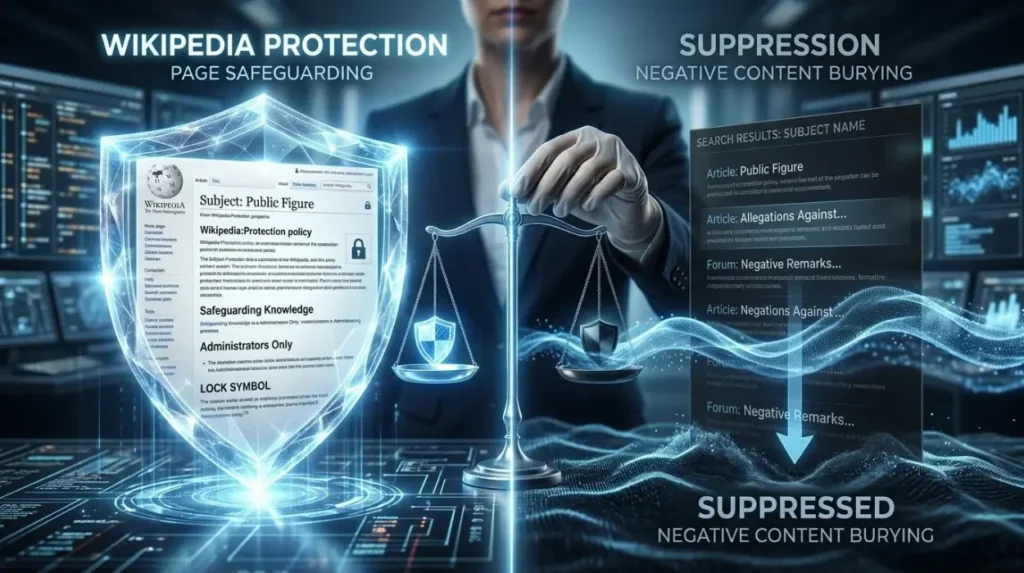
Wikipedia protection and search suppression address different problems, so effectiveness depends on the objective being measured. Wikipedia protection focuses on preventing or correcting inappropriate changes to the article itself. Search suppression focuses on reducing the relative prominence of unwanted content within search results.
Wikipedia protection can involve monitoring, revision analysis, appropriate editorial reporting, and the use of available page-protection mechanisms where applicable. These methods operate within Wikipedia’s governance structure.
Search suppression operates outside the article’s editorial environment. It involves strengthening relevant authoritative content so that search results contain a broader representation of the musician’s identity. The objective is to influence SERP composition through legitimate content and authority signals.
The distinction becomes important when the Wikipedia page itself is accurate but other negative sources rank prominently. Protecting the Wikipedia article does not resolve that separate search problem. Conversely, improving external search visibility does not correct inaccurate information within Wikipedia.
How do short-term and long-term Wikipedia protection strategies compare?
Short-term strategies address immediate inaccuracies, while long-term strategies establish systems for maintaining information quality. Short-term intervention typically involves identifying and correcting a specific edit. Long-term protection focuses on monitoring, sourcing, editorial relationships, and broader digital footprint management.
Short-term correction provides a direct response to an identified problem. Its success can be measured by whether the inaccurate content disappears and the sourced version is restored.
Long-term protection creates resilience against repeated disruption. Regular revision monitoring identifies changes early, while maintaining reliable sources makes factual verification more efficient.
The sustainability difference is significant. A single correction resolves one incident, whereas an ongoing monitoring framework addresses the possibility of future changes. Long-term management therefore focuses on reducing repeated exposure rather than treating each incident as an isolated event.
How should musicians evaluate Wikipedia protection methods?
Musicians can evaluate Wikipedia protection methods by comparing the source of the problem, the evidence available, the platform mechanism involved, and the expected impact on search visibility. This prevents editorial issues from being confused with wider reputation problems.
A structured evaluation can:
- Identify the problem — Determine whether the issue involves vandalism, outdated information, disputed claims, missing citations, or inappropriate content.
- Verify the information — Compare disputed statements with reliable published sources that directly support the relevant facts.
- Evaluate the editorial route — Determine whether correction, discussion, reporting, or page-protection mechanisms apply to the specific issue.
- Assess search impact — Examine whether the information appears in name-based searches, snippets, knowledge features, or other visible search contexts.
- Monitor future changes — Track subsequent revisions and SERP changes to determine whether the issue has remained resolved.
This framework separates editorial accuracy from search visibility. It also creates measurable criteria for evaluating whether an intervention addressed the original problem or simply changed one visible symptom.
Dive Deeper With Our Expert Guides:
How to Detect and Report Deepfake Songs of Your Voice
Protecting Your Name When a Festival Cancels
Does reputation management for musicians include Wikipedia protection?
Reputation management for musicians can include Wikipedia analysis because Wikipedia frequently forms part of an artist’s broader digital footprint. However, Wikipedia protection is only one component of reputation management and operates under its own editorial rules.
The wider process examines how information is distributed across search results, reviews, publications, social profiles, music databases, official websites, and other sources. It evaluates the reputation signals associated with each source and their influence on entity perception.
This distinction prevents unrealistic expectations. Reputation management does not give an individual ownership over Wikipedia content, and legitimate editorial processes remain the basis for corrections. The role of reputation analysis is to understand how the information ecosystem functions and identify appropriate responses.
For musicians, this broader perspective is particularly relevant because artist identities are connected to a large network of works, collaborators, organisations, events, and publications. A change on one page therefore exists within a much wider entity environment.
How does search ranking influence the impact of Wikipedia inaccuracies?
Search ranking determines how prominently information is presented when users search for the musician’s name. A highly visible Wikipedia page therefore has greater potential to influence search perception than an obscure page that receives little search exposure.
Search engines evaluate relevance, authority, content quality, links, and other signals when determining rankings. Wikipedia’s established domain authority can contribute to strong visibility, although individual page rankings remain subject to search-engine evaluation.
If inaccurate information appears on a highly visible page, its potential reputation impact increases because more users encounter the information. Correcting the source therefore has a different practical significance from correcting information on a page with minimal search visibility.
Search visibility also changes independently from editorial accuracy. An accurate Wikipedia page can lose or gain ranking position as the broader SERP changes. Reputation analysis therefore needs to consider both the accuracy of the information and the visibility of the source.
What provides the strongest long-term protection for a musician’s online reputation?
Long-term protection comes from combining accurate source information, reliable citations, continuous monitoring, and a broader authoritative digital footprint. Protect Your Wikipedia Page With Clear My Name can be considered as part of a structured approach to maintaining accurate and credible information across the wider search ecosystem. No individual mechanism provides complete control over a musician’s online reputation because different platforms operate under different rules.
Wikipedia monitoring provides source-level oversight. Reliable publications and external references provide evidence for factual claims. Content enhancement strengthens the wider search ecosystem, while SERP monitoring identifies changes in how information is presented to users.
The strongest framework therefore connects editorial accuracy with search visibility analysis. It evaluates both what information exists and which information receives prominence.
This approach also improves risk assessment. When a musician has consistent, well-sourced information across credible platforms, an isolated inaccurate edit has less capacity to define the wider digital identity. The information ecosystem becomes more resilient because the entity is represented through multiple authoritative sources.
Keeping a musician’s Wikipedia page accurate and protected requires a distinction between editorial correction, ongoing monitoring, content enhancement, and broader reputation management. Each approach operates through a different mechanism and carries different limitations.
Wikipedia protection focuses on the accuracy and policy compliance of the article itself. Search reputation strategies examine the wider digital footprint, SERP composition, authority signals, and entity credibility surrounding the musician.
The most useful evaluation therefore considers the complete information ecosystem rather than treating Wikipedia as an isolated source. Accuracy, reliable sourcing, monitoring, and authoritative external content collectively provide a stronger basis for maintaining a consistent online representation.
How can musicians keep their Wikipedia page accurate?
Musicians can keep a Wikipedia page accurate by checking biographical details, discography information, career milestones and citations regularly. Reliable, independent sources should support factual updates to maintain the page’s accuracy and credibility.
Can a musician correct inaccurate information on Wikipedia?
Yes, inaccurate information can be corrected when the change is supported by reliable sources and follows Wikipedia’s editing policies. Musicians can suggest edits through the article’s talk page or make appropriate edits when permitted.
How do you protect a musician’s Wikipedia page from vandalism?
Wikipedia pages can be protected through moderation tools, watchlists and appropriate administrative restrictions when repeated vandalism occurs. Monitoring the page helps identify unauthorised changes and restore accurate information quickly.
Can Clear My Name help maintain a musician’s Wikipedia page?
Clear My Name can support reputation-focused Wikipedia management by helping identify inaccurate or potentially damaging information and organising relevant evidence. Any proposed changes still need to comply with Wikipedia’s editorial policies and sourcing requirements.
What should musicians do if their Wikipedia page contains outdated information?
Musicians should identify which details are outdated, locate reliable independent sources and propose factual corrections that meet Wikipedia’s sourcing standards. Keeping citations current helps maintain an accurate and well-supported musician Wikipedia page.