

Reputation management is the process through which information, credibility signals and public perceptions shape how individuals and organisations are understood across digital environments. Online reputation refers to the collection of searchable information, professional evidence, reviews and other reputation signals that influence how recruiters, employers and candidates evaluate credibility.
In the UK life sciences sector, salary information provides context for understanding professional roles, employer expectations and recruitment activity. However, salary data and recruiter reputation represent distinct information categories that intersect when candidates research career opportunities. Search engines organise these signals through indexing, relevance assessment and ranking, influencing the information candidates encounter before applying for a position. Understanding these systems explains how digital footprints, professional credibility and search visibility shape perceptions of recruiters and employers.
How does online reputation influence the way candidates evaluate recruiters?
Online reputation is the accumulated digital evidence that influences how candidates assess a recruitment organisation’s credibility, expertise and professional conduct. Within life sciences recruitment, this evidence includes recruiter profiles, company information, professional publications, reviews and publicly available employment-related content. Candidates use these sources to establish whether a recruiter understands the scientific disciplines, technical qualifications and employment conditions associated with biotechnology and pharmaceutical roles. Search engines organise relevant information into results that help users investigate these professional relationships. The consistency of the available information affects the overall impression formed during that research process.
Recruiter reputation develops through repeated interactions between published information, professional activity and audience interpretation. A recruiter specialising in clinical research, regulatory affairs or bioprocessing communicates sector relevance through the terminology, experience and employment information presented online. When these details align across professional profiles and organisational pages, the digital footprint presents a more consistent entity identity. Contradictory descriptions, outdated employment details or unrelated content introduce uncertainty into that identity. Search visibility determines which parts of this evidence candidates encounter first, while entity perception reflects the conclusions they draw from it.
Reputation is therefore distinct from visibility alone. A recruiter appearing prominently in search results has greater discoverability, but ranking position does not independently establish expertise or trustworthiness. Candidates interpret search results alongside professional credentials, published information and feedback from previous interactions. This distinction is important in specialist recruitment, where scientific terminology and industry knowledge influence perceptions of professional competence. Search presence establishes access to information; the quality and consistency of that information shape its interpretation.
How do search engines form a recruiter’s digital reputation?
A recruiter’s digital reputation emerges from the relationship between indexed content, identifiable entities and the relevance of information associated with those entities. Search engines discover publicly accessible pages, analyse their content and store eligible information in an index. Ranking systems then evaluate relevance and other signals to determine which results appear for a particular query. Searches involving pharmaceutical recruitment, biotechnology salaries or clinical research careers produce results aligned with the query’s meaning and context. These results create the information environment in which candidates evaluate recruiters.
Content indexing is the process through which eligible web pages enter a search engine’s searchable database. A recruitment agency’s website, professional biography, industry commentary and public company profile provide distinct sources of information about its activities. Search engines analyse page content, links, structured information and other available signals to understand relationships between subjects and entities. Indexing does not guarantee prominent ranking, and the existence of a page does not establish that its claims are accurate. Search visibility depends on whether indexed information satisfies the relevance and quality requirements associated with a particular query.
Entity recognition also contributes to reputation formation. An entity is a distinguishable person, organisation, place or concept represented across information sources. Search systems use contextual relationships, names and other identifying details to distinguish entities and associate relevant content with them. A recruiter with a clearly defined professional identity is easier for users to distinguish from unrelated organisations or individuals with similar names. Inconsistent names, incomplete profiles and conflicting descriptions complicate that interpretation and affect how audiences connect information across search results.
How does search visibility affect recruiter credibility?
Search visibility describes the extent to which a recruiter’s digital content appears in relevant search results. It influences discoverability because candidates generally encounter information through queries related to job titles, employers, scientific disciplines and recruitment specialisms. A recruiter appearing for searches about pharmaceutical hiring demonstrates visibility for those queries, but the position alone does not prove professional authority. Credibility depends on the evidence presented by the result and the consistency of supporting information. Search visibility and credibility therefore operate as connected but separate dimensions of digital reputation.
Search engine results pages (SERPs) organise information into a ranked interface that shapes the order in which users discover sources. Organic listings, professional profiles, company pages, review platforms and other eligible result types compete for attention according to query relevance and the search engine’s presentation systems. The composition of a SERP influences which reputation signals receive initial exposure. A detailed professional profile can provide evidence of industry knowledge, while an outdated page can present an incomplete picture of current activities. The visible results influence the starting point of candidate research without determining the final judgement.
Ranking dynamics also change according to query intent. A search for a life sciences salary guide prioritises compensation information, whereas a search for a specialist pharmaceutical recruiter focuses on recruitment expertise and professional relevance. The same organisation can therefore appear prominently for one query and remain less visible for another. Search performance must be interpreted in relation to the specific question a user is asking. This query-level distinction prevents visibility from being mistaken for a universal measure of reputation.
How do online reviews influence recruiter reputation?
Online reviews are publicly accessible evaluations that communicate users’ reported experiences with an organisation or professional service. In recruitment, review content can address communication, role suitability, feedback, transparency and the handling of applications. Readers interpret these statements as reputation signals when deciding whether a recruiter demonstrates professional consistency. The meaning of a review depends on its content, context, specificity and perceived reliability. A star rating provides a compressed evaluation, whereas written feedback supplies details that help readers interpret the underlying experience.
Review platforms organise feedback through their own display and moderation systems, while search engines determine whether eligible review pages appear for relevant queries. These are separate processes: a platform’s decision to publish a review does not guarantee that the review page ranks prominently in search results. Search visibility depends on the relevance and ranking characteristics of the indexed page. Consequently, review content influences reputation through both the evaluation it communicates and the likelihood that candidates encounter it during research.
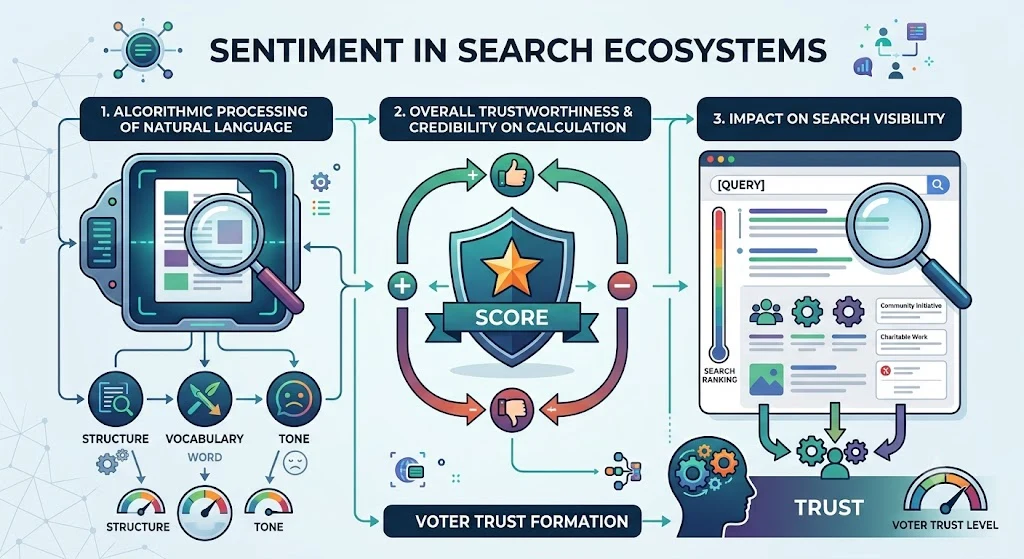
Sentiment interpretation refers to the analysis of language that expresses positive, negative or neutral attitudes. Words describing delayed communication, unclear job specifications or strong technical knowledge communicate different aspects of a recruitment experience. Automated systems can classify linguistic patterns, but sentiment classification does not independently establish whether an allegation is accurate. Readers also distinguish between isolated criticism and recurring themes across multiple accounts. The credibility of the overall review profile depends on context, consistency and the quality of available evidence rather than sentiment alone.
What trust and authority signals shape recruiter credibility online?

Trust and authority signals are indicators that audiences and search systems use to evaluate the reliability, relevance or expertise associated with an entity. These indicators include identifiable professional qualifications, relevant industry experience, accurate company information and evidence-backed publications. In life sciences recruitment, sector-specific knowledge is particularly relevant because scientific and regulatory roles require an understanding of specialised terminology and professional requirements. Clear evidence helps candidates assess whether a recruiter understands the field in which they operate. The presence of a trust signal, however, does not constitute a guarantee of performance or integrity.
Search engines evaluate numerous signals when determining page relevance and quality, and no single visible indicator represents a complete assessment of trustworthiness. Links from relevant websites, clear authorship, useful content and consistent entity information contribute different forms of context. Their interpretation depends on the page, query and broader search environment. A professional article explaining pharmaceutical hiring requirements provides evidence of subject knowledge, while an unsupported claim of industry leadership provides less verifiable information. The distinction between demonstrated expertise and self-description is central to credibility assessment.
Authority also depends on topical relevance. A recruiter publishing accurate material about clinical operations establishes a different relationship with that subject from a recruiter whose public content focuses exclusively on unrelated industries. Search systems assess page-level relevance and other signals rather than assigning every page the same level of authority. Candidates similarly evaluate whether the available information answers their specific questions. Topical alignment therefore connects content relevance with perceived professional competence.
How does a digital footprint shape entity perception?
A digital footprint is the collection of information associated with a person or organisation across online platforms. It includes official websites, professional profiles, industry directories, published articles, public discussions and review pages. These sources contribute different types of evidence, and their combined presentation shapes how an entity is understood. A complete digital footprint is not necessarily a positive one because visibility can include inaccurate, outdated or contradictory information. Its significance depends on the relevance, reliability and interpretation of the material available.
Entity perception refers to the understanding that audiences develop about a person or organisation from the information they encounter. Candidates researching a life sciences recruiter can compare stated specialisms with professional biographies, published job information and external evaluations. Consistency across these sources helps establish a coherent identity, while discrepancies create questions about accuracy or current activity. Search engines affect this process by determining which pages are discoverable for relevant queries. The resulting perception reflects both the available evidence and the order in which users encounter it.
Content freshness also affects interpretation. An old profile describing a previous role or discontinued specialism does not necessarily represent the recruiter’s current activities. Search engines can continue to index historical material when it remains accessible and relevant to a query. Candidates therefore need to distinguish between the publication date, the date of the events described and the current validity of the information. A digital footprint represents an evolving record rather than a single, permanently accurate account.
Dive Deeper With Our Expert Guides:
How Does Life Sciences Recruitment Work? Biotech, Pharma, and MedTech Roles
Best Supply Chain Recruitment Agencies UK: 2026 Guide
How do salary guides and recruitment content influence search perception?
Salary guides influence search perception by providing structured information about compensation, job titles, qualifications and market conditions. In the UK life sciences sector, biotechnology and pharmaceutical salary data can help candidates compare positions in research and development, clinical operations, regulatory affairs, manufacturing and commercial functions. The value of a guide depends on its scope, publication date, geographical coverage and explanation of the underlying data. A salary figure without a defined role, experience level or location offers limited comparative value. Readers interpret compensation information more accurately when the methodology and limitations are explicit.
Recruitment content also communicates professional relevance. A guide that distinguishes between research scientists, clinical research associates and regulatory affairs specialists demonstrates an understanding of the differences between occupational categories. Clear definitions help search engines interpret the subject of a page and help users determine whether the information answers their query. Accurate headings, descriptive terminology and consistent explanations support content indexing and topical relevance. These characteristics do not guarantee rankings, but they make the subject and purpose of the material clearer.
Salary information must also be separated from recruiter reputation. A competitive salary range does not establish that a recruitment agency communicates effectively, while a well-regarded recruiter does not guarantee a particular salary outcome. Compensation data describes employment-market conditions, whereas reputation signals describe perceptions of professional identity, conduct and credibility. Search results sometimes bring these information categories together because candidates investigate salaries, employers and recruiters within the same research journey. Understanding the distinction prevents one type of evidence from being treated as proof of another.
How can candidates interpret conflicting information about recruiters?
Candidates interpret conflicting information by evaluating the source, context, date and evidential basis of each claim. An official profile, a third-party review and an industry article serve different informational purposes and require different forms of assessment. A profile is useful for identifying stated experience, while an independent account provides a perspective on a reported interaction. Neither source automatically resolves a disagreement between them. Reliable interpretation depends on comparing the available evidence rather than treating a single page as a definitive account.
Content accuracy is particularly important when information relates to professional qualifications, employment history or recruitment specialisms. A discrepancy can arise from outdated content, ambiguous wording, incomplete records or a genuine disagreement between sources. Search engines organise available pages but do not independently verify every statement before displaying it. A high-ranking result is therefore evidence of search visibility, not proof that its contents are correct. Distinguishing ranking from factual verification is essential when assessing professional credibility.
Candidates also benefit from recognising the limits of review summaries and automated sentiment indicators. A numerical rating compresses individual experiences into a single measure and conceals differences in context. A negative comment about one recruitment interaction does not establish that every aspect of the organisation’s work is deficient. Equally, positive reviews do not independently establish that every professional claim is accurate. Balanced evaluation considers patterns, specific evidence and the relevance of each source to the question being investigated.
What is the relationship between reputation signals and search perception?
Reputation signals are pieces of information that influence how an individual or organisation is evaluated online. These signals include professional credentials, published expertise, reviews, company records and the consistency of information across digital platforms. Search perception describes the impression formed when users encounter and interpret those signals through search results and other online sources. The two concepts are connected because discoverable information provides the evidence from which users form judgements. Their relationship depends on content quality, relevance, credibility and visibility.
The process can be understood as a sequence of connected stages. Content is published or generated through online activity, eligible pages are discovered and indexed, ranking systems select relevant results, and users interpret the information presented. Each stage affects what becomes visible and how it is understood. An accurate page that remains difficult to discover has limited exposure, while a prominent page containing outdated information can influence perception without providing a current account. This distinction explains why reputation analysis requires attention to both information quality and search visibility.
Recruitment research follows the same general pattern. Candidates identify a professional need, search for relevant recruiters, compare available information and assess whether the evidence aligns with their expectations. Queries about the research process itself connect to How Do Scientist Candidates Research Recruiters Before Applying?, which examines the candidate’s information-gathering perspective. That query is related to reputation analysis because it concerns how professional information is discovered and evaluated before an application decision. The underlying mechanism remains the interpretation of accessible evidence rather than search ranking alone.
How should online reputation be understood in life sciences recruitment?
Online reputation is an evolving interpretation of information associated with a person or organisation across digital environments. Search engines influence that interpretation by indexing eligible content, ranking relevant pages and determining which information receives visibility for specific queries. Reviews, professional credentials, industry publications and consistent entity details contribute distinct reputation signals. Their significance depends on context, accuracy and relevance rather than visibility or sentiment in isolation.
In the UK biotechnology and pharmaceutical recruitment market, salary guides and professional reputation answer different questions. Salary data explains compensation patterns across roles, experience levels and employment contexts, while reputation information helps candidates assess recruiters’ identities, expertise and reported conduct. Search perception develops when users encounter these sources and compare the evidence they contain. Understanding the distinction between discoverability, authority, factual accuracy and audience interpretation provides a clearer framework for analysing digital reputation.
What is the average life sciences salary in the UK in 2026?
Life sciences salaries in the UK vary by role, experience, location and employer, with biotechnology and pharmaceutical positions covering research, clinical operations, regulatory affairs and manufacturing. Candidates should compare current salary surveys and advertised vacancies to assess realistic compensation ranges for their specialism.
Which biotechnology and pharmaceutical jobs pay the most in the UK?
Senior pharmaceutical leadership, specialist clinical development, medical affairs and experienced regulatory roles often command higher salaries because they require advanced expertise and carry significant responsibilities. Actual pay depends on qualifications, therapeutic area, employer size and whether the position involves management or technical specialisation.
How can scientists research recruiters before applying for jobs?
Scientists can assess recruiters by reviewing professional profiles, life sciences recruitment experience, industry specialisms, independent reviews and the accuracy of published job information. Consistent professional details and credible evidence help candidates evaluate recruiter reputation before sharing personal information or applying.
How does a recruiter’s online reputation affect life sciences candidates?
A recruiter’s online reputation influences how candidates interpret professional credibility, communication standards and sector expertise. Search engine results, public reviews and professional profiles act as reputation signals that shape perceptions before candidates engage with a recruiter.
How can recruitment agencies manage negative online reviews in the life sciences sector?
Recruitment agencies can assess negative reviews by checking their accuracy, responding professionally to legitimate criticism and reporting content that violates a platform’s policies. Clear My Name provides reputation management services for recruiters, including support with assessing online reputation risks and addressing eligible harmful content.