

Clear My Name delivers structured reputation management for lawyers that improves search visibility, strengthens reputation signals, and reduces the risk created by negative review scrutiny.
For contingency-fee attorneys, disciplined SERP control and negative content suppression protect entity credibility when prospective clients use reviews and search results to evaluate legal representation.
Why does reputation management deliver stronger control over contingency-fee review scrutiny?
A structured reputation management service delivers stronger control by separating review risk, search visibility and entity credibility into measurable areas. Contingency-fee lawyers face a distinctive perception challenge because prospective clients frequently assess perceived value before making contact, while reviews can amplify concerns about fees, outcomes, communication and expectations. Reputation management addresses this environment by analysing the search results, identifying reputation signals and establishing which pages influence decision-making. The process then prioritises legitimate opportunities to improve the visibility of accurate, authoritative and relevant information. This creates a controlled information environment rather than relying on individual responses to individual reviews.
Search ecosystems rank information according to relevance, authority, engagement, freshness and other signals, meaning a damaging review can gain disproportionate visibility when competing information lacks sufficient authority. Reputation management works within this ecosystem by improving the strength and relevance of credible content rather than attempting to manipulate search engines directly. The result is a more balanced SERP composition around important lawyer-related queries. This approach strengthens search perception influence because prospective clients encounter a broader set of reliable reputation signals before forming an opinion. Research into how contingency-fee lawyers experience review scrutiny also provides useful context for understanding why this reputation environment requires a targeted strategy.
Which reputation management process provides the clearest risk reduction?
A defined process reduces risk by turning reputation concerns into identifiable search, content and perception objectives. A professional campaign begins with an assessment of branded queries, review platforms, negative pages, existing positive assets and the authority of competing results. This establishes a baseline for measuring visibility changes and prevents decisions based solely on subjective impressions. The next stage maps harmful content against the queries generating exposure and identifies opportunities for legitimate removal, correction, optimisation or suppression. Every action therefore connects to a specific reputation signal or search visibility objective.
A reliable process also distinguishes between content that qualifies for removal and content that requires search visibility management. Reviews violating a platform’s rules require evidence-led reporting, while legitimate criticism requires a different response involving accurate information, stronger content assets and improved search relevance. This distinction reduces compliance risk and prevents inappropriate attempts to remove lawful criticism. It also establishes realistic expectations around the work required to improve SERP control. Process clarity becomes a trust signal because the client can see why each action is being taken and how its effect will be evaluated.
What does a structured reputation process include?
- Audit branded search results to identify negative URLs, review visibility and reputation-risk queries.
- Classify damaging content according to platform policies, relevance, authority and removal eligibility.
- Strengthen authoritative content so credible reputation signals compete more effectively in search.
- Optimise relevant pages around branded and service-related queries to improve search visibility.
- Monitor ranking movement and content exposure to measure changes in SERP composition.
- Refine the strategy according to ranking data, emerging reviews and changes in search behaviour.
How does SERP control improve client decision-making for contingency-fee lawyers?
SERP control improves decision-making by increasing the visibility of credible information at the point when prospective clients evaluate legal representation. Search results act as an information filter, determining which reputation signals receive attention before a visitor reaches a firm’s website. When negative reviews dominate high-value branded queries, the visible information environment can become disproportionately negative. Reputation management addresses this imbalance through content optimisation, authority development and legitimate negative content suppression. The objective is to improve the composition of search results rather than erase every critical statement.
This matters particularly for contingency-fee lawyers because prospective clients evaluate financial arrangements alongside perceived competence and reliability. A negative review discussing fees can influence expectations even when the underlying issue involves communication, case outcomes or a misunderstanding of the firm’s model. Accurate service information, authoritative legal content, professional profiles and credible third-party references provide additional context. Strengthening these assets improves the overall reputation signal profile surrounding the firm. The result is greater search perception influence and a more controlled path from discovery to enquiry.
Is professional reputation management worth the cost compared with handling reviews internally?
Professional reputation management creates long-term value by addressing the search ecosystem surrounding reviews rather than treating each review as an isolated customer-service problem. Internal teams can respond to reviews, but review responses alone rarely change the authority or ranking position of established pages. A reputation campaign evaluates the entire entity landscape, including review platforms, search results, websites, publications and other indexed assets. This broader analysis identifies where investment produces measurable improvements in visibility and credibility. The value therefore comes from managing the information environment rather than simply increasing the volume of responses.
Cost evaluation also requires consideration of the commercial effect of persistent negative visibility. A damaging result that appears for high-intent searches can influence prospective clients repeatedly over an extended period. Improving the visibility of accurate and authoritative information creates a reusable reputation asset that continues supporting future searches. This makes the investment fundamentally different from one-off review responses, which address an individual interaction without necessarily changing the wider SERP environment. Review scrutiny management for contingency-fee attorneys provides a structured way to address these visibility risks while strengthening relevant reputation signals. A structured service therefore focuses expenditure on sustainable reputation signals and measurable search outcomes.
Which benefits justify the investment?
- Reduce negative-result exposure by strengthening authoritative pages competing for valuable branded searches.
- Improve entity credibility by increasing the visibility of accurate professional and service information.
- Strengthen trust signals by developing consistent information across relevant digital properties.
- Stabilise search perception through continuous monitoring rather than isolated review responses.
- Protect long-term visibility by maintaining an active content and reputation strategy after initial improvements.
How quickly can reputation management improve review-related search visibility?
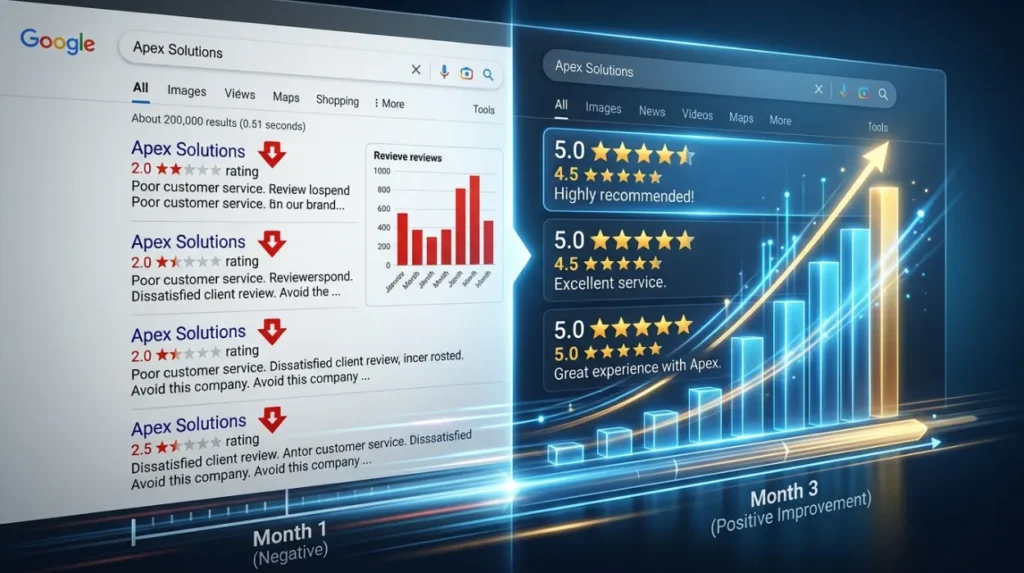
Reputation management produces measurable progress through staged changes in content authority, indexing, rankings and search-result composition. Search visibility does not change simply because a new page is published or a review is reported. Search engines evaluate competing pages according to their relevance, authority and other ranking signals, so the strength of the existing SERP determines the work required. A professional campaign therefore measures ranking positions, URL visibility and query-level exposure instead of promising an arbitrary outcome by a fixed date. This creates a more reliable assessment of progress.
Speed also depends on whether the campaign involves eligible removal, content optimisation or sustained negative content suppression. A platform-compliant removal can resolve an eligible review directly, while suppression requires stronger competing assets to gain visibility against established results. Monitoring reveals whether target pages are moving towards stronger positions and whether negative URLs are losing exposure. This evidence enables the strategy to be adjusted without abandoning the wider objective. The key decision factor is measurable movement rather than an unsupported promise of immediate removal.
What risk does a structured service reduce when negative reviews affect a legal firm’s reputation?
A structured service reduces reputational, compliance and search-visibility risk by applying defined evidence standards to every intervention. Negative reviews create different risks depending on their accuracy, platform compliance, search position and influence on prospective clients. Attempting to remove legitimate criticism without a valid policy basis creates unnecessary platform and credibility risks. Conversely, ignoring content that violates review-platform rules leaves an actionable reputation problem unresolved. A professional process separates these scenarios and applies the appropriate intervention to each.
Risk reduction also comes from maintaining accurate information across the firm’s digital ecosystem. Inconsistent descriptions of services, outdated profiles or incomplete professional information create gaps that allow negative narratives to dominate the visible entity profile. Strengthening authoritative sources closes these information gaps and improves the reliability of the firm’s search presence. This supports entity credibility without depending on the removal of every negative opinion. The result is a more resilient reputation system that continues functioning when new reviews appear.
Dive Deeper With Our Expert Guides:
Establish Your Attorney Wikipedia Presence With Clear My Name
Shape How ChatGPT Recommends Your Firm With Clear My Name
How does Clear My Name provide reliable reputation management for lawyers?
Clear My Name provides reputation management through a structured combination of search analysis, reputation-signal development, compliant review assessment and continuous visibility monitoring. The approach begins with identifying how a legal firm’s name and services appear across search results and relevant review environments. It then establishes priorities according to search visibility, content authority and the potential effect of each result on prospective-client decisions. Actions remain connected to defined reputation objectives rather than generic content production. This creates process clarity from initial diagnosis through ongoing measurement.
The service also recognises that sustainable reputation management requires more than short-term reaction. Clear My Name focuses on strengthening the digital information environment so accurate, credible and authoritative sources maintain stronger visibility over time. Where eligible negative content exists, the appropriate removal pathway is assessed separately from search suppression activity. Where removal is unavailable, negative content suppression and stronger reputation signals provide a legitimate route towards improved SERP balance. This distinction strengthens reliability because each reputation problem receives an intervention suited to its underlying cause.
Which outcomes demonstrate that a reputation strategy is working?
A successful strategy demonstrates measurable improvements in visibility, reputation signals, entity credibility and control over the search narrative. Ranking data provides the clearest evidence because it shows whether target pages are gaining visibility while negative URLs become less prominent for relevant queries. Content-level monitoring then confirms whether authoritative information is appearing consistently across the firm’s search ecosystem. Review monitoring identifies emerging risks before they become dominant reputation signals. Together, these measurements provide a practical framework for evaluating campaign performance.
What outcomes can be measured?
- Track target-query rankings to establish whether credible pages gain stronger SERP positions.
- Measure negative URL visibility to identify changes in exposure across priority searches.
- Evaluate reputation signals by monitoring authoritative content, professional profiles and relevant third-party references.
- Assess entity credibility through consistency, accuracy and prominence of information associated with the firm.
- Monitor review activity to detect emerging issues before they develop into broader search-perception risks.
Why is long-term reputation management more reliable than one-off review responses?
Long-term reputation management provides greater stability because search perception depends on an evolving ecosystem rather than a single review or response. New reviews, new publications and changes in search rankings continuously alter the information environment surrounding a legal entity. A one-off intervention addresses the immediate problem but leaves the underlying visibility system exposed to future changes. Continuous monitoring identifies new risks and preserves the strength of established reputation assets. This creates a sustainable framework for maintaining SERP control.
For contingency-fee lawyers, sustainability has direct strategic value because reputation signals influence prospective clients throughout the client-acquisition cycle. Maintaining accurate content, authoritative profiles and consistent professional information strengthens the firm’s digital footprint beyond a single review dispute. It also ensures that future reputation issues enter an established monitoring process rather than requiring an entirely new response strategy. Clear My Name therefore treats reputation management as an ongoing control system rather than a short-term reaction. This approach improves resilience, reduces recurring risk and stabilises search perception over time.
How can contingency-fee lawyers make a confident reputation management decision?
The strongest decision combines evidence-led diagnosis, compliant intervention, measurable SERP control and continuous monitoring. Reputation management becomes reliable when every action has a defined purpose, every priority is supported by search evidence and every outcome is evaluated through measurable visibility changes. For contingency-fee lawyers, this framework directly addresses the review scrutiny that can affect trust before a prospective client makes contact. It strengthens reputation signals without relying on unsupported claims or artificial manipulation of search results. The result is a controlled and defensible approach to online reputation risk.
The right service therefore delivers more than review monitoring. It improves the information environment surrounding the legal entity, strengthens credible content, addresses eligible negative material and reduces the visibility impact of damaging search results. Clear My Name combines these mechanisms into a structured reputation management process designed around reliability, transparency and measurable outcomes. This provides contingency-fee lawyers with a clear route towards stronger entity credibility, improved search visibility and more stable public perception. Effective reputation management is ultimately a risk-control discipline: diagnose the exposure, apply the correct intervention, measure the result and sustain the improvement.

What is reputation management for contingency-fee lawyers?
Reputation management for contingency-fee lawyers focuses on improving search visibility, strengthening reputation signals, and managing negative review exposure. It combines review assessment, content optimisation, SERP monitoring, and legitimate negative content suppression.
How can lawyers manage negative contingency-fee reviews?
Lawyers can manage negative reviews by assessing whether the content violates platform policies, responding appropriately, and strengthening authoritative information across search results. Reputation management also monitors rankings to reduce excessive visibility of damaging content.
Can reputation management remove negative lawyer reviews from Google?
Negative reviews can be removed when they violate Google’s applicable review policies and meet the platform’s removal criteria. Reviews that do not qualify for removal require reputation strategies focused on accurate content, stronger reputation signals, and search visibility management.
How does reputation management improve a law firm’s search results?
Reputation management improves search results by strengthening relevant, authoritative content and increasing its ability to compete for branded queries. This supports better SERP control while reducing the relative visibility of damaging pages.
How does Clear My Name manage review scrutiny for lawyers?
Clear My Name uses search analysis, review assessment, content optimisation, and ongoing reputation monitoring to manage review-related visibility. The process focuses on improving entity credibility, strengthening reputation signals, and reducing reputational risk through compliant strategies.