

Photos and tags in Facebook reviews influence buyer perception by adding visual evidence, contextual information, and connections between a business, its customers, and related entities. Reputation management is the structured process of understanding and influencing how information about an entity is created, interpreted, indexed, and presented across digital ecosystems.
How do photos in Facebook reviews influence buyer perception?
Photos function as visual reputation signals because they provide additional evidence alongside written review content. A Facebook review containing an image communicates information about products, premises, staff interactions, service delivery, or customer experiences without relying exclusively on descriptive language. This visual information contributes to entity perception because users evaluate images as part of the broader information environment surrounding a business. Search and social platforms also process image-associated information through captions, surrounding text, metadata, and contextual relationships. The result is a review format containing multiple information types rather than a purely textual sentiment signal.
Visual content also changes how users evaluate the credibility of a review. A written statement provides an assertion, while an accompanying photograph provides contextual material that users can independently interpret. The image does not automatically establish factual accuracy, but it increases the amount of observable information associated with the review. This distinction is important within reputation systems because credibility depends on the relationship between claims, supporting information, source context, and consistency. Photos therefore operate as supplementary reputation signals rather than standalone proof of a customer’s experience.
Why do tagged people and pages matter in Facebook reviews?
Tags create entity relationships that connect review content with identifiable profiles, pages, products, locations, or other digital entities. A tag establishes a contextual association between the review and the entity being referenced, making the content more specific than an isolated textual mention. Within social information ecosystems, these relationships contribute to how content is organised and understood. Entity perception is influenced by the consistency and relevance of connections surrounding a recognised entity. Tags therefore add relational context to review content while extending its digital footprint.
The significance of tagging also depends on the context surrounding the tagged entity. A relevant tag connects the review to a recognisable subject, whereas an unrelated tag introduces additional information without necessarily strengthening relevance. Platforms evaluate content through combinations of textual, visual, behavioural, and relational signals rather than through a single attribute. Consequently, tags operate as contextual signals within a larger content structure. Their reputation value comes from the relationship they establish between the review and the entities discussed within it.
How do photos and tags change the information contained in a review?
Photos and tags transform a review from a single-format statement into a richer information object. Text communicates sentiment and claims, images provide visual context, and tags establish relationships with identifiable entities. These components create a broader semantic representation of the customer’s content. From a reputation perspective, this expands the digital footprint associated with the business because additional information becomes connected to the entity. The resulting content contains more signals for users and platforms to interpret.
This information structure also affects how review content is categorised. A review discussing a restaurant, for example, can contain text describing service quality, photographs showing the premises or food, and tags connecting the post to the restaurant’s Facebook page. Each component reinforces a particular contextual relationship. Search engines and social platforms process content according to their own indexing and ranking systems, but the underlying information remains part of the entity’s wider online presence. Richer review content therefore creates a more detailed representation of how an entity appears within digital environments.
How do Facebook review signals affect online reputation?
Facebook review signals contribute to online reputation by influencing the information users encounter when evaluating an entity. Online reputation refers to the collective perception formed from accessible digital information about a person, business, organisation, or brand. Reviews contribute to this perception through sentiment, recency, relevance, engagement, photographs, and associated entities. Positive and negative review signals therefore form part of the broader information environment surrounding an entity. The significance of an individual review depends on its visibility, context, credibility, and relationship with other reputation signals.
Review content also contributes to the balance of information available about an entity. A digital footprint containing consistent information, descriptive customer feedback, visual evidence, and relevant entity connections presents a more detailed reputation profile than a footprint dominated by isolated claims. This does not mean that platforms automatically interpret every positive signal as trustworthy or every negative signal as inaccurate. Instead, reputation emerges from the interaction between information sources and the systems that organise them. Reputation management therefore requires understanding how separate content elements collectively influence entity perception.
How does sentiment in Facebook reviews interact with visual content?
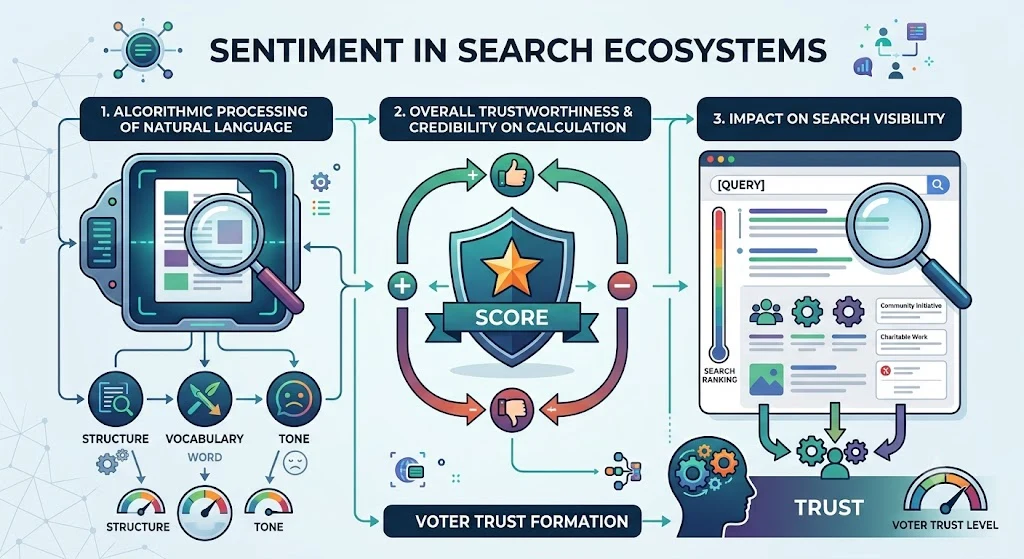
Sentiment represents the evaluative direction expressed through review language, while visual content provides additional context for interpreting that evaluation. A positive textual review accompanied by a photograph creates a combined content signal containing both sentiment and visual information. A negative review with an image creates a different information structure because the visual material can reinforce, contradict, or contextualise the written claim. Users frequently evaluate these components together when forming an initial perception of an entity. The combined presentation therefore affects the informational weight of the review in the user’s decision process.
Sentiment interpretation remains dependent on context rather than individual words. Review systems analyse language and engagement patterns through platform-specific mechanisms, while users interpret meaning according to the surrounding content. Images can influence this interpretation because they provide contextual information that written sentiment alone does not contain. A photograph of a product, premises, or service interaction can therefore strengthen the perceived relevance of a review. This makes visual content an important component of reputation signals without making it an independent measure of credibility.
Can Facebook review photos influence search visibility?

Facebook review photos can contribute to search visibility when associated content is publicly accessible, indexed, or surfaced through search features. Search visibility is the extent to which an entity and its associated information appear within search results for relevant queries. Search engines evaluate indexed content using factors relating to relevance, authority, accessibility, and content relationships. Public Facebook content can form part of the broader digital footprint considered during SERP evaluation, although indexing and ranking remain controlled by individual search systems. The presence of an image does not guarantee a specific ranking position.
The wider importance lies in the information ecosystem surrounding the entity. Search engines encounter references across websites, social platforms, review environments, directories, and other digital sources. These references contribute to the volume and diversity of information associated with an entity. A Facebook review containing relevant text, visual material, and entity references represents one component of that ecosystem. Its search impact therefore depends on accessibility, relevance, indexing status, authority, and the competitive environment for the associated query.
How do tagged entities contribute to reputation signals?
Tagged entities provide structured relationships that help identify who or what the review concerns. Entity relationships are important because reputation systems operate around identifiable subjects rather than isolated pieces of content. A business page tagged in a review establishes a direct association between the review and that business. A customer profile, location, or product reference adds further contextual information to the content. These relationships create connections within the entity’s digital footprint.
The value of these relationships depends on relevance and consistency. Repeated associations between an entity and relevant customer-generated content can create a recognisable information pattern across a platform. In contrast, irrelevant or misleading associations do not automatically strengthen credibility because contextual accuracy remains important. Entity perception is therefore shaped by the quality and consistency of connected information rather than by the number of tags alone. Tags function as relationship signals within a wider semantic network.
Why does customer-generated visual content matter for digital credibility?
Customer-generated visual content matters because it introduces information created independently from the entity being evaluated. Digital credibility refers to the perceived reliability and trustworthiness of information associated with an entity across online environments. Customer-generated material forms one category of third-party information that users can compare with official descriptions, professional reviews, and other external references. This comparison creates a broader basis for evaluating consistency. The informational value comes from the source relationship as well as the content itself.
Visual customer content also contributes to information diversity. A business’s official website generally communicates controlled information, while customer reviews provide externally generated observations. Photographs add another layer by showing elements that users can visually assess. This creates a distinction between first-party reputation signals and third-party reputation signals. Search perception becomes stronger when users can evaluate an entity through multiple relevant information sources rather than relying on a single controlled channel.
Dive Deeper With Our Expert Guides:
Why Review Velocity Matters More Than Total Review Count
How Meta’s Review Policies Decide What Content Stays
How do photos and tags fit into the wider digital footprint?
Photos and tags form part of the digital footprint because they create persistent or semi-persistent references connecting an entity with specific content. A digital footprint is the accumulated set of publicly accessible digital information and relationships associated with an entity. Facebook reviews represent one component of that footprint, alongside websites, directories, social profiles, news articles, forums, and other platforms. Each source contributes different types of information to the overall reputation environment. The combined footprint influences how users encounter and interpret an entity online.
The importance of Facebook content therefore extends beyond the individual review interface. Publicly available information can be discovered through platform searches, external search engines, social recommendations, and direct profile visits. Where content becomes indexed or repeatedly surfaced, it forms part of the entity’s broader search environment. Reputation signals are consequently distributed across multiple information systems rather than concentrated on one platform. Understanding this distribution is central to analysing online reputation.
How should Facebook reviews be interpreted within search reputation systems?
Facebook reviews are best interpreted as contextual reputation signals rather than isolated measures of business quality. Their meaning depends on sentiment, source context, visual content, entity relationships, engagement, recency, and the wider information environment. Search reputation systems evaluate entities through interconnected signals rather than treating one review as a complete representation of credibility. A single photograph or tag therefore does not independently determine search perception. Its significance emerges through its relationship with surrounding information.
The broader principle is that reputation is constructed through information accumulation and interpretation. Written reviews communicate claims, photographs provide visual context, tags establish entity relationships, and engagement indicates user interaction. Search engines and social platforms organise these signals according to their own ranking and indexing mechanisms, while users form perceptions from the information presented to them. Understanding this system explains why customer-generated content can influence both social perception and the wider digital footprint.
What role do photo-rich Facebook recommendations play in online reputation?
Photo-rich recommendations create a more comprehensive form of customer-generated reputation content because they combine sentiment, visual evidence, and contextual information. This structure gives users additional material for evaluating an entity beyond a numerical rating or short written statement. Encouraging Photo-Rich Facebook Recommendations From Customers therefore relates to the broader principle that richer customer-generated content produces more detailed reputation signals. The effect remains dependent on relevance, authenticity, visibility, and the surrounding information ecosystem. Photo-rich content is consequently best understood as one component of a wider reputation system rather than a standalone ranking mechanism.
From a semantic perspective, these recommendations strengthen the information relationships surrounding an entity. Text identifies the experience, photographs add visual context, and tags connect the content with relevant entities. Together, these elements expand the entity’s digital footprint and provide additional material for users to interpret. Their contribution to search visibility depends on whether the content is accessible and indexed, while their contribution to perception depends on how users evaluate the information. The resulting reputation signal is therefore multidimensional.
What are the key principles for understanding Facebook review influence?
Facebook review influence is based on the interaction between content, context, entities, and visibility. Photos add visual information, tags establish relationships, sentiment communicates evaluation, and engagement indicates interaction with the content. These elements contribute to the broader reputation signals surrounding an entity. Their influence is not determined by one isolated factor because reputation systems process information within interconnected digital environments.
The central distinction is between content creation and content interpretation. Customers create reviews, photographs, tags, and recommendations, while platforms organise and distribute that information through their own systems. Search engines then evaluate accessible content for relevance, authority, and contextual relationships when generating search results. Users interpret the resulting information according to their own evaluation criteria. Online reputation therefore emerges from the interaction between what is published, how it is connected, how it is surfaced, and how it is perceived.

Photos and tags make Facebook reviews information-rich reputation signals by combining written sentiment, visual context, and entity relationships. These components contribute to digital footprints and influence how users evaluate credibility, relevance, and consistency surrounding an entity. Search visibility depends on indexing and ranking mechanisms, while buyer perception depends on how accessible information is interpreted alongside other reputation signals.
The broader concept is that online reputation is an information ecosystem rather than a single rating or review. Text, photographs, tags, engagement, authority, and third-party references collectively shape entity perception across digital environments. Understanding these relationships provides a clearer basis for analysing how customer-generated content contributes to search reputation and online credibility.
How do photos in Facebook reviews influence buyers?
Photos provide visual context that helps buyers evaluate products, premises, services, or customer experiences alongside written review content. They act as additional reputation signals that can influence trust, credibility, and overall brand perception.
Do tags in Facebook reviews affect business reputation?
Tags create direct relationships between review content and identifiable businesses, people, pages, or locations. These associations add contextual information to the digital footprint and can influence how users interpret an entity’s online reputation.
Can Facebook reviews affect search visibility?
Publicly accessible Facebook reviews can contribute to an entity’s wider digital footprint when search engines discover and index the content. Their effect on search visibility depends on factors such as relevance, accessibility, indexing, authority, and the wider search environment.
Why are photo-rich Facebook recommendations important?
Photo-rich recommendations combine written sentiment with visual information, creating more detailed customer-generated reputation signals. This additional context gives buyers more information when evaluating credibility and forming perceptions about a business.
How do Facebook reviews influence online reputation?
Facebook reviews contribute to online reputation through sentiment, visual content, tags, engagement, and associations with relevant entities. These signals form part of the broader digital footprint that users and search systems evaluate when assessing credibility and entity perception.