
Managing Google Reviews across multiple business locations requires a consistent reputation management process that protects search visibility, strengthens customer trust and maintains accurate brand perception. Clear My Name helps businesses organise review-related reputation work so that each location receives focused attention while the wider brand maintains a coherent digital identity.
Why Is Professional Google Reviews Management Essential for Multi-Location Brands?
Professional Google Reviews management gives multi-location brands a structured way to protect local reputation signals, maintain response consistency and improve the information customers encounter in search results. Each location operates as a distinct point of customer interaction, yet customers also judge the wider organisation through repeated experiences across branches. An unanswered complaint at one site can influence perceptions of service standards across the entire brand. A well-managed review process establishes accountability for monitoring, responding to feedback and escalating policy-violating content. This approach strengthens entity credibility by aligning public responses with actual service standards and documented business information.
Google Business Profiles display customer ratings, review text, business details and owner responses that help people evaluate local businesses. These signals influence how customers compare branches before making contact, booking an appointment or visiting a premises. Review management does not guarantee higher rankings, because local search visibility depends on multiple factors, including relevance, distance and prominence. However, accurate profile information, active customer engagement and policy-compliant review handling support a more dependable local search presence. Businesses that coordinate these activities gain greater control over how customers interpret their reputation across locations.
How Does Clear My Name Manage Google Reviews Across Multiple Locations?
A reliable service begins with a clear assessment of each location’s review profile, reputation risks and operational responsibilities. Clear My Name focuses on structured reputation management that helps businesses identify review-related issues, coordinate appropriate responses and establish a consistent process for protecting their public image. The work starts by distinguishing routine customer feedback from complaints requiring investigation and reviews that appear to violate platform policies. Each category requires a different response because a service complaint calls for operational attention, while suspected policy violations require evidence-based reporting. This classification prevents businesses from treating every negative review as a removal request.
A practical multi-location process includes the following steps:
- Audit each Google Business Profile to identify rating differences, unanswered reviews, recurring complaints and inconsistencies in business information.
- Categorise feedback by location, sentiment, subject and urgency to identify recurring service problems and reputation risks.
- Assign response responsibilities to named team members so that every location has a clear owner and escalation route.
- Document suspected policy violations with review links, screenshots, relevant dates and a concise explanation of the applicable policy concern.
- Measure response coverage, response time, complaint themes and rating trends to assess whether the process improves over time.
This process establishes a reliable operating structure without assuming that every review requires the same intervention. It also creates an audit trail that helps managers understand what happened, which action followed and whether further investigation remains necessary. For brands with central marketing teams and local branch managers, defined responsibilities reduce duplicated work and inconsistent communication. A documented process also supports continuity when staff change or the business opens additional locations. The result is more controlled review management rather than disconnected activity across individual profiles.
Which Reputation Management Approach Delivers the Most Reliable Results?
A hybrid approach combining central oversight with local accountability offers a practical model for multi-location businesses. Central teams maintain response standards, reporting rules and escalation procedures, while local managers contribute accurate information about specific customer experiences. This structure balances brand consistency with the context required to resolve individual complaints. A fully centralised system creates stronger control but risks generic responses when the central team lacks operational detail. A fully decentralised system gives branches more autonomy but can produce uneven response quality and inconsistent handling of sensitive issues.
The appropriate balance depends on the number of locations, review volume, regulatory exposure and internal resources available. A business with a small number of branches can manage review activity through a shared register and scheduled checks, while a larger organisation benefits from centralised monitoring and location-level reporting. The key measure is not the complexity of the software but whether the process identifies important reviews, assigns responsibility and records the outcome. Businesses evaluating how to manage Google reviews across multiple business locations need to assess these operational requirements before selecting a tool or external provider. A reliable model makes performance visible and creates a consistent route from review detection to resolution.
The strongest approach also separates reputation protection from attempts to control legitimate customer opinion. Genuine criticism provides information about customer experience and requires a professional response, not suppression. Content that violates Google’s policies follows a different route through evidence collection and platform reporting. This distinction protects credibility because customers recognise the difference between a business addressing a concern and a business attempting to silence criticism. It also reduces the risk of wasting resources on removal requests that lack a valid policy basis.
Can Google Reviews Management Improve Search Visibility and Public Perception?
Effective review management improves the quality and consistency of the information customers encounter, although no provider can guarantee a specific ranking position or the removal of legitimate criticism. Local search systems use multiple signals to determine which businesses are relevant to a query, and reviews form part of the wider prominence and customer perception environment. Ratings and review content also influence user decisions independently of rankings because searchers compare feedback before selecting a provider. A professional process helps businesses keep profile information accurate, respond to concerns and identify repeated issues that affect customer confidence. These actions strengthen the relationship between the business’s actual service quality and its public digital representation.
Search perception influence involves more than changing one rating or responding to one complaint. Customers can encounter review snippets, local listings, business websites and third-party pages during their research. When these sources communicate consistent, accurate information, customers receive a clearer picture of the organisation and its locations. Where negative content dominates the visible results, legitimate and useful content about the business can improve the balance of information available to searchers. This is the basis of negative content suppression: strengthening relevant, trustworthy assets so that damaging material becomes less prominent where search systems determine that other content deserves visibility.
Suppression does not mean deleting criticism from third-party websites or manipulating search algorithms. Search engines retain control over indexing, ranking and presentation, while review platforms decide whether reported content violates their policies. Businesses therefore need to evaluate outcomes across multiple measures rather than treating a ranking movement as proof of success. Useful indicators include profile accuracy, response coverage, changes in review themes, branded search results and customer enquiries. Tracking these measures together gives managers a more credible view of whether reputation work is improving visibility, trust and operational consistency.
Dive Deeper With Our Expert Guides:
Fix Inconsistent Google Ratings With Clear My Name
Defend Against Review Bombing With Clear My Name
How Should Businesses Handle Negative or Policy-Violating Google Reviews?
Businesses achieve more reliable outcomes when they match each review to the correct response route. A legitimate complaint requires acknowledgement, investigation and a proportionate explanation that respects customer privacy. A review containing a suspected policy violation requires evidence and a report through Google’s established process. An inaccurate business detail requires profile correction rather than a review-removal request. Separating these cases reduces unnecessary escalation and helps teams focus resources on issues with a defensible route to resolution.
A structured response protocol protects both customer relationships and the organisation’s reputation:
- Acknowledge legitimate criticism with a concise response that recognises the concern without disclosing personal or confidential information.
- Investigate the underlying experience with relevant staff and service records before making factual claims in public.
- Escalate suspected policy violations with the review URL and evidence that explains the specific policy concern.
- Correct verified operational problems and record the improvement so that repeated complaints receive a substantive response.
- Review unresolved cases through the platform’s available reporting and appeal procedures rather than repeatedly submitting unsupported requests.
This approach reduces reputational and operational risk because each action has a clear purpose and evidence requirement. It also prevents staff from promising customers that a review will be removed when the platform retains the final decision. Businesses must avoid incentives or pressure designed to secure positive reviews, as well as retaliatory responses to critical feedback. Review solicitation and customer communication need to comply with applicable platform policies and consumer protection requirements. Clear procedures help teams remain professional even when criticism is public, emotionally charged or commercially sensitive.
How Can Businesses Measure the Value of a Google Reviews Management Service?
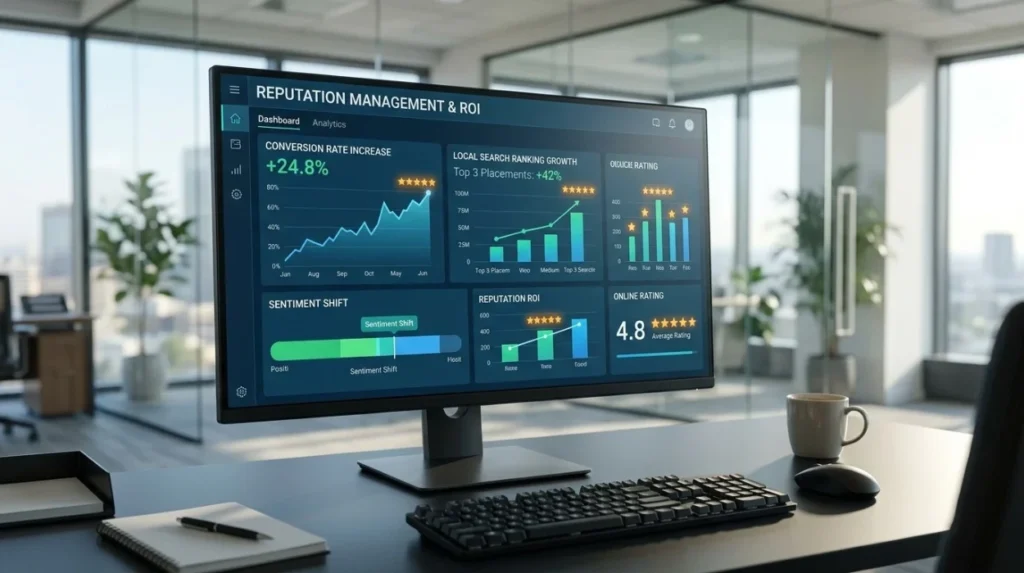
The value of a reputation management service depends on measurable improvements in process quality, customer-facing information and business outcomes rather than a guaranteed increase in star ratings. Before work begins, businesses need a baseline showing the review count, average rating, unanswered-review volume, response times and recurring complaint themes for each location. This baseline enables managers to compare performance over a defined period and identify where the process is producing measurable improvements. Reporting also helps distinguish work completed by the management team from changes determined by customers or Google. Without baseline data, a business cannot reliably attribute reputation changes to a specific intervention.
A useful measurement framework includes operational, reputation and commercial indicators. Operational indicators track how consistently teams monitor reviews, respond and escalate issues. Reputation indicators track rating trends, review sentiment, recurring themes and the visibility of accurate business information. Commercial indicators examine relevant outcomes such as qualified enquiries, appointment bookings or conversions from local traffic, where reliable analytics are available. These indicators need to be interpreted together because a rating can remain stable while response coverage improves, or customer sentiment can improve without an immediate ranking change. A balanced dashboard supports evidence-based decisions instead of relying on one headline metric.
Cost evaluation also needs to account for the time and risk involved in unmanaged review activity. Internal teams may manage a limited portfolio effectively, but fragmented responsibilities become harder to maintain as locations and review volumes grow. An external service introduces a direct cost while providing a more structured approach to monitoring, documentation and escalation. Businesses can compare the service cost with internal labour, missed response opportunities, reporting effort and the value of clearer accountability. The strongest investment case comes from a defined scope, transparent deliverables and regular performance reviews rather than promises of guaranteed removals or rankings.
How Quickly Can a Multi-Location Reputation Management Service Deliver Results?
Operational improvements begin when monitoring responsibilities, response standards and escalation procedures are established, but public reputation outcomes follow different timelines. A team can implement a review register and assign responsibilities before any change appears in search results. Customer responses depend on staff access to accurate information, while platform review decisions depend on Google’s assessment and processes. Search visibility changes also depend on indexing, competition, location and other ranking signals beyond the provider’s control. A credible service separates immediate process milestones from longer-term changes in public perception and search performance.
Businesses can assess progress through scheduled reporting rather than relying on a single deadline. Early reviews can confirm whether profile audits are complete, priority issues have owners and response procedures are being followed. Later reporting can examine whether response coverage has increased, complaint patterns have changed and location-level performance has become more consistent. Where policy reports are submitted, the business records submission dates and decisions without assuming approval. This staged approach creates transparency and makes delays easier to explain, investigate and manage.
Sustainable results also depend on continued operational discipline. A temporary response campaign does not resolve the underlying causes of recurring negative feedback or maintain consistency as new reviews arrive. Staff training, regular audits, documented escalation rules and ongoing performance measurement help maintain progress. Businesses also need to adapt when Google’s policies or profile features change. Long-term reliability comes from a repeatable system that continues to operate after the initial audit, not from a one-off attempt to improve a rating.
Why Choose Clear My Name for Multi-Location Google Reviews Management?
Clear My Name provides a reputation management route for businesses that need structured oversight of Google Reviews across multiple locations. The decision to engage a service is strongest when the scope identifies what will be audited, how reviews will be categorised, who handles responses and how policy concerns will be documented. Clear responsibilities reduce the risk of missed reviews and inconsistent public communication. Evidence-based escalation also ensures that suspected violations are assessed against platform rules rather than treated as guaranteed removal opportunities. These safeguards support a more dependable process for protecting trust and maintaining an accurate public presence.
Before appointing a provider, businesses need clarity on deliverables, reporting frequency, approval responsibilities, access requirements and the limits of external control. They also need to understand which tasks remain with local teams, particularly when a complaint requires operational investigation or a customer-specific resolution. A transparent service explains how it records work, measures progress and communicates platform decisions. It avoids guaranteeing ranking positions, permanent suppression or removal of reviews that comply with platform policies. This level of clarity helps decision-makers compare providers on accountability and process quality rather than unsupported promises.
For multi-location brands, the most useful outcome is a reputation management process that can be evaluated and maintained. Consistent monitoring improves visibility into emerging concerns, structured responses support customer confidence and documented escalation gives policy-related cases a defensible route forward. Clear My Name offers a service-focused option for businesses seeking a more organised approach to Google Reviews and location-level reputation risks. The right engagement begins with an assessment of current profiles, defined objectives and realistic measures of success. With a clear scope and ongoing review, businesses can strengthen reputation signals, reduce operational uncertainty and make better-informed decisions about their search presence.
How do you manage Google Reviews across multiple business locations?
Businesses can manage Google Reviews across multiple locations by centralising monitoring, setting consistent response guidelines and assigning responsibility to each branch. A structured process tracks review activity, identifies recurring complaints and maintains consistent customer communication.
Can reputation management services improve Google Reviews and local search visibility?
Reputation management services improve review response consistency, profile accuracy and the quality of customer-facing information. These activities support customer trust and local search performance, although Google rankings depend on multiple factors and cannot be guaranteed.
Can Google remove negative reviews from multiple business locations?
Google removes reviews that violate its content policies, not simply because they are negative or damage a business’s reputation. Businesses can report suspected violations with supporting evidence, but Google makes the final decision on removal.
How can businesses maintain consistent responses to Google Reviews across different branches?
Businesses can establish shared response guidelines, assign review ownership and use a central monitoring process while allowing local managers to investigate branch-specific concerns. Regular audits of response times, tone and unresolved complaints help maintain consistent service standards.
What does Google Reviews management from Clear My Name involve?
Google Reviews management from Clear My Name focuses on organising review monitoring, identifying reputation risks and supporting appropriate responses or policy-based escalation. The process helps businesses maintain consistent review handling across locations without guaranteeing review removal or specific search rankings.