
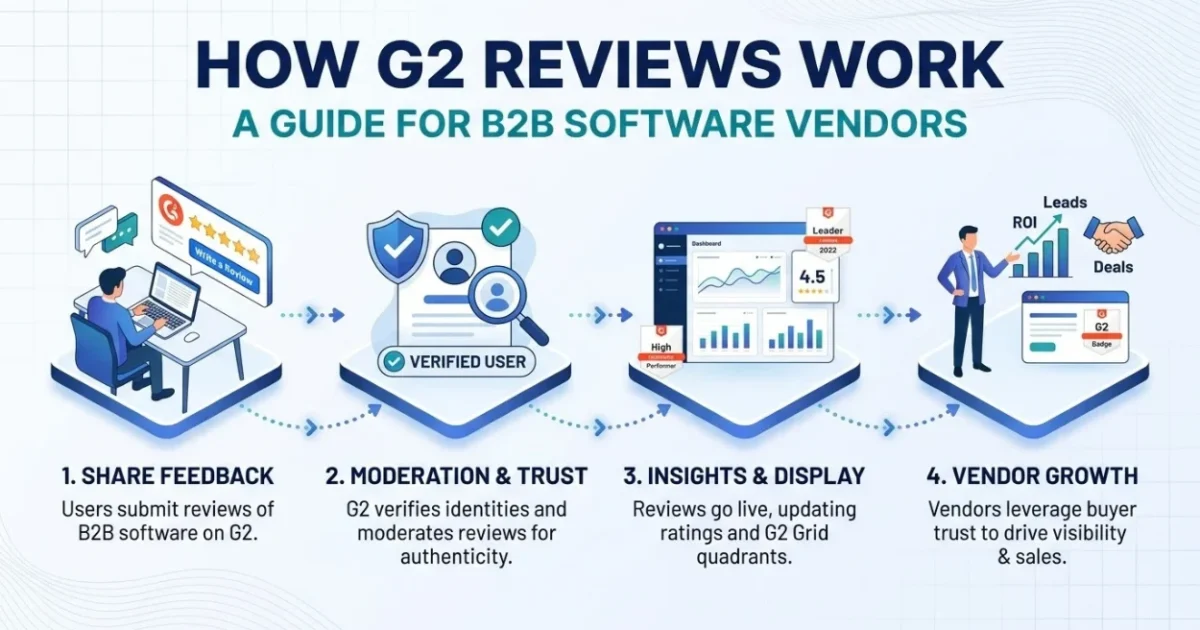
G2 reviews are customer-generated evaluations of business software that influence product comparison, buyer confidence and a software vendor’s online reputation. Reputation management is the process of understanding how digital information, including reviews, ratings and public feedback, shapes the credibility and perceived reliability of an organisation.
Online reputation refers to the collective interpretation of information associated with a business across search engines, review platforms and other digital sources. For B2B software vendors, G2 provides a structured environment in which customer experiences become reputation signals that influence software discovery, product evaluation and purchasing decisions.
What Are G2 Reviews and How Do They Work?
G2 reviews are evaluations submitted by users who share their experiences with business software, including its functionality, usability, support and overall value. The platform organises these evaluations into structured feedback that helps prospective buyers compare products within relevant software categories. Review content includes written commentary, ratings and responses to questions about the customer experience. This structure converts individual opinions into information that supports broader assessments of software performance and vendor credibility. The resulting review profile becomes part of a company’s digital footprint.
The review process connects customer feedback with product discovery. Users submit reviews through the platform, where review collection and moderation processes help establish whether submissions meet applicable requirements. Published reviews contribute to the information available on product profiles and comparison pages. Buyers interpret this information alongside product features, pricing, integrations and other purchasing criteria. Consequently, G2 reviews function as both customer feedback and publicly accessible reputation signals.
How Does G2 Verify Reviews and Evaluate Reviewer Credibility?
G2 uses review verification and moderation processes to assess whether submitted feedback meets its review requirements. Verification helps distinguish credible customer experiences from submissions that fail applicable authenticity or eligibility checks. The precise process depends on the platform’s current policies and the information available for an individual submission. Review moderation is therefore a governance mechanism rather than a guarantee that every published opinion is universally representative. Understanding this distinction is essential when interpreting a software vendor’s review profile.
Reviewer credibility affects how feedback is interpreted. A review supported by an identifiable professional context and a relevant software-use experience provides information about the relationship between the reviewer and the product. Moderation procedures address submission integrity, while review content communicates the user’s reported experience. These are separate dimensions of credibility: a submission can satisfy platform requirements without representing every customer’s experience. Buyers therefore evaluate the review’s substance, relevance and context rather than treating verification as proof of universal accuracy.
Review authenticity also matters to the integrity of reputation systems. Fabricated submissions, undisclosed incentives and attempts to manipulate ratings undermine the relationship between reported sentiment and actual customer experience. Review platforms establish policies to address these risks and maintain confidence in their content. The credibility of a review ecosystem depends on consistent enforcement, transparent rules and reliable feedback processes. These mechanisms influence how users interpret the platform as a source of information.
How Do G2 Ratings Reflect Customer Sentiment?
G2 ratings summarise reported customer experiences using a structured scoring system. They provide a compact representation of user sentiment, allowing buyers to compare software products without reading every individual review. However, a rating is an aggregate indicator rather than a complete measurement of product quality. Its meaning depends on the underlying reviews, the experiences represented and the criteria used to calculate the score. A high rating therefore communicates positive reported sentiment, not a guarantee that a product meets every buyer’s requirements.
Sentiment interpretation involves examining the tone, subject matter and consistency of customer feedback. Positive reviews frequently identify strengths such as ease of use, customer support or integration capabilities, while critical reviews describe problems, limitations or unmet expectations. Repeated comments about the same feature provide a stronger indication of a recurring perception than an isolated statement. Nevertheless, review frequency alone does not establish the prevalence of an issue across the entire customer base. The available reviews represent the experiences of contributors, not necessarily every user of the software.
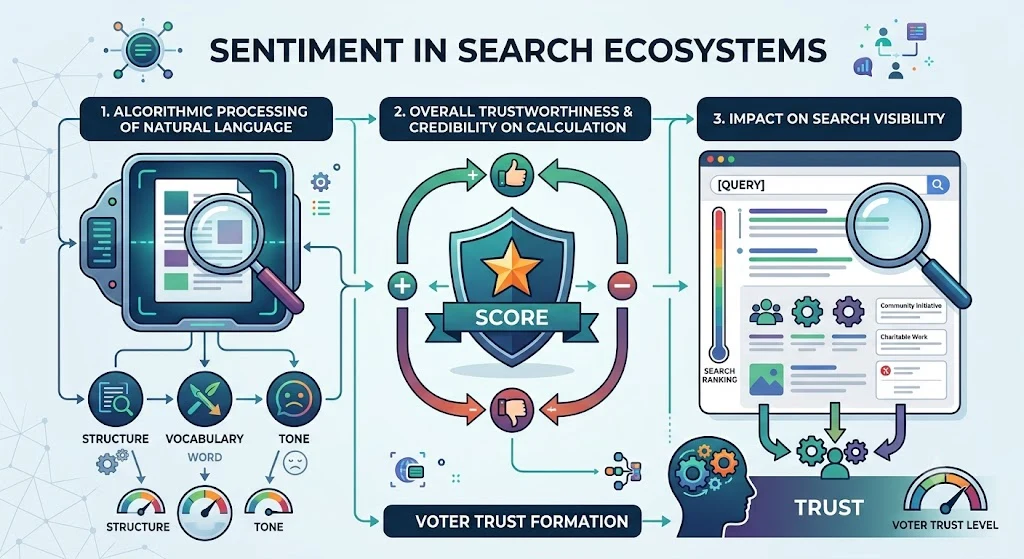
Ratings also require contextual interpretation. A software product serving a specialised market has a different competitive environment from a product designed for a broad audience. The expectations of enterprise procurement teams also differ from those of smaller organisations evaluating entry-level software. Buyers assess ratings alongside product category, use case, functionality and review recency. This contextual approach reduces the risk of interpreting a numerical score as an independent measure of suitability.
How Do G2 Reviews Influence Software Buying Decisions?
G2 reviews influence software buying decisions by providing third-party descriptions of product performance and customer experience. B2B buyers use these accounts to evaluate whether a product addresses operational requirements and whether the vendor appears capable of supporting long-term adoption. Reviews contribute evidence to the evaluation process, particularly when buyers compare products with similar feature sets. Their influence depends on the relevance and credibility of the information rather than the rating alone. Review content therefore operates as one component of a broader purchasing assessment.
The decision process often involves comparing multiple reputation signals. A buyer can examine overall ratings, detailed comments, reported product limitations and feedback about implementation or support. These signals help identify differences that product specifications do not fully explain. For example, two products with similar functionality can receive different assessments because users report different onboarding experiences or support quality. Such feedback provides context for evaluating the operational implications of a software purchase.
Review interpretation also involves risk assessment. Enterprise buyers consider the consequences of selecting software that fails to meet security, integration, compliance or service expectations. Reviews offer user-reported evidence about some of these concerns, although they do not replace technical validation, contractual review or independent security assessment. A credible evaluation combines customer sentiment with verifiable product information. This relationship explains why review platforms form part of the wider information environment surrounding B2B procurement.
How Do G2 Reviews Affect Search Visibility and SERP Evaluation?
G2 reviews contribute to online visibility through the content and product pages available on the platform. Search engine results pages (SERPs) present information that search engines select and rank in response to a query. A software vendor’s G2 profile can appear alongside its official website, industry publications, directories and other third-party references. The resulting search landscape gives users multiple sources through which to assess the organisation. The prominence of each source depends on search algorithms, query relevance, content quality and other ranking considerations.
Content indexing is the process through which search engines analyse and store information from accessible web pages. Once indexed, a review profile or comparison page becomes eligible to appear for relevant searches, subject to the search engine’s ranking systems. The presence of customer reviews does not guarantee a particular position in search results. Search engines evaluate pages using multiple signals, and their ranking systems do not simply reproduce the average rating shown on a review platform. A vendor’s search visibility therefore reflects a broader relationship between relevance, authority, technical accessibility and competition.
Third-party review pages can also shape entity perception. An entity is a distinct person, organisation, product or concept that search systems and users recognise through associated information. When a vendor’s name appears consistently across product profiles, business websites and relevant industry sources, users encounter a wider body of information about that entity. Reviews contribute customer-generated descriptions to this information environment. However, consistency of mentions does not independently establish trustworthiness, and repeated information does not automatically improve rankings.
Search reputation also depends on the relationship between branded queries and the content presented in results. A prospective customer searching for a software product by name can encounter its G2 profile, critical reviews, positive reviews and independent comparisons. These results influence the information available during the evaluation process. The content that users encounter first can affect which strengths or weaknesses receive attention. Search visibility and reputation are therefore connected through the discoverability and interpretation of third-party information, rather than through a direct equation between ratings and rankings.
What Makes a G2 Review Profile Credible and Authoritative?

A credible G2 review profile presents information that appears authentic, relevant and consistent with the product’s intended use. Credibility is the perceived reliability of a source or claim, while authority refers to the extent to which a source is recognised as relevant and knowledgeable within a particular context. These concepts overlap but are not identical. A platform can have established authority in software discovery while an individual review still contains subjective or incomplete information. Buyers need to distinguish the credibility of the platform from the reliability of each specific claim.
Review diversity provides useful context for evaluating a profile. Feedback from users with different roles, organisational sizes and implementation requirements reveals how experiences vary across customer groups. A consistent pattern of detailed comments about a particular feature offers more contextual information than a collection of short, general endorsements. At the same time, differences in customer requirements explain why contradictory reviews can coexist without either account necessarily being fabricated. A credible assessment considers the conditions under which each experience occurred.
Recency also affects the interpretation of review content. Software products change through feature releases, interface updates, integrations and service improvements. An older review can describe a product limitation that no longer exists, while a recent review can identify an emerging issue that has not yet appeared consistently across the profile. Reviewing dates alongside the content helps users distinguish historical feedback from more current experiences. Recency adds context, although it does not automatically make a newer review more accurate than an older one.
How Do Review Guidelines Influence G2 Reputation Signals?
Review guidelines establish the conditions under which users submit feedback and vendors engage with the review process. These rules help protect the integrity of the information used in product evaluation. Platform requirements can address reviewer eligibility, authenticity, conflicts of interest, incentives and inappropriate attempts to influence ratings. Their purpose is to reduce distortions that weaken the relationship between customer experience and published sentiment. Understanding the rules is essential because review acquisition practices affect both compliance and the credibility of the resulting profile.
The distinction between requesting feedback and manipulating feedback is particularly important. A request that allows customers to describe their experiences honestly differs from a process that selectively seeks positive reviews or pressures users to change negative ratings. Selective solicitation can produce a distorted representation of customer sentiment, even when the individual submissions describe genuine experiences. Incentives or review campaigns also require careful assessment against the platform’s applicable policies. Compliance depends on the actual method used, not simply on whether the resulting reviews appear authentic.
For further context, How to Get More G2 Reviews Without Breaking G2’s Guidelines examines the relationship between review collection practices and platform compliance. This topic connects reputation formation with the processes that determine which customer experiences enter the public record. The distinction matters because review volume alone does not establish credibility. A reliable reputation signal depends on the authenticity, relevance and integrity of the feedback being collected.
How Should B2B Software Vendors Interpret Negative G2 Reviews?
Negative G2 reviews are critical accounts of a user’s experience with a software product, service or vendor relationship. Their significance depends on the issues described, the context of the experience and the extent to which similar concerns appear elsewhere. A critical review does not automatically demonstrate a systemic product failure, just as a positive review does not prove that a product performs equally well for every customer. Interpretation requires distinguishing an individual complaint from a recurring pattern. This approach supports a more accurate assessment of the information contained in the profile.
The subject of a negative review provides an initial basis for classification. Feedback about usability relates to the user experience, while comments about integration failures concern technical compatibility. Complaints about response times or onboarding address service delivery rather than necessarily indicating a product defect. Categorising feedback by subject helps buyers understand which operational risks the review describes. It also prevents unrelated complaints from being combined into a single, misleading assessment of overall quality.
A vendor response contributes additional information to the public record. A factual response can clarify product functionality, explain a documented limitation or describe the steps taken to address a reported issue. However, a response does not erase the original review or independently establish that the complaint was resolved. Readers interpret both contributions when assessing the vendor’s communication and accountability. The resulting exchange becomes part of the visible reputation associated with the product.
Negative reviews also require a distinction between unfavourable opinions and policy violations. A review that criticises a product is not necessarily in breach of platform rules, even when the vendor disputes its accuracy. A moderation request depends on the applicable policy and the evidence supporting the alleged violation. This distinction separates legitimate customer criticism from content that falls outside the platform’s requirements. It also explains why ratings, reputation and moderation outcomes represent different aspects of the review ecosystem.
Dive Deeper With Our Expert Guides:
What Is G2? A Complete Guide for SaaS and Enterprise Software Companies
How Do G2 Reviews Shape a Software Vendor’s Digital Footprint?
A digital footprint is the collection of information associated with an organisation across digital platforms, websites, search results and publicly accessible discussions. For a B2B software vendor, this footprint includes its official product information, customer reviews, comparison listings and independent commentary. Each source contributes a different perspective on the organisation’s products and conduct. G2 reviews form one part of this wider information environment. Their significance depends on how they relate to other available evidence.
The digital footprint influences entity perception by creating a network of information through which users identify and evaluate a vendor. Consistent product descriptions and verifiable company information help users connect references to the correct organisation. Contradictory claims, outdated listings or unrelated product information can make that evaluation more difficult. Search engines also process publicly accessible pages as separate documents within their indexing and ranking systems. The appearance of information across multiple sources does not mean every source receives equal visibility or credibility.
Online credibility emerges from the relationship between claims and supporting evidence. Product documentation explains intended functionality, customer reviews describe reported experiences, and independent sources provide additional context. Buyers compare these information types to determine whether a vendor’s public presentation aligns with observed customer outcomes. G2 reviews therefore contribute evidence to a larger assessment rather than defining the vendor’s entire reputation. A complete interpretation considers source reliability, publication date, relevance and the consistency of available information.
What Do G2 Reviews Reveal About B2B Software Reputation?
G2 reviews are structured forms of customer-generated information that influence software discovery, product comparison and public perceptions of vendor credibility. Their ratings summarise reported sentiment, while written feedback explains the experiences and expectations behind those scores. Verification and moderation processes support review integrity, but individual reviews remain contextual accounts rather than universal measurements of product quality. Search engines determine the visibility of review pages through broader indexing and ranking systems, not through ratings alone.
A software vendor’s online reputation develops through the combined interpretation of reviews, product information, third-party references and other digital signals. Review credibility depends on authenticity, relevance, recency and compliance with platform requirements. Negative feedback, positive sentiment and vendor responses each contribute different information to the public record. Understanding these distinctions provides a more accurate foundation for interpreting G2 profiles and their role in the wider B2B software evaluation process.
How do G2 reviews work for B2B software vendors?
G2 reviews allow customers to evaluate business software based on usability, features, customer support and overall experience. These reviews help prospective buyers compare software products and assess vendor credibility before making purchasing decisions.
How does G2 verify customer reviews?
G2 uses verification and moderation processes to assess whether submitted reviews meet its authenticity and eligibility requirements. These checks help maintain review integrity, although verification does not guarantee that every review represents the experience of all customers.
Do G2 reviews affect a software company’s online reputation?
Yes, G2 reviews influence a software company’s online reputation by presenting public feedback, ratings and customer experiences. Positive and negative reviews shape buyer perceptions and contribute to the information users encounter when researching a software vendor.
Can negative G2 reviews be removed?
Negative G2 reviews are not automatically eligible for removal simply because a software vendor disagrees with them. Reviews that violate G2’s policies can be reported for assessment, and Clear My Name focuses on G2 review management for SaaS and enterprise software, including understanding applicable review removal options.
How can B2B software vendors manage their G2 reviews effectively?
B2B software vendors can manage G2 reviews by monitoring customer feedback, responding professionally to criticism and identifying recurring product or service issues. Following G2’s review guidelines and maintaining authentic feedback practices supports a credible software review profile and a more reliable online reputation.