

Managing public perception during an artist feud requires balancing reactive reputation management with long-term control of search visibility, content context and reputation signals. The most effective approach depends on whether the priority is reducing harmful visibility, strengthening credible information, or managing the interaction between both.
Reputation management strategies differ based on the source, persistence and search visibility of information surrounding the dispute. Online reputation control methods are evaluated through SERP composition, content authority, sentiment distribution, entity credibility and search behaviour. An artist feud can produce interviews, social posts, news coverage, commentary, forum discussions and derivative content, creating a distributed information environment rather than a single reputation problem. This makes the distinction between content removal and content enhancement particularly important when evaluating strategic options. Search perception is influenced not only by what exists online, but also by which sources receive sustained visibility for relevant artist-related queries.
Which reputation management methods are most effective during an artist feud?
Content enhancement provides stronger long-term search influence, while removal strategies address specific pieces of harmful or qualifying content. Content enhancement is the process of publishing or strengthening accurate, authoritative material that gives search engines additional context about an artist. It operates by expanding the information ecosystem around an entity through relevant pages, profiles, interviews, biographies and other credible resources. Removal operates differently by seeking the deletion, de-indexing or restriction of qualifying material through platform policies, legal mechanisms or webmaster processes. The two approaches therefore address different stages of the reputation problem.
Removal has a direct effect when the targeted content meets a platform, legal or indexing requirement. Its limitation is that eligibility depends on the characteristics of the material, its publisher and the applicable rules. Content enhancement has broader applicability because it does not depend on qualifying harmful content for removal. However, enhancement does not erase existing information and instead competes with established pages for search ranking influence. Evaluating both approaches therefore requires distinguishing between eliminating an information source and changing the relative visibility of competing information.
How does content creation compare with content removal for controlling search visibility?
Content creation is generally more scalable than individual removal when a feud generates a large volume of indexed material. Creating authoritative content establishes additional sources that search engines can associate with the artist’s entity. These sources can include factual biographies, professional profiles, verified publications and substantive editorial material. Content removal is more targeted because each piece of content requires a separate assessment of eligibility, ownership, policy compliance or legal basis. As a result, removal is more precise, while content creation provides a broader mechanism for influencing SERP composition.
The difference becomes more significant when controversy has been repeated across multiple websites. Removing one article does not automatically eliminate syndicated coverage, social references or independently produced commentary. Content enhancement addresses this distribution by increasing the quantity and quality of relevant information available around the artist. Search engines evaluate individual pages rather than applying a single reputation score to a person, so authoritative content must establish relevance and credibility at page level. The comparative outcome depends on whether the objective is source-specific correction or broader search perception management.
Does reactive reputation management outperform organic reputation development?
Reactive reputation management is more immediate because it responds directly to newly published claims, reviews, articles or social content. It operates through monitoring, assessment, response, correction, reporting and removal where appropriate. This approach is useful when inaccurate information creates an identifiable and measurable risk. Its limitation is that continuous reaction can create an operational cycle in which each new mention requires individual attention. Organic reputation development takes a different approach by building authoritative information before and during periods of heightened scrutiny.
Organic development creates a stronger foundation because the search ecosystem already contains relevant, credible information when users investigate the artist. It includes maintaining accurate profiles, publishing substantive professional information and strengthening legitimate third-party references. The approach is less dependent on individual incidents because it develops entity credibility over time. Reactive management remains necessary for qualifying harmful content, but relying exclusively on reaction leaves search visibility exposed to the speed and volume of new publications. A combined evaluation therefore separates incident response from structural reputation development.
How do short-term and long-term strategies affect artist reputation differently?
Short-term strategies focus on immediate changes in visibility, sentiment and audience interpretation. Responding to inaccurate claims, requesting corrections and addressing qualifying content can alter the information environment around a specific incident. These actions are measured through changes in indexed pages, search-result positioning, content visibility and public response. Their impact can occur relatively quickly when the underlying platform or publisher responds promptly. However, short-term interventions generally have limited influence over the broader information ecosystem created by an extended feud.
Long-term strategies focus on building durable reputation signals that remain relevant after the immediate dispute loses attention. Consistent professional content, accurate biographies and credible third-party coverage create a wider information base for search engines to evaluate. This reduces dependence on controversy-related pages as the primary sources of information about the artist. Long-term development also supports stronger entity credibility because search engines can associate the artist with a wider set of relevant and authoritative resources. The distinction is therefore between managing an incident and changing the structural composition of the artist’s search environment.
How do search engines interpret reputation signals during an artist feud?

Search engines do not treat public opinion as a single reputation metric. They analyse signals associated with individual pages, entities, queries, links, relevance, authority, freshness and user interaction. Reputation signals therefore emerge from the combined characteristics of the information ecosystem rather than from one universal sentiment score. A highly discussed feud can produce substantial search visibility because publishers and users continue generating content connected to the same entities and queries. High visibility does not automatically establish factual importance or determine the complete identity of an artist.
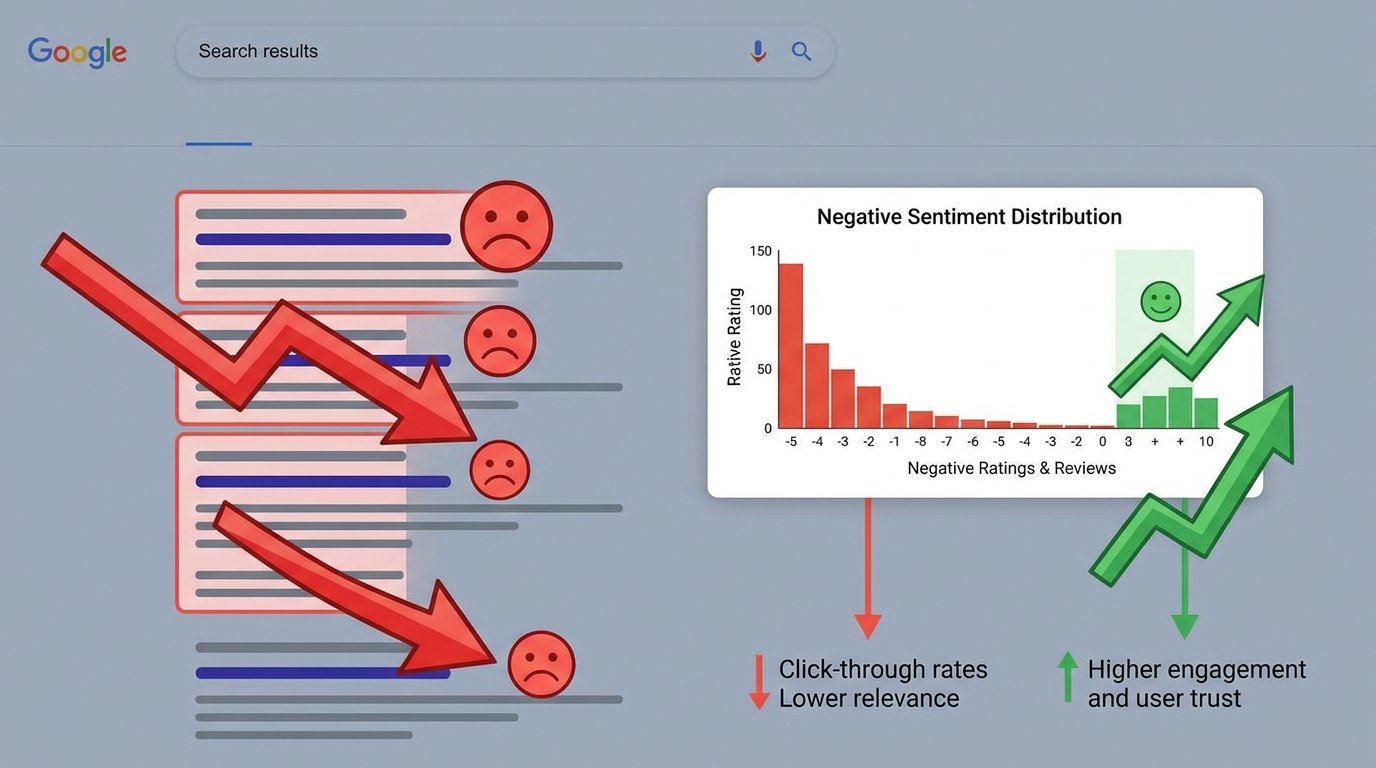
Entity credibility becomes particularly relevant when competing pages provide different interpretations of the same dispute. Search systems assess the relationship between queries and available information, meaning authoritative professional content can provide additional context without directly removing controversial material. Sentiment distribution also matters because search results can contain positive, neutral, critical and factual pages simultaneously. The resulting SERP composition reflects which pages achieve visibility for particular queries. Reputation analysis therefore measures the distribution and authority of information rather than assuming that search rankings represent objective public sentiment.

Is content suppression or content enhancement more sustainable?
Content suppression is more sustainable when it forms part of a broader strategy rather than operating as the sole mechanism. Suppression focuses on reducing the visibility of specific harmful pages through legitimate technical, editorial or search-related processes. It operates by changing the relative prominence of information rather than necessarily deleting the underlying source. Its effectiveness depends on competing-page authority, query relevance, content quality and the persistence of the original material. Suppression therefore requires ongoing measurement because search-result positions can change as new content is indexed.
Content enhancement offers greater sustainability when credible information remains relevant independently of the original dispute. Strengthening authoritative pages creates assets that continue to provide context after temporary controversy declines. Its limitations include the time required to establish authority and the inability to guarantee the disappearance of negative results. Suppression and enhancement therefore perform complementary functions. The first addresses visibility imbalance, while the second expands the credible information available for search engines and users to evaluate.
Which approach provides the lowest risk exposure?
Evidence-led intervention provides lower risk exposure than aggressive attempts to manipulate or conceal information. Reputation management becomes riskier when responses introduce unsupported claims, attempt to remove legitimate criticism or create artificial signals. A defensible strategy distinguishes factual inaccuracies from legitimate commentary and assesses each source according to its content, authority and applicable platform requirements. This distinction protects entity credibility because corrective information remains aligned with verifiable evidence. It also reduces the risk of creating additional controversy through poorly supported responses.
Risk assessment also requires analysing the origin of the information. A defamatory statement, inaccurate article, legitimate criticism and factual reporting represent different categories requiring different responses. Applying the same tactic to every result reduces strategic precision and increases unnecessary exposure. A structured assessment instead measures factual accuracy, search visibility, authority, relevance and potential impact before intervention. This creates a clearer relationship between reputation risk and the mechanism selected to address it.
Dive Deeper With Our Expert Guides:
How to Respond When Your Demos or Tracks Leak Online
Correcting Misinterpreted Lyrics on Genius and Lyric Sites
How can the effectiveness of artist feud reputation strategies be measured?
Effectiveness is measured through observable changes in search visibility, SERP composition, content authority and sentiment distribution rather than through assumptions about public opinion. Establishing a baseline identifies which queries contain controversy-related results, which pages occupy prominent positions and how frequently negative or neutral information appears. Monitoring then compares these indicators over defined periods. This provides evidence of whether content enhancement, removal or suppression is producing measurable movement. Without a baseline, ranking changes cannot be reliably attributed to a specific intervention.
A practical evaluation framework can compare the approaches across four measurable dimensions:
- Measure visibility changes by recording the ranking positions, indexing status and search presence of controversy-related pages.
- Compare authority signals by assessing the credibility, relevance and prominence of competing sources within target SERPs.
- Track sentiment distribution by categorising visible results as positive, neutral, critical or factual and measuring changes over time.
- Evaluate sustainability by checking whether improvements remain after new feud-related content enters the search ecosystem.
This framework separates activity from outcome. Publishing additional pages does not itself demonstrate successful reputation management, just as submitting a removal request does not confirm reduced search visibility. The meaningful measurement concerns how the information landscape changes after an intervention. Search ranking influence, content persistence and entity credibility provide stronger indicators than publication volume alone.
How can public perception be managed without increasing feud visibility?
Managing public perception requires controlling the information environment without unnecessarily amplifying the controversy. Repetitive responses can create additional indexed material and reinforce the association between the artist and the dispute. A more analytical approach assesses whether responding to a specific claim reduces misinformation or instead increases query relevance around the controversy. This makes search behaviour an important component of reputation strategy. The objective is to provide accurate context while limiting unnecessary expansion of the controversy’s searchable footprint.
For artists facing sustained attention, Manage an Artist Feud’s Fallout represents a decision-stage consideration because the focus moves from understanding search perception to evaluating structured reputation intervention. The strategic distinction remains between addressing individual harmful sources and strengthening the broader information ecosystem. Both mechanisms influence perception differently and require different measurements. Their relative value depends on the authority, persistence and relevance of the content surrounding the feud.
What strategic combination provides the strongest long-term reputation control?
A combined strategy provides broader coverage because removal, suppression, response and enhancement address different mechanisms within the search ecosystem. Removal targets qualifying sources directly, while suppression reduces the relative visibility of harmful information. Content enhancement strengthens authoritative alternatives, and reactive monitoring identifies new risks as they emerge. Each mechanism therefore contributes to a different layer of search perception control. The strategic value comes from coordinating these mechanisms rather than treating them as interchangeable tactics.
The most sustainable model begins with diagnosis and baseline measurement before selecting an intervention. Content is then assessed according to accuracy, authority, relevance, visibility and risk exposure. Appropriate actions are measured against changes in SERP composition, reputation signals, entity credibility and sentiment distribution. Long-term monitoring identifies whether gains persist as search engines recrawl pages and new content enters the ecosystem. This creates a structured framework in which reputation management becomes an evidence-based process rather than a reaction to individual incidents.
Managing public perception during an artist feud involves evaluating how information is created, indexed, ranked and interpreted across search ecosystems. Content removal provides targeted intervention, content suppression addresses visibility, content enhancement strengthens credible alternatives, and reactive management addresses immediate developments. Organic reputation development provides longer-term structural support by expanding authoritative information associated with the artist’s entity.
The distinction between search visibility and factual importance remains central. A feud can dominate SERPs because users and publishers continually generate information around it, not because the dispute represents the complete identity of either artist. Evaluating reputation signals, entity credibility, search ranking influence, sentiment distribution and SERP composition provides a more accurate basis for comparing strategies. Long-term reputation control therefore depends on measurable information management rather than simply reducing the existence of negative discussion.
How can artists manage their online reputation during a feud?
Artists can manage their online reputation by monitoring search results, addressing factual inaccuracies, and strengthening accurate, authoritative content. Reputation management for musicians also evaluates sentiment distribution, reputation signals and the visibility of controversy-related pages.
Can reputation management remove negative content about an artist?
Reputation management can pursue removal when content violates platform rules, privacy requirements or applicable legal standards. Where removal is unavailable, content suppression and authoritative content enhancement can help influence SERP composition.
How does an artist feud affect Google search results?
An artist feud can increase search visibility because news articles, social posts, interviews and commentary create repeated content around the same entities and queries. Search engines then evaluate these pages according to relevance, authority, freshness and other ranking signals.
What is the difference between content suppression and content removal for musicians?
Content removal seeks to eliminate qualifying material, while content suppression focuses on reducing the visibility of harmful pages in search results. Content enhancement takes a different approach by strengthening credible information that can compete for relevant search positions.
How long does it take to improve an artist’s online reputation after a feud?
The timeframe depends on the volume, authority and persistence of controversy-related content, as well as the strength of existing reputation signals. Progress is typically evaluated through changes in SERP composition, search rankings, sentiment distribution and entity credibility.