
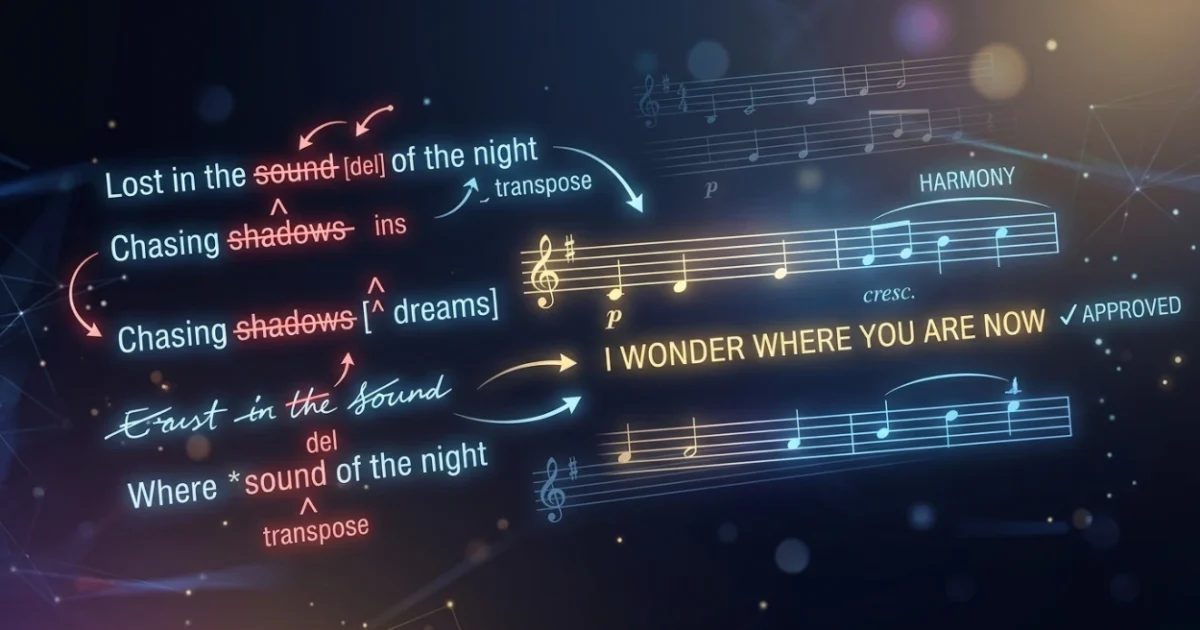
Correcting misinterpreted lyrics requires separating factual inaccuracies from subjective interpretation, then evaluating which correction mechanism addresses the underlying information problem. Reputation management strategies differ based on whether the issue concerns incorrect lyrics, misleading annotations, weak source context, or excessive search visibility.
Online reputation control methods are evaluated through accuracy, source authority, search visibility and the resulting perception of an artist’s digital entity. Lyric platforms create an important part of this environment because transcriptions, annotations and explanations can become indexed content associated with an artist and their work. A correction therefore involves more than changing individual words. It requires analysing how the information enters search ecosystems, how users interpret it and how alternative authoritative information affects the surrounding SERP composition.
How should misinterpreted lyrics be evaluated before correction?
Misinterpreted lyrics need to be classified before a correction method is selected. A factual error concerns information that can be verified, such as an incorrect transcription, attribution or statement about the song. An interpretive disagreement concerns meaning, symbolism or artistic intent and does not always have one objectively verifiable answer. Treating both categories as identical creates an inaccurate correction strategy. Reputation analysis therefore begins by determining whether the problem is factual, contextual or interpretive.
The distinction also affects risk exposure. A demonstrable transcription error has a clear evidential basis for correction, while an interpretation requires contextual explanation rather than an assertion that one reading is universally correct. This classification protects entity credibility because the corrective information remains proportionate to the underlying issue. It also prevents additional inaccuracies from entering the digital footprint. A structured assessment therefore provides the foundation for evaluating the most appropriate response.
Which lyric correction approach is more effective: removal or contextual enhancement?
Removal and contextual enhancement address different layers of a lyric-related reputation problem. Removal focuses on taking down or correcting specific information where a legitimate platform or legal basis exists. Contextual enhancement focuses on increasing the availability of accurate, authoritative information that helps users evaluate existing interpretations. Neither mechanism represents a universal solution because each operates at a different point in the information ecosystem. The appropriate approach depends on whether the underlying problem is inaccurate source content or incomplete search context.
Content removal has a direct effect when inaccurate information is successfully corrected at its original source. Its limitation is scope because removing one page does not automatically change references published elsewhere. Contextual enhancement operates differently by strengthening the wider information environment through authoritative material. Its effect relates more closely to SERP composition and search perception than to deletion of the original content. Comparing the two therefore requires measuring both source-level correction and search-level visibility.
How does correcting lyric transcriptions differ from correcting lyric interpretations?
Correcting a lyric transcription is an accuracy-focused process because the objective is to align published text with the verified lyrics. A transcription error can involve a misheard word, incorrect phrase, omitted section or attribution mistake. The correction addresses the underlying information directly. This makes the mechanism relatively distinct from an interpretation dispute. Reputation management evaluates the correction according to source accuracy and the effect of the incorrect information on the artist’s digital footprint.
Correcting an interpretation requires a different analytical framework. An annotation can describe a lyric as representing a particular theme without claiming that the artist formally defined that meaning. If the annotation presents an unsupported interpretation as established fact, contextual clarification becomes relevant. The objective is not to eliminate legitimate discussion but to distinguish interpretation from verified authorial information. This preserves both informational accuracy and the credibility of the artist’s digital entity.
How do search engines evaluate corrected lyric information?
Search engines evaluate corrected lyric information through their broader ranking and indexing systems rather than applying a dedicated reputation score. When a page is updated, the revised information enters the content indexing process and becomes available for future evaluation. Search systems then determine relevance and ranking according to their own signals. The correction therefore does not guarantee an immediate change in search position. Its significance depends on how the updated page interacts with the wider search ecosystem.
Search visibility also depends on competing pages. If other websites continue publishing the original interpretation, the corrected source represents only one part of the SERP composition. Search users can therefore encounter conflicting information across multiple results. Reputation analysis evaluates this distribution rather than treating one corrected page as the complete solution. Monitoring indexed results provides evidence about whether the correction has changed the wider search environment.
Is content creation more sustainable than reactive lyric correction?
Content creation provides a longer-term mechanism for strengthening the information environment, while reactive correction addresses specific inaccuracies after they become visible. Reactive correction is efficient when a defined factual error exists on a known page. Its limitation is that each new inaccurate reference creates another source requiring evaluation. Content enhancement operates at a broader level by providing accurate contextual information that remains available for future searches.
Sustainability depends on the quality and relevance of the information created. Authoritative artist biographies, verified interviews and contextual explanations provide stronger semantic signals than repetitive promotional material. These sources expand the digital footprint with information directly connected to the artist and their work. Over time, this creates a broader basis for entity perception. The approach therefore complements source-level correction rather than replacing it.
How do reputation signals affect the interpretation of lyric content?
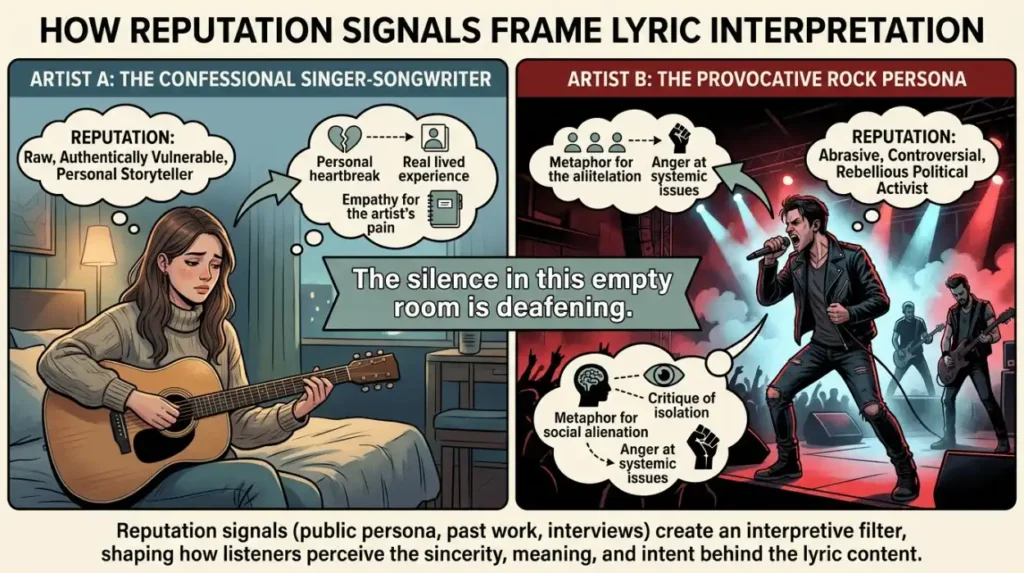
Reputation signals describe information that contributes to how an entity is understood within a search ecosystem. In lyric-related searches, these signals include transcriptions, annotations, reviews, interviews, editorial commentary and references from other websites. Each source contributes information with different levels of authority and relevance. Search users then encounter these signals through the results presented for specific queries. Entity perception develops from the combined information environment rather than from one isolated page.
The quality of a reputation signal depends on context. A verified artist statement represents direct evidence of the artist’s position, while an anonymous annotation represents third-party interpretation. Search visibility does not automatically transform the latter into authoritative information. Reputation analysis therefore evaluates source quality alongside prominence. This distinction reduces the risk of treating popular interpretations as equivalent to verified facts.
How does sentiment distribution influence lyric-related reputation?
Sentiment distribution describes how positive, neutral or negative associations are distributed across content connected with an entity. A single negative interpretation does not establish the overall sentiment surrounding an artist. Reputation analysis evaluates the wider collection of indexed references to determine whether a particular sentiment is isolated or repeated. The source quality and topical relevance of those references also influence their analytical significance. This creates a more complete view of online credibility.
Lyric-related sentiment becomes more significant when the same interpretation appears across multiple sources. Repetition can establish a stronger semantic association within the digital footprint, even when the original claim lacks direct evidence. This does not make the interpretation factually correct. It demonstrates why source evaluation and sentiment distribution need to be considered together. The resulting assessment distinguishes repetition from authority.
Which strategy provides better control over search visibility: reactive or organic methods?
Reactive methods provide direct attention to identified inaccuracies, while organic methods focus on strengthening the broader search information environment. Reactive work begins with a specific page, annotation or search result and evaluates its factual or contextual problem. Organic methods build relevant, authoritative content that contributes additional information to the entity’s digital footprint. The two approaches therefore operate at different levels of search perception influence.
A reactive strategy has a defined target and measurable correction point. An organic strategy has a broader scope because its impact relates to the composition and relevance of multiple indexed sources. Organic visibility also develops through normal search ranking processes rather than guaranteed placement. Effective evaluation therefore considers the number and quality of relevant sources, their search visibility and the persistence of inaccurate information. This provides a clearer basis for comparing short-term correction with long-term information development.
Dive Deeper With Our Expert Guides:
A Rapid-Response Plan for Musicians Facing Cancel Campaigns
How to Keep One Bad Concert Review From Defining Your Tour
How can artists measure the effectiveness of a lyric correction?
Effectiveness is measured by tracking accuracy, indexing, search visibility and changes in the information environment. A correction has a clear source-level outcome when the inaccurate text is replaced or removed from the original page. Search-level effectiveness requires additional analysis because other pages can continue displaying the disputed information. Measuring both levels prevents a successful source correction from being mistaken for complete reputation resolution.
A structured evaluation process includes:
- Identify the inaccurate lyric, annotation or interpretation and record the source where it appears.
- Verify the correct information using authoritative evidence connected directly with the artist or creative work.
- Classify the issue as a transcription error, factual error, contextual omission or subjective interpretation.
- Measure the visibility of the disputed content across relevant artist and song searches.
- Monitor indexed results after correction to evaluate changes in SERP composition and information persistence.
This framework produces measurable evidence rather than relying on subjective impressions. It also separates the correction outcome from broader changes in search perception. A page update represents one measurable event, while changes across multiple search results represent a wider reputation signal. Both measurements are necessary for accurate evaluation.
What are the limitations of lyric content correction strategies?
Lyric correction strategies have limitations because artists do not control every third-party source or search ranking decision. A platform can determine its own editorial and correction procedures, while search engines independently determine indexing and ranking. A successful correction on one website therefore does not guarantee identical changes elsewhere. This creates a distinction between source control and search ecosystem influence.
Interpretive ambiguity represents another limitation. Creative works frequently contain metaphor, narrative perspectives and language that supports more than one reading. Presenting one interpretation as the only legitimate meaning can reduce rather than improve informational accuracy. A sustainable approach therefore distinguishes verified corrections from legitimate discussion. This reduces reputational risk while maintaining analytical credibility.
How does content suppression compare with content enhancement for lyric disputes?
Content suppression focuses on reducing the visibility of specific information, while content enhancement focuses on strengthening the availability and relevance of accurate information. Suppression is closely connected with search visibility and the position of disputed results. Enhancement operates through additional content, source authority and contextual relevance. These approaches therefore address different mechanisms within search perception control.
Suppression also has a narrower target. It evaluates a specific piece of content and attempts to change its prominence where an appropriate mechanism exists. Enhancement addresses the broader information ecosystem by introducing additional authoritative context. The sustainable outcome depends on the complete SERP composition rather than one ranking position. Comparing the approaches therefore requires evaluating accuracy, scalability, risk exposure and persistence.
What role does source authority play in correcting lyric misinformation?
Source authority determines the credibility assigned to information during reputation analysis. Direct statements, verified interviews and authoritative publications provide stronger evidence about an artist’s documented position than unsupported third-party interpretations. Search engines independently evaluate pages, so authority does not guarantee a particular ranking. It remains an important factor in assessing the reliability of information available to users.
Authority also operates through topical relevance. A source with established expertise in music provides a different information signal from an unrelated discussion platform. This does not make every specialist interpretation factually correct. It provides a basis for evaluating evidence and context more carefully. Source authority therefore supports a more precise assessment of entity credibility.
How can artists choose between short-term correction and long-term reputation management?
The choice depends on whether the primary problem is a defined source-level error or a broader search-perception issue. Short-term correction directly addresses inaccurate information at its source and provides a clear immediate objective. Long-term reputation management evaluates the wider digital footprint, including authoritative content, search visibility and recurring reputation signals. These approaches address different stages of the same information problem.
A combined evaluation provides stronger strategic clarity. Source correction addresses factual accuracy, while long-term information development strengthens the surrounding context. Monitoring then determines whether the disputed information continues to influence relevant searches. This approach connects immediate correction with sustainable search perception analysis. It also reduces dependence on any single platform or ranking outcome.
What is the most balanced approach to correcting misinterpreted lyrics?
The most balanced approach separates factual correction, contextual clarification and search visibility analysis. Factual errors receive evidence-based correction, while subjective interpretations receive contextual treatment rather than automatic removal. Search visibility is then evaluated independently to determine how prominently the information appears. This creates a distinction between what is factually incorrect and what is simply interpretive.
A balanced strategy also recognises that reputation management does not require eliminating every third-party opinion. The objective is to establish an accurate and contextually complete information environment. Verified sources contribute stronger evidence to that environment, while transparent labelling helps users distinguish fact from interpretation. This model supports entity credibility without attempting to control legitimate discussion.
Correcting misinterpreted lyrics on Genius and other lyric sites requires a distinction between factual inaccuracies and subjective interpretations. Removal, correction, content enhancement and search visibility management operate through different mechanisms and therefore produce different outcomes. Evaluating each approach through accuracy, authority, scalability, risk exposure and sustainability provides a clearer basis for strategic decisions.
Search perception is shaped by the wider information ecosystem rather than one lyric page alone. Authoritative sources, accurate context and continued monitoring contribute to a more reliable digital footprint, while source-level correction addresses specific inaccuracies. The strongest approach therefore combines precise classification with evidence-based correction and broader search analysis. For decision-stage consideration, correct misread lyrics online represents the relevant next step for evaluating how a specific lyric-related reputation issue can be addressed.
How can artists correct misinterpreted lyrics online?
Artists can correct misinterpreted lyrics by identifying inaccurate lyric pages, verifying the intended wording, and submitting corrections through the relevant platform’s available processes. Accurate lyric information helps maintain consistent artist identity and online credibility.
Why do lyric websites sometimes display incorrect lyrics?
Lyric websites can contain inaccurate wording because lyrics are transcribed, submitted, edited, or automatically processed from different sources. These discrepancies can affect how an artist’s message is understood across search results and music platforms.
Can incorrect lyrics affect an artist’s online reputation?
Yes, inaccurate lyrics can influence an artist’s digital reputation when incorrect wording is repeatedly indexed or referenced online. Consistent, accurate information helps strengthen entity credibility and reduce misleading reputation signals.
How does reputation management for musicians handle incorrect lyric information?
Reputation management for musicians focuses on identifying inaccurate content, assessing its search visibility, and addressing corrections through appropriate channels. The process also considers source authority, content indexing, and the wider context of an artist’s digital footprint.
Does correcting lyrics improve an artist’s search visibility?
Correcting inaccurate lyrics improves information consistency across indexed sources, which supports clearer entity representation. Search visibility depends on factors such as content relevance, source authority, indexing, and the overall quality of available information.