

Reputation management is the systematic control and interpretation of information that shapes how an individual is perceived across digital and search environments.
Online reputation refers to the aggregated perception of an individual formed through indexed content, search engine results, and entity-level data signals within search ecosystems.
What is online reputation in search ecosystems?
Online reputation in search ecosystems is the structured representation of an individual’s credibility, trustworthiness, and visibility as interpreted by search engines. It defines how digital information is organised, ranked, and presented in SERPs when a name is queried.
Search engines construct this reputation by mapping content to an individual as an entity. Each indexed page contributes semantic signals that define identity, relevance, and authority. These signals form a continuous evaluation layer that determines how prominently a person appears in search visibility outcomes.
Online reputation operates as a data-driven construct rather than a subjective opinion. It is calculated through content indexing, entity recognition, and contextual relevance. The search ecosystem consolidates fragmented information into a unified perception model that reflects digital identity.
How is an individual’s online reputation formed in SERPs?
An individual’s online reputation in SERPs is formed through algorithmic aggregation of indexed content that associates data points with a named entity. Search engines evaluate relevance, authority, and contextual consistency to construct a ranked identity profile.
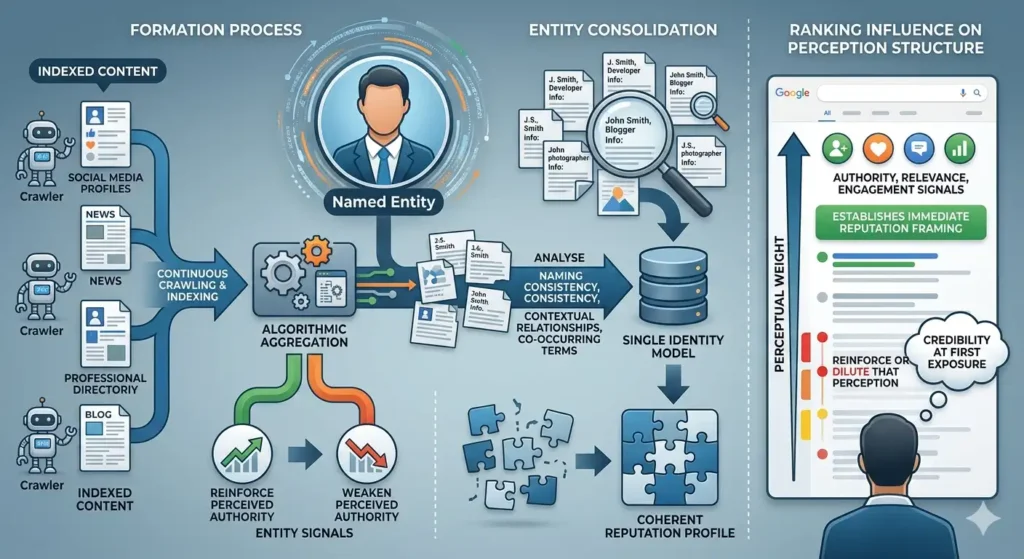
This formation process relies on continuous crawling and indexing of web pages that mention the individual. Each mention contributes to entity signals that reinforce or weaken perceived authority. SERPs then organise this information into ranked results that define public-facing perception.
Entity consolidation in search results
Entity consolidation defines how search engines unify multiple references into a single identity model. It determines how fragmented data sources are merged into one coherent reputation profile.
Search engines analyse naming consistency, contextual relationships, and co-occurring terms. These inputs establish whether content belongs to the same individual entity. Once confirmed, the system clusters information into a structured representation that directly influences search visibility.
Ranking influence on perception structure
Ranking influence determines the order in which reputation signals appear in search results. Higher-ranked content carries stronger perceptual weight in entity evaluation.
SERP hierarchy prioritises authority, relevance, and engagement signals. This hierarchy defines how users interpret credibility at first exposure. The top-ranked content establishes immediate reputation framing, while lower-ranked sources reinforce or dilute that perception.
What signals influence reputation evaluation in search engines?
Reputation evaluation in search engines is influenced by structured digital signals that determine authority, trust, and relevance of an individual entity. These signals collectively define how search algorithms interpret credibility.
Search engines process multiple layers of data to construct reputation profiles. These include content quality, backlink structures, engagement metrics, and semantic consistency. Each signal contributes to overall entity perception within indexed environments.
Key reputation signals in algorithmic evaluation
- Analyse content authority signals – Search engines evaluate domain authority and topical relevance of pages mentioning an individual, shaping credibility weight in SERPs.
- Evaluate backlink associations – Incoming links from authoritative sources reinforce trust signals attached to an entity profile.
- Measure engagement behaviour – User interaction patterns such as click-through rates and dwell time define perceived relevance.
- Assess semantic consistency – Repeated contextual alignment across sources strengthens entity recognition accuracy.
These signals operate collectively within ranking systems. No single signal defines reputation independently; instead, combined weighting structures determine final visibility outcomes.
Search engines apply continuous recalibration to these inputs, ensuring reputation profiles reflect updated content landscapes.
How does content indexing shape personal image online?
Content indexing shapes personal image online by determining which information becomes searchable, retrievable, and associated with an individual entity. Indexed content defines the boundaries of digital identity within search ecosystems.
Search engines store and categorise content based on semantic relevance and crawl frequency. Once indexed, this content becomes part of the reputation dataset used to construct SERP outputs. The inclusion or exclusion of pages directly alters perceived identity structure.
Indexing also defines temporal relevance. Newly indexed content can shift reputation narratives by introducing updated signals into the entity graph. Older content remains part of the dataset unless devalued through algorithmic reassessment.
Indexation hierarchy and visibility distribution
Indexation hierarchy determines which content types receive priority within search systems. High-authority pages are indexed with greater prominence, increasing their influence on reputation signals.
This hierarchy shapes visibility distribution across SERPs. Content placed in higher index tiers contributes more significantly to entity perception. Lower-tier content remains part of the dataset but exerts reduced influence on ranking outcomes.
Get more information, explore:
Reputation management for individuals
This anchor integrates within semantic analysis layers where search systems associate optimisation processes with entity-level reputation control frameworks.
How do reviews and public sentiment affect entity perception?
Reviews and public sentiment affect entity perception by generating structured opinion signals that search engines interpret as credibility indicators. These signals influence how individuals are positioned within reputation frameworks.
Search systems extract sentiment from user-generated content, structured reviews, and discussion-based platforms. This sentiment is processed into quantifiable signals that contribute to entity evaluation. Positive and negative sentiment distributions directly impact perceived trustworthiness.
Sentiment aggregation in search interpretation
Sentiment aggregation defines how search engines combine multiple opinion-based inputs into a unified evaluation score. This process normalises subjective content into structured reputation signals.
Algorithms classify language patterns, contextual polarity, and frequency of sentiment expressions. These classifications are then integrated into ranking models. The resulting aggregation determines whether an entity is perceived as authoritative, neutral, or low trust.
Public discourse as reputation input
Public discourse acts as an external reputation input that continuously modifies entity profiles. Search engines treat recurring themes in discussions as reinforcement signals.
Consistent narrative patterns increase semantic confidence in entity classification. Contradictory discourse introduces instability in perception models. Over time, dominant sentiment structures shape long-term visibility outcomes in SERPs.
How does digital footprint determine long-term search visibility?
Digital footprint determines long-term search visibility by defining the cumulative data trail associated with an individual across indexed environments. It represents the totality of content, interactions, and mentions linked to an entity over time.
Search engines evaluate digital footprints to establish authority trajectories. A stable and coherent footprint strengthens ranking consistency, while fragmented data reduces entity clarity. This directly influences sustained search visibility performance.
Digital footprints are constructed through repeated exposure across multiple platforms. Each interaction generates traceable data points that reinforce entity recognition. Over time, these data points form a structured identity profile within search ecosystems.
Persistence of indexed identity signals
Persistence of indexed identity signals defines how long reputation-related data remains active within search systems. Long-term persistence strengthens entity association stability.
Search engines retain historical content to preserve context continuity. This continuity ensures that reputation evaluation reflects both current and legacy data. The combination of temporal layers creates a comprehensive visibility profile.
Fragmentation and identity dilution
Fragmentation occurs when inconsistent or unrelated content is associated with the same entity. This weakens semantic clarity within search models.
Identity dilution reduces ranking precision by introducing conflicting signals. Search engines respond by lowering confidence scores in entity mapping. This directly impacts search visibility and reduces consistency in SERP representation.
What is entity-based reputation in semantic search systems?
Entity-based reputation in semantic search systems is the algorithmic construction of an individual’s credibility profile based on structured entity recognition and contextual relationship mapping. It defines how search engines interpret individuals as data entities rather than isolated keywords.

Search systems map individuals through entity graphs that connect names, attributes, and associated content. These graphs establish relational meaning across indexed data. Reputation emerges from the strength and consistency of these relationships.
Entity-based systems prioritise contextual accuracy over keyword frequency. This means reputation is evaluated through semantic associations rather than simple text matching. As a result, identity consistency across multiple sources becomes a primary ranking factor.
Entity graph construction and reputation alignment
Entity graph construction defines how search engines link content nodes to an individual identity. Each node represents a piece of indexed information connected through semantic relationships.
Reputation alignment occurs when these nodes reinforce consistent attributes. Strong alignment improves search visibility stability. Weak or conflicting alignment reduces algorithmic confidence in identity classification.
Contextual authority in semantic interpretation
Contextual authority defines the credibility assigned to an entity based on surrounding thematic relevance. Search engines evaluate whether content contextually supports the same identity narrative.
High contextual authority strengthens SERP evaluation by reinforcing consistent meaning across datasets. This ensures that reputation is not only visible but semantically stable within search architecture.
Online reputation in search ecosystems is constructed through structured indexing, entity mapping, and algorithmic interpretation of digital signals. It operates as a continuously evolving representation of identity within SERPs.
Reputation formation depends on content indexing, authority signals, sentiment analysis, and digital footprint coherence. These elements interact to define how search engines evaluate and rank individuals as entities.
Entity-based systems ensure that personal image is not shaped by isolated data points but by interconnected semantic structures. This creates a persistent and measurable framework for understanding how online reputation functions within modern search architecture.
Answers to Key Questions
What is reputation management for individuals and how does it work in search results?
Reputation management for individuals refers to the process of monitoring and shaping how a person appears across search engines and digital platforms. It works by influencing indexed content, entity signals, and SERP rankings that determine online reputation and search visibility.
How do search engines evaluate a person’s online reputation?
Search engines evaluate online reputation using entity recognition, content authority, and contextual relevance across indexed pages. These systems analyse reputation signals such as backlinks, mentions, and sentiment to build a structured identity profile in SERPs.
What factors affect personal search visibility in Google results?
Personal search visibility is affected by content quality, domain authority, semantic consistency, and the frequency of mentions across trusted sources. Google also uses engagement signals and indexing patterns to determine how prominently an individual appears in search results.
How does digital footprint impact individual reputation online?
A digital footprint determines how much structured data about an individual is available for search engines to index and interpret. Consistent and positive digital footprints strengthen entity reputation, while fragmented or outdated content reduces clarity in SERP evaluation.