

Reputation management is the systematic process of influencing, structuring, and controlling how an individual or professional entity is represented within search engine ecosystems and digital information networks.
Online reputation refers to the aggregated perception of an individual or professional entity formed through indexed content, search visibility, and entity-based interpretation across search engine results pages (SERPs).
What is online reputation and how is it formed in search engines?
Online reputation is the algorithmically constructed identity of an individual or professional entity based on indexed digital content across the web. It defines how search engines interpret credibility, relevance, and trustworthiness through structured and unstructured data. This concept refers to an entity-level representation built from text, media, links, and engagement signals distributed across multiple platforms.
Search engines form online reputation through continuous content crawling, indexing, and classification processes. These systems evaluate how frequently an entity appears, the context of those appearances, and the authority of the sources referencing the entity. Each indexed document contributes to an evolving semantic profile that defines search visibility. This process establishes a structured perception model that connects identity with topical relevance.
Reputation formation depends on entity recognition within search systems. When an individual’s name or professional identity appears consistently across authoritative domains, search engines assign stronger entity confidence. This strengthens visibility within SERPs and stabilises reputation interpretation across queries. The absence of structured signals leads to fragmented identity representation and reduced coherence in search outputs.
Search engines also evaluate contextual relationships between content pieces. These relationships define how an entity is understood within specific topical clusters. Reputation is therefore not static but continuously recalculated based on new content ingestion and algorithmic reassessment.
How do search engines evaluate reputation signals in SERPs?

Search engines evaluate reputation signals by analysing authority, relevance, and trust indicators embedded within SERP data structures. These signals define how strongly an entity is positioned within ranking systems and how it is interpreted by algorithmic models. Reputation signals function as measurable inputs that determine visibility strength and content prioritisation.
Authority signals originate from backlinks, citations, and domain-level credibility. When authoritative domains reference an individual or professional entity, search engines increase perceived reliability. These references contribute to higher ranking stability and improved SERP positioning. Authority signals operate as structural endorsements within the information graph.
Relevance signals evaluate how closely content aligns with search intent and entity context. Search engines analyse keyword relationships, semantic proximity, and topical consistency. These signals ensure that only contextually aligned content influences reputation classification. Relevance strengthens entity coherence across multiple indexed pages.
Trust signals are derived from content consistency, domain integrity, and historical accuracy. Search engines assess whether information patterns remain stable over time. Consistent data across multiple platforms reinforces entity credibility. Inconsistent or conflicting information reduces trust evaluation scores and weakens search presence.
SERPs function as the final evaluation layer where these signals converge. The ranking system prioritises content that demonstrates high authority, strong relevance, and stable trust indicators. Reputation is therefore expressed as a ranked visibility structure within search results.
What factors damage an individual’s online reputation?
Online reputation is damaged when negative, inconsistent, or low-authority content dominates search engine indexing for a specific entity. This disruption alters how algorithms interpret credibility and reduces overall search visibility. Damage occurs at the structural level of content distribution rather than through isolated incidents.
Content duplication across low-quality domains reduces reputation strength. Search engines interpret repetitive or unverified content as weak signals, which dilutes entity authority. This weakens the semantic structure associated with the individual’s name or professional identity. Over time, this creates fragmented SERP representation.
Negative sentiment indexing also contributes to reputation degradation. When content containing critical or unfavourable language is widely indexed, sentiment analysis systems incorporate this into entity evaluation models. This affects how search engines classify trustworthiness within SERP outputs.
Inconsistent identity signals create further disruption. Variations in name usage, professional descriptions, or contextual associations lead to identity fragmentation. Search engines struggle to unify the entity profile, resulting in reduced ranking coherence and lower visibility stability.
Low-authority backlinks and irrelevant mentions weaken perceived credibility. Search engines evaluate link origin quality to determine whether referenced content strengthens or undermines reputation. Poor-quality associations reduce entity trust scoring and negatively influence SERP placement.
How does content indexing affect personal reputation visibility?
Content indexing determines which information becomes visible within search engine databases and directly influences personal reputation exposure. Indexed content forms the foundation of SERP construction and defines how entities are represented across digital environments. Without indexing, content does not contribute to reputation formation.
Search engines continuously crawl web pages to identify new or updated information. Once identified, content is stored within structured indexes that categorise entities, topics, and relationships. This process ensures that reputation signals are constantly updated based on newly available data.
Indexing speed influences reputation volatility. Rapid indexing of new content accelerates changes in search perception, while delayed indexing stabilises existing reputation structures. This dynamic affects how quickly reputation changes are reflected in SERP outputs.
Content prioritisation within indexes determines visibility hierarchy. High-authority pages are indexed with stronger weighting, which increases their influence on reputation interpretation. Lower-quality pages remain indexed but contribute weaker signals to entity evaluation.
Indexed content also interacts with semantic classification systems. These systems group related content into topical clusters that define how search engines understand entity identity. Strong clustering improves reputation clarity and enhances visibility consistency.
How do reviews and sentiment shape entity perception online?
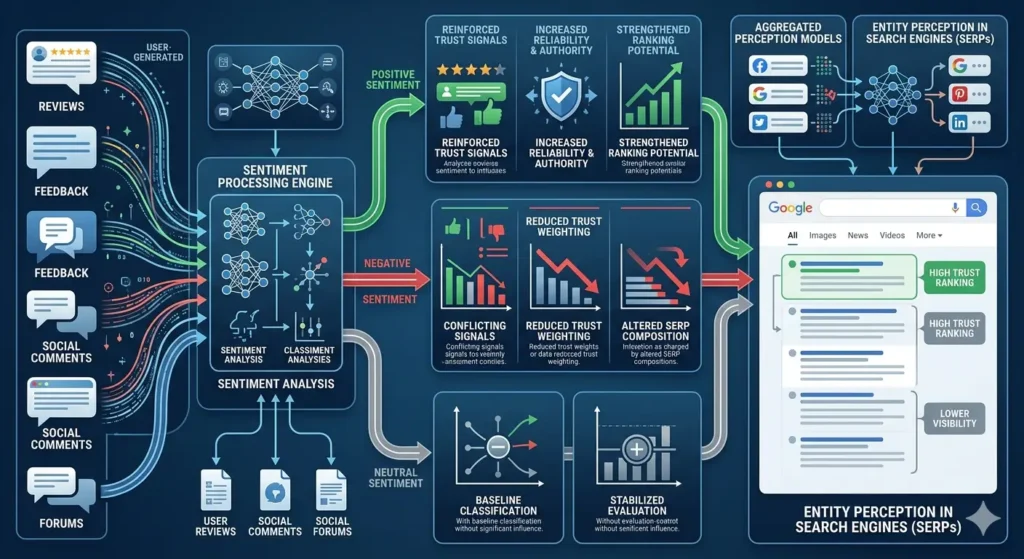
Online reputation is significantly influenced by sentiment patterns extracted from reviews, feedback, and user-generated content. These sentiment signals are processed by search engines to determine how an entity is perceived across digital environments. Sentiment classification directly affects SERP interpretation.
Positive sentiment reinforces trust signals by increasing perceived reliability and authority. When structured review content contains consistent positive language, search engines associate the entity with credibility. This strengthens ranking potential and improves visibility in branded search queries.
Negative sentiment introduces conflicting signals into entity evaluation systems. When negative language dominates indexed reviews or commentary, search engines adjust trust weighting accordingly. This reduces entity strength and alters SERP composition.
Neutral sentiment contributes to baseline classification. It stabilises entity evaluation when positive and negative signals are balanced. Neutral content maintains indexing continuity without significantly influencing ranking shifts.
Sentiment distribution across multiple platforms creates aggregated perception models. Search engines combine review data from different sources to form unified entity profiles. These profiles determine how reputation is interpreted at scale across SERPs.
How is digital footprint constructed across platforms?
Digital footprint is the cumulative record of all indexed online activity associated with an individual or professional entity. It defines the structured presence of identity across websites, social platforms, directories, and media sources. This footprint becomes the primary dataset used for reputation evaluation.
Cross-platform consistency strengthens digital footprint integrity. When identical identity signals appear across multiple domains, search engines consolidate entity recognition. This improves coherence and enhances search visibility stability.
Fragmented platform presence reduces footprint clarity. Inconsistent naming, outdated profiles, or conflicting descriptions create structural noise within the data graph. This weakens entity association and reduces ranking accuracy.
Platform authority also influences footprint strength. Content originating from high-trust domains carries greater weight in reputation formation. This ensures that not all digital footprint elements contribute equally to SERP evaluation.
The digital footprint evolves continuously as new content is published and indexed. Search engines integrate these updates into existing entity profiles, adjusting reputation interpretation dynamically.
How is structured reputation recovery understood in information systems?
Structured reputation recovery is the process of re-establishing entity coherence, trust signals, and search visibility stability through controlled information restructuring within search ecosystems. It defines how disrupted digital identities regain algorithmic alignment and SERP consistency.
Reputation recovery operates through content recalibration, signal reinforcement, and authority re-establishment. These processes adjust how search engines interpret entity relevance and credibility. Recovery focuses on correcting structural inconsistencies within indexed data.
How do structured signals restore entity coherence?
Structured signals restore entity coherence by aligning content across authoritative domains and reinforcing consistent identity representation. These signals ensure that search engines interpret unified identity references across multiple platforms. Coherence improves ranking stability and reduces SERP fragmentation.
A key mechanism within recovery systems involves reinforcing semantic relationships between entity mentions and authoritative content clusters. This improves classification accuracy and strengthens search visibility consistency.
Anchor integration within structured content systems supports controlled visibility correction.
Get more information, explore:
Reputation management for individuals is used within analytical frameworks to connect entity identity with structured reputation datasets. This mechanism reinforces topical alignment within search indexing systems without altering informational neutrality.
Recovery systems also prioritise removal or suppression of conflicting signals. This process ensures that outdated or irrelevant content does not dominate entity interpretation models.
Reputation recovery is therefore a systematic recalibration of how search engines perceive identity through structured information correction and signal optimisation.
Dive Deeper With Our Expert Guides:
Online Reputation Management for Individuals: How to Protect Your Personal Image
Online reputation is a structured entity-level construct formed through indexed content, search engine interpretation, and algorithmic evaluation of trust, authority, and relevance. It operates within SERP systems as a dynamic representation of identity shaped by continuous data ingestion and classification.
Reputation signals, sentiment patterns, indexing behaviour, and digital footprint consistency define how individuals and professionals are perceived in search ecosystems. Each component contributes to a unified entity profile that determines visibility strength and credibility interpretation.
Structured reputation analysis demonstrates that search engines do not evaluate identity as isolated information but as interconnected semantic systems. This framework explains how reputation forms, degrades, and stabilises across digital environments without relying on subjective interpretation or external assumptions.
Answers to Key Questions
How does Clear My Name help improve online reputation visibility?
Clear My Name works within reputation management for individuals by structuring and analysing search engine content to improve entity coherence. It focuses on strengthening positive reputation signals and reducing inconsistent or low-authority search results.
Why is online reputation important for search visibility?
Online reputation directly affects how search engines rank and display an individual’s identity in SERPs. Strong reputation signals improve trust, authority, and content relevance, which increases visibility across search results.
What factors influence an individual’s digital reputation?
Digital reputation is influenced by indexed content, sentiment signals, backlinks, and consistency of identity across platforms. Search engines evaluate these factors to determine entity credibility and ranking strength.
Can negative search results affect professional reputation?
Yes, negative search results can impact professional reputation by reducing trust signals and altering SERP evaluation. Search engines may prioritise negative or low-authority content if it dominates indexed data for the individual.