
A law firm merger requires structured reputation management to maintain search visibility, preserve entity credibility and prevent conflicting information from weakening public trust. Clear My Name provides a reputation management framework that evaluates, addresses and strengthens the reputation signals influencing how a merged firm appears across search ecosystems.
Which reputation management approach delivers the strongest protection during a merger?
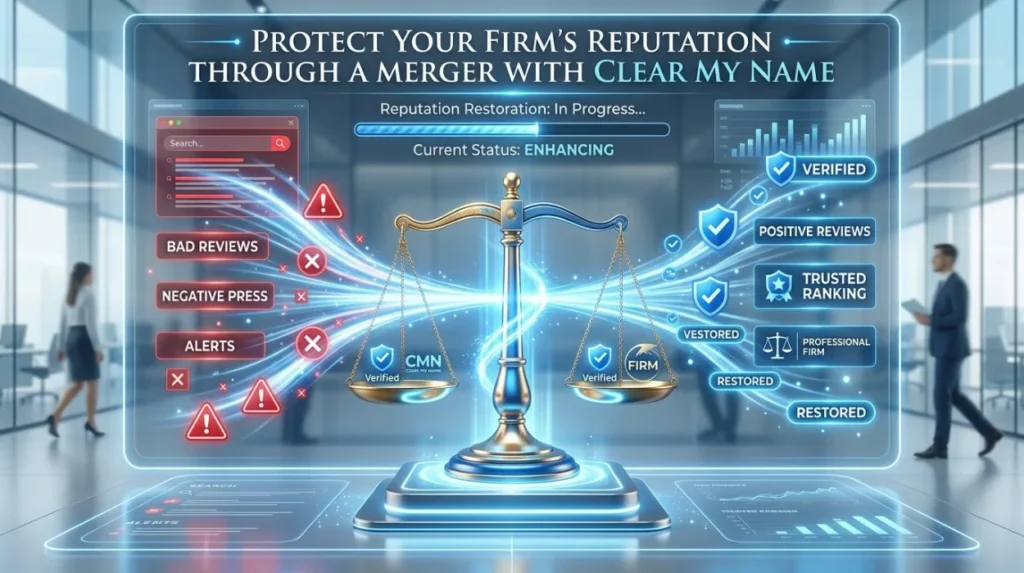
A structured reputation management process delivers stronger protection because it addresses the entire search environment rather than isolated search results. A merger changes firm names, websites, solicitor profiles, locations, reviews and historical content, creating new relationships between existing and current entities. Search engines evaluate these relationships when determining relevance, authority and entity credibility. Reputation management for lawyers therefore focuses on identifying conflicting signals and establishing a more coherent digital representation. The objective is measurable control over information visibility, rather than simply adding positive content.
The process begins with reputation intelligence and search perception analysis. Relevant SERPs are assessed to identify which pages appear for branded, professional and merger-related searches. Each result represents a reputation signal that contributes to the firm’s overall digital footprint. Analysing these signals establishes whether the primary issue involves inaccurate information, negative content, outdated material or insufficient authoritative coverage. This diagnostic stage provides the evidence required to select an appropriate intervention.
A reliable strategy also separates content problems according to their mechanism. Incorrect information requires factual correction, while outdated profiles require identity alignment and negative content requires a specific visibility assessment. Content enhancement provides an additional route when authoritative information is insufficient within prominent search positions. This distinction prevents resources being directed towards tactics that do not address the underlying reputation issue. It also creates a clearer basis for measuring progress through visibility, consistency and entity perception.
How does reputation management for lawyers improve search visibility after a merger?
Reputation management for lawyers improves search visibility by strengthening the information signals that connect the firm’s current identity with relevant indexed content. How a law firm merger affects online reputation becomes particularly important when historical and current information appear together across search results. Search engines process websites, professional profiles, directories, reviews, publications and other sources when constructing SERPs. A merger introduces additional identity relationships that require clear contextual signals. Aligning these signals gives search systems stronger evidence about which content represents the current organisation. This supports a more coherent search presence across relevant queries.
Search visibility is not controlled through a single ranking adjustment. It develops through the relationship between content relevance, entity information, authority and the query context. A reputation management process therefore evaluates the firm’s search environment as a connected system. Pages that accurately represent the current organisation can be strengthened through content optimisation and authoritative information. At the same time, inaccurate or outdated sources can be assessed for appropriate correction or legitimate removal pathways.
This approach is particularly relevant when a firm’s historical identity continues appearing in search results. The firm’s previous name can remain associated with indexed articles, profiles and directory pages after a merger. Without a clear connection to the current entity, those pages create fragmented search perception. A structured reputation strategy analyses these relationships and establishes stronger continuity between historical and current information.
What makes negative content suppression effective for a merged law firm?
Negative content suppression is effective when it targets a clearly identified source that materially affects the firm’s search perception. Suppression focuses on reducing the prominence or visibility of specific content through legitimate mechanisms rather than attempting to erase every unfavourable reference. The appropriate method depends on the content’s accuracy, ownership, platform and eligibility for removal or de-indexing. This makes evidence-based assessment essential before any intervention. The result is a targeted strategy rather than indiscriminate content removal.
Content suppression differs from content enhancement because the two approaches influence SERP composition through different mechanisms. Suppression addresses the visibility of an existing source, while enhancement introduces stronger relevant information into the search environment. A high-visibility negative page requires analysis of its ranking position, relevance, authority and relationship to the firm. Where legitimate removal is unavailable, strengthening authoritative competing content provides an alternative route to improving search perception.
A controlled suppression process also reduces operational risk. Removing or challenging content without assessing its factual basis can create unnecessary complications and undermine credibility. A professional reputation management process instead evaluates the source, documents the relevant evidence and selects an appropriate response. This creates process clarity and establishes a defensible basis for each intervention.
Can reputation management restore trust after a law firm merger?
Reputation management strengthens trust by improving the consistency and credibility of information encountered during online research. Prospective clients, professional contacts and other stakeholders evaluate search results before forming an opinion about a firm’s current identity. Conflicting names, outdated profiles and disconnected organisational information create uncertainty within that evaluation process. Consistent and authoritative information provides clearer evidence of the firm’s current structure. Trust restoration therefore depends on information quality as well as search visibility.
Entity credibility is central to this process. Search engines and users need to connect the firm’s current name, website, professionals, locations and published information with the same organisational identity. A reputation management strategy evaluates these relationships across first-party and third-party sources. Strengthening consistency reduces the risk of users interpreting historical and current information as unrelated organisations. This produces a more coherent representation of the firm.
Reviews also contribute to trust evaluation. Historical reviews can remain visible after a merger and represent experiences associated with an earlier organisational period. Current reviews provide more recent sentiment signals, but both groups can influence perception when they appear for relevant searches. Analysing review context, dates and entity references creates a more accurate understanding of the firm’s sentiment distribution. Reputation management therefore addresses the complete information environment rather than relying on ratings alone.
Dive Deeper With Our Expert Guides:
Clear My Name Helps Immigration Attorneys Stand Apart From Consultants
Manage Public-Record Visibility for Your Debt Practice With Clear My Name
How does Clear My Name’s reputation management process support SERP control?
Clear My Name supports SERP control through a structured process centred on search analysis, reputation signals and targeted content intervention. The process begins by identifying the search results influencing the firm’s current perception. Relevant URLs, entity references and content types are then evaluated according to their visibility and reputation impact. This establishes a prioritised view of the firm’s search environment. The resulting strategy connects individual actions with measurable reputation outcomes.
The process can be understood through four connected stages:
- Analyse the firm’s branded and reputation-related SERPs to identify high-visibility content, entity inconsistencies and negative reputation signals.
- Classify each result according to accuracy, relevance, sentiment, authority and potential impact on entity credibility.
- Address eligible content through correction, legitimate removal pathways, suppression or authoritative content enhancement.
- Measure changes in search visibility, SERP composition, content indexing and the consistency of the firm’s digital footprint.
This structure creates operational transparency because each intervention has an identifiable purpose. Instead of treating every search result as an equivalent problem, the process establishes which signals require correction, reduction or reinforcement. Measurement then evaluates whether the selected approach changes the relevant search environment. This evidence-driven model supports more predictable decision-making throughout the merger or rebrand.
Is reputation management more valuable than handling reputation problems reactively?

A structured reputation management programme provides greater long-term value than relying exclusively on reactive intervention because it addresses both existing risks and the conditions that create future inconsistency. Reactive reputation control focuses on individual negative or inaccurate results after they become visible. That approach provides targeted intervention but does not necessarily strengthen the firm’s wider entity representation. A structured programme combines immediate risk management with ongoing digital consistency. This creates greater sustainability across changing search environments.
The cost-versus-value assessment also depends on the persistence of the reputation issue. A single inaccurate listing has a limited scope, while inconsistent firm information across dozens of sources creates a broader operational problem. Addressing the underlying information structure reduces repeated correction requirements. Developing authoritative content also creates reusable assets that continue supporting the firm’s current identity. Long-term value therefore comes from building a coherent reputation system rather than repeatedly responding to individual results.
The financial impact also relates to search behaviour. A prospective client researching a law firm encounters a sequence of reputation signals before making a decision. Inconsistent information increases the amount of verification required, while credible and consistent information supports a clearer evaluation. Reputation management reduces unnecessary friction by improving the quality and coherence of the information environment. The value is therefore connected to risk reduction, search perception and sustained entity credibility.
How quickly can a law firm’s online reputation improve after a merger?
The speed of reputation improvement depends on the type of intervention, the visibility of the affected content and the time required for search engines to process updated information. Protecting firm reputation during a merger or rebrand requires evaluating these timelines alongside the firm’s existing digital footprint and reputation signals. Factual corrections can improve the accuracy of a source once the relevant platform updates its content. Removal or de-indexing can produce a more direct change when an eligible page is successfully processed. Content enhancement requires indexing and competitive ranking before it materially changes SERP composition. These mechanisms operate on different timelines and therefore require separate measurement.
Search engines do not treat reputation changes as instant replacements. Updated information enters an indexing and evaluation process before appearing consistently across relevant queries. Historical pages also retain their own authority and relevance signals. A reputation management strategy therefore measures progress through changes in indexed content, rankings, visibility and entity consistency rather than relying on a single date. This provides a more accurate assessment of performance.
Speed also needs to be balanced against risk. Rapid action without proper source analysis can result in ineffective interventions or incorrect assumptions about the origin of a reputation signal. A structured process prioritises high-impact results while maintaining evidence and procedural accuracy. This approach improves the reliability of decisions throughout a merger transition.
How does reputation management reduce risk for law firms undergoing rebranding?
Reputation management reduces risk by identifying reputation signals before they become disconnected from the firm’s current identity. Rebranding changes names, domains, profiles, descriptions and other entity attributes across the digital footprint. Every inconsistent reference creates an additional point that requires reconciliation within the search ecosystem. Systematic monitoring identifies these inconsistencies and establishes priorities based on search visibility and reputation impact. Risk reduction therefore begins with visibility into the firm’s digital environment.
A reputation risk assessment also distinguishes between factual, technical and perception-related problems. An outdated solicitor profile represents an information consistency issue, while an inaccurate review presents a different type of reputation signal. A legacy domain creates technical and entity continuity considerations. Separating these categories enables targeted interventions and prevents unrelated issues from being handled through the same method.
Sustainability comes from maintaining the information environment after the initial merger transition. New pages, profiles and third-party references continue entering search ecosystems over time. Monitoring ensures that future changes remain aligned with the firm’s current identity. This transforms reputation management from a one-time response into an ongoing risk-control process.
Which outcomes demonstrate effective reputation management for lawyers?
Effective reputation management is demonstrated through measurable improvements in search visibility, information consistency, entity credibility and SERP composition. A reduction in the visibility of an identified negative result represents one measurable outcome. Increased visibility of accurate, authoritative information represents another. Greater consistency between first-party and external entity information provides an additional indicator of improved search perception. These measurements provide stronger evidence than general claims about improved reputation.
The primary outcomes include:
- Improve search visibility by strengthening authoritative content that accurately represents the firm’s current identity.
- Reduce reputation risk by addressing high-impact inaccurate, outdated or eligible negative content through appropriate mechanisms.
- Strengthen entity credibility by aligning names, domains, professional profiles, locations and organisational references.
- Stabilise SERP composition by developing a consistent information environment across relevant branded and reputation-related queries.
Measurement also requires a defined baseline. Initial SERP positions, indexed URLs, content types, entity inconsistencies and sentiment distribution establish the starting point for evaluation. Subsequent monitoring compares these indicators against the original search environment. This makes reputation management accountable to observable changes rather than subjective impressions.
Why is Clear My Name a credible solution for protecting a firm’s reputation?
Clear My Name provides a structured approach that connects reputation analysis with targeted search perception management. The value of a professional reputation management process lies in its ability to identify the actual source of search risk before selecting an intervention. Each reputation signal requires evaluation according to visibility, relevance, accuracy and entity relationship. This evidence-led approach supports more precise decisions than treating every negative result as a removal problem.
The process also aligns short-term intervention with long-term reputation stability. Immediate issues receive targeted analysis, while content and entity consistency support the firm’s continuing digital identity. This combination addresses both current SERP risk and the broader information environment influencing future searches. For law firms, that distinction is important because merger-related reputation signals remain distributed across multiple digital sources.
A reliable reputation strategy ultimately provides process clarity and measurable outcomes. Search visibility, content indexing, SERP composition and entity credibility provide observable indicators for assessing progress. The objective is not to guarantee a particular ranking position but to improve the quality, consistency and visibility of information representing the firm. This creates a defensible framework for protecting professional credibility during organisational change.
How can a law firm protect its reputation through a merger?
A law firm’s reputation during a merger requires active management because historical and current information continue competing within the same search ecosystem. Effective reputation management combines SERP analysis, entity consistency, content enhancement, negative content suppression and appropriate removal mechanisms. Each approach addresses a different reputation signal and requires measurement against visibility, credibility and risk. A structured process therefore provides stronger control than isolated reactive actions.
The most reliable approach connects immediate risk reduction with long-term search perception influence. High-impact content receives targeted assessment, while authoritative information strengthens the current organisational identity. Consistent entity signals reduce fragmentation, and ongoing monitoring identifies new risks as the digital footprint evolves. This combination creates a sustainable reputation framework for firms undergoing mergers or rebrands.
For law firms evaluating professional reputation management for lawyers, the decisive factor is process quality rather than the volume of interventions. Clear My Name applies an evidence-driven framework that evaluates reputation signals, identifies appropriate mechanisms and measures changes across the search environment. The result is a structured path towards stronger search visibility, clearer entity credibility and reduced reputation risk during organisational transition.
How can a law firm protect its reputation during a merger?
A law firm can protect its online reputation by maintaining consistent firm names, websites, professional profiles, reviews and directory information. Reputation management for lawyers also evaluates search results and reputation signals to reduce entity confusion and strengthen online credibility.
What does reputation management for lawyers include during a merger?
Reputation management for lawyers includes SERP analysis, entity consistency checks, content monitoring, reputation signal evaluation and appropriate content correction or suppression. These methods help control how historical and current firm information appears in search results.
Can a law firm remove negative content after a merger?
Negative content can be addressed through legitimate removal or de-indexing mechanisms when the specific content qualifies. Where removal is unavailable, content enhancement can strengthen authoritative information and influence the overall SERP composition.
How does a law firm merger affect Google search results?
A merger can change search results when firm names, domains, locations, profiles and historical content create conflicting entity signals. Search engines evaluate these signals when determining relevance, authority and how the firm’s current identity appears in SERPs.
How does Clear My Name help with law firm reputation management?
Clear My Name uses reputation analysis to evaluate search visibility, entity credibility, content signals and SERP composition during organisational changes. The process focuses on identifying reputation risks and selecting appropriate strategies for correction, suppression or content enhancement.