
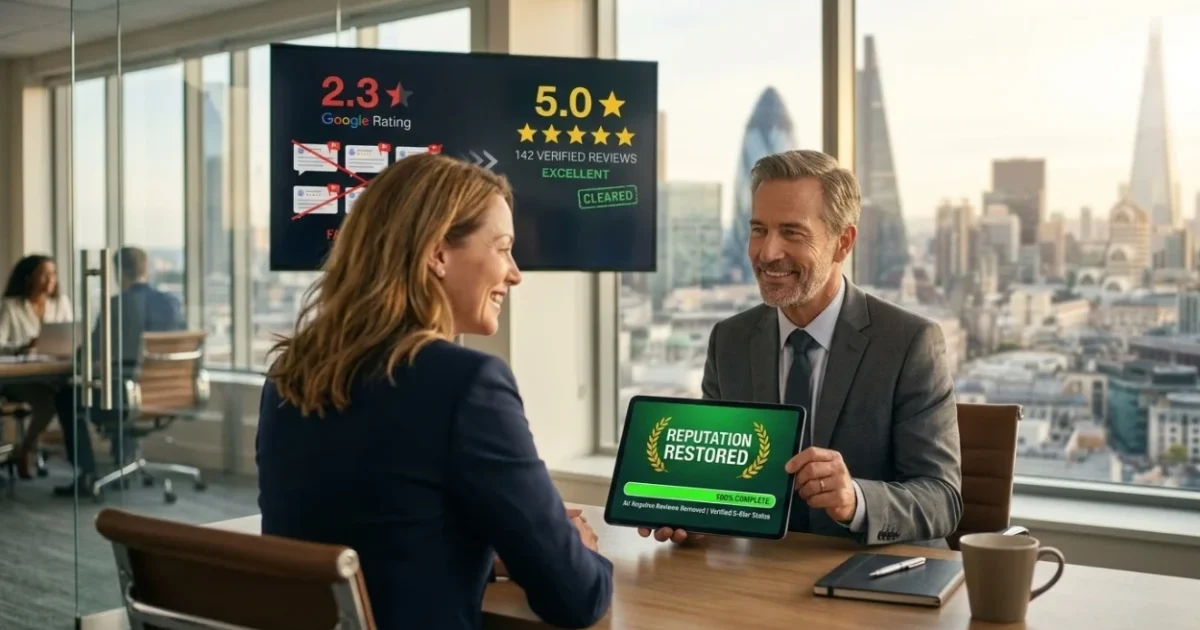
Reporting and removing fake Google reviews requires objective evidence, policy alignment and a structured reputation management process.
Controlling how damaging review content appears in search results protects reputation signals, strengthens entity credibility and supports more reliable customer decisions.
Why is professional management the right approach for fake Google reviews?
Professional management provides a controlled process for identifying suspicious reviews, documenting policy violations and pursuing the appropriate removal route. A fake review is not removed simply because a business disputes its claims; the decisive factor is whether evidence connects the content to a Google policy violation. This distinction creates a defensible process that separates legitimate criticism from content that breaches platform rules. It also reduces the risk of inappropriate reporting, repeated submissions and ineffective responses. For businesses facing persistent review-related reputation issues, professional Google review management provides a structured route from assessment through resolution.
Search visibility makes this process commercially important because review content can become part of the first impression formed around a business. Negative review snippets, star ratings and reviewer activity contribute to the reputation signals encountered before a prospective customer reaches a website. When inaccurate or policy-violating content occupies prominent search positions, it affects search perception influence alongside the business’s own controlled assets. Effective reputation management therefore addresses both the individual review and its relationship with the wider search ecosystem. The objective is not to eliminate legitimate criticism but to reduce the visibility and influence of content that has a demonstrable policy basis for removal.
How does Clear My Name evaluate whether a Google review qualifies for action?
Clear My Name applies an evidence-led evaluation before recommending a reporting or removal route. The assessment examines the review’s factual context, language, reviewer behaviour, relationship to the business and relevant Google policy category. This process prevents disagreement with a review from being treated as proof that the review is fake. Instead, the focus remains on objective indicators that establish whether the content falls outside acceptable platform behaviour. Clear evidence creates a stronger foundation for reporting and improves process clarity when the platform evaluates the complaint.
The evaluation also considers the broader reputation environment surrounding the review. A single suspicious review has a different significance from a pattern involving repeated reviewer accounts, coordinated activity, duplicated claims or content that conflicts with identifiable facts. These characteristics help establish whether the issue concerns authenticity, prohibited content, manipulation or a legitimate customer experience. The resulting evidence can then be organised around the specific mechanism involved rather than relying on a general claim that the review is unfair. This approach strengthens risk control because every action is connected to an identifiable reason.
Businesses can also validate their decision before taking action by examining how fake Google reviews are identified and reported through the earlier consideration-stage analysis. Understanding the distinction between suspicious content and legitimate negative feedback makes the subsequent removal process more precise. It also establishes why evidence quality matters when attempting to influence the visibility of review content. A well-defined assessment prevents reputation management from becoming a reaction to negative sentiment alone.
What does the Google review removal process involve?
The removal process begins with evidence collection and policy mapping, followed by the appropriate reporting route and structured follow-up. Each review requires an assessment of the specific policy mechanism rather than a generic removal request. Relevant evidence is organised so that the complaint clearly explains the connection between the review and the applicable violation. This creates a consistent record of the issue and supports a more transparent review process. Where removal is appropriate, the objective is to present the case accurately and efficiently rather than repeatedly submitting unsupported complaints.
A professional process can be organised into defined stages:
- Assess the review against identifiable Google policy criteria and distinguish policy violations from ordinary customer dissatisfaction.
- Document reviewer activity, factual inconsistencies and content characteristics that provide objective evidence of the suspected violation.
- Map the evidence to the relevant reporting mechanism so the complaint addresses the actual issue rather than general reputational harm.
- Report the review through the appropriate platform process using concise, evidence-based reasoning.
- Monitor the review status and search visibility to identify whether further action is required.
- Respond publicly where appropriate to maintain customer confidence while the platform evaluates the removal request.
This structured sequence improves reliability because each stage has a defined purpose. It also reduces the operational risk created by impulsive responses, unsupported allegations or repeated reporting without additional evidence. The process therefore supports both immediate review management and longer-term SERP control.
Dive Deeper With Our Expert Guides:
Clear My Name’s Complete Google Review Management Framework
Scale Your Online Reputation With Google Review Management Services
How does removing fake review content affect search visibility and trust?
Removing policy-violating review content can improve the composition of reputation signals presented to searchers, particularly when the disputed review has prominent visibility. Google review information can appear directly in search results, local listings and other discovery environments, making review content an important component of online perception. When an inaccurate or prohibited review is removed, that individual piece of negative content no longer contributes to the visible review profile. The effect is therefore connected to content visibility rather than an artificial manipulation of legitimate ranking factors. Businesses gain greater control over the information prospective customers encounter during search.
Search perception also depends on the relationship between review content and other reputation assets. A business with a strong website, accurate business information, credible third-party references and authentic customer feedback presents a broader collection of reputation signals. Removing a qualifying fake review prevents one policy-violating asset from disproportionately influencing that collection. This creates a cleaner environment in which legitimate evidence of entity credibility can be assessed. The resulting improvement is best understood as negative content suppression through legitimate removal, not the creation of artificial positive sentiment.
The impact also extends beyond a single Google profile when customers use branded searches before making decisions. A prospective customer can encounter review information alongside websites, directories, social profiles, news coverage and other references. Effective reputation management considers this complete SERP composition rather than treating one review as an isolated asset. This wider perspective allows businesses to stabilise perception while maintaining accurate and defensible information across the search ecosystem.
Is Google review removal worth the cost compared with managing the problem internally?

The value of professional review management depends on the commercial and reputational impact of the content, the evidence available and the resources required to manage the process internally. Internal teams often have direct knowledge of customer interactions, but platform reporting requires a separate understanding of policy categories, evidence presentation and follow-up procedures. A poorly structured complaint consumes internal time without creating a clear route towards resolution. Professional management turns the process into a defined workflow with documented reasoning and measurable status tracking.
Cost also needs to be assessed against the potential persistence of visible negative content. A review that repeatedly appears during branded or local searches can influence customer perception long after the original incident. Addressing a qualifying policy violation early limits the period during which the content contributes to negative reputation signals. At the same time, legitimate criticism remains part of the business’s authentic reputation and requires a different response. This distinction ensures that expenditure focuses on content where a defensible removal mechanism exists.
The long-term value comes from process repeatability rather than a single removal attempt. A documented assessment framework gives businesses a consistent method for handling future suspicious reviews. It also enables teams to recognise recurring patterns and distinguish isolated customer dissatisfaction from coordinated or prohibited activity. This reduces operational uncertainty and supports a more stable reputation management strategy.
How quickly can fake Google reviews be addressed?
The speed of action depends on the quality of the evidence, the nature of the policy issue and the platform’s review process. Immediate reporting does not guarantee immediate removal because the platform retains responsibility for evaluating reported content. A professional service therefore focuses on reducing avoidable delays created by incomplete evidence, unclear explanations or incorrect reporting categories. The first measurable outcome is process readiness: the business has a documented case and an appropriate reporting route. Further progress is then assessed through review status and changes in visible content.
Speed also matters because search perception develops through repeated exposure. The longer policy-violating content remains visible, the longer it can contribute to the reputation signals encountered by prospective customers. Prompt evidence collection therefore reduces the period of uncontrolled exposure even when the final platform decision requires additional processing time. This creates a practical distinction between acting quickly and promising an unrealistic removal deadline. Reliable reputation management controls what can be controlled while accurately representing what depends on the platform.
How can businesses reduce the risk of future fake review problems?
Long-term protection requires continuous review monitoring, evidence preservation and a broader reputation strategy. Removing one fake review does not prevent another suspicious review from appearing later, so businesses need a repeatable method for how fake Google reviews are identified and abnormal activity is assessed. Monitoring can reveal changes in review patterns, sudden clusters of negative content or reviewer behaviour that warrants closer examination. Early identification gives the business more time to document relevant evidence before the content becomes deeply established in search results. This converts reputation management from a reactive process into an ongoing control system.
A sustainable reputation framework also strengthens legitimate reputation signals:
- Monitor new reviews consistently to identify unusual patterns before they become persistent search assets.
- Preserve relevant evidence so policy concerns can be demonstrated with clear supporting information.
- Encourage authentic customer feedback through compliant business practices that expand genuine reputation signals.
- Maintain accurate business information across search platforms to reinforce entity credibility.
- Audit branded search results to identify negative content that requires a distinct suppression or response strategy.
These actions create resilience because the business does not rely exclusively on individual review removals. Strong authentic signals provide greater context around the business entity while monitoring identifies content requiring investigation. This combination supports sustainable search perception influence without attempting to manufacture customer sentiment.
Why does Clear My Name provide a reliable route for Google review reputation management?
Clear My Name provides a structured reputation management process centred on evidence, policy alignment and search visibility control. The service approach connects review assessment with the wider reputation environment, ensuring that decisions are based on identifiable mechanisms rather than emotional reactions to negative feedback. This creates a clearer distinction between content that qualifies for removal and criticism that requires a public response or reputation-building strategy. Process clarity also gives businesses a consistent framework for assessing outcomes and deciding on further action. The result is a more controlled approach to Google Reviews and wider online reputation management.
The strongest outcome is not simply the removal of an individual review. It is the restoration of control over the reputation signals presented to customers during search. When qualifying fake or policy-violating content is addressed, legitimate reviews and other credible business information gain greater contextual importance. When removal is unavailable, alternative actions such as public responses, content enhancement and negative content suppression provide additional mechanisms for stabilising SERP composition. This layered approach reduces reliance on one outcome and supports a sustainable reputation strategy.
For businesses deciding whether to act, the essential consideration is evidence and mechanism. A credible service does not promise that every negative review disappears; it establishes whether the review has an actionable policy basis, prepares the evidence, follows the appropriate process and measures the resulting visibility changes. Clear My Name therefore provides a defined route for businesses seeking professional control over fake Google review issues while maintaining accuracy, compliance and reputational integrity.
What is the most reliable way to manage a fake Google review?
The most reliable approach combines objective assessment, evidence-based reporting, platform-compliant removal requests and ongoing search perception management. Businesses need to establish why a review qualifies for action before attempting to remove it, then select the response mechanism that matches the evidence. Where removal is justified, a structured reporting process creates a clear case for platform evaluation. Where removal is not available, public response, authentic reputation signals and negative content suppression provide alternative methods of protecting customer perception. This ensures the strategy remains focused on measurable visibility, trust and control rather than unrealistic removal promises.
Google Reviews form only one part of the wider search ecosystem, but prominent review content can influence how a business is evaluated before direct engagement takes place. Managing that environment requires consistency, evidence and an understanding of how reputation signals interact across search results. A structured service reduces operational uncertainty by connecting assessment, action and monitoring into one process. For businesses dealing with demonstrably fake or policy-violating reviews, this provides a credible foundation for restoring control over online perception while preserving legitimate customer feedback.
How can I report a fake Google review?
Identify the specific Google review policy violation and gather objective evidence supporting the report. The review can then be reported through Google’s review reporting process, with further action based on the platform’s assessment.
Can Clear My Name remove fake Google reviews?
Clear My Name can support the assessment and reporting of reviews that appear to violate Google’s policies. Removal depends on whether Google determines that the review breaches its applicable content guidelines.
What evidence is needed to report a fake Google review?
Useful evidence includes factual inconsistencies, suspicious reviewer activity, duplicated content, conflicts of interest and other indicators connected to a specific Google policy. Evidence is strongest when it directly demonstrates why the review violates the relevant rule.
How long does it take to remove a fake Google review?
The timeframe depends on Google’s review and enforcement process, so removal does not have a guaranteed fixed deadline. Businesses can reduce avoidable delays by submitting a clear report supported by relevant evidence.
Can a business remove a negative Google review that is not fake?
A negative review is not automatically removable because a business disagrees with its content. Removal generally depends on whether the review violates Google’s policies rather than whether it is damaging, critical or unfavourable.