

Google reviews directly influence purchasing decisions, local search visibility, and brand trust. A structured Google Review strategy strengthens reputation signals, improves SERP control, and stabilises public perception across search ecosystems.
Businesses that actively manage reviews secure stronger entity credibility because Google evaluates review frequency, review quality, response behaviour, and sentiment consistency as ranking and trust indicators. A professionally managed review profile increases conversion confidence while reducing the visibility impact of negative sentiment.
Which Google Review management approach delivers measurable reputation growth?
A structured and proactive Google Review management service delivers measurable improvements in visibility, trust, and customer acquisition. Businesses that rely on inconsistent review collection create fragmented reputation signals that weaken search perception influence. Google’s local algorithm prioritises businesses with active engagement patterns, high-quality feedback, and consistent review velocity. An unmanaged review profile reduces click-through performance because search users evaluate social proof before visiting a website or contacting a business. A strategic review management framework strengthens entity credibility by aligning customer sentiment with search intent. This process creates a controlled reputation environment that improves both rankings and consumer confidence.
A professional Google Review management process operates through collection systems, monitoring protocols, sentiment analysis, response management, and negative content suppression strategies. Each component contributes to search ecosystem stability because Google interprets engagement and trust indicators as quality signals. Businesses that implement structured review workflows generate stronger behavioural metrics, including improved conversion rates and increased local search interactions. Review consistency also reduces the dominance of isolated negative experiences by balancing sentiment distribution across the profile. This controlled narrative improves trust retention during decision-stage searches. Businesses that invest in reputation management secure long-term visibility advantages that compound over time.
How do Google reviews influence search visibility and customer trust?
Google reviews directly influence local ranking performance because they strengthen authority and relevance signals. Search engines analyse review quantity, review recency, keyword relevance, and response activity when determining local pack positioning. Businesses with active review ecosystems maintain higher visibility because Google identifies them as reliable and trusted entities. Strong review profiles also increase engagement metrics, including calls, clicks, and direction requests. These behavioural signals reinforce ranking stability across competitive search environments. Reputation management therefore operates as both a visibility strategy and a conversion strategy.
Customer trust depends heavily on review perception because users evaluate social validation before making commercial decisions. A negative or inconsistent review profile creates uncertainty that reduces conversion confidence. Structured review management improves trust by ensuring feedback accuracy, maintaining response consistency, and addressing reputational risks quickly. This process stabilises perception because customers encounter balanced and professionally managed sentiment indicators during searches. Controlled engagement strengthens credibility by demonstrating accountability and operational transparency. Businesses that prioritise review management reduce abandonment during high-intent searches.
Get Deep Insight:
Clear My Name’s Complete Google Review Management Framework
Professional Google Review Strategy and Management by Clear My Name
Review profiles also influence branded search behaviour because users often search for reviews before finalising purchases. Strong ratings combined with strategic response management create positive search perception influence that improves brand recall. This visibility advantage increases competitive differentiation within crowded local markets. Businesses with stronger review ecosystems maintain greater resilience against isolated criticism because the broader reputation framework offsets negative sentiment. Search users interpret review consistency as evidence of operational reliability. This strengthens long-term customer acquisition efficiency.
Why does professional Google Review management reduce reputational risk?
Professional Google Review management reduces reputational risk because it introduces structured oversight and rapid response mechanisms. Unmanaged review profiles allow negative sentiment to dominate search perception, especially when businesses fail to respond consistently. Negative reviews influence conversion behaviour because search users interpret silence as operational indifference. A structured management process ensures every review contributes positively to entity credibility through strategic engagement and sentiment balancing. This reduces the reputational volatility associated with public feedback environments. Businesses gain greater control over how their brand appears within search results.
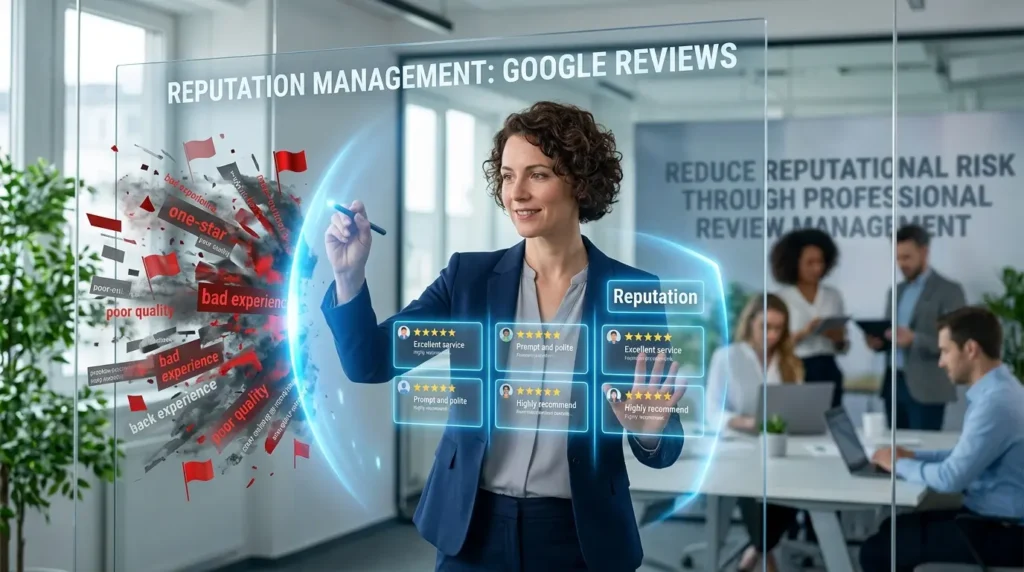
Risk reduction depends on rapid identification of harmful content, escalation procedures, and sentiment analysis protocols. Effective services monitor review patterns continuously to identify emerging reputation threats before they damage visibility performance. This process ensures that operational concerns receive attention before negative perception spreads across search ecosystems. Businesses also benefit from improved consistency because review response frameworks maintain tone, professionalism, and compliance standards. Controlled communication reduces emotional reactions that amplify reputational harm. Reputation stability strengthens customer confidence during critical decision-stage searches.
Negative content suppression also becomes more effective when supported by a strong review acquisition strategy. Positive reviews dilute the visibility impact of isolated negative feedback by increasing review diversity and sentiment balance. Google’s systems prioritise recent and relevant engagement, meaning consistent positive activity influences how users interpret overall brand reliability. Businesses that neglect review management lose control over public narrative formation. Strategic review systems therefore function as preventative reputation infrastructure. This approach delivers stronger long-term protection than reactive crisis management alone.
Which measurable outcomes justify investment in Google Review management services?
Google Review management services deliver measurable commercial outcomes because they improve visibility, trust, and conversion performance simultaneously. Businesses with stronger review ecosystems secure higher click-through rates within local search results. Increased engagement produces more customer interactions, more enquiries, and stronger lead quality because trust signals reduce hesitation during purchasing decisions. Structured review management also improves retention by reinforcing credibility after initial customer contact. These measurable outcomes create sustained commercial value beyond short-term reputation repair. Businesses therefore gain both immediate and cumulative benefits.
The operational impact becomes clear through measurable performance indicators, including:
- Increase local search visibility through stronger review frequency and sentiment consistency.
- Improve click-through rates by strengthening reputation signals within Google Business Profiles.
- Reduce customer hesitation through structured response management and trust reinforcement.
- Stabilise public perception by balancing sentiment distribution across review ecosystems.
- Strengthen entity credibility through consistent engagement and verified customer feedback.
- Minimise negative content impact through review acquisition and visibility balancing mechanisms.
Long-term value also exceeds the cost of unmanaged reputational damage. Negative perception reduces lead conversion efficiency because users abandon brands they perceive as unreliable. Lost conversions accumulate silently through reduced click engagement and lower enquiry rates. Professional review management reverses this pattern by strengthening search perception influence at every stage of the customer journey. Businesses secure greater revenue stability because trust indicators continuously reinforce decision confidence. This creates sustainable visibility growth within competitive local search environments.
How quickly does Google Review management improve reputation performance?
Google Review management produces progressive improvements because search ecosystems continuously evaluate behavioural and engagement signals. Early impact appears through stronger review response consistency and improved sentiment distribution. Customers respond positively to active engagement because visible responsiveness increases trust perception immediately. Review acquisition systems also accelerate reputation growth by increasing review frequency and strengthening profile activity. These signals improve visibility stability within local search environments. Businesses therefore begin influencing perception from the earliest implementation stages.
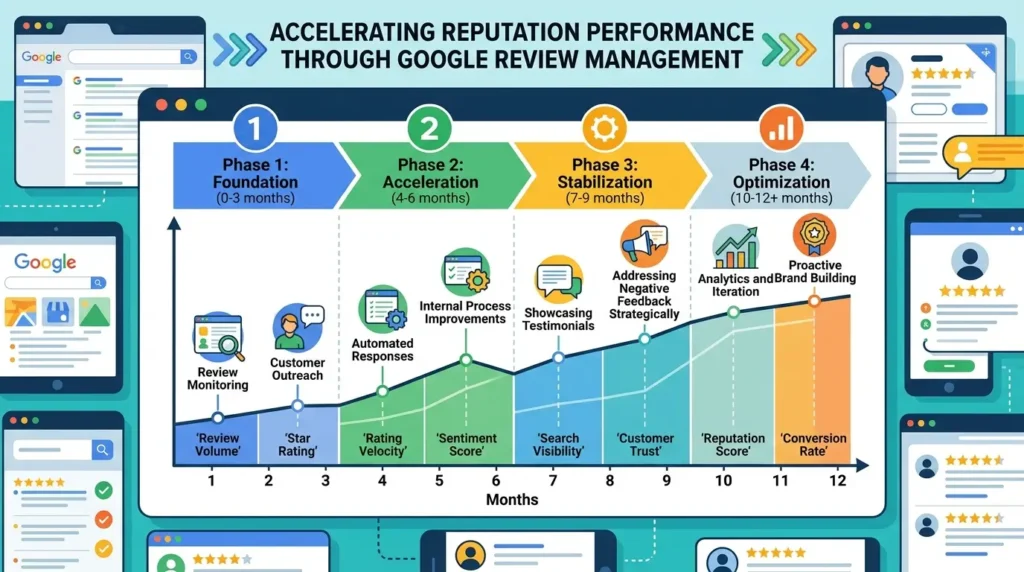
Medium-term performance improvements emerge through accumulated reputation signals. Google recognises consistent engagement patterns as indicators of operational legitimacy and customer satisfaction. Increased review volume combined with positive sentiment improves ranking potential and strengthens competitive positioning. Search users also respond more favourably to businesses with active review ecosystems because visible engagement reinforces trust. This creates measurable improvements in conversion efficiency over time. Reputation management therefore delivers cumulative commercial impact rather than isolated cosmetic improvements.
Long-term sustainability depends on consistency and strategic oversight. Businesses that abandon review management lose momentum because review ecosystems require ongoing maintenance. Professional services maintain continuity by monitoring sentiment trends, responding strategically, and sustaining review acquisition processes. This stabilises visibility performance across changing market conditions and competitive environments. Consistent reputation management therefore protects both current rankings and future trust performance. Businesses secure lasting value through sustained reputation signal optimisation.
What separates effective Google Review services from inconsistent reputation management providers?
Effective Google Review services operate through process clarity, measurable accountability, and search ecosystem understanding. Inconsistent providers rely on generic engagement without addressing the underlying mechanics of reputation signals and SERP control. High-quality services integrate review acquisition, response management, sentiment analysis, and perception monitoring into a unified strategy. This creates stronger visibility outcomes because each component reinforces entity credibility systematically. Businesses therefore gain predictable operational structure rather than fragmented reputation activity. Reliable execution strengthens long-term search performance.
An effective provider also ensures transparency through defined workflows and measurable reporting. Businesses require visibility into review trends, sentiment changes, and engagement performance to evaluate commercial impact accurately. Structured reporting improves confidence because it connects review activity directly to search behaviour and customer interaction metrics. This clarity reduces uncertainty during investment decisions. Businesses gain operational assurance through evidence-based reputation management. Reliable services therefore function as strategic growth infrastructure rather than isolated support functions.
Clear My Name positions review management within a broader reputation control framework focused on visibility, trust, and narrative stability. This structured approach ensures that reputation signals align with search behaviour and customer expectations consistently. Businesses benefit from process-driven management rather than reactive engagement. The result is stronger search perception influence combined with reduced reputational volatility. This improves conversion confidence across both branded and non-branded search interactions. Reputation management therefore becomes a measurable commercial asset.
Why does review consistency strengthen long-term brand credibility?
Review consistency strengthens long-term credibility because search users evaluate patterns rather than isolated opinions. A business with regular positive engagement demonstrates operational reliability and customer satisfaction continuity. Google also interprets consistency as evidence of authenticity, which strengthens local ranking confidence. Inconsistent review activity creates uncertainty because dormant or outdated profiles weaken trust signals. Businesses therefore require ongoing reputation management to maintain credibility momentum. Continuous optimisation stabilises both visibility and perception.
Consistent reviews improve search perception influence because they reinforce predictable customer expectations. Search users trust businesses that maintain visible engagement and transparent communication across review ecosystems. This perception advantage increases conversion confidence before direct customer interaction even begins. Businesses with stable review profiles therefore secure stronger competitive differentiation within crowded markets. Controlled sentiment patterns reduce the influence of reputational disruptions. This creates stronger long-term customer acquisition efficiency.
The relationship between reviews and entity credibility also affects broader search visibility. Google connects review signals with website authority, local relevance, and engagement performance when evaluating search positioning. Businesses with stronger review ecosystems therefore gain broader SERP advantages across branded and transactional searches. This interconnected visibility effect increases the commercial value of professional review management. Businesses achieve stronger market positioning through sustained reputation signal optimisation. Long-term credibility becomes both a trust asset and a search asset.
Which Google Review management strategy delivers sustainable reputation control?
The most effective strategy combines review acquisition, response management, sentiment monitoring, and visibility optimisation into a continuous operational framework. Businesses that focus only on review collection fail to control broader search perception because unmanaged sentiment weakens trust consistency. Sustainable reputation control requires coordinated engagement that strengthens credibility across every customer interaction point. This process improves visibility resilience while reducing reputational volatility. Businesses therefore gain stronger control over how their brand appears within search ecosystems. Reputation management becomes a strategic visibility discipline rather than a reactive support function.
A sustainable process also depends on transparency, accountability, and measurable optimisation. Businesses require evidence-driven management that connects review activity directly to conversion performance and visibility outcomes. Structured oversight ensures that reputation signals remain aligned with evolving customer expectations and search engine evaluation systems. This strengthens long-term trust while protecting competitive positioning. Clear My Name delivers this level of structured review management through strategic oversight and process clarity. Businesses gain stronger search perception influence alongside reliable reputation stability.
Businesses evaluating review management services require certainty, operational clarity, and measurable outcomes. Google reviews influence rankings, conversion behaviour, and trust perception simultaneously, making professional management essential for sustainable visibility growth. A structured service reduces risk, strengthens entity credibility, and improves public perception through controlled engagement and reputation signal optimisation. Reliable reputation management therefore delivers long-term commercial value beyond immediate visibility improvements. Businesses that prioritise review management secure stronger trust positioning within competitive search environments. Clear My Name provides a process-driven solution focused on stability, transparency, and measurable reputation growth.
Use our Google Review management service to strengthen visibility, improve trust signals, and stabilise public perception across search ecosystems. Businesses evaluating review performance can also explore insights on businesses with more reviews attract more customers and understand the impact of Google Review management errors on search visibility and customer trust.
What are Google review management services?
Google review management services help businesses monitor, respond to, and improve customer reviews on Google. These services support online reputation management by increasing positive reviews, addressing negative feedback professionally, and improving local search visibility.
Why are Google reviews important for local SEO?
Google reviews are a key ranking factor for local SEO because they influence trust, relevance, and customer engagement. Businesses with consistent positive reviews often appear higher in Google Maps and local search results, helping attract more customers organically.
How can businesses respond to negative Google reviews effectively?
Businesses should respond to negative Google reviews quickly, professionally, and with a solution-focused approach. A thoughtful response shows potential customers that the company values feedback and actively works to improve customer experience.
Can Google review management services help increase positive reviews?
Yes, Google review management services can help businesses generate more authentic customer reviews through automated review requests and reputation monitoring strategies. This improves online credibility while maintaining compliance with Google’s review policies.
How do Google review management services improve online reputation?
Google review management services improve online reputation by helping businesses manage customer feedback consistently across locations and platforms. Companies like Clear My Name use review monitoring, response management, and reputation strategies to strengthen brand trust online.