

Reputation management is the process of monitoring, analysing, and shaping how a business is understood through digital information sources and search ecosystems.
Online reputation refers to the collection of reputation signals, content assets, reviews, mentions, and entity associations that influence trust, credibility, and search visibility.
What Is Reputation Management for Businesses?
Reputation management for businesses is the process of understanding, evaluating, and maintaining the information that defines a business across search ecosystems. It focuses on how search engines, users, and information retrieval systems interpret credibility through digital signals. Reputation is not limited to customer opinion. It includes indexed content, review sentiment, third-party references, knowledge graph associations, and brand mentions.
Within search ecosystems, reputation functions as an entity-level evaluation framework. Search engines analyse information consistency, source reliability, content quality, and user interaction signals to determine trustworthiness. These signals contribute to how a business appears across search engine results pages (SERPs). The resulting perception influences both visibility and credibility.
Reputation management also refers to the continuous analysis of digital assets connected to a business entity. Every indexed page, review, article, social profile, and citation contributes to reputation formation. Search engines evaluate these assets collectively rather than individually. This process creates a broader understanding of entity perception across the web.
How Is Business Reputation Formed in Search Engines?
Business reputation is formed through the aggregation and interpretation of digital information. Search engines collect data from websites, reviews, directories, social platforms, and news publications to construct entity understanding. This information becomes part of the entity’s searchable footprint.
The process begins with content indexing. Search engines crawl digital assets and extract information about organisations, products, services, and public references. Structured and unstructured data contribute to entity recognition. As content relationships become clearer, search systems create contextual connections between information sources.
Search algorithms then evaluate reputation signals. These include review sentiment, citation frequency, content relevance, source authority, and information consistency. Positive and negative signals both contribute to overall entity perception. Search systems analyse these signals continuously as new content enters the index.
SERP evaluation reflects this process. Businesses associated with strong credibility indicators often achieve stronger visibility for relevant queries. Visibility is therefore linked to information quality and trust-related signals rather than isolated ranking factors.
Why Does Online Reputation Influence Customer Trust?
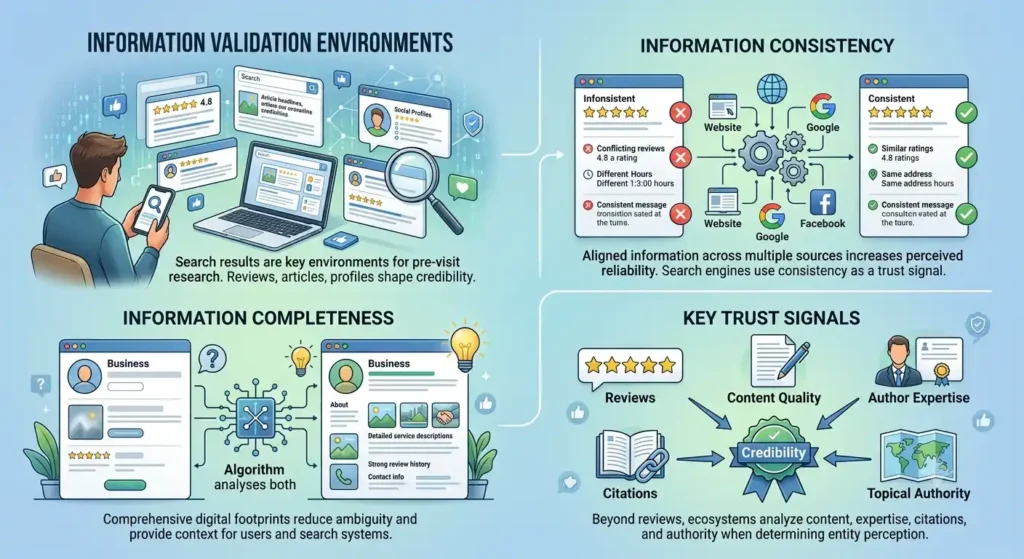
Online reputation influences customer trust because search results function as information validation environments. Users frequently evaluate businesses through the information displayed before visiting a website. Reviews, articles, profiles, and search snippets collectively shape credibility assessments.
Trust develops through information consistency. When users encounter aligned information across multiple sources, perceived reliability increases. Search engines also use consistency as a trust signal because stable information improves entity understanding. Consistency therefore benefits both human evaluation and algorithmic interpretation.
Credibility is also influenced by information completeness. Businesses with comprehensive digital footprints provide stronger context for search engines and users. Detailed information helps reduce ambiguity and improves entity recognition. As a result, search systems gain a clearer understanding of the organisation being evaluated.
Trust signals extend beyond reviews. Content quality, author expertise, citation references, and topical authority contribute to credibility formation. Search ecosystems analyse these elements collectively when determining entity perception and search visibility.
What Is a Digital Footprint and Why Does It Matter?
A digital footprint is the collection of indexed information associated with a business across digital environments. It includes websites, articles, reviews, social profiles, directory listings, multimedia assets, and third-party mentions. Every indexed asset contributes to entity understanding.
Within search ecosystems, digital footprints act as evidence repositories. Search engines use them to validate entity existence, relevance, and credibility. Larger footprints provide more data points for evaluation. Strong data coverage improves contextual understanding and reduces uncertainty.
Digital footprints also influence content discoverability. Each indexed asset creates additional entry points into search results. This expands search visibility and strengthens topical associations. The breadth of information available therefore affects how comprehensively a business can be understood.
Information quality remains essential. Search systems prioritise accurate and relevant data when constructing entity relationships. Inconsistent or outdated information weakens entity clarity and introduces ambiguity into reputation assessments.
How Do Reviews Affect Reputation Signals?
Reviews affect reputation signals by providing direct user-generated feedback that search engines can analyse. Reviews contain sentiment indicators, behavioural data, and contextual information related to customer experiences. These elements contribute to reputation evaluation frameworks.
Search systems interpret review signals through sentiment analysis. Positive, neutral, and negative language patterns help algorithms understand public perception. The distribution of sentiment across review platforms contributes to overall entity perception. Review consistency also influences credibility assessments.
Review freshness plays an important role in reputation evaluation. Search engines continuously analyse newly published feedback because current information improves relevance. Recent reviews provide updated insight into public perception and operational performance.
Review ecosystems also contribute to trust validation. Independent review platforms create external reputation signals that support entity verification. Search engines evaluate these signals alongside website content, citations, and other authority indicators to develop a broader reputation profile.
How Do Search Engines Evaluate Authority and Credibility?

Search engines evaluate authority and credibility by analysing evidence from multiple sources. Authority refers to recognised expertise and relevance within a topic area. Credibility refers to the reliability and trustworthiness of the information associated with an entity.
Content quality functions as a primary authority signal. Search systems evaluate topical depth, factual accuracy, semantic relevance, and information completeness. High-quality content strengthens entity associations and improves contextual understanding.
External references also contribute to authority assessment. Mentions from trusted sources act as validation signals. These references help search systems confirm entity relevance and strengthen confidence in information accuracy. Authority therefore emerges through recognised connections across the web.
Credibility evaluation extends beyond content creation. Information consistency, review sentiment, citation accuracy, and source reliability all contribute to trust analysis. Search systems combine these signals to create a comprehensive credibility profile that influences search visibility.
How Does Content Influence Reputation and Perception?
Content influences reputation and perception because it acts as a primary source of entity information. Search engines rely on content to understand topics, expertise, relationships, and organisational relevance. Every published asset contributes to entity interpretation.
Content defines how an entity is associated with specific subjects. Semantic relationships within articles, guides, research materials, and informational resources help search systems identify topical expertise. Strong topical alignment improves entity understanding and strengthens reputation signals.
Information quality also affects perception. Accurate, comprehensive, and well-structured content supports credibility assessments. Search engines analyse content depth and contextual coverage when evaluating authority. These evaluations contribute to search visibility and entity perception.
Within reputation ecosystems, reputation management for business is often discussed in relation to content governance, information accuracy, and trust signal analysis. The phrase connects directly to broader discussions surrounding search visibility, entity perception, and digital credibility without referring to a commercial service.
What Role Do SERPs Play in Reputation Evaluation?
SERPs function as reputation evaluation environments where users analyse available information before making judgments. Search engine results pages display a combination of websites, reviews, news content, profiles, and knowledge-based information. These elements collectively influence perception.
The structure of a SERP determines information prominence. Content appearing in visible positions receives greater attention and contributes more significantly to reputation formation. Search visibility therefore affects how information is consumed and interpreted.
SERPs also create comparative evaluation environments. Users often assess multiple information sources simultaneously. This process increases the importance of information consistency and credibility. Contradictory information introduces uncertainty and weakens trust signals.
Search engines continuously refine SERP composition based on relevance, authority, and user satisfaction metrics. As a result, reputation signals influence not only rankings but also the broader information landscape presented to users.
How Is Entity Perception Connected to Reputation?
Entity perception refers to how search systems understand and classify a business based on available information. It is a core component of reputation analysis because search engines evaluate entities rather than isolated pages. Entity perception shapes visibility, relevance, and credibility assessments.
Search systems construct entity profiles through relationship mapping. They analyse connections between topics, mentions, reviews, citations, and content assets. These relationships help define the entity’s position within a broader knowledge framework.
Strong entity perception emerges when information demonstrates consistency and topical relevance. Search engines gain confidence in entity classification when supporting signals align across multiple sources. This confidence improves information retrieval accuracy and strengthens reputation indicators.
Entity perception also influences query matching. Search systems use entity understanding to determine which results satisfy user intent. Businesses with clear entity definitions often achieve stronger alignment with relevant search queries.
How Can Businesses Maintain Long-Term Online Credibility?
Long-term online credibility is maintained through information accuracy, consistency, and continuous content relevance. Credibility depends on the ongoing quality of reputation signals rather than temporary visibility fluctuations. Search ecosystems reward stable and trustworthy information environments.
Maintaining credibility involves three core processes:
- Monitor information accuracy – Verify business details across indexed assets to maintain entity consistency and reduce ambiguity.
- Update content relevance – Refresh informational resources to align with current topics, ensuring search systems recognise ongoing expertise.
- Evaluate reputation signals – Analyse reviews, mentions, citations, and content performance to understand changes in entity perception.
These processes support stronger search ecosystem understanding. Consistent information creates reliable trust signals that benefit both search engines and users. Credibility therefore becomes a measurable outcome of information quality and entity clarity.
Reputation management for businesses is fundamentally connected to how information is created, indexed, interpreted, and evaluated within search ecosystems. Search engines analyse reputation signals through reviews, content, citations, authority indicators, and entity relationships to determine credibility and search visibility.
Digital footprints, SERP evaluation, sentiment analysis, and entity perception all contribute to reputation formation. Online credibility emerges from consistent information, trustworthy signals, and accurate content relationships. Understanding these mechanisms provides a clearer view of how reputation functions as an information system rather than a standalone marketing concept.
Answers to Key Questions
What is reputation management for businesses?
Reputation management for businesses is the process of monitoring and influencing how a company appears across search engines, reviews, and digital platforms. It focuses on improving trust signals, online credibility, and search visibility through content, reviews, and entity-based information.
How does online reputation affect search visibility for a business?
Online reputation affects search visibility by influencing how search engines evaluate trust, authority, and relevance. Positive reviews, consistent business information, and high-quality content improve SERP positioning and strengthen entity perception.
Why are reviews important in business reputation management?
Reviews are key reputation signals that search engines use to measure sentiment, credibility, and user trust. A strong review profile helps improve ranking signals and reinforces positive brand perception across search results.
How do search engines evaluate a business’s reputation?
Search engines evaluate reputation by analysing content quality, review sentiment, backlinks, and entity consistency across the web. These signals help determine how trustworthy and relevant a business is for specific search queries.