

Controlling search engine results page (SERP) visibility directly determines a company’s commercial viability and customer acquisition efficiency in the UK market. Digital reputation signals dictate user selection behaviour during the critical decision-making phase, transforming algorithmic perception into measurable financial outcomes.
When prospective corporate or retail buyers evaluate a brand, negative content suppression and proactive asset optimisation prevent revenue leakage to competitors. Establishing complete authority over brand-related search queries neutralizes reputational risk and ensures that entity credibility remains pristine across all digital touchpoints.
Why do professional reputation management services deliver predictable search visibility control?
Professional reputation management services neutralize damaging digital content by restructuring the search ecosystem to prioritise authoritative, positive assets. Search engine algorithms rank content based on trust, relevance, and entity credibility, meaning malicious or outdated links only persist when unchallenged by stronger digital properties. By systematically deploying optimised information nodes, a professional campaign alters the algorithmic landscape to diminish the visibility of defamatory material. This programmatic approach ensures that accurate, brand-aligned assets dominate the first page of search results, guaranteeing long-term algorithmic stability.
The primary mechanism relies on engineering high-authority digital entities that outrank negative press, forum threads, or competitor attacks. Clear My Name executes this strategic positioning by establishing robust information architectures across high-authority platforms, social channels, and media networks. These new or optimised properties feed positive signals directly into search engine knowledge graphs, accelerating the demotion of unverified or harmful URLs. As search engine crawlers recognize the superior engagement, trust, and structural integrity of these new assets, the undesirable links naturally decline in visibility.
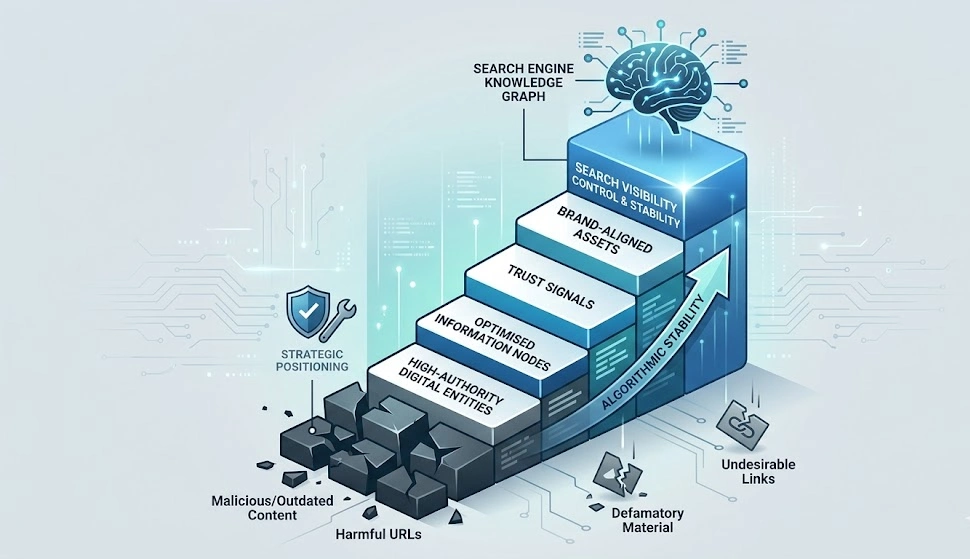
How search perception influence mitigates algorithm-driven revenue risk
Altering search perception influence requires deep technical alignment with modern search engine evaluation criteria, specifically targeting user intent and semantic relevance. When a business experiences a localized reputational crisis, algorithmic systems amplify user engagement with negative links, artificially sustaining their high positions on the SERP. Implementing a targeted suppression framework breaks this feedback loop by redirecting search volume and user clicks toward verified corporate properties. This process stabilises perception and isolates negative sentiment, preventing systemic damage to the broader brand architecture.
The technical process behind negative content suppression
Achieving permanent negative content suppression requires a multi-layered technical methodology rather than temporary public relations adjustments. The execution framework delivers comprehensive digital protection through specific, sequential operations:
- Audits the entire digital footprint to map every active reputation signal, identifying harmful URLs, algorithmic vulnerabilities, and high-risk search queries across the UK market.
- Optimises existing brand-owned assets by restructuring metadata, internal linking, and semantic markup to maximize their native authority within search engine indexes.
- Establishes verified digital entities on trusted third-party platforms to construct an impenetrable defensive barrier around primary brand keywords.
- Deploys semantic content networks that answer user queries comprehensively, neutralizing the search visibility of hostile or irrelevant web pages.
- Monitors real-time SERP fluctuations to intercept emerging threats before they achieve sufficient visibility to influence consumer choice.
Which reputation management approach secures long-term entity credibility?
An engineering-led reputation strategy delivers sustainable entity credibility by treating the search engine as an interconnected database of entities rather than a simple index of keywords. Temporary fixes, such as aggressive link-building or basic social media creation, fail because they do not alter the underlying semantic association between the brand and the negative event. Sustainable success demands a thorough restructuring of the digital entity relationship, ensuring that search engines associate the brand with authoritative industry contributions, transparent corporate governance, and verified customer validation. This systematic transformation builds long-term equity that safeguards the business against future volatility.
Deploying a holistic approach ensures that your brand narrative remains resilient against malicious actors, disgruntled ex-employees, or inaccurate media reporting. Utilizing a professional reputation management service ensures that your organization retains absolute control over its digital narrative, safeguarding customer acquisition pipelines. This proactive defensive posture is validated by looking closely at business reputation statistics, which demonstrate that corporate buyers abandon procurement processes immediately upon encountering unverified negative content on the first page of search results. Implementing a rigorous framework guarantees that your digital presence consistently projects compliance, capability, and trust.
Evaluating the commercial value of controlled search narratives
Investing in search narrative control yields measurable returns by lowering customer acquisition costs and increasing conversion rates across all marketing channels. When a business permits unverified negative content to occupy premium SERP real estate, every pound spent on paid advertising or organic marketing suffers diminished efficiency. Resolving these digital discrepancies creates a frictionless path for prospects, directly accelerating pipeline velocity and maximizing lifetime customer value. Clear My Name provides the precise operational framework required to secure these commercial efficiencies, stabilizing your market positioning against competitive pressures.
The operational milestones of a trust restoration campaign
Quantifying the progress of an active reputation campaign requires tracking explicit operational milestones that correlate directly with improved trust metrics. A standard engagement ensures accountability through verifiable structural phases:
- Saturates the top positions of the primary SERP with controlled, verified corporate assets within the initial phase of deployment.
- Reduces click-through rates on negative URLs by systematically displacing them from high-visibility zones to lower, unvisited search pages.
- Strengthens entity trust scores within search engine core databases by generating consistent, positive semantic associations across recognized industry publications.
- Improves conversion rates by eliminating conflicting brand signals that cause hesitation during the user evaluation journey.
How do businesses justify the cost against the speed and sustainability of results?
The financial commitment required for enterprise-grade reputation management represents a capital investment in risk mitigation and asset protection rather than an operational expense. While primitive marketing tactics offer short-lived visibility, professional search perception control alters the structural indexing of your brand permanently. The speed of impact depends on the authority of the negative hosting domains and the age of the content, but measurable suppression outcomes usually materialize within ninety days of campaign initialization. The sustainability of these results is maintained through continuous monitoring and the compounding authority of the newly established digital assets.
Failing to address visible reputational damage creates a compounding financial deficit that far exceeds the cost of professional intervention. Corporate decision-makers who delay remediation frequently discover clear signs of online reputation damage, including declining inbound lead quality, protracted sales cycles, and increased recruitment costs. By engaging Clear My Name, UK enterprises eliminate these hidden operational drains and restore full equilibrium to their digital ecosystem. The resulting search environment provides an uninterrupted foundation for commercial scaling, free from the disruptive influence of historical or unverified digital crises.
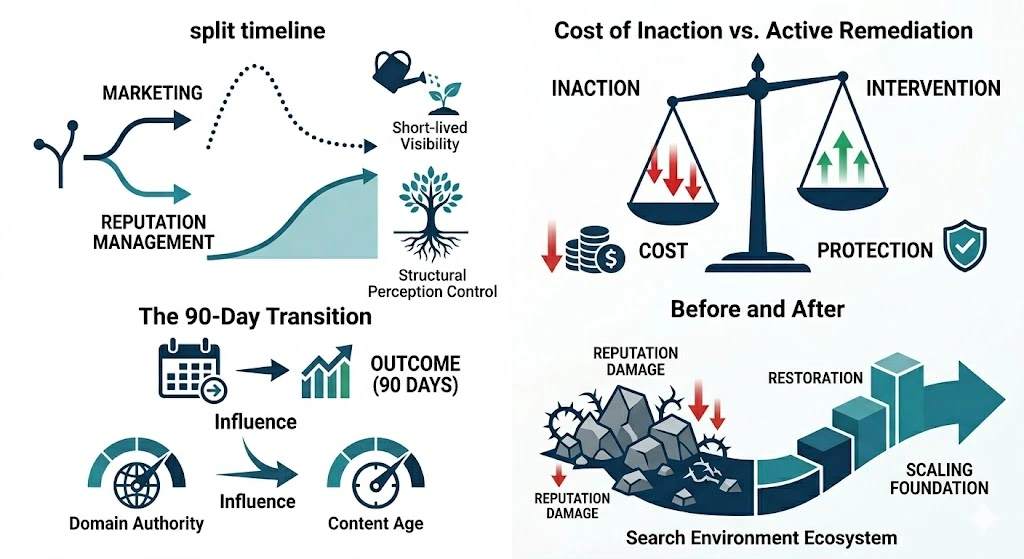
Mitigating long-term operational risk through continuous asset reinforcement
Maintaining a clean digital profile requires continuous reinforcement of your corporate asset network to prevent historical negative content from resurfacing during algorithm updates. Search engine algorithms undergo frequent core reconfigurations, which can inadvertently elevate older content if your primary assets lack dynamic authority. A continuous optimization strategy keeps your brand properties updated with fresh, semantically rich data, ensuring they retain their dominant positions regardless of algorithmic adjustments. This persistent defense creates an enduring competitive advantage, insulating your corporate identity from unexpected digital shifts.
Measurable outcomes of an enterprise reputation strategy
A data-driven reputation framework delivers clear performance indicators that allow corporate boards to verify the precise efficacy of their investment. The deployment consistently secures explicit, measurable outcomes:
- Delivers absolute SERP ownership by controlling over eighty percent of first-page search assets for core corporate search terms.
- Ensures message uniformity across all external digital channels, aligning public perception with actual corporate values and performance.
- Improves corporate valuation by presenting a clean, risk-mitigated digital profile to potential investors, auditors, and acquisition partners.
- Reduces vulnerability to defamation by creating an active, high-authority digital shield that neutralizes unauthorized negative narratives automatically.
Securing a resilient digital reputation requires decisive, programmatic intervention within the search ecosystem rather than passive public relations statements. UK companies must treat search engine results pages as the definitive benchmark of consumer trust and corporate credibility. By deploying advanced negative content suppression and entity optimization, businesses permanently eliminate revenue-draining digital signals and establish total narrative control. Clear My Name delivers the exact technical expertise, process clarity, and outcome certainty required to protect your enterprise identity and ensure sustained commercial growth.
Frequently Asked Questions
How long does a professional reputation management service take to show results?
The timeline for a professional reputation management service depends on the authority of the websites hosting the negative links and the strength of your existing digital assets. Initial search perception influence and negative content suppression milestones typically materialize within 30 to 90 days. Achieving permanent SERP control and full entity credibility across the UK search ecosystem requires sustained optimization over several months.
Can a company completely delete negative search results from Google?
A business cannot directly delete third-party search results unless the hosting website removes the page or the content violates legal guidelines, such as copyright laws or GDPR. Instead, an agency like Clear My Name utilizes strategic negative content suppression to systematically demote harmful URLs off the first page of search engine results. This process replaces damaging links with controlled, high-authority corporate assets to permanently stabilize public perception.
What is the difference between PR and business reputation management?
Public relations focuses on generating positive media coverage and managing brand communications through press releases and traditional marketing channels. In contrast, corporate reputation management for business optimizes the actual search engine ecosystem by targeting algorithmic evaluation criteria and entity credibility. It actively builds an technical barrier on the SERP to protect companies from hostile search signals, revenue risk, and competitor attacks.
How do online reviews affect a business entity’s search engine visibility?
Online reviews serve as critical reputation signals that directly influence search engine knowledge graphs and brand authority metrics. Consistently poor or unverified feedback lowers your overall entity credibility, which can cause search algorithms to reduce the visibility of your primary corporate properties. Implementing a rigorous search perception influence framework ensures that positive customer validation outweighs negative digital noise to protect inbound pipelines.
Why should UK companies invest in proactive reputation signaling?
Proactive reputation signaling allows UK enterprises to secure absolute narrative control before an unexpected digital crisis or competitor attack occurs. Establishing robust, high-authority digital assets prevents unverified negative content from easily scaling to the top of search engine results pages. By maintaining strong entity credibility ahead of time, organizations significantly reduce long-term operational risk and maintain lower customer acquisition costs.