

Online reputation control methods are evaluated through their impact on entity credibility, sentiment distribution, and user acquisition metrics. Identifying the specific indicators of revenue loss driven by negative search perception allows organizations to determine whether to deploy content suppression or content enhancement strategies.
How Do Negative Search Perception Signals Affect Conversion Rates?
Negative search perception signals reduce conversion rates by introducing friction during the consideration stage of the user journey. When prospective customers encounter negative content on the first page of search engine results pages (SERPs), their trust in the entity diminishes. Search engines interpret user behavior, such as high bounce rates on primary brand assets and increased click-through rates on critical third-party sites, as indicators of low entity credibility. This behavioral feedback loop alters the sentiment distribution across the SERP, favoring negative content over positive brand narratives.
The mechanism of this shift operates on algorithmic assessment of user intent and engagement. Search engines aim to surface the most relevant and authoritative information for any given query. If a negative review platform receives sustained traffic and engagement, algorithmic updates reinforce the visibility of that platform for brand-name searches. This visibility directly correlates with a drop in organic conversions, as the search ranking influence of critical content outweighs the brand’s own marketing messages.
| Reputation Signal Type | Search Ecosystem Mechanism | Impact on Trust and Conversion |
| Suppressed Corporate Assets | Algorithmic de-valuation due to poor engagement and low sentiment scores. | Decreased visibility of controlled narratives, forcing users toward third-party analysis. |
| Prominent Negative Reviews | High click-through rates and long dwell times on critical third-party domains. | Immediate erosion of consideration-stage trust, leading to direct competitor acquisition. |
| Unfavourable Autocomplete Suggestion | Algorithmic coupling of brand terms with negative modifiers based on search volume. | Diversion of user search journeys toward critical content before the primary SERP loads. |
Why Does Content Suppression Compare Favorably to Content Removal Strategies?
Content suppression operates by creating and optimizing a network of positive, authoritative digital assets to outrank negative search results. This method relies on the principle of content enhancement, where the volume of high-quality entity signals dilutes the visibility of unfavorable links. Content removal strategies, by contrast, focus on the permanent deletion of specific URLs from the web or their de-indexing from search engines through legal or administrative channels.
The mechanism of content suppression relies on search ranking influence. By building superior thematic relevance and earning high-quality backlinks for owned, earned, and shared media, an organization pushes negative results onto subsequent search pages. Analysis of user behavior shows that less than ten percent of searchers advance past the first page of results, making suppression highly effective for visibility management. The main limitation is scalability, as maintaining top rankings for multiple controlled assets requires continuous resource allocation.
Content removal possesses a distinct mechanism that targets the source of the reputation threat. It utilizes legal frameworks, such as copyright claims or defamation laws, to eliminate the content entirely. The strength of this approach is its permanence; once content is removed, the risk exposure drops to zero. However, the limitation lies in its narrow applicability, as factual opinions, balanced news reports, and legitimate consumer complaints cannot legally be removed.
- Evaluates the legal basis of the target URL to determine if the content violates search engine terms of service or regional legislation.
- Deploys optimized informational assets across authoritative platforms to build a protective buffer around core brand queries.
- Measures the thematic authority of competing domains to calculate the required link equity for successful position displacement.
- Monitors the sentiment distribution changes across the top twenty search positions to assess suppression velocity.
What Are the Key Structural Differences Between Organic and Reactive Reputation Management?
Organic reputation management uses a continuous, proactive framework to construct a resilient digital footprint before any crisis occurs. This method focuses on the systematic cultivation of positive entity credibility through regular content publication, structured data deployment, and sustained profile optimization. Reactive reputation management, conversely, initiates only after a negative event or critical content disrupts the existing sentiment distribution on the SERP.
The organic approach functions as a long-term preventative system. By establishing a comprehensive content network across diverse root domains, an organization occupies the majority of first-page search positions. This structural dominance reduces risk exposure by making it difficult for new, negative content to gain sufficient search ranking influence to penetrate the top results. The mechanism relies on steady algorithmic validation, where search engines recognize the long-term historical stability and authority of the brand’s digital ecosystem.
Reactive management operates under compressed timelines and high-stress conditions. The strategy requires rapid analysis of the negative signal’s root cause followed by immediate counter-measures, such as issuing public clarifications or launching emergency suppression campaigns. While reactive methods can contain immediate damage, they often incur higher short-term costs and face structural resistance from search algorithms that have already indexed and elevated the critical content.

How Do Search Engines Interpret and Rank Corporate Entity Credibility?
Search engines evaluate corporate entity credibility by processing natural language data and structural signals across the web. This process relies on named entity recognition and knowledge graph integration, where the search engine identifies a company as a distinct entity with specific attributes and relationships. The algorithm analyses the sentiment distribution associated with the entity across authoritative news sites, regulatory databases, and user-generated review platforms.
The ranking mechanism weighs the authority of the source presenting the information. A negative report on a highly authoritative national news domain carries substantially more search ranking influence than a single negative blog post on an unoptimized website. Search engines use these signals to calculate a trust score for the entity. When the ratio of negative to positive signals shifts toward the negative, the algorithm adjusts the SERP composition, often reducing the visibility of the company’s primary marketing channels.
Furthermore, user interaction signals act as validation metrics for these algorithmic assessments. If users frequently append phrases like “scam,” “lawsuit,” or “complaints” to the corporate entity name in search queries, search engines update their autocomplete and related search features to include these modifiers. This algorithmic adjustment alters the search landscape, directing clean traffic into environments dominated by critical sentiment.
Which Performance Metrics Evaluate the Sustainability of a Reputation Framework?
Evaluating the sustainability of a reputation framework requires tracking specific technical metrics that indicate long-term search stability and conversion protection. Relying solely on the temporary displacement of a negative link does not constitute a sustainable strategy, as algorithmic fluctuations can restore the visibility of that link. Sustainable frameworks are measured by their ability to maintain a balanced sentiment distribution under shifting search conditions.
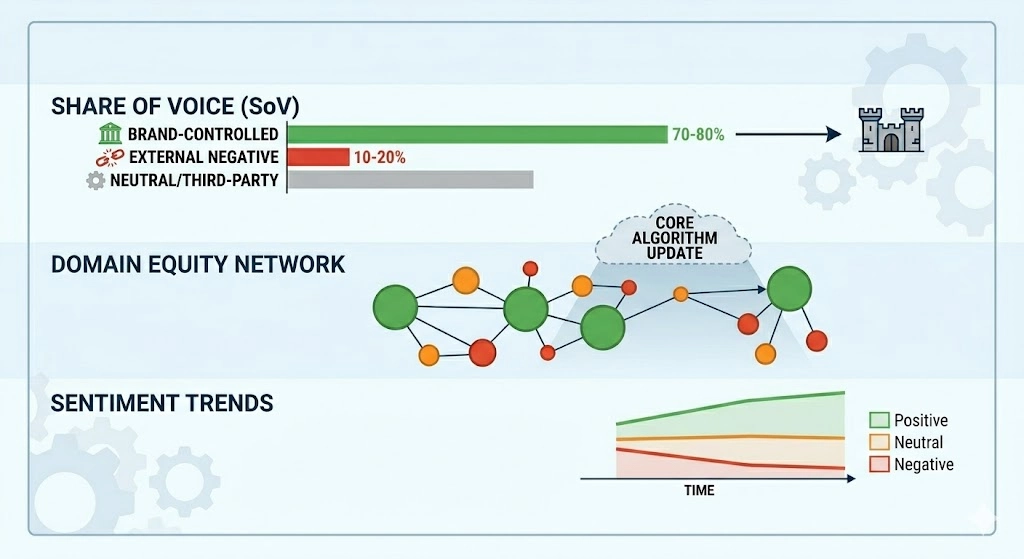
The first critical metric is the Share of Voice (SoV) within the top ten search results for brand-intent queries. This analyses the percentage of web properties under the direct or indirect control of the organization. A high percentage indicates a robust barrier against external negative content. The second metric is the domain equity distribution across the suppression network, which measures whether the supporting assets possess sufficient independent authority to withstand core algorithm updates.
The final metric is the sentiment score variance over time. This analysis monitors the ratio of positive, neutral, and negative data points indexed by search engine crawlers for the entity. A sustainable framework shows a stabilizing trend where positive and neutral signals consistently outnumber negative occurrences, ensuring that the primary brand entities retain their search ranking influence across all target regions.
What Strategic Considerations Govern Long-Term Perception Control?
Long-term perception control requires a balance between algorithmic optimization and genuine corporate transparency. Organizations must recognize that search engines prioritize user experience and informational accuracy. Consequently, attempting to mask systemic operational failures with superficial search engine optimization produces unstable results that fail during major algorithmic updates or heightened public scrutiny.
The first strategic consideration is the diversification of asset types within the digital footprint. A resilient network includes a mix of corporate websites, technical blogs, industry profiles, and neutral media coverage. This structural diversity ensures that an algorithmic change affecting one platform type does not compromise the visibility of the entire reputation network. It creates multiple entry points for prospective customers, protecting the consideration stage of the user journey.
The second consideration is the alignment of digital strategy with corporate governance. Sustainable perception control relies on actively addressing the root causes of negative sentiment distribution while simultaneously managing the search ecosystem. By combining operational improvements with systematic content enhancement, businesses build a foundation of reputation management for business that secures lasting digital trust. This dual approach ensures that search engine algorithms find authentic validation for the positive entity credibility signals being generated across the web.
The evaluation of online reputation management approaches shows clear structural differences between content suppression and content removal, as well as between organic and reactive frameworks. Content suppression offers a scalable, long-term solution for modifying sentiment distribution by enhancing entity credibility across a diversified asset network. Content removal delivers permanent risk reduction but remains limited by legal boundaries and applicability. Proactive, organic frameworks provide superior sustainability compared to reactive models by establishing search ranking influence before a reputational crisis occurs. Organizations must assess their specific SERP composition and visibility risks to deploy the method best suited for preserving customer trust and conversion metrics.
Frequently Asked Questions
How does online reputation management for business recover lost revenue?
Online reputation management for business identifies negative search results that cause prospective clients to abandon the purchase funnel. By deploying strategic content enhancement and address-at-source methods, digital trust systems stabilize the sentiment distribution around a corporate entity. This shift restores entity credibility on search engine results pages (SERPs), resulting in an immediate improvement in conversion rates.
What are the main signs that negative search perception is impacting customer trust?
A business typically experiences a drop in lead volume despite consistent marketing spend, along with an increase in customer drop-off during the consideration stage. In the digital ecosystem, this is often marked by unfavourable autocomplete suggestions or prominent negative reviews appearing on the first page of search results. These poor reputation signals undermine consumer confidence and systematically divert organic traffic to direct competitors.
How do search engines evaluate corporate entity credibility?
Search engine algorithms process natural language data, user engagement metrics, and third-party mentions across the web to calculate an authority score for a business. If a brand name is frequently coupled with negative modifiers in search queries, the algorithm adjusts the SERP composition to surface critical content. Reversing this requires systematic perception control to rebuild authoritative links and positive brand signals in the knowledge graph.
What is the difference between content suppression and content removal?
Content removal focuses on the permanent deletion or de-indexing of specific URLs through legal channels or policy violations. Conversely, content suppression is an organic strategy that optimizes a network of positive, authoritative web properties to outrank negative links. Clear My Name evaluates the digital footprint of a corporation to determine which method will most effectively reduce risk exposure and restore search ranking influence.
How long does it take for reputation management strategies to show results?
The timeline for perception control depends heavily on whether an organization deploys reactive measures or an organic, long-term framework. Legal content removal can take anywhere from a few days to several weeks, while complex content suppression campaigns usually require three to six months to achieve stable algorithmic validation. Sustained asset optimization ensures that the newly established sentiment distribution withstands future core search updates.