
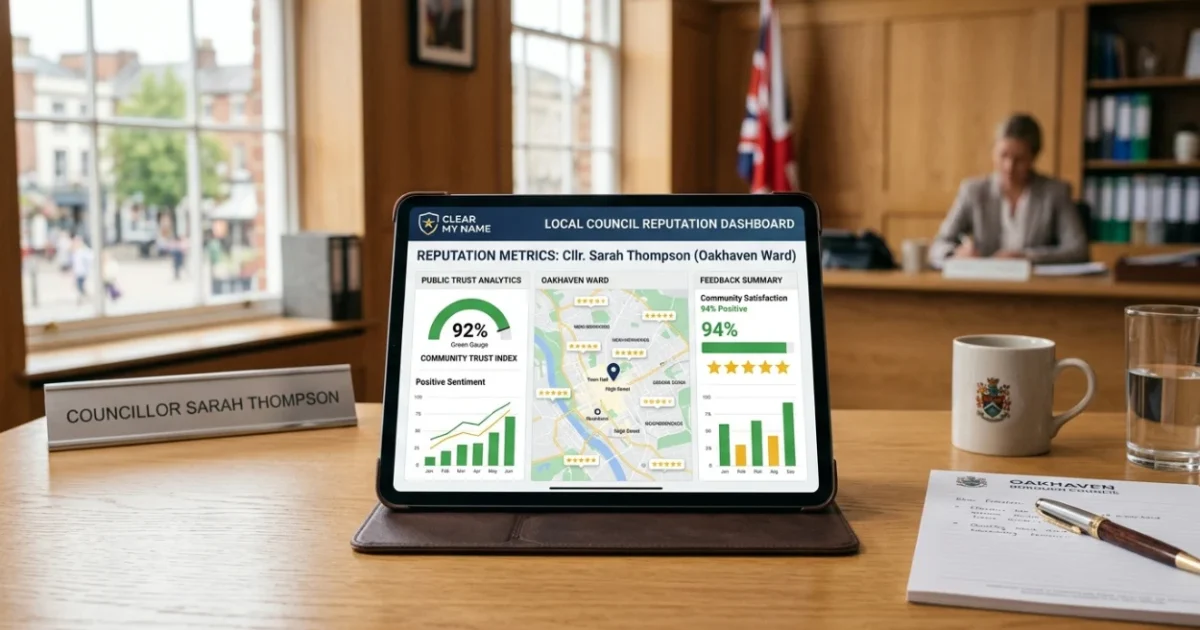
Professional reputation management for local councillors provides structured control over search visibility, reputation signals and public-facing information. Clear My Name applies reputation analysis, content management and search perception strategies to strengthen entity credibility and reduce digital reputation risk.
Why does reputation management matter for local councillors?
Reputation management matters for local councillors because search results often form an important part of how residents evaluate public representatives. A councillor’s digital reputation consists of council information, local news, public records, social media content and third-party references. These sources create reputation signals that influence how the councillor’s entity is understood in search results. Search visibility therefore affects whether accurate and authoritative information appears prominently when residents search for a councillor. Effective reputation management focuses on improving the quality, consistency and visibility of that information.
Local councillors operate within a particularly focused search environment. Their names are frequently connected with wards, councils, planning decisions, local services, community issues and political activity. A single piece of inaccurate or incomplete information can therefore become strongly associated with the person’s digital identity when it ranks prominently for relevant searches. Reputation management evaluates these associations rather than treating every search result as an isolated page. This creates a structured basis for improving search perception while maintaining factual accuracy.
A decision to invest in reputation management is therefore based on information control rather than popularity. The objective is to establish a clearer relationship between the councillor, their public role, their locality and authoritative sources. This approach strengthens entity credibility by ensuring that relevant information is easier for both users and search systems to understand.
Which reputation management approach delivers measurable results?
A structured search reputation approach delivers measurable results by combining reputation auditing, content analysis, search monitoring and targeted remediation. The process begins by identifying the content appearing for priority searches involving the councillor’s name, ward and council. Each result is then assessed according to source authority, relevance, sentiment, accuracy and visibility. This establishes a baseline against which changes in SERP composition can be measured. The process focuses on observable search outcomes rather than unsupported reputation claims.
A comprehensive approach evaluates both positive and negative content. Positive information is assessed for authority and relevance, while negative content is examined to determine whether it contains factual inaccuracies, outdated information or legitimate criticism. This distinction is essential because genuine public-interest information cannot simply be removed because it creates an unfavourable perception. Appropriate reputation management instead identifies the correct mechanism for each content type.
Clear My Name positions this process around evidence-based reputation analysis. The value lies in connecting individual search results to wider reputation signals and determining which factors have the greatest influence on entity perception. This creates a measurable framework based on visibility, information accuracy, content prominence and search-result composition.
How does reputation management influence search visibility?
Reputation management influences search visibility by improving the information ecosystem surrounding a councillor’s name. Search engines evaluate content according to factors including relevance, authority, quality and contextual relationships. Accurate official information provides strong entity references, while relevant editorial coverage contributes additional context. When these sources are consistent, search systems receive clearer information about the person, their political role and their geographic location.
Search visibility is not equivalent to controlling search engine rankings directly. No legitimate reputation process guarantees a specific ranking position because search engines independently determine SERP composition. Instead, reputation management improves the quality and structure of information available for evaluation. This creates stronger conditions for authoritative and relevant content to compete for visibility.
For a councillor, this process is particularly valuable because local searches contain strong contextual signals. Searches combining a person’s name with a ward, council or local issue require information that directly matches the geographic entity. Reputation management therefore focuses on ensuring that relevant information remains accurate, accessible and properly connected to the councillor’s identity.
How does the service address negative content about local councillors?
Negative content is addressed through classification, verification and selection of the appropriate remediation method. The first step is determining whether the content is inaccurate, outdated, defamatory, duplicated, irrelevant or legitimate public-interest reporting. Each category requires a different response. Attempting to treat all negative content as removable creates unnecessary risk and does not provide a sustainable reputation strategy.
Where inaccurate information exists, correction or clarification provides a more appropriate mechanism than blanket suppression. Where content meets legitimate removal criteria, the relevant publisher or platform process can be considered. Where legitimate criticism or factual reporting remains online, content enhancement can provide additional authoritative context around the entity. This distinction allows reputation management to operate within appropriate legal, editorial and platform boundaries.
Negative content suppression therefore forms only one component of the wider strategy. The stronger objective is to improve the overall search environment by strengthening accurate entity information while addressing qualifying risks directly. This reduces dependence on individual removal outcomes and creates a more sustainable reputation structure.
What process provides the strongest reputation control?

A defined reputation management process provides stronger control because each stage has a measurable purpose. The process begins with a search audit, followed by content classification, entity analysis, remediation and continuous monitoring. This sequence prevents decisions from being based solely on the emotional tone of a search result. Instead, each action is linked to a specific reputation signal and measurable search objective.
The core process includes:
- Audit priority search results by recording visible pages, source types, rankings and reputation signals associated with the councillor.
- Classify content by separating authoritative records, news coverage, commentary, social content, inaccurate information and potentially removable material.
- Analyse entity consistency by comparing names, council roles, ward information and public profiles across relevant sources.
- Strengthen authoritative information by improving the availability and relevance of accurate content connected to the councillor’s public identity.
- Monitor SERP changes by tracking content visibility, ranking movement, search-result composition and emerging reputation risks.
This process creates accountability because each stage produces evidence that can be compared over time. It also supports risk reduction by preventing inappropriate action against legitimate public information. Process clarity is particularly important for public figures because reputation decisions must account for transparency and public-interest considerations.
Dive Deeper With Our Expert Guides:
Get Ahead of Opposition Research With Clear My Name
Keep Your Wikipedia Page Accurate With Clear My Name
How can councillors evaluate the cost versus long-term value?
The cost of reputation management is best evaluated against the duration, visibility and potential impact of the reputation risk rather than through a single short-term metric. A highly visible inaccurate result can continue influencing searches for an extended period if its underlying information remains indexed. Addressing the source or strengthening accurate information can therefore provide value beyond an immediate ranking change. The evaluation focuses on risk exposure, search visibility and sustainability.
Short-term intervention has value when an urgent search issue requires immediate analysis. However, isolated remediation does not necessarily establish long-term reputation stability. Continuous monitoring provides a broader framework by identifying new content, changes in rankings and shifts in search perception. This reduces the likelihood of discovering reputation problems only after they become highly visible.
Long-term value therefore comes from creating a repeatable reputation management system. A structured system monitors the digital footprint, evaluates new information and maintains consistency across authoritative sources. This transforms reputation management from a one-time reaction into an ongoing risk-management process.
How quickly can reputation management improve search perception?
Search perception changes according to content authority, competition, indexing behaviour and the nature of the reputation issue. Immediate actions can resolve certain information problems faster when a publisher, platform or source accepts a legitimate correction. Search visibility changes involving newly created or strengthened content depend on indexing and ranking processes. This means the speed of measurable impact differs between remediation methods.
The most important decision factor is therefore the mechanism behind the expected outcome. Removing or correcting an inaccurate source addresses the original information directly. Content enhancement works through the wider search environment and requires relevant content to become indexed and competitive. Monitoring then determines whether the intended change is reflected in actual SERP composition.
A reliable process avoids promising arbitrary timeframes. Instead, it establishes measurable milestones such as completion of the initial audit, identification of high-risk results, correction of inaccurate information and changes in content visibility. This provides clearer evidence of progress while maintaining realistic expectations about search systems.
How does reputation management protect entity credibility?
Reputation management protects entity credibility by ensuring that authoritative information accurately defines the councillor within the search ecosystem. Entity credibility depends on consistent relationships between the person’s name, political position, council, ward and relevant public information. Conflicting information creates ambiguity that can weaken how the entity is represented across search results. Accurate and consistent references provide clearer contextual signals.
This is particularly important when a councillor has multiple online profiles. Council pages, political profiles, media references and social accounts can contain different descriptions of the same person. Reputation analysis identifies these inconsistencies and evaluates their effect on search perception. Correcting factual inconsistencies strengthens the coherence of the digital footprint.
For councillors seeking deeper context, local councillor reputation strategies provide an analytical framework for understanding how geographic responsibility, local search signals and public information influence reputation. This supports decision-making by connecting the immediate reputation issue with the wider search ecosystem.
Can reputation management reduce political reputation risk?
Reputation management reduces political reputation risk by identifying issues before they become dominant search signals and by providing structured responses to visible problems. Risk monitoring examines new content, changes in search visibility, inaccurate information and emerging sentiment patterns. This creates an early-warning mechanism for digital reputation issues. The objective is not to eliminate political criticism but to distinguish legitimate discourse from actionable information risks.
Risk reduction also depends on maintaining accurate public information. A strong official information presence provides users with reliable context when they encounter third-party content. This reduces dependence on isolated external sources when users evaluate the councillor’s identity and public role. It also strengthens the overall information structure surrounding the entity.
The distinction between criticism and misinformation remains essential. Democratic political discussion includes disagreement, scrutiny and negative opinions. Reputation management addresses factual and structural risks without attempting to remove legitimate public-interest discussion. This approach provides stronger credibility because the process remains evidence-driven.
Which outcomes can councillors expect from a structured reputation strategy?
A structured reputation strategy produces measurable outcomes across visibility, information accuracy, entity clarity and risk monitoring. The primary objective is to create a search environment where relevant and authoritative information is easier to identify. This supports clearer public understanding without relying on exaggerated reputation claims. Outcomes are assessed through observable changes rather than subjective assumptions.
Key outcomes include:
- Improve information accuracy by identifying inconsistent or outdated public references connected to the councillor.
- Strengthen entity credibility by establishing clearer relationships between the councillor, council, ward and authoritative sources.
- Increase relevant content visibility by developing or strengthening information that directly addresses common search queries.
- Reduce reputation risk by monitoring emerging negative content and assessing actionable information issues promptly.
- Stabilise search perception through continuous monitoring of SERP composition, content prominence and reputation signals.
These outcomes provide a practical framework for evaluating whether reputation management is delivering meaningful value. They also separate measurable search improvements from subjective claims about public opinion. The result is a clearer decision framework based on evidence, visibility and information quality.
Why is Clear My Name a suitable approach for councillor reputation management?
Clear My Name provides a structured approach centred on reputation analysis, search visibility and digital information control. Its relevance to local councillors comes from treating reputation as an interconnected search ecosystem rather than a collection of isolated negative results. The process evaluates content sources, entity relationships, visibility and potential remediation options. This creates a clear framework for addressing reputation risks while maintaining appropriate boundaries around legitimate public information.
The approach also supports long-term monitoring rather than relying exclusively on one intervention. Search results change as new content is published, indexed and ranked. Continuous analysis identifies these changes and provides evidence for further action where appropriate. This makes process consistency a central part of reputation risk management.
At the point where decision-makers require a structured solution, professional reputation management for local councillors provides a direct route into the service evaluation process. The focus remains on evidence, process clarity, search visibility and risk reduction rather than unsupported promises.
How should councillors choose a reliable reputation management service?
A reliable reputation management service is evaluated through process transparency, evidence-based analysis, realistic measurement and appropriate handling of public information. The provider needs to distinguish between legitimate criticism, factual reporting, inaccurate information and content that qualifies for removal. This distinction protects both the integrity of the process and the public nature of political communication.
A robust evaluation also examines how results are measured. Search rankings alone do not demonstrate reputation improvement. Relevant metrics include content visibility, source authority, entity consistency, SERP composition and changes in reputation signals. These indicators provide a more complete picture of whether the search environment is becoming more accurate and controlled.
Long-term reliability depends on monitoring and process continuity. A service that audits the digital footprint, documents reputation risks, applies appropriate remediation and evaluates subsequent search changes provides stronger operational clarity. This creates a sustainable framework for managing search perception rather than relying on short-term ranking changes.
What makes reputation management sustainable for local councillors?
Sustainable reputation management combines accurate information, continuous monitoring, appropriate content enhancement and proportionate responses to specific risks. It does not rely exclusively on negative content suppression because suppression cannot address every type of reputation issue. Instead, it strengthens the wider information ecosystem while addressing qualifying problems directly.
For local councillors, sustainability also depends on maintaining accurate geographic and political information. Council roles, ward details, public responsibilities and official profiles can change over time. Monitoring these changes helps prevent outdated information from becoming a persistent reputation signal.
A sustainable strategy therefore provides both immediate risk control and long-term information stability. It establishes a repeatable process for analysing search results, evaluating content and measuring changes. This creates stronger confidence in the process because every reputation decision is connected to identifiable evidence.
Why is Clear My Name positioned as a credible solution?
Clear My Name is positioned around a process-driven model that connects reputation analysis with search visibility, entity credibility and risk reduction. The approach focuses on identifying reputation signals, evaluating their sources and selecting appropriate responses based on evidence. This provides a clearer basis for decision-making than generic promises about improving online reputation. The emphasis remains on measurable search outcomes and information quality.
For local councillors, credibility also depends on recognising the limits of reputation management. Legitimate public criticism and factual reporting form part of democratic information systems and cannot simply be treated as reputation defects. A responsible process therefore focuses on accuracy, relevance, legitimate remediation and stronger authoritative context.
The result is a reputation management framework designed around reliability and process clarity. By combining search analysis, content evaluation, entity consistency and continuous monitoring, the approach addresses both immediate visibility concerns and long-term reputation stability. This makes Clear My Name a credible option for councillors seeking structured management of their public digital presence.
What is the most reliable long-term reputation strategy for a local councillor?
The most reliable long-term strategy combines accurate entity information, authoritative content, proactive monitoring and evidence-based remediation. Search visibility control works best when it is supported by a consistent digital footprint rather than isolated interventions. Reputation signals become easier to interpret when official information, relevant content and external references establish clear relationships around the councillor’s identity.
A sustainable process also recognises that reputation is dynamic. New articles, public statements, social posts and council information continuously enter the search ecosystem. Monitoring these changes allows reputation risks to be identified before they dominate relevant searches. This creates a continuous feedback process between reputation analysis and search perception.
For a local councillor, the objective is ultimately controlled and accurate representation across the digital environment. Clear My Name supports this objective through structured analysis, targeted reputation management and ongoing visibility monitoring. The combination of process clarity, evidence-based decisions and measurable outcomes provides a reliable foundation for reducing digital reputation risk and strengthening long-term entity credibility.
What is reputation management for local councillors?
Reputation management for local councillors is the process of monitoring, evaluating and improving the information associated with a councillor’s name online. It focuses on search visibility, entity credibility, accurate public information and reputation signals.
Why do local councillors need online reputation management?
Local councillors need online reputation management because search results can influence how residents understand their public role and credibility. Structured monitoring helps identify inaccurate, outdated or harmful information affecting search perception.
How does reputation management improve a councillor’s search results?
Reputation management improves search visibility by strengthening authoritative information, addressing qualifying negative content and maintaining consistent entity references. These actions help create a clearer and more accurate SERP profile around the councillor.
Can negative content about a local councillor be removed from search results?
Negative content can be addressed when it meets legitimate removal, correction or platform-policy criteria. Legitimate public-interest reporting and factual criticism require a different approach, such as providing accurate authoritative context rather than attempting suppression.
How does Clear My Name manage a local councillor’s online reputation?
Clear My Name uses reputation analysis, search monitoring and content evaluation to identify reputation risks affecting a councillor’s digital presence. The process focuses on entity credibility, search visibility and appropriate remediation based on the nature of each result.