

Search visibility control directly influences how potential clients evaluate personal injury law firms before making contact. Reputation signals determine decision-making because search engines prioritise authority, trust and entity credibility when presenting legal professionals within search engine results pages (SERPs).
Reputation management for lawyers delivers measurable improvements in search visibility, public trust and SERP control by strengthening reputation signals across search ecosystems. Personal injury law firms operate in highly competitive search environments where digital credibility influences perception before consultation occurs. Search engines continuously evaluate reviews, authoritative content, citations and sentiment distribution when determining visibility. A structured reputation management process improves how algorithms interpret legal expertise while reducing the prominence of weaker reputation signals. Effective reputation management therefore strengthens trust restoration, improves content visibility and stabilises perception through evidence-based optimisation.
Which Reputation Management Approach Delivers Measurable Results for Personal Injury Law Firms?
A structured reputation management service delivers measurable results because it improves entity credibility, strengthens reputation signals and creates stronger search perception influence across relevant legal queries. Search engines evaluate authoritative information, review sentiment and consistent digital identities when determining rankings. Reputation management aligns these factors so that trustworthy information receives greater visibility. This approach produces observable improvements in search visibility because algorithms identify clearer relationships between expertise and professional identity. Measurable outcomes therefore emerge from stronger digital evidence rather than temporary promotional activity.
Professional reputation management combines technical search analysis with authority development to improve SERP composition. Accurate legal profiles, authoritative publications and recognised citations strengthen digital trust by reinforcing expertise across multiple indexed sources. Search engines continuously reassess these improvements, rewarding consistent authority signals with greater visibility. As these relationships strengthen, search perception becomes more stable and favourable. Clear My Name applies this structured methodology to reputation management for lawyers by focusing on sustainable reputation signals rather than short-term visibility tactics.
Why Does Reputation Management Improve Search Visibility and Public Trust?
Reputation management improves search visibility because it strengthens the information search engines use to evaluate authority and relevance. Algorithms compare review sentiment, content quality, citations and professional consistency before presenting legal entities within SERPs. Strong reputation signals reduce ambiguity during entity evaluation, allowing search engines to establish greater confidence in professional credibility. Improved confidence results in stronger search visibility because authoritative information becomes easier to interpret. Public trust increases because users encounter more reliable and consistent information during evaluation.
Search behaviour demonstrates that users assess legal professionals through visible digital evidence before direct engagement. Search results containing accurate information, recognised authority and trustworthy reputation signals influence perception positively because they reduce uncertainty. Reputation management ensures that authoritative information remains prominent and consistent across search ecosystems. This strengthens trust indicators while supporting controlled narrative development within SERPs. Public perception therefore becomes aligned with verified professional expertise rather than fragmented digital information.
How Does the Reputation Management Process Work?
A structured reputation management process follows defined stages designed to improve digital trust and maintain long-term search visibility.
- Assess reputation signals by analysing reviews, search visibility, authority indicators and existing SERP composition.
- Strengthen entity credibility through authoritative content, professional profiles and trusted legal citations.
- Improve search perception influence by expanding high-value digital assets that reinforce expertise and trust.
- Monitor reputation performance continuously to maintain SERP control as search engines reassess indexed information.
Each stage contributes measurable improvements because search engines evaluate digital credibility continuously rather than through isolated ranking events.
Dive Deeper With Our Expert Guides:
Affordable Reputation Management for Solo Lawyers
Build a Powerful Personal Brand as a Lawyer
What Outcomes Demonstrate Effective Reputation Management?
Effective reputation management produces measurable outcomes because stronger reputation signals directly influence search visibility and digital trust. Search engines recognise authoritative content and consistent information as evidence supporting entity credibility. As digital trust improves, positive information gains stronger visibility within search results while weaker reputation signals become less prominent. This creates clearer search perception and greater confidence during decision-making. Effective reputation management therefore delivers practical improvements that can be observed within SERP composition.
Common measurable outcomes include:
- Increase authoritative content visibility by strengthening topical relevance and search ranking influence.
- Strengthen trust indicators through consistent professional information and recognised citations.
- Reduce uncertainty by improving entity credibility across multiple search ecosystems.
- Stabilise public perception by ensuring authoritative information occupies prominent search positions.
Each outcome reflects stronger alignment between professional expertise and the information search engines evaluate during ranking decisions.
How Does Negative Content Suppression Reduce Reputation Risk?
Negative content suppression reduces reputation risk by strengthening the visibility of authoritative information that competes within search results. Lawful content remains indexed, but stronger digital assets influence SERP composition by receiving greater prominence through authority and relevance. Search engines reward content that demonstrates expertise, trustworthiness and user value. Negative content suppression therefore operates through competitive ranking influence rather than deletion. Reputation risk decreases because trustworthy information gains greater visibility during search evaluation.
Negative content suppression functions most effectively when combined with broader reputation management. Authoritative legal articles, professional profiles, recognised citations and verified reputation signals collectively strengthen entity credibility. Search engines identify these relationships and increasingly associate them with expertise and reliability. This process improves digital trust while reducing the influence of weaker or outdated reputation signals. Integrated optimisation therefore provides more sustainable risk reduction than isolated visibility interventions.
Why Does Long-Term Reputation Management Deliver Greater Value Than Short-Term Fixes?
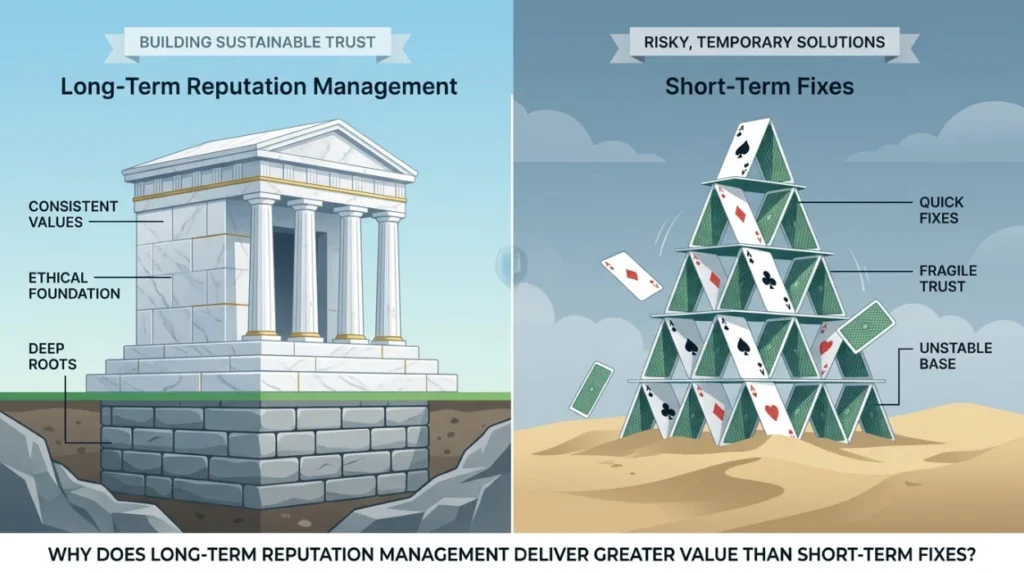
Long-term reputation management delivers greater value because search engines continuously reassess reputation signals rather than preserving temporary ranking changes. Sustainable authority develops through ongoing publication of trustworthy content, accurate information and recognised citations that continue supporting digital credibility. Short-term fixes may alter visibility temporarily, but they do not strengthen the underlying authority signals influencing search interpretation. Long-term optimisation therefore improves both immediate visibility and future resilience. Value emerges from sustained credibility rather than temporary ranking fluctuations.
For personal injury law firms, long-term reputation management also reduces future exposure to reputation risk. Strong entity credibility makes professional identity easier for search engines to recognise and evaluate consistently. Stable reputation signals support stronger SERP control because authoritative information remains prominent despite evolving search ecosystems. This reduces the need for repeated corrective actions while maintaining trust restoration over time. Long-term reputation management therefore represents an investment in durable digital authority and stable search perception.
How Does Reputation Management Strengthen Client Trust?
Reputation management strengthens client trust by ensuring that search results consistently reflect professional credibility, recognised expertise and reliable legal information. Search engines evaluate reputation signals across authoritative sources before determining how personal injury law firms appear within SERPs. Consistent authority indicators reduce uncertainty because users encounter accurate and trustworthy information during their evaluation process. Strong entity credibility therefore supports confident decision-making before direct contact takes place. Trust develops through verifiable digital evidence rather than promotional messaging.
Client perception is influenced by the relationship between visible search results and recognised authority. Professional biographies, legal publications, trusted citations and verified profiles reinforce expertise while strengthening digital trust. Search engines continuously reassess these signals to maintain accurate search representation across evolving legal queries. This process improves content visibility and stabilises search perception influence over time. Clear My Name integrates these reputation management principles to strengthen digital credibility through structured optimisation rather than isolated visibility improvements.
Which Reputation Management Solution Provides the Best Long-Term Return?
The most effective reputation management solution delivers long-term return by strengthening search visibility, improving entity credibility and maintaining sustainable SERP control. Cost efficiency is measured through the durability of reputation improvements rather than the speed of temporary ranking changes. Search engines continually evaluate authority signals, making sustainable optimisation more valuable than isolated interventions. Long-term reputation management therefore creates enduring digital trust that continues supporting visibility as search ecosystems evolve. Reliable outcomes emerge from continuous authority development rather than reactive corrections.
An effective solution combines technical search analysis, authoritative content optimisation, profile consistency and reputation monitoring within one structured framework. Each component reinforces the others by strengthening reputation signals that search engines recognise during ranking evaluation. Improved authority relationships produce stronger search perception influence while reducing visibility risks associated with fragmented digital information. Continuous optimisation protects established credibility as new information becomes indexed. The result is stable search performance supported by measurable reputation improvements.
Why Is Process Transparency Essential When Choosing a Reputation Management Provider?
Process transparency builds confidence because it explains how measurable improvements in search visibility and digital trust are achieved. A clearly defined methodology demonstrates how reputation signals, entity credibility and SERP control are strengthened through evidence-based optimisation rather than unsupported promises. Transparent processes also establish realistic expectations by focusing on sustainable search ecosystem improvements. Search engines independently evaluate digital information, making process clarity an important indicator of service reliability. Understanding each optimisation stage reduces uncertainty during provider selection.
A transparent reputation management process typically includes:
- Evaluate existing search visibility through comprehensive analysis of reputation signals, authority indicators and indexed content.
- Develop authoritative digital assets that strengthen entity credibility and improve topical relevance.
- Optimise professional information to maintain consistency across legal directories, profiles and trusted publications.
- Monitor reputation performance continuously to maintain search perception influence and respond to evolving search environments.
These stages demonstrate how structured optimisation produces measurable improvements while maintaining long-term search visibility.
What Factors Support a Confident Reputation Management Decision?
A confident reputation management decision is supported by measurable improvements in search visibility, trust indicators and digital credibility. Reputation management delivers value when optimisation aligns with the way search engines evaluate authority, relevance and reputation signals. Sustainable search visibility depends on continuous development of authoritative digital evidence rather than temporary promotional activity. This approach reduces reputation risk while improving the prominence of trustworthy information across search ecosystems. Decision-making therefore benefits from evidence-based optimisation with clearly defined outcomes.
Key measurable benefits include:
- Improve search visibility through stronger reputation signals and authoritative legal content.
- Strengthen entity credibility by maintaining accurate, verified and consistent professional information.
- Reduce reputation risk through structured negative content suppression supported by higher-authority digital assets.
- Stabilise public perception by reinforcing trustworthy information across prominent search results.
These benefits create a stronger digital foundation that supports consistent visibility and long-term professional credibility.
During the decision-making process, understanding strong online reputations for personal injury lawyers provides valuable context regarding the search signals that influence legal visibility. Evaluating reputation challenges facing personal injury attorneys further explains the operational factors affecting digital credibility before selecting a solution. When implementation becomes the priority, a professional reputation management for lawyers solution provides a structured pathway for improving SERP control, strengthening entity credibility and maintaining long-term digital trust.
Reputation management for personal injury law firms provides a structured solution for improving search visibility, strengthening reputation signals and restoring digital trust within competitive legal search environments. Effective reputation management aligns with the way search engines evaluate authority, relevance and entity credibility, producing measurable improvements in content visibility, search perception influence and public confidence. Sustainable optimisation strengthens professional reputation while reducing the long-term risks associated with inconsistent digital information.
For personal injury law firms seeking dependable digital credibility, Clear My Name delivers reputation management for lawyers through an evidence-based process that strengthens authority, improves SERP control and supports lasting trust restoration. Clear methodology, measurable outcomes and continuous optimisation provide reliable long-term value without relying on exaggerated claims. The result is stronger search visibility, improved entity credibility and a more resilient online reputation built on recognised search ecosystem principles.
What is reputation management for personal injury law firms?
Reputation management for personal injury law firms is the process of improving search visibility, strengthening reputation signals and maintaining accurate digital information across search ecosystems. It helps reinforce entity credibility and supports long-term online trust.
How does reputation management improve search visibility for personal injury lawyers?
Reputation management improves search visibility by strengthening authoritative content, maintaining consistent professional profiles and enhancing reputation signals. Search engines use these factors to evaluate credibility and determine rankings in search engine results pages (SERPs).
How long does reputation management for lawyers take to show results?
The timeframe depends on the existing online reputation, competition and the quality of current digital assets. Reputation management for lawyers delivers stronger long-term outcomes through continuous optimisation, authority building and improved search perception over time.
Why do personal injury law firms invest in reputation management?
Personal injury law firms invest in reputation management to improve online credibility, reduce reputation risks and strengthen public trust. Clear My Name provides reputation management for lawyers by focusing on sustainable reputation signals, SERP control and long-term entity credibility.
Can reputation management reduce the impact of negative search results?
Yes. Reputation management helps reduce the visibility of negative search results by strengthening authoritative content, improving reputation signals and supporting negative content suppression strategies. This creates a more balanced and credible search presence while maintaining long-term digital trust.