

Taking down revenge content requires matching the removal method to the content type, platform rules, legal basis and level of search visibility. The most effective approach distinguishes direct removal from search suppression, content enhancement and longer-term reputation management strategies.
Reputation management strategies differ based on whether the objective is to remove the source material, reduce its accessibility, or improve the surrounding search environment. Online reputation control methods are evaluated through their effect on content visibility, reputation signals, entity credibility and SERP composition. Revenge content can include private photographs, videos, messages, accusations, personal information, reviews or reposted screenshots. Each format creates a different removal pathway because platforms apply different policies to privacy, harassment, intimate imagery, copyright and personal information. A structured evaluation therefore begins with identifying where the content exists and determining which mechanism directly addresses it.
Which Revenge Content Removal Method Is Most Effective?
Direct platform removal is generally the most targeted method when the content clearly violates a platform’s rules or an applicable legal right. Removal operates by eliminating or restricting access to the original publication rather than attempting to influence the visibility of competing search results. This approach provides a direct reduction in source-level visibility because users can no longer access the material through the affected URL once removal is successful. Its effectiveness depends on the evidence supporting the report and the specific policy applicable to the content. Platform removal therefore has a strong direct impact but limited usefulness when the same material exists across multiple websites.
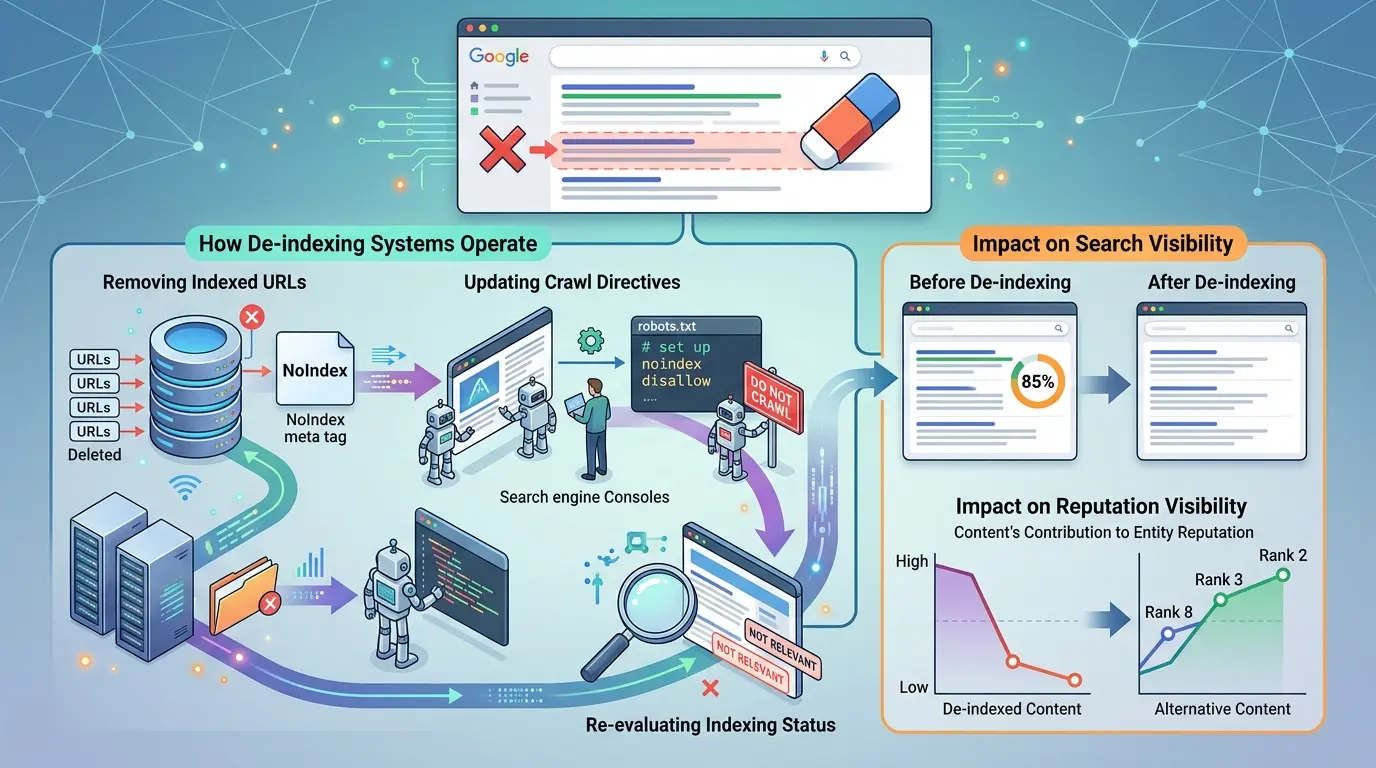
Search de-indexing represents a different mechanism because it affects search visibility rather than necessarily removing the source page. A search engine can sometimes remove qualifying results from particular searches while the underlying webpage remains accessible elsewhere. This distinction matters because de-indexing reduces discoverability but does not necessarily eliminate the content from the internet. Direct removal therefore provides stronger source control, while de-indexing provides narrower search-result control.
Content suppression and content enhancement operate further away from the original source. Suppression seeks to reduce the prominence of negative pages by strengthening the visibility of more relevant and authoritative information, while enhancement develops accurate content that provides stronger contextual signals about the individual. These approaches do not remove the revenge material and therefore carry different risk profiles. Their value becomes greater when direct removal is unavailable or when duplicated content has created a broader SERP problem.
How Do Platform Removal and Search De-Indexing Compare?
Platform removal addresses the source, while search de-indexing addresses its discoverability through a particular search engine. This distinction makes platform removal more comprehensive at the URL level because successful enforcement can prevent ordinary users from accessing the material through the platform itself. De-indexing instead changes the search pathway without necessarily changing the source webpage. A page that disappears from a search engine can therefore remain available through direct URLs, other search engines, social platforms or external references. The two mechanisms consequently solve different parts of the same visibility problem.
The evidence requirements also differ between the approaches. Platform reporting typically depends on demonstrating a policy violation such as non-consensual intimate imagery, privacy infringement, harassment or another prohibited form of content. Search removal mechanisms often depend on specific legal, privacy or policy criteria and can apply only to particular queries or jurisdictions. The strength of either approach therefore depends on the relationship between the content and the relevant rule rather than the reputational harm alone. A negative statement that is offensive or damaging does not automatically qualify for removal.
From a search visibility perspective, successful de-indexing can produce a rapid reduction in exposure for the affected query. However, the original content remains part of the wider digital footprint when it continues to exist elsewhere. Platform removal can therefore reduce both source accessibility and downstream redistribution opportunities when the original publication acts as the source for copies. Evaluating both methods requires measuring source availability, indexed URLs and remaining references rather than relying on a single ranking position.
Is Content Removal More Effective Than Content Suppression?
Content removal is more direct because it targets the existence or accessibility of the problematic material. Content suppression operates by changing the relative visibility of competing pages within the SERP rather than deleting the negative result. Removal therefore addresses the underlying source, while suppression addresses the search environment surrounding it. The distinction is particularly important when the content qualifies for a legitimate removal process. Where removal does not apply, suppression becomes an alternative search-visibility mechanism rather than an equivalent substitute.
Suppression depends on the strength of competing content and the authority of the pages occupying relevant search positions. Search engines evaluate relevance, quality, authority and other signals when determining SERP composition. Developing authoritative pages can therefore increase the number of credible results competing for identity-based searches. However, suppression does not guarantee permanent removal of a negative page because search ranking remains dynamic.
Content enhancement provides a related but distinct mechanism. It focuses on improving the quality, accuracy and completeness of information associated with the individual or entity, creating stronger contextual signals for search engines and users. Enhancement can support suppression by increasing the depth of the positive or neutral information ecosystem. Its limitation is that it requires sustained content quality and does not directly change the original revenge publication.
How Does an Organic Approach Compare With Reactive Removal?
Organic reputation management focuses on strengthening the wider information ecosystem, while reactive removal responds directly to an identified piece of problematic content. Organic strategies operate through content creation, authoritative references, profile optimisation and improved entity information. Reactive strategies operate through reporting, legal requests, platform procedures or search-engine removal mechanisms. The former influences the competitive environment around the content, while the latter targets a specific source or URL.
Organic approaches offer greater scalability when a reputation issue involves numerous search queries rather than one isolated page. A structured content ecosystem can address branded searches, professional queries and related entity terms simultaneously. However, organic activity does not automatically remove unlawful or policy-violating material. Reactive removal therefore remains more appropriate when the primary issue is content that qualifies for direct intervention.
The two approaches also differ in risk exposure. Reactive action requires accurate evidence and careful selection of the applicable removal mechanism because unsupported claims can weaken a request. Organic activity carries a different risk when content is produced primarily to manipulate rankings without providing genuine informational value. Search visibility strategies therefore require relevance, accuracy and legitimate authority rather than artificial reputation signals.
Which Strategy Produces Faster Search Visibility Changes?
Reactive removal generally produces the fastest visibility change when a platform or search engine accepts a valid request and processes the affected content. The mechanism is direct because eliminating access to a page or removing it from search results immediately changes the available SERP inventory. Timing still depends on the platform, evidence, review process and scope of the request. A successful removal therefore has a more immediate relationship with search visibility than a content-development strategy.
Organic strategies require search engines to discover, index and evaluate newly created or improved information. Ranking changes then depend on the authority and relevance of competing pages within the SERP. This creates a longer-term mechanism because new information must establish sufficient signals to compete with existing results. The approach therefore provides broader ecosystem development but does not offer the same direct pathway as successful removal.
Short-term and long-term objectives consequently require different measurements. Short-term evaluation focuses on URL accessibility, indexing status and immediate SERP changes. Long-term evaluation measures the stability of authoritative results, entity associations, sentiment distribution and the persistence of negative visibility. Comparing strategies without separating these timeframes produces an incomplete assessment of effectiveness.
How Do Reputation Signals Affect Revenge Content in Google?

Reputation signals influence how information surrounding an individual is interpreted within the search ecosystem. These signals include references, source authority, topical relevance, content quality, entity relationships and the broader distribution of information associated with a name. Search engines do not simply assign a single reputation score to an individual and rank pages according to that score. Instead, search ranking influence emerges from how individual pages satisfy retrieval and quality systems for specific queries.
A revenge page can become more visible when it strongly matches a person’s name or another identity-related query. Its visibility also depends on the authority of the hosting domain and the strength of competing pages. This means the same content can occupy different SERP positions for different searches. Evaluating reputation signals therefore requires query-level analysis rather than treating online reputation as one universal ranking factor.
Sentiment distribution provides another layer of analysis. A search ecosystem containing predominantly negative references creates a different perception environment from one containing balanced professional, neutral and positive information. Sentiment does not establish factual accuracy, but its distribution affects what users encounter when evaluating an individual. Content enhancement can influence this distribution by increasing the availability of accurate and relevant information without changing the factual status of existing claims.
How Should Different Removal Strategies Be Evaluated for Risk?
Removal strategies are best evaluated through eligibility, evidence quality, scalability and downstream search impact. A useful framework separates the content itself from the mechanism available to challenge it. The evaluation can then focus on whether the material violates a platform rule, infringes a recognised right, contains personal information or falls within another legitimate removal category.
- Identify the content type by distinguishing intimate imagery, personal information, defamatory allegations, copyright-protected material, reviews, screenshots or ordinary commentary.
- Document the source by recording URLs, publication dates, account information and relevant screenshots before submitting a removal request.
- Match the mechanism by selecting the platform policy, privacy process, copyright procedure or search-engine request that corresponds to the evidence.
- Measure the outcome by checking source accessibility, indexing status, search visibility and duplicate publications after the request is processed.
This framework reduces the risk of using an unsuitable mechanism for the content. It also creates measurable criteria for comparing direct removal with search suppression and content enhancement. The most important distinction is between a strategy that changes the source and one that changes only its discoverability or competitive search environment.
Is Content Suppression Sustainable for Reposted Revenge Content?
Content suppression is more sustainable when it forms part of a broader information ecosystem rather than functioning as a single ranking intervention. Reposted revenge content creates multiple URLs, meaning that suppressing one result does not automatically address other indexed copies. A sustainable approach therefore evaluates the complete content network, including source pages, screenshots, social posts, forum discussions and secondary references. The objective is to understand how each URL contributes to the overall SERP composition.
Content enhancement supports sustainability by increasing the depth of accurate information associated with the relevant entity. Strong professional profiles, authoritative references and useful factual resources create additional legitimate information for search systems to evaluate. This does not erase negative content, but it changes the competitive environment in which that content appears. Sustainability therefore depends on maintaining relevant information rather than relying on one temporary ranking movement.
Monitoring remains essential because search results change as pages are published, updated, removed or re-evaluated. A page that loses visibility can return if its relevance or authority changes, while a new repost can introduce another indexed URL. Long-term evaluation therefore measures SERP stability, new content discovery, entity associations and changes in reputation signals. This provides a more accurate assessment than checking one result at a single point in time.
Dive Deeper With Our Expert Guides:
How to Separate Your Identity From Someone Who Shares Your Name
Clearing Dismissed or Expunged Court Records From Google
Which Approach Best Balances Removal, Suppression and Reputation Control?
The strongest strategic evaluation treats removal, suppression and content enhancement as separate mechanisms rather than competing versions of the same tactic. Removal directly targets qualifying material, de-indexing reduces search discoverability, suppression changes SERP composition and content enhancement strengthens the surrounding information ecosystem. Each approach has a different mechanism, evidence requirement, timescale and limitation. The appropriate strategy depends on the nature of the content and the specific search visibility problem.
Direct removal provides the clearest outcome when a valid policy or legal basis exists. De-indexing provides narrower control when the source remains online but qualifying search-result removal applies. Suppression and enhancement provide broader search perception influence when the problem involves multiple pages or an imbalance between negative and authoritative information. Combining mechanisms requires careful sequencing so that each action addresses a distinct stage of the information lifecycle.
The key consideration is therefore not which strategy is universally superior, but which mechanism corresponds to the specific reputation risk. A single revenge post with a clear policy violation presents a different problem from dozens of reposted screenshots appearing across search results. Evaluating source accessibility, search visibility, reputation signals, entity credibility and SERP composition provides the basis for selecting an appropriate response.
What Are the Key Differences Between Revenge Content Removal Strategies?
The principal difference between removal strategies lies in what each method changes within the digital information ecosystem. Direct removal changes source accessibility, de-indexing changes search discoverability, suppression changes relative SERP visibility and content enhancement changes the strength of surrounding information. These mechanisms therefore produce different outcomes even when they address the same underlying reputation concern. Take Down Revenge Content Fast With Clear My Name provides a focused route for addressing harmful revenge content through appropriate removal and search visibility strategies. Comparing these approaches requires measuring both immediate visibility changes and longer-term search stability.
Removal and de-indexing are primarily reactive, while content creation and enhancement are primarily organic. Reactive methods focus on an existing problem and can produce faster changes when eligibility is established. Organic methods build information gradually and provide broader coverage across identity-related searches. A balanced evaluation considers effectiveness, scalability, risk exposure and sustainability rather than treating speed as the only measure of success.
Ultimately, reputation control is an information-management problem involving multiple interconnected systems. Revenge content becomes more consequential when it is indexed, repeated, associated strongly with an entity and positioned prominently within relevant searches. Understanding the difference between source removal, search de-indexing, content suppression and content enhancement provides a clearer basis for analysing available options. The resulting strategy can then be evaluated according to measurable changes in accessibility, search visibility, trust signals and entity perception.
How can I take down revenge content posted by an ex-partner?
Start by preserving evidence, recording the URLs, and reporting the content to the platform hosting it. Depending on the material, privacy laws, harassment policies, copyright rules, or image-based abuse policies can provide grounds for removal.
Can revenge photos or videos be removed from Google Search?
Google can remove certain intimate or personal content from search results when it meets its removal criteria. Removing a result from Google does not necessarily delete the original content from the website hosting it.
What evidence is needed to report revenge content?
Keep screenshots, page URLs, publication dates, account details, messages, and any relevant ownership or consent records. Clear evidence helps platforms, search engines, or legal representatives assess the removal request.
Can an ex-partner be forced to remove revenge content?
Legal remedies depend on the circumstances, location, type of content, and applicable privacy or harassment laws. A solicitor or appropriate legal authority can explain available options when voluntary platform reporting does not resolve the issue.
How does Clear My Name help with revenge content removal?
Clear My Name can assist with identifying harmful online material and pursuing appropriate content removal or search-result de-indexing routes. The available approach depends on the platform, type of content, applicable policies, and evidence supporting the request.