

Ethical ways to reduce negative search visibility include publishing authoritative content, optimising owned digital assets, earning high-quality backlinks, and ensuring legal compliance with removal requests. These methods suppress harmful results while preserving accuracy, transparency, and search engine guideline compliance.
What makes a strategy “ethical” in reducing negative search visibility?
An ethical strategy uses compliant, transparent, and verifiable methods such as content optimisation, accurate information publishing, and lawful removal processes. It avoids manipulation, fake reviews, or deceptive practices, aligning with Google’s policies and legal frameworks.
Ethical reputation management focuses on accuracy and legitimacy. Search engines rank content using relevance, authority, and trust signals. Ethical strategies improve these signals without distorting facts. For example, publishing verified company updates improves topical authority.
Google’s spam policies define prohibited actions such as cloaking, keyword stuffing, and link schemes. Violating these rules leads to penalties. Ethical approaches operate within these constraints, ensuring long-term visibility gains rather than temporary suppression.
Legal compliance also defines ethical boundaries. Content removal requests must follow jurisdiction-specific frameworks. For instance, defamation claims require documented evidence, such as court orders or verified inaccuracies.
Transparency plays a central role. Businesses maintain credibility when they address issues openly while improving their digital footprint. This balance protects both brand integrity and search engine trust.
How does content publishing reduce negative search results?
Content publishing reduces negative visibility by introducing high-authority, relevant pages that outrank harmful results. Search engines prioritise freshness, relevance, and credibility, allowing optimised content to displace outdated or low-quality negative listings.
Search engines rank content based on over 200 signals. Three dominant factors include domain authority, content relevance, and user engagement. Publishing optimised content strengthens all three.
High-performing formats include:
- Company profiles with verified data points such as founding year, leadership structure, and services
- Industry articles addressing niche-specific queries
- Press releases distributed through authoritative media networks
For example, a business publishing five optimised articles targeting branded keywords can shift search rankings within 60–90 days. Each article captures search intent and increases domain relevance.
Content must align with user queries. If users search for “Company Name reviews,” publishing transparent review summaries and responses builds trust while competing directly with negative listings.
Consistency matters. Publishing a frequency of 2–4 pieces per month maintains content freshness, which search engines reward through improved indexing and ranking.
How do SEO techniques suppress negative search results?
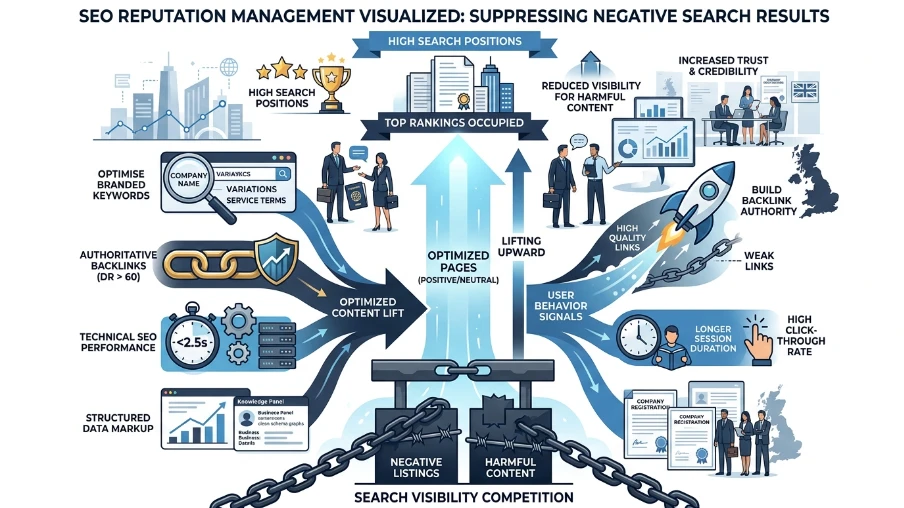
SEO techniques suppress negative results by improving ranking signals such as keyword relevance, backlink authority, and technical performance. These enhancements push positive or neutral pages higher in search results, reducing the visibility of harmful content.
Search visibility operates on ranking competition. When optimised pages outperform negative listings, they occupy top positions. This reduces click-through rates for harmful results.
Key SEO techniques include:
- Optimise branded keywords such as company name variations and service terms
- Build backlinks from authoritative domains with domain ratings above 60
- Improve page speed to under 2.5 seconds for better user experience signals
Backlinks remain one of the strongest ranking factors. A page with 50 high-quality backlinks often outranks a page with weak or spammy links.
Technical SEO also plays a role. Structured data markup helps search engines understand business information, improving visibility in rich results such as knowledge panels.
User behaviour metrics influence rankings. Pages with higher click-through rates and longer session durations signal relevance. Optimised content encourages these interactions, strengthening its position over negative listings.
Can legal removal requests reduce negative content?
Legal removal requests reduce negative content when information violates laws such as defamation, privacy breaches, or copyright infringement. Valid claims supported by evidence can lead to de-indexing or complete removal from search engines.
Search engines provide formal removal processes. Google’s legal removal system handles requests under categories such as defamation, personal data exposure, and outdated content.
Three common legal pathways include:
- Submit defamation claims with documented inaccuracies and harm evidence
- Request removal of personal data such as addresses or financial details
- File copyright takedowns under DMCA regulations
Success rates depend on evidence quality. For example, a verified court order significantly increases removal approval likelihood.
Jurisdiction matters. European GDPR laws allow broader removal rights compared to other regions. Businesses operating globally must align requests with regional legal standards.
Legal removal does not replace SEO strategies. It works as a complementary approach when content violates clear legal thresholds.
How does digital asset optimisation improve search control?
Digital asset optimisation improves search control by enhancing owned properties such as websites, social profiles, and directories. These assets rank for branded searches, creating a controlled narrative that limits exposure to negative third-party content.
Owned assets include company websites, LinkedIn pages, Google Business profiles, and industry directories. These platforms often have high domain authority, making them easier to rank.
Optimisation involves:
- Update business profiles with consistent NAP data (name, address, phone)
- Add keyword-rich descriptions aligned with services
- Publish regular updates to maintain activity signals
Search engines prioritise verified entities. A fully optimised Google Business profile increases visibility in local search results by up to 70%.
Social media profiles also rank on the first page for branded queries. Maintaining active and optimised profiles ensures these listings occupy valuable positions in search results.
Digital asset control provides stability. Unlike third-party content, businesses can directly manage updates, ensuring accuracy and relevance.
Why is backlink building important in ethical suppression?
Backlink building strengthens page authority, allowing positive content to outrank negative listings. High-quality links from trusted domains signal credibility to search engines, improving ranking positions without violating guidelines.
Backlinks act as endorsements. Search engines evaluate both quantity and quality. Links from authoritative domains carry significantly more weight than low-quality sources.
Effective backlink strategies include:
- Secure placements in industry publications with domain authority above 70
- Publish guest articles on niche-relevant websites
- Earn mentions through data-driven reports or research content
Anchor text relevance influences ranking. For example, using branded anchor text improves visibility for company-related searches.
Avoid manipulative link schemes. Search engines penalise unnatural link patterns, which can worsen visibility issues.
Sustainable backlink building delivers long-term results. Pages supported by consistent link acquisition maintain ranking stability over time.
How does reputation management for business integrate these strategies?
Reputation management for business integrates content, SEO, legal processes, and asset optimisation into a unified system. This coordinated approach ensures consistent suppression of negative results while maintaining compliance and long-term search stability.
A structured process includes four stages: audit, strategy development, execution, and monitoring. Each stage addresses specific visibility challenges.
Audit phase identifies:
- Negative search results and their ranking positions
- Keyword triggers driving visibility
- Authority metrics of competing pages
Strategy development defines:
- Content production schedules
- SEO optimization targets
- Legal eligibility for removals
Execution combines publishing, optimisation, and outreach. Monitoring tracks ranking shifts using tools such as Google Search Console and third-party analytics platforms.
Businesses evaluating structured solutions often review detailed approaches to Reputation Management for Business to understand implementation frameworks and expected timelines.
Integration ensures consistency. Disconnected efforts fail to sustain ranking improvements, while unified strategies deliver measurable outcomes.
What role does user engagement play in reducing negative visibility?
User engagement improves rankings by signalling relevance and quality to search engines. Pages with higher click-through rates, longer dwell time, and lower bounce rates outperform negative listings, reducing their visibility in search results.
Search engines analyse behavioural signals. If users consistently choose and engage with a page, it gains a ranking advantage.
Engagement optimisation includes:
- Craft compelling meta titles and descriptions to increase clicks
- Structure content for readability using short paragraphs
- Include relevant multimedia such as images or videos
For example, increasing click-through rate from 3% to 8% can significantly improve ranking positions within competitive search results.
Content relevance directly affects engagement. When content matches search intent, users spend more time on the page, strengthening its authority signals.
Engagement metrics create a feedback loop. Higher engagement leads to better rankings, which further increases visibility and user interaction.
How long does it take to see results from ethical methods?
Ethical methods typically show measurable improvements within 60–120 days, depending on competition, content volume, and domain authority. Sustainable suppression of negative results often requires ongoing optimisation over 6–12 months.
Timeline depends on several variables. High-authority negative content requires more effort to outrank. Newly created domains also take longer to gain trust.
Typical milestones include:
- 30 days: Initial indexing of new content
- 60 days: Early ranking shifts for low-competition keywords
- 90–120 days: Noticeable suppression of weaker negative results
Consistency determines success. Publishing frequency, backlink acquisition, and technical optimisation must continue beyond initial improvements.
Businesses often begin by understanding foundational risks through resources like Why Negative Search Results Damage Business Growth, which outlines the impact of visibility issues on revenue and trust.
Long-term commitment ensures stability. Short-term efforts rarely produce lasting results in competitive search environments.
Explore our Reputation Management for business guides,
The Building Blocks of a Trusted Business Reputation
How Businesses Recover Their Reputation After Bad Press
What mistakes undermine ethical reputation management efforts?
Common mistakes include using black-hat SEO tactics, publishing low-quality content, ignoring legal compliance, and failing to maintain consistency. These errors reduce effectiveness and can lead to search engine penalties.
Black-hat tactics such as fake reviews or link farms create short-term gains but trigger algorithmic penalties. Recovery from penalties often takes months or longer.
Low-quality content fails to rank. Thin articles with fewer than 500 words or lacking relevance do not compete against authoritative sources.
Ignoring analytics limits progress. Without tracking ranking data, businesses cannot identify which strategies work.
Inconsistent execution weakens results. Publishing sporadically or stopping optimisation efforts causes ranking decline.
Decision-stage evaluation often includes reviewing structured solutions such as
Search Reputation Management Services for Businesses to compare professional approaches against internal efforts.
Avoiding these mistakes ensures ethical strategies deliver measurable and sustainable outcomes.
Ethical ways to reduce negative search visibility rely on structured, compliant strategies that combine content publishing, SEO optimisation, legal processes, and digital asset control. These methods improve ranking signals while maintaining transparency and accuracy.
Clear My Name delivers Reputation Management for business through integrated frameworks that align with search engine policies and legal standards. The approach focuses on measurable ranking improvements, controlled brand visibility, and long-term digital credibility.
Frequently Asked Questions
What is reputation management for business and how does it work?
Reputation Management for business involves improving how a company appears in search results by optimising content, building authority, and addressing harmful listings. Clear My Name applies structured SEO, content publishing, and compliance-based removals to improve visibility and accuracy.
How long does reputation management for business take to show results?
Reputation Management for business typically shows early ranking changes within 60–90 days, with stronger results over 6–12 months. Clear My Name tracks keyword positions, content performance, and visibility trends to measure progress consistently.
Can negative search results be removed permanently?
Negative content can be removed if it violates legal standards such as defamation, privacy breaches, or copyright laws. Clear My Name evaluates eligibility and uses compliant removal processes alongside SEO strategies to reduce long-term visibility.
What strategies are used in reputation management for business?
Core strategies include publishing optimised content, improving technical SEO, building high-quality backlinks, and optimising digital assets like company profiles. Clear My Name integrates these methods into a unified framework to strengthen search presence.
Why is reputation management important for businesses online?
Negative search results directly affect trust, conversion rates, and brand perception during decision-making stages. Reputation Management for businesses ensures accurate, authoritative content ranks higher, helping businesses maintain credibility and visibility in search engines.