

Reputation equity does not transfer automatically when a senior legal partner retires because search engines associate reputation signals with identifiable entities, content, and authoritative references. The strongest approach combines structured content enhancement, accurate entity relationships, and selective content management rather than relying on a single reputation control method.
Reputation management strategies differ based on whether the objective is to remove existing information, strengthen new reputation signals, or rebalance the composition of search results. Online reputation control methods are evaluated through their effect on search visibility, entity credibility, sentiment distribution, SERP composition, risk exposure, and long-term sustainability.
How does content enhancement compare with content removal for transferring partner reputation?
Content enhancement and content removal address different reputation conditions, with enhancement building new signals while removal targets specific existing information. Content enhancement operates by creating or strengthening authoritative, relevant material associated with the new associate, including professional biographies, legal commentary, publications, institutional profiles, and accurate practice-area references. Content removal operates by addressing information that is inaccurate, unlawful, outdated, defamatory, or otherwise eligible for legitimate removal through the relevant publisher or platform. The two approaches therefore affect different parts of the information environment.
Content enhancement generally focuses on expanding the evidence available about the successor rather than altering historical information about the retiring partner. This approach can improve the successor’s entity credibility by increasing the number and quality of relevant references connected to their identity. Content removal has a narrower mechanism because its effect depends on whether specific material meets the applicable removal criteria. Removing a page also does not automatically create equivalent positive signals for the new associate. The strategic distinction is therefore between reducing unwanted visibility and increasing relevant visibility.
Which approach provides stronger search visibility: content creation or content suppression?
Content creation provides a broader mechanism for increasing search visibility because it introduces additional information that search systems can evaluate for relevance and authority. New content can establish relationships between the associate, legal practice areas, professional experience, publications, and the firm. Content suppression focuses instead on reducing the prominence of existing pages through legitimate search optimisation or addressing eligible content at its source. Its effectiveness depends heavily on the strength, relevance, and persistence of the pages being suppressed.
Search ranking influence results from the interaction between competing documents rather than from a single reputation variable. If a retiring partner has highly authoritative historical pages, creating weak or repetitive content provides limited competitive value. Conversely, suppressing one negative or outdated page does not establish a complete professional identity for the successor. A stronger evaluation therefore considers the balance between content enhancement and content suppression. The objective is to understand how each method changes the overall SERP composition rather than treating ranking movement as an isolated outcome.
How do organic and reactive reputation strategies differ?
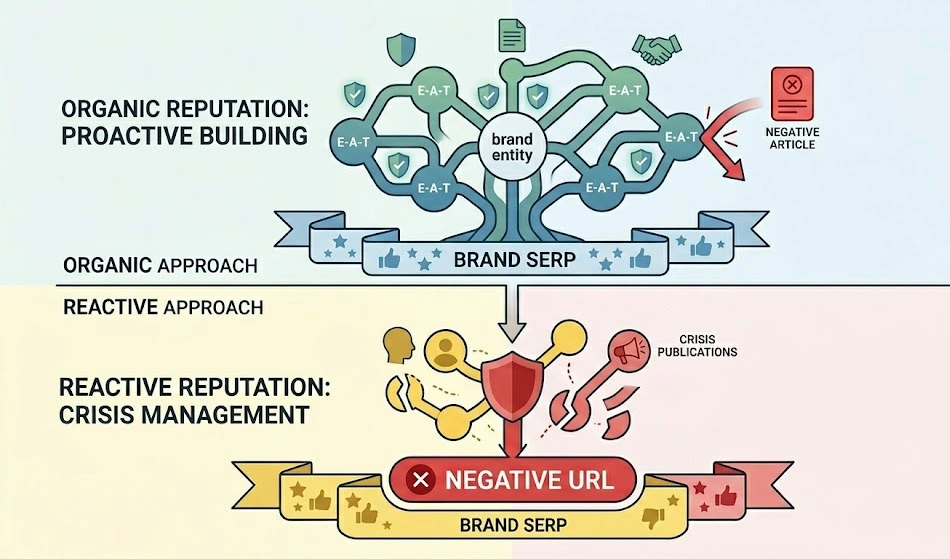
Organic reputation strategies build reputation signals progressively through consistent professional information, authoritative references, and relevant content. They operate by establishing an identifiable relationship between the new associate and the subjects for which professional credibility is required. Reactive strategies respond to existing reputation problems, such as inaccurate profiles, outdated information, misleading references, or damaging search results. Their mechanism is triggered by a defined issue rather than by the broader development of an entity footprint.
Organic approaches offer stronger continuity because they create an information base that remains relevant beyond one reputation incident. Reactive approaches provide greater precision when a specific problem requires intervention, particularly where content is demonstrably inaccurate or inappropriate. The limitation of an exclusively organic strategy is that problematic existing content remains part of the search environment while new signals develop. The limitation of an exclusively reactive strategy is that removing or challenging individual pages does not necessarily establish sufficient positive evidence for the successor.
How effective is content enhancement for building a successor’s entity credibility?
Content enhancement is effective when new material provides clear, consistent, and authoritative evidence connecting the associate with relevant legal expertise. Entity credibility develops through coherent references across professional profiles, organisational pages, legal publications, authoritative directories, and other relevant sources. Search engines use these relationships to interpret what an entity represents and which topics are associated with that entity. Consistency reduces ambiguity between the retiring partner, the law firm, and the successor.
The quality of content remains more important than simple publication volume. Repetitive pages containing limited original information provide weaker contextual evidence than substantive material that demonstrates expertise and establishes clear entity relationships. Content also requires accurate attribution so that authorship and professional identity remain distinguishable. Enhancement therefore works as an entity-building process rather than as a numerical exercise in publishing more pages. Its effectiveness is measured through stronger topical relevance, improved search visibility, and clearer representation of the successor across relevant queries.
When is content removal more appropriate than reputation enhancement?

Content removal is more appropriate when a specific page contains information that qualifies for legitimate removal, correction, de-indexing, or amendment under the relevant circumstances. Removal operates at the source or platform level and directly changes the availability of the targeted information. This provides a different mechanism from search optimisation, where the information remains available but competing pages receive stronger visibility. The distinction is important because not every undesirable result qualifies for removal.
A removal-led approach also has a limited transfer effect. Removing a retiring partner’s outdated biography, for example, does not automatically establish the new associate as the current authority for that practice area. The search ecosystem still requires independent evidence connecting the successor with the relevant topic. Removal therefore functions best as a corrective mechanism when specific content creates an identifiable information problem. Enhancement remains necessary when the broader objective involves establishing current entity credibility.
How do short-term and long-term reputation strategies compare?
Short-term strategies focus on resolving defined visibility problems, while long-term strategies build a durable information structure around the successor. Short-term interventions include correcting outdated profiles, addressing inaccurate references, improving existing pages, and responding to specific search-result problems. Their impact can be easier to measure because the target and expected change are clearly defined. Long-term strategies focus on sustained publication, authoritative references, consistent entity information, and continued development of relevant reputation signals.
The difference becomes important during partner succession because historical reputation develops over an extended period. A new associate cannot reproduce years of accumulated authority through a single content intervention. Search engines require discoverable evidence that establishes relevance and credibility across the wider information ecosystem. Long-term content enhancement therefore provides greater sustainability, while short-term interventions provide targeted control over immediate reputation issues. An effective evaluation measures both initial SERP movement and the durability of the resulting search representation.
How does SERP composition change under different reputation management methods?
SERP composition changes when the relative visibility of pages associated with different entities changes. Content enhancement introduces additional pages that compete for relevant queries, while suppression reduces the prominence or availability of selected existing results. Removal eliminates qualifying content from its original source or search index, subject to applicable policies and processes. These mechanisms influence the balance of information presented to search users.
Search engines do not evaluate a reputation as a single fixed score displayed to users. Instead, they retrieve and rank documents according to query relevance, content characteristics, authority, context, and other ranking systems. A retiring partner can therefore continue occupying prominent positions even after leaving active practice if historical pages retain strong relevance. Increasing the visibility of authoritative successor content changes the competitive environment around those queries. SERP evaluation consequently requires measuring the composition of results rather than focusing exclusively on individual rankings.
Which reputation strategy has lower risk exposure during partner succession?
A structured content enhancement strategy generally presents lower information risk when it relies on accurate, verifiable, and professionally relevant material. It builds reputation signals without requiring the alteration of legitimate historical information. Removal strategies carry greater procedural dependency because their success relies on eligibility, publisher policies, legal grounds, or platform rules. Aggressive attempts to manipulate or erase legitimate information also introduce credibility and compliance risks.
Risk exposure therefore depends on the mechanism used rather than simply on the desired outcome. Accurate entity information reduces ambiguity between a retiring partner and successor, while unsupported claims can create additional inconsistencies across the digital footprint. A controlled approach prioritises factual accuracy, transparent attribution, and legitimate optimisation. This creates a clearer distinction between reputation management and attempts to manipulate search results through artificial or misleading signals.
Dive Deeper With Our Expert Guides:
Protecting Firm Reputation During a Law Firm Merger or Rebrand
How to Distinguish Your Immigration Practice From Unlicensed Consultants Online
How scalable are reputation strategies across multiple retiring partners?
Content enhancement is more scalable when a firm has repeatable systems for creating accurate professional profiles, structured author information, authoritative references, and relevant publications. A standardised information architecture allows each new associate to establish an independent entity footprint without duplicating identical content. Removal strategies are less scalable because each target page requires individual assessment and often depends on circumstances specific to that content. Scaling removal therefore involves case-by-case evaluation rather than a consistent publishing framework.
Scalability also depends on maintaining entity consistency across the organisation. Names, professional roles, practice areas, authorship, biographies, and organisational relationships require alignment across relevant sources. Inconsistent information can weaken entity understanding and create ambiguity during the transition. A scalable reputation framework therefore combines structured content governance with targeted remediation rather than relying exclusively on reactive interventions.
How should firms evaluate whether reputation equity has transferred effectively?
Effective transfer is evaluated by comparing the digital representation of the retiring partner with the visibility and credibility of the successor across relevant search queries. The evaluation includes indexed content, authoritative references, professional profiles, sentiment distribution, entity associations, and SERP composition. It also distinguishes historical reputation signals from current professional signals so that residual visibility is not incorrectly interpreted as current authority. Measurement therefore focuses on information relationships rather than one ranking position.
A practical evaluation framework can examine four dimensions:
- Compare entity visibility across name-based and practice-area queries to identify whether the successor appears for relevant subjects.
- Measure indexed references connecting the associate with authoritative sources to assess the development of entity credibility.
- Evaluate sentiment distribution across reviews and public references to distinguish historical perceptions from current signals.
- Analyse SERP composition over time to determine whether successor content gains visibility while outdated or irrelevant results lose prominence.
These measurements distinguish genuine reputation development from temporary ranking fluctuations. They also provide a basis for evaluating sustainability, because a durable digital footprint depends on continuing authoritative references rather than a single optimisation event.
Is combining reputation enhancement and content removal more effective than using one method?
A combined strategy provides broader coverage because enhancement and removal address different mechanisms within the search ecosystem. Enhancement strengthens legitimate reputation signals associated with the new associate, while removal addresses specific information that qualifies for correction or elimination. Using both methods prevents the strategy from treating every reputation issue as either a ranking problem or a content-removal problem. The appropriate balance depends on the type, authority, accuracy, and search visibility of the information involved.
The combination also improves risk control because each intervention has a defined function. Content enhancement establishes current professional identity, while targeted removal or correction deals with information that requires direct remediation. This creates a clearer separation between building entity credibility and addressing problematic content. The resulting approach is more comprehensive than relying exclusively on suppression, removal, or publication. It also aligns reputation control with the underlying structure of search systems, where multiple documents and entities contribute to the visible SERP landscape.
Which approach best supports reputation equity transfer?
Transferring reputation equity from a retiring partner to a new associate is fundamentally an entity and information-architecture challenge rather than a simple content replacement exercise. Content enhancement builds new reputation signals, content removal addresses qualifying information at its source, organic strategies develop long-term credibility, and reactive strategies address defined problems. Each approach affects search visibility and SERP composition through a different mechanism.
The strongest evaluation therefore considers effectiveness, scalability, risk exposure, and sustainability together. A successor requires independent evidence connecting their identity with relevant expertise, while historical information about the retiring partner remains part of the existing search ecosystem. Transfer Partner Reputation to New Associates describes this transition as an information continuity problem: current professional identity must become sufficiently represented within the indexed environment while historical information is evaluated according to its accuracy, relevance, and context.
How can a retiring partner’s reputation be transferred to a new associate?
Reputation equity can be developed for a new associate through authoritative content, accurate professional profiles, relevant publications, and consistent entity references. Search engines evaluate these reputation signals separately, so professional succession does not automatically transfer individual-level credibility.
Is content creation or content removal better for transferring reputation equity?
Content creation strengthens the new associate’s digital footprint, while content removal addresses specific information that qualifies for legitimate correction or removal. The appropriate approach depends on whether the primary issue is weak search visibility or problematic existing content.
How long does it take to build a new associate’s online reputation?
Building online reputation is a cumulative process based on indexed content, authority references, topical relevance, and consistent entity information. Short-term changes can occur through targeted content improvements, while sustainable reputation development requires continued evidence across the search ecosystem.
How does SEO affect reputation transfer between retiring partners and new associates?
SEO affects reputation transfer by improving the discoverability and relevance of information associated with the new associate. Content optimisation, internal linking, authoritative references, and accurate entity information can strengthen search visibility and influence SERP composition.
What reputation signals matter when a law firm replaces a retiring partner?
Key reputation signals include authoritative publications, professional biographies, legal directory profiles, reviews, relevant third-party references, and consistent practice-area associations. These signals help search engines evaluate entity credibility and distinguish the new associate from the retiring partner.