

Podcast and webinar appearances become authority content when they are converted into structured, searchable evidence of a professional’s expertise and subject relevance. The strongest approach connects recordings, transcripts, speaker profiles, and related content so search engines can interpret consistent authority signals across the digital footprint.
Reputation management strategies differ based on whether the objective is to remove problematic information, strengthen positive information, or improve the overall balance of an entity’s search results. Online reputation control methods are evaluated through their effect on search visibility, reputation signals, entity credibility, and long-term SERP composition. For lawyers, podcast and webinar appearances represent content enhancement because they introduce additional evidence of expertise rather than attempting to eliminate existing information. Their effectiveness depends on content quality, indexing, topical relevance, attribution, and the relationship between individual content assets.
Which is more effective for authority building: content creation or content removal?
Content creation is generally the more direct mechanism for building authority because it introduces new evidence about expertise, while content removal operates by reducing the visibility or availability of specific information. Content enhancement adds indexed assets such as interviews, transcripts, speaker pages, articles, and educational resources to an entity’s digital footprint. Content removal focuses on qualifying information for deletion, de-indexing, correction, or platform-level restriction where applicable. The two approaches therefore address different reputation problems rather than performing the same function.
Content creation has a cumulative structure because each relevant asset adds another information node to the search ecosystem. A podcast transcript can establish topical relevance, while a webinar page can provide educational context and a speaker biography can reinforce professional identity. Removal has a narrower mechanism because its effect depends on whether the targeted information qualifies for a legitimate removal or restriction process. Content enhancement therefore offers broader control over the information an entity contributes to the ecosystem, while removal is dependent on external platform and search-system conditions.
The distinction between content suppression and content enhancement is particularly important. Suppression attempts to reduce the prominence or accessibility of existing information, whereas enhancement introduces stronger, relevant information into the same search environment. Authority development primarily operates through enhancement because expertise requires evidence rather than absence of negative material. The appropriate evaluation therefore depends on whether the underlying issue concerns harmful information, insufficient authority evidence, or both.
How does podcast content compare with webinar content for authority development?
Podcast content provides authority signals through discussion, expert commentary, and association with a defined subject, while webinar content provides authority signals through structured education and deeper subject coverage. A podcast episode generally centres on an interview or discussion, creating contextual evidence around the speaker’s knowledge. A webinar normally has a more formal educational structure, allowing the speaker to explain concepts, processes, legal developments, or specialist topics in greater depth. Both formats create searchable content when the associated pages and transcripts are accessible to search engines.
Podcast content often provides stronger breadth because an appearance can associate an individual with different publications, hosts, topics, and professional discussions. Webinar content often provides stronger depth because the format supports longer explanations and structured educational material. Neither format automatically creates stronger search ranking influence because ranking depends on the relevance and quality of the resulting content ecosystem. The evaluation therefore focuses on how clearly each format establishes the relationship between the professional entity and the subject.
Transcripts increase the authority value of both formats by converting audio or video discussion into indexable text. A podcast transcript captures explanations and terminology, while a webinar transcript can expose a larger body of structured expertise. Search engines can then evaluate the text against relevant queries and entity relationships. The underlying recording still provides contextual value, but accessible textual information gives indexing systems a clearer basis for interpretation.
Should organic authority building be prioritised over reactive reputation management?
Organic authority building focuses on establishing positive and relevant information before a reputation issue requires a response, while reactive reputation management addresses existing search or perception problems. Organic activity includes expert interviews, webinars, educational publishing, professional profiles, and consistent topical content. Reactive activity includes responding to inaccurate information, managing review-related issues, correcting factual discrepancies, and assessing harmful search results. The distinction concerns timing, purpose, and mechanism rather than the quality of the individual tactic.
Organic authority building has a long-term orientation because content accumulates and establishes repeated associations between an entity and its areas of expertise. A lawyer who consistently appears in educational discussions creates a broader information network around professional knowledge. Reactive management has a more immediate orientation because it addresses a defined reputation signal or search-result issue. Its effectiveness depends on the nature of the problem and the available mechanisms for correction or removal.
The two approaches operate most effectively as separate analytical categories. Organic authority building does not remove inaccurate or harmful content, and reactive management does not automatically establish professional expertise. Treating them as interchangeable creates inaccurate expectations about search ranking influence. A clear strategy therefore evaluates whether the primary requirement is authority enhancement, reputation correction, or a combination of both.
What is the difference between short-term and long-term authority content?
Short-term authority content is designed around an immediate topical opportunity, while long-term authority content contributes to a sustained network of expertise signals. A newly published webinar can generate immediate indexed information around a current legal subject. Its long-term value depends on continued accessibility, topical relevance, references, and integration with other professional content. Authority therefore develops through persistence and connectivity rather than publication alone.
Short-term content has a narrower measurement window because its initial visibility depends on current search demand and indexing conditions. Long-term content becomes part of an expanding digital footprint as additional pages reference related subjects and reinforce entity relationships. Podcast appearances can remain useful after publication when episode pages and transcripts continue to be accessible. Webinar recordings can perform a similar function when their educational value remains relevant to recurring search queries.
The key difference is sustainability. Short-term content can address a specific query or topic, while a connected authority-content system establishes recurring associations between the professional entity and a subject area. Search visibility becomes more durable when multiple relevant documents support the same entity-topic relationship. This makes long-term authority content more dependent on topical consistency than on isolated publication frequency.
How do search engines evaluate authority signals from podcasts and webinars?

Search engines evaluate authority signals through the information contained within documents and the relationships between entities, topics, and sources. A podcast page identifies a speaker, publisher, episode subject, and supporting description. A webinar page can identify speakers, educational topics, event information, recordings, and associated resources. These elements provide contextual evidence that assists search systems in understanding what the content represents and which entities are connected to it.
Content indexing determines whether publicly accessible information enters the search engine’s searchable corpus. Indexing does not guarantee prominent placement because ranking systems evaluate indexed documents against query intent and other relevance signals. A transcript with clear subject terminology gives search systems more textual information than an audio file with limited accompanying text. Structured speaker information also helps connect the content to the correct professional entity.
Authority signals therefore operate through relationships rather than isolated metrics. A single appearance identifies a topic association, while repeated appearances across relevant subjects create a broader pattern. When the same professional identity appears consistently across podcast pages, webinar recordings, biographies, and expert publications, entity credibility becomes easier to interpret. The resulting signal is contextual rather than a simple numerical authority score.
How does content enhancement affect SERP composition?
Content enhancement affects SERP composition by introducing additional relevant documents that search engines can consider for queries associated with an entity or subject. SERP composition refers to the collection and ordering of content types presented for a particular search query. New podcast pages, webinar recordings, transcripts, interviews, and expert articles expand the available information ecosystem. Their ranking positions depend on relevance, quality, authority, search intent, and competition from other documents.
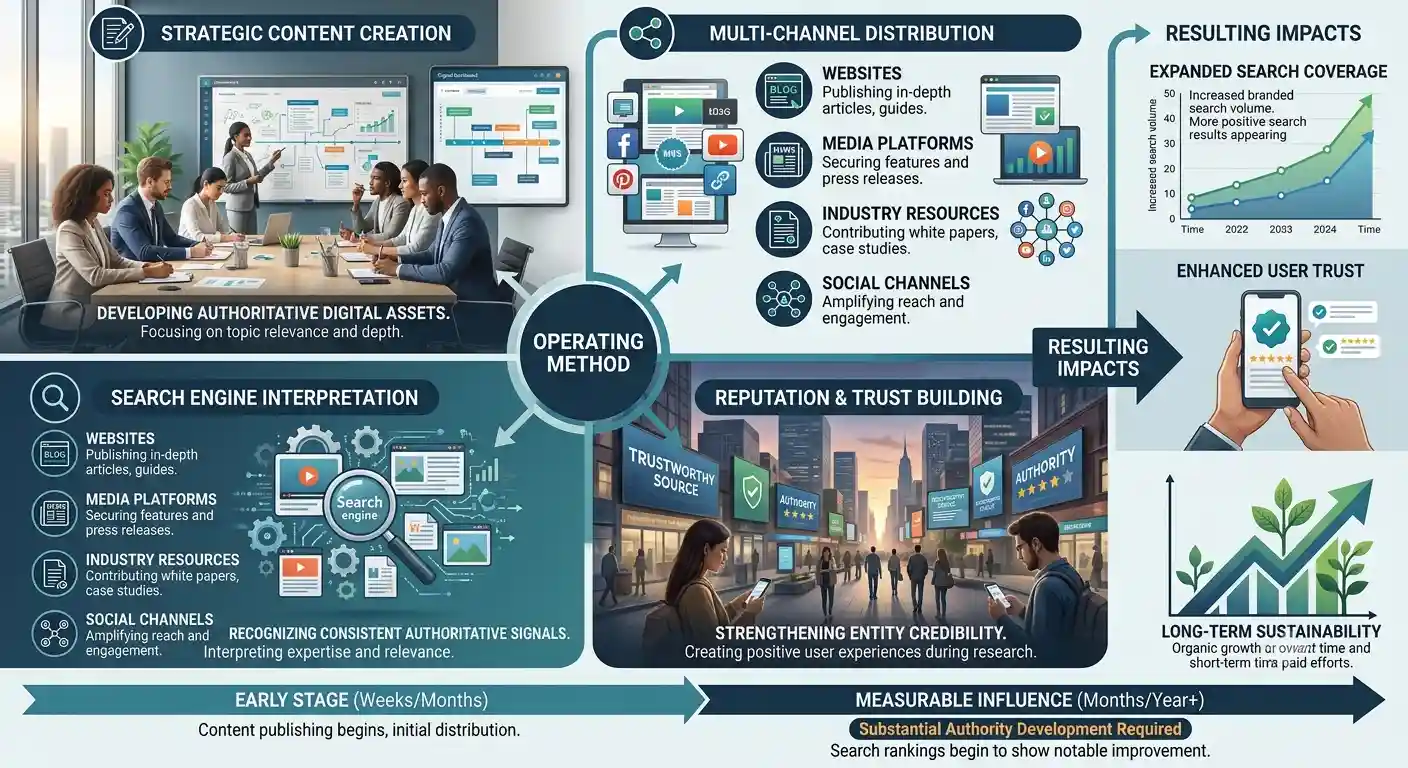
The effect is different from direct suppression. Suppression attempts to reduce the prominence or availability of an existing result, while enhancement increases the pool of potentially relevant information. When new authority content becomes indexed and gains visibility, it can occupy additional positions within relevant searches. This does not guarantee displacement of existing results because search engines independently evaluate each document.
SERP composition also reflects the diversity of content formats available for a query. A search result page can contain articles, videos, interviews, profiles, event pages, and other content types. Podcast and webinar assets therefore expand the range of formats through which a professional entity can become discoverable. The strategic value lies in creating relevant information that satisfies distinct search intents rather than producing duplicate pages with limited semantic differentiation.
How scalable is podcast and webinar authority content?
Podcast and webinar authority content is scalable when one expert appearance produces multiple connected content assets without weakening topical relevance or factual consistency. A single discussion can generate an episode page, transcript, speaker profile, topic summary, educational article, and supporting references. Each asset provides a different access point to the same expertise while maintaining a common entity relationship. Scalability therefore depends on structured repurposing rather than simply increasing publication volume.
A scalable system also requires consistent entity information. The professional name, role, qualifications, specialist areas, and subject descriptions need to remain factually aligned across derivative assets. Inconsistent information introduces entity ambiguity and weakens the relationship between documents. Quality control therefore becomes increasingly important as the number of content assets increases.
Scalability also has a risk dimension. Producing large quantities of repetitive material can reduce semantic distinctiveness and create weak content that adds limited value to the search ecosystem. Effective scaling focuses on extracting genuinely different information from the original appearance. One transcript can support multiple useful assets when each asset addresses a distinct informational purpose.
What are the risks of relying on podcast and webinar appearances for reputation building?
The primary risk is assuming that an appearance itself establishes authority without evaluating the surrounding information ecosystem. A podcast with limited contextual information provides weaker entity evidence than an episode page containing a clear biography, topic description, transcript, and relevant references. A webinar with poor attribution can create similar limitations. Authority content therefore requires accurate identification and meaningful subject context.
Another risk concerns topical inconsistency. An extensive collection of appearances covering unrelated subjects does not automatically create a coherent professional authority signal. Search systems evaluate relevance to individual queries, so disconnected topics provide weaker evidence for a specific area of expertise. A focused content network creates clearer relationships between the professional entity and defined subjects.
There is also a distinction between reputation enhancement and reputation correction. New authority content does not automatically eliminate inaccurate reviews, negative information, or disputed claims from search results. Those issues require separate evaluation based on accuracy, platform rules, search visibility, and available correction mechanisms. Combining content enhancement with unrealistic expectations about suppression creates strategic risk.
Dive Deeper With Our Expert Guides:
Aligning Your Glassdoor Employer Reviews With Client-Facing Trust
How Class Action Firms Can Manage Coordinated Online Backlash
How can authority content be measured against reputation objectives?
Authority content can be evaluated through indexing, search visibility, topical relevance, entity consistency, and the quality of associated reputation signals. Indexing establishes whether the content is discoverable by search systems, while search visibility measures its presence for relevant queries. Topical relevance evaluates whether the content clearly connects the professional entity with the intended subject. Entity consistency measures whether separate content assets accurately represent the same professional identity.
A useful evaluation framework also examines the relationship between individual assets and the wider content network:
- Measure indexing by checking whether podcast pages, webinar pages, and transcripts are discoverable in search results.
- Evaluate topical alignment by comparing the subjects discussed with the professional areas represented across the wider digital footprint.
- Analyse entity consistency by checking names, professional descriptions, biographies, and specialist terminology across connected pages.
- Assess SERP composition by examining which content types appear for relevant branded and non-branded queries.
- Compare sentiment distribution by analysing how reviews and other evaluative content contribute to the overall reputation signal.
This framework separates authority development from simple publication volume. It also distinguishes visibility from credibility because a page can rank without providing strong evidence of expertise. Measurement therefore requires both search-level and content-level analysis.
When is authority content more sustainable than reputation suppression?
Authority content is more sustainable when the objective is to establish durable evidence of expertise rather than temporarily reduce the visibility of an existing result. Suppression-based approaches depend on the continued ranking behaviour of other pages and the availability of legitimate mechanisms for reducing prominence. Authority content operates by continually adding relevant information to the entity’s digital footprint. Its sustainability comes from the accumulation of connected, useful, and consistently attributed content.
Sustainability also depends on maintenance. Outdated webinar descriptions, broken recording pages, inconsistent biographies, or inaccessible transcripts reduce the continuing value of older authority assets. Regular evaluation preserves the relationship between the professional entity and the content network. This creates a distinction between content publication and reputation infrastructure.
The most important strategic consideration is therefore the problem being solved. Content creation addresses information scarcity and authority representation, while removal and suppression strategies address specific problematic information. Organic authority building creates long-term evidence, while reactive management responds to defined reputation risks. Podcast and webinar appearances are most valuable when evaluated as components of a wider digital trust system rather than as isolated promotional achievements.
For a more detailed examination of this authority-building approach, see Turn Podcast and Webinar Appearances Into Authority.
Turning podcast and webinar appearances into authority content involves more than publishing recordings or mentioning professional expertise. Content creation and content removal operate through different mechanisms: enhancement adds relevant evidence to the digital footprint, while removal or suppression addresses specific existing information. Podcast content generally provides discussion-based authority signals, whereas webinars provide structured educational evidence. Transcripts strengthen both formats by converting spoken expertise into indexable text.
Organic and reactive reputation management also serve different purposes. Organic authority building establishes durable associations between an entity and specialist subjects, while reactive management addresses existing reputation signals and search-result risks. Short-term content can support immediate topical visibility, but long-term authority depends on consistent information, sustained accessibility, and connected content assets. Scalability depends on structured repurposing without sacrificing semantic relevance or factual accuracy.
The central evaluation principle is to measure authority content through its effect on entity credibility, search visibility, SERP composition, indexing, and reputation signals. Podcast and webinar appearances provide useful source material, but their authority value emerges from the information network built around them. A sustainable reputation ecosystem therefore prioritises relevance, consistency, accessibility, and clear entity relationships rather than relying on publication volume or isolated ranking outcomes.
How can podcast appearances be turned into authority content?
Podcast appearances become authority content when recordings are supported by transcripts, expert profiles, topic summaries, and relevant indexed pages. This creates additional reputation signals connecting professional expertise with specific subjects.
Are webinars effective for building online authority?
Webinars provide structured educational content that demonstrates subject knowledge and creates searchable evidence of professional expertise. Recordings, transcripts, speaker pages, and event descriptions can strengthen a professional digital footprint.
What is the difference between content enhancement and content removal?
Content enhancement adds relevant, authoritative information to an entity’s digital footprint, while content removal focuses on reducing or eliminating specific existing information where legitimate mechanisms apply. The two approaches address different reputation management objectives.
Do podcast transcripts improve search visibility?
Podcast transcripts convert spoken discussions into indexable text, giving search engines more information about the speaker, subject, and expertise discussed. This can strengthen topical relevance and support search visibility for related queries.
How does podcast content affect online reputation?
Podcast content contributes to online reputation by associating a professional entity with defined subjects, expertise, and third-party discussions. When accurately attributed and consistently presented, these appearances become supporting reputation signals within the wider digital footprint.