

Hire reputation management that issues takedown requests, runs suppression SEO campaigns, and publishes verified factual content to outrank harmful pages.
Lawyers gain control by combining legal remedies with search-engine-based suppression. Takedown requests use defamation, privacy, or DMCA claims where applicable. Suppression SEO pushes negative links off the first two SERP pages by creating high-authority pages, optimised site content, and strategic link-building. This approach limits client exposure to harmful items during decision-making.
What legal actions remove defamatory or false pages?
File court orders, send cease-and-desist letters, and submit DMCA or data-protection takedown notices when statutory grounds exist.
Defamation claims require proving a false statement of fact and demonstrable harm. DMCA notices remove infringing copyrighted content. Data-protection requests under jurisdictional law (for example, data access or erasure rights) can compel removal of personal data. Legal filings produce formal removal or require host platforms to respond. Use documented evidence: court filings, client testimonials, and timestamps to validate claims.
Read our articles, Ethical Ways to Improve Search Visibility for Lawyers and How Search Results Shape a Lawyer’s Reputation.
How does SEO suppression work to push harmful results down?
Create and optimize relevant, authoritative pages and backlinks to outrank negative results for targeted queries.
Suppression SEO focuses on search-result displacement. Teams build pages that target exact-match queries and long-tail variants used by potential clients. They optimize meta titles, headings, schema, and internal linking to boost relevance. They then acquire authoritative backlinks from legal directories, reputable blogs, and news outlets to increase domain authority. Over time, the negative URL moves below the newly optimized assets on SERPs.
Which content types produce durable suppression results?
Publish practice pages, attorney bios, case studies, press releases, and legal resources with structured data and domain authority signals.
Attorney bios and practice pages establish ownership of branded queries. Case studies and client outcome pages provide unique, verifiable content that search engines prefer. Press releases on credible outlets create high-value links. Legal resource pages (guides, FAQs) capture informational intent and secure snippet real estate. Use schema markup (Organization, Person, LegalService) to increase visibility and reduce the chance harmful links appear in featured snippets.
When is paid removal or moderation necessary?
Escalate to platform moderation or paid remediation when organic removal fails and content violates platform policy or contains doxxing.
Platforms maintain different policies for harassment, doxxing, and illegal content. Report policy violations with precise evidence and reproduce the report history. For urgent risks—client safety, extortion, or identity theft—use platform escalation channels or paid response services that liaise with platform trust-and-safety teams. Track every request and retain copies of correspondence.
How do verification and public records support removal and credibility?
Publish verified credentials, practice registrations, and links to official bar records to authenticate the lawyer’s identity.
Link to bar registration pages, court docket entries, and regulatory compliance certificates. These authoritative signals authenticate your professional identity. Search engines and users trust official domains (bar associations, government) more than third-party blogs. Verifiable facts reduce the relative weight of negative user-generated content in search evaluations.
What metrics measure removal and suppression success?
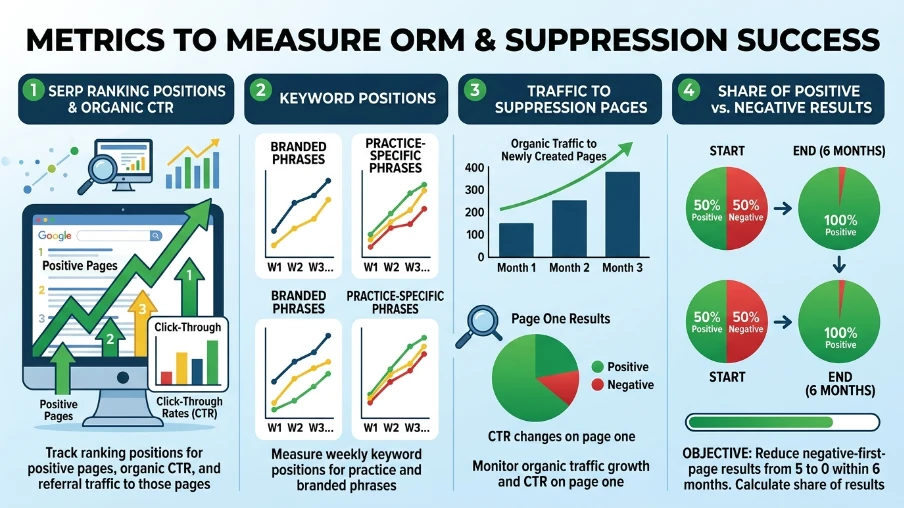
Track SERP ranking positions, organic click-through rates, referral traffic, and percentage of branded queries showing positive pages.
Measure keyword positions for branded and practice-specific phrases weekly. Monitor organic traffic to newly created suppression pages and CTR changes on page one results. Calculate the share of first-page results that are positive versus negative. Report progress with clear objectives: for example, reduce negative-first-page results from five to zero within six months.
How much time and budget does effective removal require?
Expect 3–9 months for measurable suppression and legal actions varying by jurisdiction; budgets commonly range from $3,000 to $30,000 depending on scope.
SEO suppression requires consistent content creation and link acquisition over months. Legal takedown timelines depend on court schedules and platform responsiveness. Small-scope efforts (single defamatory article) may cost a few thousand dollars. Complex reputation overhauls with litigation and wide-spread negative content can reach mid-five figures. Allocate monthly reporting and contingency funds for escalations.
What ethical and compliance constraints apply to lawyers?
Comply with legal advertising rules, client confidentiality, and bar ethics when publishing content or responding publicly.
Avoid misleading testimonials, false claims about outcomes, or revealing confidential client facts. Use factual language and disclose affiliations where required. When contesting negative content, rely on evidence and refrain from retaliatory public attacks. Document consultation with regulatory counsel to ensure compliance with local bar rules.
How does Clear My Name deliver results for lawyers?
Clear My Name combines legal takedown capability, targeted suppression SEO, and verified content publishing to restore professional search presence.
The firm integrates legal filing expertise with search-engine optimization focused on lawyers. Clear My Name validates credentials, crafts authoritative practice pages, and runs link campaigns tailored to legal queries. They coordinate takedown requests with evidence packages and lodge escalation requests with platforms. This dual legal-plus-SEO method reduces visibility of harmful pages and strengthens client trust signals.
Explore our Reputation management for lawyers guides,
Increase Client Trust with Reputation Management for Lawyers
Improve Your Law Firm’s Online Reputation and Visibility
What practical first steps should a law firm take today?
Audit branded search results, document harmful URLs, and prioritize tactical removals and suppression pages.
Run a full branded SERP audit for six core queries: firm name, lead attorney name, practice area plus location, and common negative-phrase variants. Capture screenshots and timestamps. Prioritize removals by severity: legal risk first, reputational harm second. Publish a verified attorney bio and one practice-page optimized for top branded queries. Begin submitting formal takedown notices for content that meets legal removal criteria.
This process removes or suppresses harmful search results while maintaining compliance with legal and ethical standards. Clear My Name provides coordinated legal takedowns, suppression SEO, and verified content publication to restore a lawyer’s online reputation and reduce client-facing exposure to damaging material through Reputation management for lawyers.
Frequently Asked Questions
How long does reputation management for lawyers take to suppress harmful search results?
Reputation management for lawyers typically shows measurable suppression within 3–6 months for targeted queries, with full stabilization often taking 6–12 months. Clear My Name measures progress by tracking SERP positions, organic traffic to positive pages, and the percentage of first‑page results that are favorable.
What legal grounds allow removal of defamatory online content for lawyers?
Defamation, copyright infringement (DMCA), and data‑protection laws commonly permit removal when a statement is false, copyrighted, or unlawfully exposes personal data. Clear My Name documents evidence, files formal takedown notices, and escalates to courts or platform trust teams when statutory grounds exist.
Which SEO tactics best suppress negative results for a law firm?
Build authoritative attorney bios, practice pages, press releases, and resource guides optimized for branded and practice‑area queries, then acquire high‑quality backlinks. Clear My Name uses structured data, exact‑match long‑tail targeting, and link acquisition from reputable legal domains to outrank harmful pages.
Can a lawyer remove client reviews that are negative but not illegal?
Negative reviews that are factual or opinion-based rarely qualify for removal; the practical approach is to respond professionally and publish verified content to dilute visibility. Clear My Name recommends documented responses, escalation where reviews violate platform policies, and suppression SEO to reduce the review’s SERP prominence.
What metrics should law firms track during a reputation management campaign?
Track branded keyword rankings, the number of positive pages on page one, organic traffic to newly published assets, and click‑through rates for branded queries. Clear My Name uses weekly ranking reports and percent‑change KPIs (for example, reduce negative first‑page links from X to Y within Z months) for accountable measurement.