
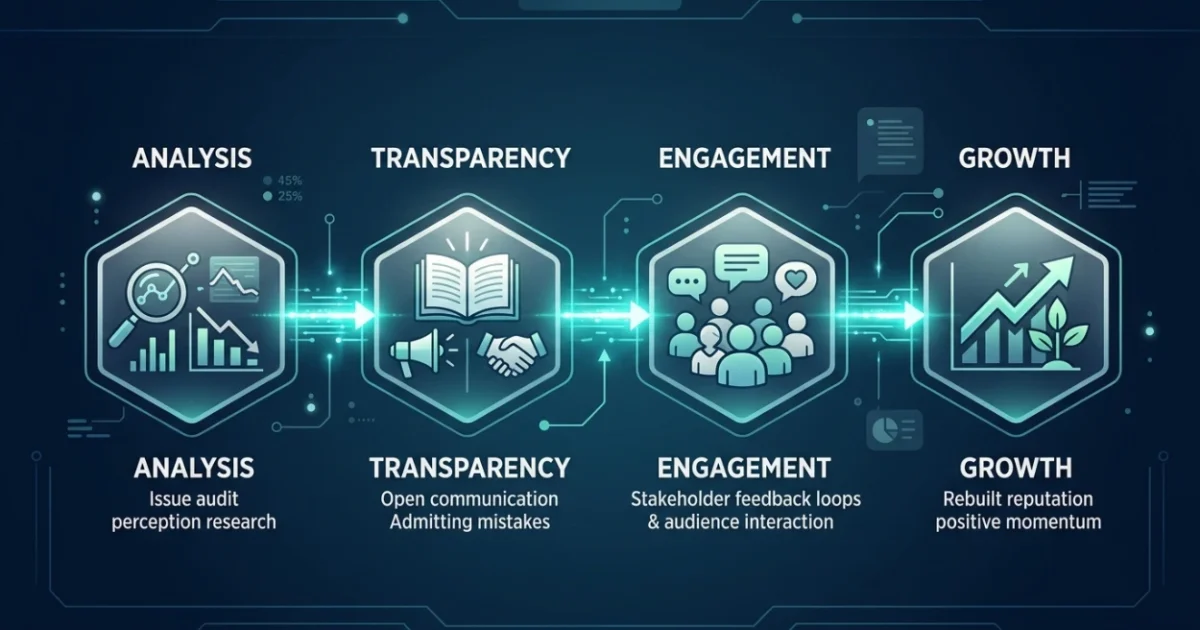
An agency reputation recovery programme includes reputation analysis, negative content assessment, SERP control, content enhancement, reputation signal monitoring and long-term search visibility management. A structured programme gives recruitment agencies a defined process for reducing negative search exposure, strengthening entity credibility and improving how candidates interpret information about the organisation.
Search visibility control matters because candidates increasingly research recruitment agencies before engaging with them, while reputation signals influence whether the information they find appears credible and consistent. Clear My Name applies a structured reputation recovery process that evaluates the search environment, identifies reputation risks and establishes measurable actions for improving digital perception.
Which reputation management approach provides the strongest recovery framework?
A structured, search-focused reputation management approach provides the strongest recovery framework because it addresses both the source of negative information and its visibility within search results. Reputation recovery is not limited to deleting an unfavourable page or publishing positive content. It requires analysis of search queries, indexed pages, source authority, sentiment distribution and the relationship between individual results and the recruitment agency entity. This process establishes which reputation signals require direct action and which require stronger competing information. The result is a controlled framework rather than a collection of disconnected reputation activities.
A professional reputation management service for recruiters evaluates these factors before selecting an intervention. Source-level removal addresses content where correction or deletion is available, while negative content suppression focuses on reducing the visibility of unwanted results through stronger relevant assets. Content enhancement strengthens existing pages by improving their usefulness, authority and relevance. Each mechanism serves a different purpose, making strategic selection essential for reliable recovery.
What does the first stage of an agency reputation recovery programme involve?
The first stage involves a comprehensive reputation and SERP assessment that establishes the current digital position of the recruitment agency. The assessment examines branded search results, review platforms, professional profiles, news references, recruitment pages and other indexed content associated with the entity. Each visible result is evaluated according to relevance, authority, sentiment, search position and potential reputation impact. This creates a baseline against which future visibility changes can be measured. It also identifies whether the principal problem concerns negative content, weak controlled assets or inconsistent entity information.
A reputation audit also separates operational reputation problems from search perception problems. An agency experiencing repeated complaints requires attention to the underlying source of those signals, while a single highly visible result requires a different search-focused response. This distinction reduces unnecessary activity and concentrates resources on measurable reputation risks. The baseline assessment therefore becomes the foundation for prioritisation, strategy selection and outcome measurement.
How does negative content assessment determine the recovery strategy?
Negative content assessment determines the recovery strategy by analysing the source, accuracy, authority, visibility and persistence of each problematic result. A negative review on a third-party platform operates differently from inaccurate information published on an agency-controlled page. Similarly, a highly authoritative article ranking for an agency name creates a different SERP challenge from an isolated low-authority comment. Assessment therefore identifies the mechanism responsible for the result before determining the appropriate response. This prevents removal, suppression and enhancement from being treated as interchangeable techniques.
The assessment also measures the relationship between negative content and branded search behaviour. A page that appears for the agency name has greater reputation relevance than content that remains disconnected from branded queries. Search perception influence increases when negative information occupies prominent positions for searches used by candidates, employers or industry stakeholders. Measuring this relationship gives the recovery programme a clear prioritisation structure. The strategy then targets the results with the greatest combination of visibility, authority and reputation significance.
Does negative content suppression improve search visibility control?
Negative content suppression improves search visibility control by strengthening relevant competing information rather than relying exclusively on deletion. Suppression operates within the search ecosystem by increasing the relevance, authority and usefulness of alternative pages that compete for the same branded queries. For example, a relevant resource such as Engineering Recruitment Salary Guide UK 2026: Rates by Discipline can serve as a stronger competing asset when it aligns with the search intent and provides useful information. Search engines determine rankings independently, so the objective is not to manipulate rankings artificially but to improve the overall quality and relevance of the information ecosystem. Stronger competing assets can occupy positions that previously exposed users to unwanted information. This changes the composition of the SERP while maintaining a legitimate information environment.
Suppression becomes particularly relevant when the original source is controlled by a third party and cannot be removed through a direct correction. The strategy then focuses on the relationship between negative content and alternative authoritative resources. Content quality, topical relevance, entity relationships and search intent all influence the competitive environment. Measurement tracks changes in ranking positions, indexed visibility and the proportion of prominent results occupied by credible information. This provides a measurable basis for evaluating SERP control.
How does content enhancement strengthen an agency’s digital credibility?
Content enhancement strengthens digital credibility by improving the quality, relevance and contextual depth of information associated with the recruitment agency. Enhanced pages provide clearer evidence about expertise, recruitment specialisms, market knowledge and organisational information. Search engines can then evaluate these pages as more useful resources for relevant queries, while candidates gain a more complete representation of the agency. The process strengthens the controlled portion of the agency’s digital footprint without depending entirely on the removal of third-party content. It therefore supports both search visibility and entity credibility.
The difference between enhancement and suppression is important at the decision stage. Enhancement improves the underlying information asset, whereas suppression focuses on its ability to compete within a particular SERP environment. An effective recovery programme uses these mechanisms according to the structure of the search results rather than applying the same technique to every problem. Stronger content also provides sustainable assets that remain useful after an individual negative result changes position. This gives content enhancement a longer-term role within reputation recovery.
How does reputation recovery restore trust signals for recruitment agencies?

Reputation recovery strengthens trust signals by improving the consistency and credibility of information encountered across relevant digital sources. Candidates assess recruitment agencies through websites, job advertisements, reviews, professional profiles and external references rather than through one isolated page. Conflicting information across these sources creates uncertainty around the entity’s credibility. A structured recovery programme therefore evaluates the complete information environment and addresses inconsistencies that affect perception. Consistency creates a clearer representation of the agency across search and recruitment channels.
Trust restoration is measured through observable changes in the digital environment rather than subjective claims. Relevant indicators include improved visibility of authoritative pages, reduced prominence of damaging results, stronger consistency across entity information and a more balanced sentiment distribution. These indicators provide evidence of progress without assuming that every negative opinion disappears. Reputation recovery focuses on improving the quality and visibility of the information environment surrounding the agency.
How should an agency measure the results of reputation recovery?
An agency should measure reputation recovery through search visibility, SERP composition, reputation signals and entity-level information consistency. Ranking position alone does not provide a complete assessment because a negative result moving from position two to position eight represents a different outcome from its complete disappearance from the first page. Measurement therefore tracks the visibility of both unwanted and controlled information across priority branded queries, including searches such as “What Makes Engineers Blacklist a Recruitment Agency? 7 Reported Causes.” Changes in review sentiment and the prominence of authoritative sources provide additional evidence. These metrics create a structured basis for evaluating whether the recovery strategy is producing measurable improvement.
A practical outcome framework includes:
- Track branded search results to measure changes in the visibility and position of negative content.
- Compare SERP composition before and after intervention to identify changes in the proportion of credible results.
- Monitor reputation signals across review and professional platforms to identify recurring sentiment patterns.
- Measure controlled content visibility to determine whether authoritative agency resources gain stronger search exposure.
- Evaluate entity consistency across digital properties to identify information gaps affecting credibility.
This measurement framework distinguishes activity from outcome. Publishing content does not automatically demonstrate reputation recovery, while measurable changes in search visibility and information consistency provide stronger evidence. Clear reporting also makes the process easier to evaluate against defined objectives and risk levels.
How quickly does an agency reputation recovery programme produce results?
The speed of reputation recovery depends on the visibility, authority and competitiveness of the negative content being addressed. A low-authority result can present a different search challenge from a highly authoritative publication with strong backlinks and established relevance. The volume of competing information and the strength of the agency’s existing digital assets also affect the recovery environment. For this reason, speed is evaluated through measurable search changes rather than an arbitrary universal timeframe. Early indicators include changes in indexing, ranking positions and visibility of targeted assets.
Fast intervention also needs to remain compatible with long-term sustainability. A short-term ranking improvement without a durable content and entity strategy provides limited protection against future reputation risks. A structured programme therefore separates immediate risk reduction from long-term reputation strengthening. This approach creates clearer expectations around what constitutes progress at each stage. The objective is controlled, measurable improvement rather than an unsupported promise of instant results.
Dive Deeper With Our Expert Guides:
How Do Tech Recruiters Build a LinkedIn Reputation Developers Trust?
How Do Tech Recruiters Push Negative Reddit Threads Down in Google?
Is reputation recovery worth the cost for a recruitment agency?
Reputation recovery represents long-term value when the cost of unresolved negative visibility affects candidate trust, employer relationships and recruitment enquiries. Recruitment agencies operate in a trust-dependent market where candidates and employers assess credibility before committing to communication or applications. A prominent negative result can therefore influence decisions beyond the original complaint or publication. Evaluating cost requires comparing the investment in reputation recovery with the potential commercial and operational risk associated with persistent negative search visibility. The assessment is strongest when linked to measurable search and reputation outcomes.
Cost also varies according to the complexity of the recovery environment. A programme addressing one controllable inaccurate page requires a different level of analysis from a programme involving multiple review platforms, persistent negative results and weak digital assets. Scope, source authority, content requirements and monitoring needs all influence resource requirements. A structured process makes these factors visible before significant activity begins. This transparency reduces financial and strategic uncertainty during reputation recovery.
How does Clear My Name provide a structured reputation recovery process?
Clear My Name approaches agency reputation recovery through a structured sequence that connects reputation analysis with search visibility management. The process begins with identifying visible reputation signals, evaluating their sources and determining their relevance to priority branded searches. It then establishes the appropriate combination of content correction, content enhancement, negative content suppression and ongoing monitoring. This creates a defined pathway from diagnosis to measurable search outcomes. Process clarity also makes each stage easier to assess against the original reputation objectives.
The value of a structured approach lies in consistency rather than volume of activity. Reputation recovery requires decisions based on source authority, search position, entity relevance and the persistence of negative information. Each intervention therefore has a defined purpose within the wider search ecosystem. This reduces the risk of applying an unsuitable method to a specific reputation problem. It also provides a clearer basis for evaluating progress and adjusting the strategy as the SERP environment changes.
How does search perception influence candidate and employer decisions?
Search perception influences candidate and employer decisions because visible search results contribute to the information environment used when evaluating a recruitment agency. Searchers often compare multiple sources, including agency websites, job advertisements, reviews and professional profiles. When credible information dominates prominent results, the entity is represented through a more consistent set of information signals. When negative or contradictory information dominates, the search environment presents a less controlled representation. Reputation recovery therefore focuses on the information available at the point where users investigate the agency.
This relationship makes search visibility control a strategic component of reputation management for recruiters. The goal is not simply to produce favourable content but to establish a credible and relevant information ecosystem around the agency entity. Search ranking influence, content quality, authority and entity relationships collectively affect which information receives visibility. Monitoring these factors provides a measurable way to assess search perception influence. The resulting strategy connects digital reputation with the actual information users encounter during decision-making.
What should an agency expect from a sustainable reputation recovery programme?
A sustainable programme delivers a combination of improved search visibility, stronger entity credibility, clearer information consistency and reduced exposure to prominent negative signals. Sustainability depends on maintaining credible digital assets rather than relying on one temporary ranking change. Continuous monitoring identifies new reputation signals before they become dominant within branded search results. Content development also provides an ongoing source of relevant information that supports the agency’s digital footprint. Together, these mechanisms create a stronger foundation for long-term reputation stability.
A sustainable recovery process therefore:
- Strengthens authoritative content to improve long-term branded search visibility.
- Monitors reputation signals to identify emerging negative sentiment and recurring complaints.
- Maintains consistent entity information across relevant digital properties.
- Evaluates SERP composition regularly to identify changes in negative-content visibility.
- Reduces risk by addressing reputation weaknesses before they become persistent search signals.
This approach connects immediate recovery with ongoing reputation protection. It also recognises that search ecosystems continuously change as new pages are published, indexed and ranked. Long-term reliability therefore comes from continuous evaluation rather than a one-time intervention.
What makes an agency reputation recovery programme reliable?
A reliable agency reputation recovery programme combines diagnosis, strategy selection, content management, SERP control and continuous measurement. Removal addresses controllable source-level problems, suppression reduces the visibility of unwanted results, and content enhancement strengthens credible information assets. These mechanisms operate differently, so effective recovery depends on matching each method to the source, authority and visibility of the reputation signal. Measurement then establishes whether the strategy improves search visibility, trust signals and entity credibility.
For recruitment agencies, reputation recovery has value because candidates and employers evaluate information across a connected search ecosystem. Clear My Name provides a structured framework for analysing this environment, prioritising reputation risks and implementing evidence-led search visibility strategies. The process focuses on measurable outcomes rather than unsupported reputation claims. This creates greater reliability, clearer decision-making and stronger control over the information associated with the recruitment agency entity.
The most dependable recovery programme is therefore one that connects every action to a defined reputation objective. Search visibility, negative content suppression, content enhancement, entity credibility and sentiment distribution can all be measured within a structured framework. This process reduces risk while establishing a sustainable foundation for stronger digital trust and search perception.
What is an agency reputation recovery programme?
An agency reputation recovery programme is a structured process for identifying, assessing, and addressing negative online content affecting an organisation’s reputation. It may include reputation monitoring, content assessment, search result analysis, and strategies for improving the overall online perception of the organisation.
What does an agency reputation recovery programme include?
An agency reputation recovery programme typically includes an online reputation audit, negative content analysis, search engine results assessment, reputation monitoring, and a recovery strategy. The exact steps depend on the type, visibility, and source of the reputational issue.
How does an agency reputation recovery programme work?
The process usually begins by identifying harmful or inaccurate content and assessing how prominently it appears online. The agency then develops appropriate reputation management actions, monitors search results, and evaluates changes over time.
How long does reputation recovery take for an agency?
The timeframe varies depending on the amount and visibility of negative content, the authority of the websites involved, and the actions available to address it. Some reputation recovery efforts can show progress within weeks, while more complex cases may require several months of ongoing monitoring and optimisation.
Can an agency reputation recovery programme remove negative search results?
In some cases, negative content may be eligible for removal when it violates a platform’s policies, contains inaccurate information, or meets applicable legal criteria. Where removal is not possible, reputation recovery may focus on improving the visibility of accurate, relevant, and trustworthy content.