
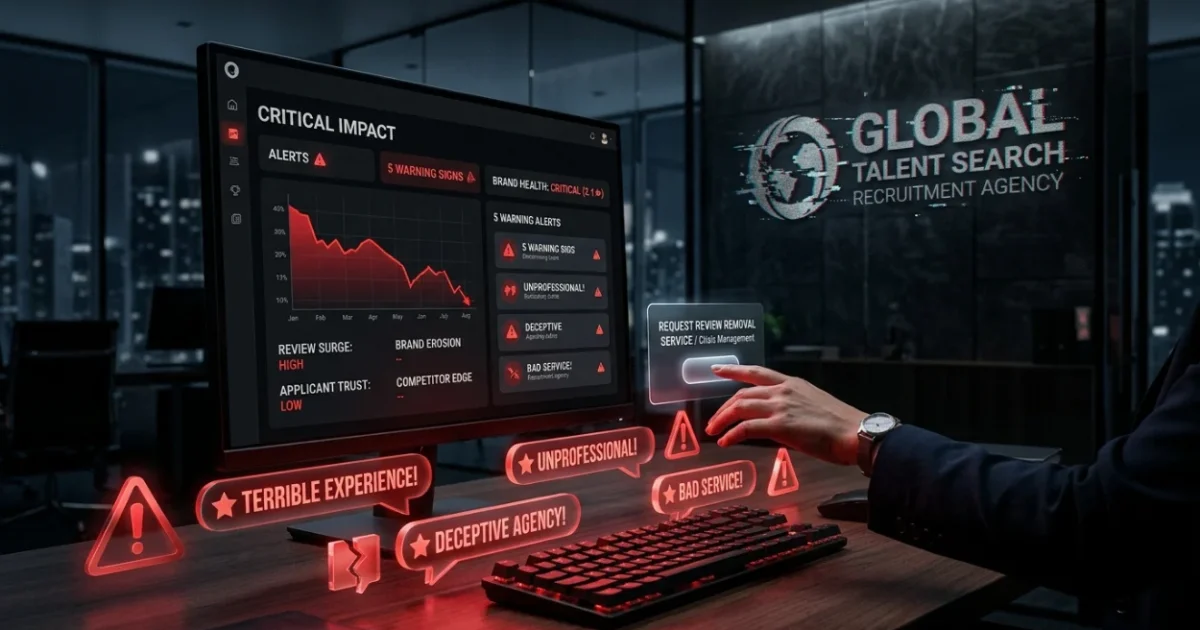
Recruitment agencies hire a review removal service when damaging reviews begin affecting search visibility, candidate trust, and client decisions. Effective reputation management delivers SERP control by addressing qualifying harmful reviews while strengthening credible reputation signals around the agency.
When Do Negative Reviews Become a Recruitment Agency Reputation Risk?
Recruitment agencies need professional intervention when negative reviews become a persistent search and trust problem rather than isolated customer feedback. A single critical review rarely defines an agency, but repeated damaging content across prominent platforms can alter the information candidates and hiring clients encounter first. Search engines evaluate relevance, authority, freshness, engagement and contextual signals when determining which pages receive visibility. This makes review management a search perception issue as well as a customer-service issue. A structured reputation management service identifies the sources creating disproportionate visibility and establishes an evidence-based response strategy.
The first warning sign is persistent negative review visibility across high-value searches. If searches for the agency name, recruiter name, specialist service or employer-facing terms repeatedly surface damaging reviews, the agency has lost control of part of its digital narrative. This visibility can affect candidate confidence before a recruiter establishes direct contact and can influence employers evaluating whether the agency represents a credible hiring partner. Negative review visibility analysis provides the evidence required to distinguish isolated criticism from a measurable SERP risk. This assessment creates a baseline against which visibility, ranking position and reputation signals can be monitored.
A professional service focuses on legitimate mechanisms rather than attempting to manipulate search engines or manufacture feedback. Qualifying reviews can be assessed against platform policies, authenticity requirements, privacy rules and applicable legal standards. Where removal is unavailable, the strategy shifts towards negative content suppression, authoritative content development and stronger entity credibility. This creates a sustainable framework for search perception influence rather than relying on one intervention.
When Do Reviews Start Affecting Candidate and Client Decisions?
Recruitment agencies need reputation intervention when reviews begin influencing how candidates and clients evaluate the agency before direct engagement. Candidates frequently research recruiters before submitting CVs, accepting interviews or responding to outreach, while employers also assess recruitment partners through online searches. A prominent negative review therefore operates as a reputation signal within a wider decision-making environment. If harmful claims occupy highly visible positions, the agency enters conversations with a trust deficit that did not exist before the search. Reputation management addresses this exposure by improving the balance between damaging content and authoritative, accurate information.
The second warning sign is measurable engagement or conversion friction associated with negative reviews. Evidence can include declining enquiry quality, reduced candidate responses, increased objections during sales conversations or repeated questions about specific allegations. These indicators connect search perception with commercial outcomes and establish a stronger business case for intervention. The objective is not to remove legitimate criticism simply because it is unfavourable; it is to identify content that qualifies for removal and reduce the disproportionate visibility of harmful material through compliant methods.
For recruitment agencies, reputation signals also affect entity credibility. Search results frequently provide the first independent evidence a prospective client sees when validating an unfamiliar agency or specialist recruiter. A controlled search environment presents accurate company information, credible expertise and relevant evidence alongside legitimate third-party feedback. This strengthens trust without requiring the agency to control every external opinion.
Agencies can also validate the commercial context through candidate review impact on recruitment pipeline performance. Understanding how candidate sentiment affects trust, engagement and agency selection provides an important decision framework before committing resources to reputation management. This connects search visibility data with the wider recruitment funnel and helps establish whether reputation intervention addresses an identifiable commercial risk.
For agencies assessing how recruitment-sector reputation affects hiring behaviour, product management recruitment trends provide useful context for understanding the importance of candidate expectations, specialist expertise and online credibility in competitive recruitment markets. This analytical perspective helps decision-makers distinguish ordinary market competition from reputation risks that require direct search visibility intervention.
When Does Review Removal Become More Valuable Than Reactive Responses?
Review removal becomes commercially valuable when the agency can establish that specific content violates a platform’s rules or applicable legal requirements. Responding publicly to every negative review does not resolve content that remains prominently indexed, repeatedly reproduced or structurally damaging to the agency’s search profile. A review removal service begins with evidence collection, classification and eligibility assessment rather than promising automatic deletion. This process reduces wasted effort by separating removable content from criticism that requires a different reputation strategy.
The third warning sign is repeated exposure to reviews containing demonstrably false, fraudulent, defamatory or policy-violating material. Evidence is central because removal requests require a defensible basis. A professional process documents the content, platform, publication context, relevant policy criteria and supporting information before submission. Where a removal route exists, the service manages the intervention and tracks the resulting visibility changes. Where removal is not available, negative content suppression provides an alternative route for improving the search environment.
A reliable service therefore operates through defined stages:
- Audit the agency’s branded search results to establish baseline rankings, review visibility and reputation signals.
- Classify harmful reviews against platform policies, authenticity indicators and applicable removal criteria.
- Document supporting evidence so every removal request has a clear and defensible basis.
- Submit compliant requests through appropriate platform or legal channels without relying on artificial engagement.
- Monitor rankings and content visibility after intervention to measure changes in SERP composition.
- Strengthen authoritative assets where removal alone cannot resolve the wider search perception problem.
This approach improves process clarity and reduces operational risk. It also prevents recruitment agencies from treating every negative review as removable content, which creates unrealistic expectations and weakens strategic decision-making. The measurable objective remains controlled visibility, stronger reputation signals and improved search perception.
At the point where an agency has established a genuine reputation risk and needs structured intervention, a professional reputation management for recruiters service provides a defined pathway from initial assessment to evidence-led action. The service model connects review analysis with search visibility control, negative content suppression and ongoing monitoring. This gives decision-makers a clearer basis for evaluating the intervention rather than treating review removal as an isolated technical request.
Dive Deeper With Our Expert Guides:
What Does Reputation Management Cost for Industrial Recruitment Firms?
How Do Agencies Raise Their Google Rating From 3 to 4.5 Stars?
When Does the Cost of Reputation Management Justify the Investment?
The cost of reputation management becomes justified when ongoing reputation damage creates a larger commercial risk than the cost of structured intervention. Recruitment agencies operate in a trust-dependent market where candidates provide personal information and employers depend on recruiters for high-value hiring decisions. A persistent negative search environment can therefore affect lead generation, candidate engagement, employer confidence and sales efficiency simultaneously. Evaluating reputation management only against the price of removing individual reviews misses the broader value of restoring a credible search environment. The correct comparison is the intervention cost against the cumulative commercial and reputational exposure created by unmanaged visibility.
The fourth warning sign is a widening gap between the agency’s actual reputation and its search reputation. An agency can deliver strong recruitment outcomes while outdated, misleading or disproportionate negative content dominates branded searches. This creates an entity credibility problem because search users judge the organisation through the information presented to them rather than through the agency’s internal performance data. Reputation management closes this gap by improving the visibility of accurate, authoritative and relevant information. The result is a more balanced digital representation of the organisation.
Clear My Name applies this principle through structured reputation management rather than treating review removal as an isolated technical task. The relevant outcome is improved information balance: qualifying harmful content is addressed directly, while credible assets receive stronger visibility where appropriate. This makes the investment easier to evaluate because progress can be measured through ranking positions, indexed content, review visibility and branded search composition.
Cost evaluation also needs to account for sustainability. A one-off removal request has limited value if new harmful content repeatedly occupies prominent positions because the wider search ecosystem remains unmanaged. Sustainable reputation management combines review assessment, content development, SERP monitoring and reputation signal strengthening. This creates a continuing control system rather than a temporary reaction to one damaging result.
When Should a Recruitment Agency Act Before Reputation Damage Escalates?

Recruitment agencies need to act before negative review visibility becomes entrenched across branded and commercial searches. Search perception becomes harder to change when harmful pages accumulate authority, attract engagement and become repeatedly referenced by other websites or platforms. Early intervention establishes baseline measurements before the problem expands and gives the agency greater control over available remediation options. Waiting until a major client or candidate raises the issue internally transfers control of the reputation problem to external search results. A defined intervention process reduces that risk.
The fifth warning sign is an expanding footprint of negative reviews, reposts or related search results. Expansion indicates that the problem is no longer confined to one review platform. Screenshots, discussion pages, directory listings and social references can create additional ranking surfaces that reinforce the same negative association. Effective reputation management maps these surfaces and determines which results require direct action, which require suppression and which require stronger authoritative competition. This creates a coordinated SERP control strategy.
The speed of impact depends on the strength of the existing search ecosystem and the intervention required. Review removal can produce a direct change when qualifying content is successfully removed, while suppression and authority-building operate through changes in the competitive visibility landscape. Measurement therefore needs to focus on defined indicators rather than arbitrary promises of instant results.
A robust monitoring framework tracks:
- Measure branded keyword rankings to identify movement in harmful and authoritative results.
- Track review visibility to determine whether damaging pages remain prominent after intervention.
- Compare search-result composition against the original baseline to quantify visibility changes.
- Monitor new content and references to identify emerging reputation risks before they gain authority.
- Evaluate candidate and client-facing search journeys to confirm that trust signals remain visible at key decision points.
This monitoring structure makes reputation management accountable. It also supports continuous optimisation because each intervention generates evidence about what is influencing search visibility. Recruitment agencies gain a clearer understanding of whether the strategy is improving perception, reducing exposure and stabilising their digital presence.
Which Reputation Management Service Delivers the Strongest Long-Term Protection?
A reliable reputation management service combines review assessment, compliant removal, negative content suppression, authoritative content development and continuous monitoring. No single tactic provides durable SERP control when reputation risk exists across multiple platforms and search results. Removal addresses content that qualifies for intervention, while suppression improves the visibility balance when removal is unavailable. Content enhancement strengthens the agency’s entity credibility by increasing the presence of accurate and authoritative information. Monitoring then ensures that reputation signals remain measurable after the initial intervention.
The strongest solution is therefore process-led rather than review-led. Recruitment agencies need a documented route from reputation-risk identification to evidence collection, intervention, search monitoring and outcome evaluation. This reduces risk because every action has a defined purpose and measurable indicator. It also ensures that legitimate criticism is distinguished from content that breaches platform rules or other applicable standards. The result is a controlled approach to search perception influence rather than an attempt to manufacture a perfect online reputation.
Clear My Name provides this structured approach for reputation management for recruiters, connecting review-risk assessment with broader search visibility control. The emphasis remains on evidence, compliant execution and measurable reputation signals rather than exaggerated removal guarantees. For recruitment agencies, this creates a practical route towards improved search results, stronger trust signals and more stable entity credibility.
The decision to hire a review removal service becomes clear when negative content moves beyond ordinary criticism and begins affecting search visibility, candidate confidence or client due diligence. Agencies that identify qualifying removal opportunities early gain a clearer intervention pathway, while agencies facing broader visibility problems benefit from combining removal with suppression and authority-building. This integrated model reduces dependence on individual review outcomes and strengthens the overall information environment. It also creates measurable checkpoints for evaluating cost, progress and sustainability.
For agencies operating in a trust-sensitive recruitment market, reputation management is ultimately a risk-control function. Strong SERP control ensures that prospective candidates and clients encounter accurate, credible information when researching the agency. A structured service delivers this through evidence-based intervention, transparent processes and continuous measurement. That combination strengthens reputation signals, improves search perception and provides a reliable foundation for long-term digital trust.
When should a recruitment agency hire a review removal service?
A recruitment agency should consider a review removal service when harmful reviews are prominent in branded searches, contain false information, or violate a platform’s policies. Early action helps reduce damaging content visibility and protect candidate and client trust.
Can a review removal service remove negative reviews about recruiters?
A review removal service can pursue removal when reviews breach platform rules or meet applicable legal removal criteria. Legitimate negative feedback that does not qualify for removal requires alternative reputation management strategies, such as negative content suppression.
How do negative reviews affect recruitment agencies?
Negative reviews can influence candidate confidence, employer due diligence and search perception when they appear prominently for branded queries. Persistent negative content can weaken reputation signals and reduce perceived entity credibility.
How does reputation management for recruiters improve search results?
Reputation management for recruiters improves search visibility by addressing qualifying harmful content and strengthening accurate, authoritative information. SEO-led content development and monitoring can improve the balance of positive and negative results over time.
Is review removal enough to repair a recruitment agency’s online reputation?
Review removal alone does not always resolve broader reputation risks. A complete strategy can combine compliant review removal, negative content suppression, authoritative content development and SERP monitoring to strengthen long-term search perception.