

English private schools that rank highly on Google typically have stronger combinations of relevance, authority, entity clarity, content quality and established digital signals rather than relying on a single ranking factor. Search positions also vary by query, location, device and search intent, so there is no permanent list of schools that always occupy the highest positions.
Reputation management strategies differ based on how a school’s digital footprint is formed, how competing pages establish authority and how search engines interpret available reputation signals. Online reputation control methods are evaluated through search visibility, entity credibility, sentiment distribution, content quality and the composition of the search results page.
Which factors most strongly influence how private schools rank on Google?
Content relevance and authority provide the strongest foundation for private-school search visibility, while entity clarity and reputation signals influence how the school is understood across the wider search ecosystem. Google explains that its ranking systems evaluate pages through numerous signals and systems designed to return relevant and useful results for individual queries.
A school’s official website normally provides the core entity information, including its name, location, admissions information, curriculum, facilities and leadership. Third-party sources then add contextual information through directories, educational publications, reviews, news coverage and independent assessments. The combination creates a broader digital footprint that allows search systems to connect different references with the same educational entity.
Content creation and content removal operate differently within this environment. Content creation expands the amount of relevant information available for indexing, whereas removal reduces the availability of specific information where legitimate removal grounds exist. The stronger approach therefore depends on whether the underlying problem concerns insufficient authoritative information, inaccurate content, harmful content or weak entity representation.
How does content creation compare with content removal for school reputation?
Content creation provides broader long-term search coverage, while legitimate content removal offers a more direct response when a particular page qualifies for removal. Google states that its systems automatically crawl, index and evaluate web content, meaning newly published material enters the same search ecosystem as existing pages rather than replacing them automatically.
Content enhancement works by creating useful, relevant pages that address identifiable search intents around the school. Admissions pages, academic information, subject-specific resources, leadership profiles and factual institutional information can strengthen topical coverage when they provide genuine value. This approach has greater scalability because one strong information architecture can support multiple related queries.
Removal operates through a narrower mechanism. A page can disappear from search visibility only when the underlying source removes it, a valid removal process applies, or Google’s policies provide a basis for removal or demotion. Google’s documentation identifies specific removal-based systems covering areas such as legal removals and personal information, demonstrating that removal is policy-dependent rather than a general reputation-management mechanism.
For private schools, content enhancement therefore provides wider control over the information environment, while removal provides targeted intervention against qualifying content. Treating the two approaches as interchangeable creates inaccurate expectations about how search visibility changes.
Is an organic reputation strategy more sustainable than a reactive strategy?
Organic reputation development is generally more sustainable because it builds digital authority before an individual search problem requires intervention. An organic approach focuses on maintaining accurate institutional information, publishing useful content, earning legitimate references and ensuring that important school information remains accessible to search engines.
A reactive strategy begins after a reputation issue has already affected search visibility. It analyses the source, ranking position, indexing status, sentiment and surrounding results before selecting an intervention. This approach is useful for identifying immediate weaknesses but operates under greater time pressure because the search ecosystem already contains competing narratives.
Organic strategies also create cumulative effects across the digital footprint. A strong institutional website, consistent entity information and authoritative third-party references can support multiple searches simultaneously. Reactive strategies normally address a defined issue and therefore require more frequent reassessment when new content enters the results.
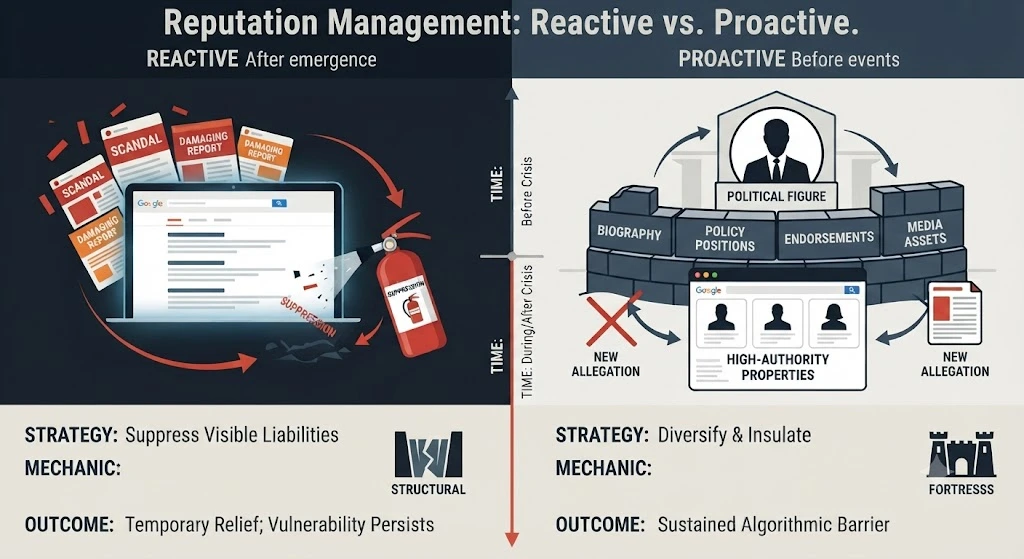
The distinction is important for Reputation Management for Private Schools because prevention and response measure different outcomes. Organic activity evaluates the strength of the underlying reputation system, while reactive activity evaluates how effectively a specific reputation problem can be contained.
Which approach has the strongest short-term impact on search visibility?
Reactive intervention can produce a more immediate change when the issue involves content that qualifies for removal or when a high-ranking page loses its visibility. The short-term effect depends on the source, Google’s processing, indexing cycles and the authority of competing pages.
Content enhancement normally requires a longer period because new pages have to be discovered, crawled, indexed and assessed within the existing search ecosystem. Google describes search as a process involving crawling, indexing and serving, with indexing and ranking decisions occurring through automated systems.
Short-term performance therefore favours targeted interventions when a legitimate removal mechanism exists. Long-term performance favours a broader strategy that strengthens authoritative content and improves the overall composition of the school’s search results.
A useful evaluation separates immediate ranking movement from durable reputation improvement. A result moving from position two to position eight represents a ranking change, while a broader improvement in the proportion of authoritative, accurate and relevant results represents a stronger change in search perception.
How do search engines interpret reputation signals around private schools?
Search engines interpret reputation indirectly through signals associated with relevance, quality, authority, links, content and the broader information environment rather than through a single reputation score. Google’s published guidance states that its ranking systems use numerous signals and that individual pages are evaluated through different systems designed for different search requirements.
Reputation signals include references from authoritative websites, consistent school information, useful first-party content, review content and relevant third-party coverage. These signals help establish whether different online references relate to the same entity and whether a page provides useful information for a specific query.
Entity credibility develops when information about the school remains consistent across important sources. A school name, location, website, leadership information and institutional description that appear consistently across trusted references create stronger entity relationships. In contrast, conflicting information introduces ambiguity into the digital footprint.

This means reputation cannot be assessed through reviews alone. Reviews contribute sentiment distribution, while institutional sources, editorial references, educational databases and other authoritative pages contribute additional forms of credibility.
How does SERP composition differ between strong and weak school reputations?

A stronger SERP composition contains a greater proportion of authoritative, relevant and entity-connected pages across the first results. A weaker composition can contain fragmented directories, outdated references, low-quality articles, negative reviews or unrelated pages that occupy valuable positions for the school’s name.
SERP composition is therefore different from simply measuring the school’s own website position. A school can rank first for its official domain while still having a fragmented first page containing third-party information that shapes perception.
Search systems also use site diversity and deduplication mechanisms. Google’s documentation explains that its systems generally limit excessive representation from a single website and use deduplication to avoid showing substantially similar results repeatedly.
This creates an important strategic limitation. Publishing ten similar pages does not guarantee ten prominent positions. Effective content enhancement instead focuses on distinct search intents, useful information and authoritative coverage that complements rather than duplicates existing pages.
How does search visibility compare with entity credibility?
Search visibility measures where information appears, while entity credibility measures how consistently and reliably the entity is represented across relevant sources. A school can have high visibility without having a particularly coherent entity profile if its search results contain inconsistent information.
Entity credibility operates through relationships between the school and its associated information. Official pages, educational references, independent publications and structured institutional information all contribute to the context in which the entity is interpreted.
Search ranking influence therefore needs to be separated from reputation perception. A page can rank highly because it matches a query exceptionally well without representing the most comprehensive view of the school. Conversely, a highly authoritative school source can remain below another page for a specific query because relevance and search intent favour the competing result.
Google states that relevance is determined through hundreds of factors, with factors such as language, location and device affecting results for particular searches. This makes ranking analysis query-specific rather than universal.
Which is more effective: improving first-party content or strengthening third-party coverage?
Improving first-party content provides greater control, while strengthening legitimate third-party coverage provides independent context and external authority. First-party content includes the school’s own website, publications, academic pages, policies and institutional resources.
Third-party coverage includes independent educational directories, reputable publications, review platforms and other sources that discuss the school without being controlled by the school itself. These references can add contextual credibility because they represent external information rather than self-published claims.
The two approaches therefore perform different functions. First-party content establishes factual depth and topical completeness, while third-party coverage strengthens the wider entity ecosystem.
Google’s guidance also emphasises helpful, reliable, people-first content and identifies experience, expertise, authoritativeness and trustworthiness as concepts used to evaluate content quality, while noting that E-E-A-T itself is not a specific ranking factor.
Dive Deeper With Our Expert Guides:
How Do Regional Private Schools Compete for a Shrinking Pool of Applicants?
Reputation Audit vs PR Agency: Which Fixes School Enrolment Decline Faster?
How do reviews and sentiment distribution affect private-school reputation?
Reviews influence reputation through the information and sentiment they add to the school’s digital footprint, but review quantity alone does not establish search authority. Review content can contribute positive, negative or mixed sentiment, creating a distribution that affects how prospective searchers interpret the entity.
The quality and context of review content also matter. Google’s reviews system is designed to reward high-quality review content that provides insightful analysis and original research, although that system primarily evaluates first-party review content rather than third-party user reviews.
Reputation analysis therefore examines sentiment distribution rather than simply counting positive and negative comments. It also considers the source, recency, relevance and prominence of review content within the search results.
A school with strong institutional content but highly visible negative third-party references has a different reputation profile from a school with similar institutional authority and balanced external sentiment. The search environment needs to be assessed as a complete system rather than through one metric.
What is the difference between short-term suppression and long-term content enhancement?
Short-term suppression attempts to reduce the visibility of a specific result, while long-term content enhancement increases the strength and breadth of authoritative information competing within the SERP. Suppression therefore targets an existing ranking problem, whereas enhancement changes the competitive environment.
Suppression has greater risk exposure when it relies on tactics that conflict with search-engine policies or create artificial signals. Google’s Search Essentials explicitly identifies spam policies and ranking manipulation as behaviours that can result in lower rankings or omission from search results.
Enhancement has greater sustainability when each page exists for a legitimate user purpose and provides distinct information. It also scales more effectively because a well-structured content ecosystem can address multiple queries without requiring a separate reactive campaign for every ranking issue.
The strongest evaluation therefore considers whether an approach improves the underlying information environment rather than only changing one position temporarily.
How can a private school evaluate reputation strategy effectiveness?
A reputation strategy is best evaluated through a combination of ranking, content, entity and sentiment measurements rather than one visibility metric. This provides a more accurate assessment of whether search perception is improving.

A practical evaluation framework can:
- Measure branded-query positions across desktop and mobile searches to identify changes in SERP composition.
- Audit indexed first-party pages to determine whether important institutional information is discoverable and relevant.
- Compare third-party results to identify authoritative, neutral, positive and negative references occupying prominent positions.
- Analyse sentiment distribution across visible review and editorial sources to identify reputation imbalances.
- Track entity consistency across school names, locations, leadership information and institutional references.
- Assess sustainability by measuring whether improvements remain visible after new content enters the search ecosystem.
This framework separates search ranking influence from broader reputation outcomes. It also prevents a temporary position change from being treated as evidence of a complete reputation improvement.
When does a combined reputation approach provide the strongest strategic balance?
A combined approach provides the broadest coverage when a school faces both weak positive search coverage and specific problematic content. Content enhancement can strengthen authoritative results while legitimate removal processes address content that qualifies for removal.
The mechanism is complementary rather than interchangeable. Enhancement expands the competitive set of relevant pages, while removal reduces the presence of qualifying problematic material. Neither mechanism automatically controls the complete SERP.
The strategic value comes from sequencing the interventions according to source, risk, authority and search position. High-impact content requires separate analysis from low-authority pages, while an entity with weak first-party coverage requires a different response from an entity with strong coverage but a concentrated negative result.
For schools evaluating Google Knowledge Panel, the same principle applies: entity information needs to be understood as part of a broader search ecosystem rather than treated as an isolated visual feature. The accuracy and consistency of underlying entity information remain relevant because Google’s systems rely on information gathered from across the web.
What approach is most sustainable for long-term private-school search reputation?
Long-term sustainability depends on maintaining accurate, authoritative and useful information while monitoring changes in the wider search ecosystem. Content enhancement generally offers stronger scalability because one coherent digital footprint can support numerous branded and non-branded searches.
Reactive methods remain important when a defined problem requires immediate assessment. Their value increases when the intervention is tied to a legitimate mechanism, measurable search outcome and clearly identified source.
The most effective evaluation therefore distinguishes between removal, suppression and enhancement. Removal addresses qualifying content at its source or within applicable search policies, suppression focuses on reducing the prominence of problematic results, and enhancement strengthens competing authoritative information.
A sustainable reputation strategy combines these distinctions with continuous measurement. It evaluates search visibility, entity credibility, reputation signals, sentiment distribution and SERP composition rather than treating a single ranking position as the complete measure of online reputation.
What do the highest-ranking English private schools reveal about Google reputation?
The highest-ranking English private schools do not succeed through one universal ranking formula. Their visibility reflects the interaction between relevant content, authoritative references, technical accessibility, entity clarity, links, reputation signals and query-specific ranking systems. Google’s own documentation confirms that ranking uses multiple automated systems and that relevance is determined through numerous signals rather than one fixed reputation score.
The comparison between reputation approaches produces a clear distinction. Content creation offers scalable long-term coverage, content removal provides targeted intervention where valid mechanisms exist, organic development builds resilience, and reactive strategies address defined search problems.
Short-term ranking movement and long-term reputation improvement also represent different outcomes. A durable strategy measures the quality and balance of the entire SERP, not only the position of a school’s website.
Ultimately, private-school search reputation is an ecosystem problem. The strongest strategic assessment examines how first-party content, third-party references, reviews, entity information and search ranking influence interact, then evaluates effectiveness, scalability, risk exposure and sustainability against the school’s actual search environment.
Which English private schools rank highest on Google and why?
English private schools tend to rank strongly when they have relevant content, authoritative references, consistent entity information and a well-developed digital footprint. Search rankings also depend on the specific query, location, search intent and other ranking signals.
What factors affect a private school’s Google ranking?
Key factors include content relevance, website quality, authoritative references, technical accessibility, links, entity clarity and reputation signals. Reviews and third-party coverage also influence the wider search environment surrounding the school.
How does reputation management affect private school search visibility?
Reputation management for private schools evaluates how institutional content, reviews, third-party references and search results collectively shape online perception. The approach can involve content enhancement, legitimate removal processes, monitoring and SERP analysis.
Is creating content better than removing negative content about a private school?
Content creation strengthens the school’s authoritative search footprint, while legitimate removal addresses specific content that qualifies for removal. The appropriate approach depends on the source, content type, ranking position and available removal mechanism.
How can a private school improve its online reputation on Google?
A private school can improve its search reputation by maintaining accurate first-party information, developing useful content, strengthening legitimate authoritative references and monitoring review sentiment. Consistent entity information across trusted sources also supports clearer online representation.