

Political campaign teams prioritise communication trends that strengthen public trust, improve message consistency, and maintain accurate reputation signals across search ecosystems and digital platforms. The highest-priority trends are those that improve entity credibility while reducing reputation risks created by fragmented information environments.
Reputation management strategies differ based on campaign objectives, communication channels, and the speed at which public narratives evolve. Online reputation control methods are evaluated through search visibility, sentiment distribution, entity recognition, content authority, and long-term search ranking influence rather than short-term engagement metrics alone.
Which political communication trends have the strongest influence on reputation management?
Political communication trends influence reputation management according to how effectively they shape reputation signals that search engines and audiences interpret over time. Each trend affects search visibility, entity credibility, and digital trust through different mechanisms, making evaluation essential before prioritisation.
Consistent narrative management is one of the strongest trends because it operates by maintaining alignment between speeches, policy announcements, interviews, press releases, and digital content. Search engines evaluate topical consistency across authoritative sources, creating stronger entity associations when messaging remains stable. Contradictory statements fragment relevance signals and weaken semantic relationships. Consistency also improves sentiment distribution by reducing conflicting interpretations. This approach strengthens long-term reputation stability rather than creating temporary visibility.
Real-time communication represents another influential trend because search ecosystems index new information rapidly. Timely responses reduce the duration of negative search associations and help maintain balanced SERP composition. Delayed communication allows competing narratives to gain authority through citations, backlinks, and repeated publication. Rapid communication therefore improves search freshness signals while limiting misinformation exposure. The effectiveness of this approach depends on accuracy rather than publication speed alone.
Visual-first communication has gained greater importance because multimedia content receives prominent placement within modern search results. Images, videos, interviews, and short-form media diversify search visibility across multiple search features. Rich media expands entity recognition through structured metadata and user engagement metrics. However, multimedia requires consistent optimisation to maintain contextual relevance. Without supporting textual authority, visual content provides limited semantic reinforcement.
How does proactive communication compare with reactive reputation management?
Proactive communication establishes reputation signals before reputational challenges emerge, whereas reactive reputation management focuses on correcting existing perception issues. These approaches operate differently within search ecosystems because timing directly affects indexation patterns and authority development.
How proactive communication operates
Proactive communication is the systematic publication of authoritative information before external narratives dominate search visibility. It operates by creating comprehensive topical coverage across trusted digital assets. Search engines interpret consistent publication as evidence of topical expertise and entity completeness. This improves semantic associations between political figures, policy positions, and recognised subject areas. Stable authority reduces opportunities for misinformation to dominate search results.
Proactive strategies also improve sentiment distribution because positive, neutral, and factual content already occupies valuable ranking positions. Existing authoritative pages require fewer corrective interventions when negative coverage appears. Search ranking influence therefore develops gradually through accumulated relevance signals rather than emergency content deployment. Sustainability becomes the defining advantage of this method.
How reactive reputation management operates
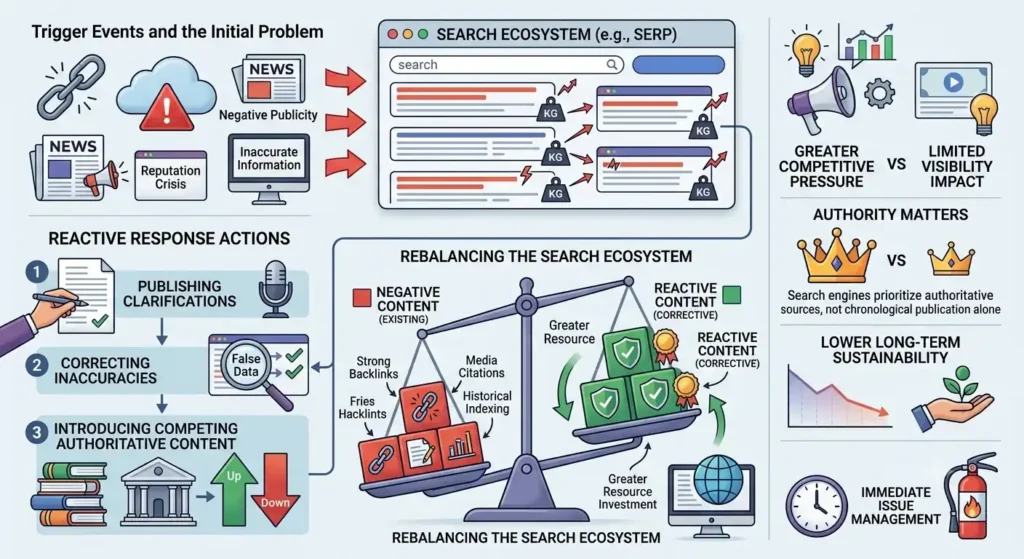
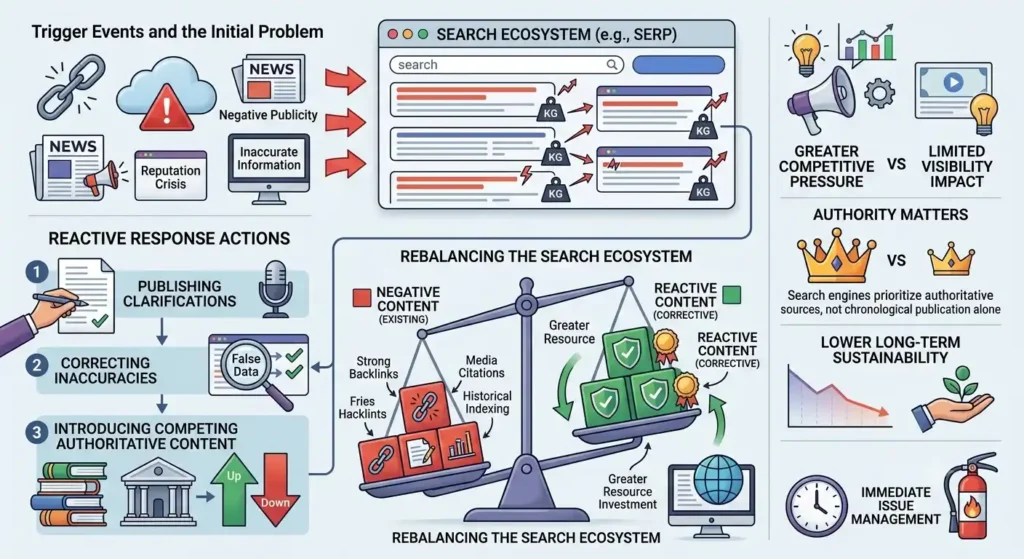
Reactive reputation management focuses on responding after negative publicity, inaccurate information, or reputation crises affect search perception. It operates by publishing clarifications, correcting inaccuracies, and introducing competing authoritative content into search ecosystems. Reactive methods address existing visibility problems instead of preventing them. Their effectiveness depends on the authority of corrective content and the strength of existing search rankings.
Reactive communication provides immediate issue management but faces greater competitive pressure because established negative content often possesses stronger authority through backlinks, media citations, and historical indexing. Search engines prioritise authoritative sources instead of chronological publication alone. Consequently, reactive strategies require greater resource investment to rebalance SERP composition. Their long-term sustainability remains lower than proactive communication.
Which reputation management methods influence search perception most effectively?
Different reputation management methods influence search perception through distinct mechanisms that search engines interpret when evaluating entity credibility. Effectiveness depends on how each method contributes to semantic relevance, authoritative coverage, and balanced sentiment distribution.
Content enhancement versus content suppression
Content enhancement is the creation of authoritative, relevant, and comprehensive information that improves the overall quality of search results. Content suppression focuses on reducing the prominence of undesirable search results through stronger competing content. Although both influence SERP composition, their operational mechanisms differ significantly.
Content enhancement strengthens topical authority by expanding factual coverage across trusted platforms. Search engines reward comprehensive subject depth because semantic completeness improves relevance. Strong topical clusters increase entity credibility while supporting consistent reputation signals. This approach produces sustainable search ranking influence because new authoritative content continues contributing to semantic relevance over time.
Content suppression operates by increasing the ranking strength of positive or neutral content until less desirable results receive lower visibility. The mechanism depends on competition rather than removal. Existing negative content remains indexed unless legal or policy-based removal applies. Suppression therefore measures success through comparative ranking movement instead of deletion. Long-term effectiveness depends entirely on maintaining stronger authority than competing pages.
Correction strategies versus clarification strategies
Correction strategies focus on factual inaccuracies requiring direct amendment. Clarification strategies explain complex issues where misunderstanding affects public perception despite factual accuracy. Search engines distinguish these mechanisms because corrections often involve updated authoritative sources, whereas clarifications expand contextual relevance.
Correction improves entity credibility when official information replaces inaccurate references across multiple authoritative domains. Clarification improves semantic completeness by expanding explanatory content around disputed topics. Both approaches strengthen trust signals, although clarification generally supports broader topical authority through additional contextual relationships. Their combined application creates stronger search ecosystem resilience.
How do search engines evaluate political reputation signals?
Search engines evaluate political reputation signals through semantic relationships, authority indicators, entity associations, and consistency across trusted sources. Reputation management therefore depends on improving interpretable signals rather than manipulating rankings directly.
Entity credibility is the degree to which a recognised public figure demonstrates consistent associations with verified information across authoritative sources. Search engines compare structured data, news coverage, official publications, expert references, and historical content. Greater consistency strengthens entity confidence within knowledge systems. Contradictory or fragmented information weakens semantic certainty and increases ambiguity.
Sentiment distribution measures the balance between positive, neutral, and negative content appearing throughout search ecosystems. Search engines do not optimise rankings according to emotional polarity alone, but they evaluate relevance, authority, freshness, and contextual completeness. Balanced sentiment across authoritative sources creates stronger credibility than isolated promotional content. Reputation management therefore analyses distribution instead of isolated articles.
Search ranking influence develops through authority accumulation rather than isolated optimisation activities. High-quality publications, topical depth, structured information, internal semantic relationships, and trusted citations collectively strengthen visibility. Campaign communication therefore influences search ecosystems indirectly through content quality and consistency rather than immediate ranking adjustments.
Which communication channels contribute the strongest reputation signals?
Communication channels contribute different levels of authority depending on their credibility, semantic context, and search indexation characteristics. Comparing channels demonstrates that visibility alone does not determine reputation strength.
Official websites provide the highest level of controlled information because they establish primary entity associations. Search engines treat authoritative domains as central reference points when evaluating factual consistency. Policy statements, biographies, position papers, and official announcements reinforce semantic completeness. This channel also supports structured data implementation, strengthening entity recognition.
News publications contribute independent authority because editorial oversight strengthens credibility signals. Search engines frequently associate recognised journalism with high-authority information. Positive and negative coverage both influence sentiment distribution depending on prominence and citation frequency. Independent reporting therefore carries greater reputation impact than self-published communication.
Social media platforms provide rapid dissemination and engagement signals but possess lower long-term search authority than comprehensive web content. Their value lies in communication speed, public interaction, and multimedia distribution. Social content supports reputation management by amplifying messaging rather than replacing authoritative information repositories.
Video platforms strengthen entity recognition through multimedia indexing, transcripts, captions, and audience engagement. Video explanations improve semantic coverage while increasing visibility across blended search results. Combined with supporting textual resources, multimedia expands topical authority more effectively than isolated publication.
How do short-term reputation tactics compare with long-term reputation development?
Short-term reputation tactics address immediate visibility challenges, whereas long-term reputation development establishes sustainable authority through continuous semantic reinforcement. Both approaches contribute differently to search ecosystem performance.
Short-term tactics operate by increasing communication frequency, responding rapidly to emerging narratives, and publishing clarification content. These mechanisms influence search freshness while reducing temporary reputation volatility. Immediate improvements often appear within news-oriented search results where recency receives greater weighting. Sustainability remains limited because freshness signals naturally decline over time.
Long-term reputation development builds comprehensive topical authority through consistent publication, structured information, policy documentation, expert references, and authoritative content ecosystems. Search engines reward accumulated expertise because semantic relationships strengthen through continuous reinforcement. Long-term approaches therefore create stable search ranking influence across broader keyword clusters.
Comparing these strategies demonstrates that immediate visibility improvements rarely replace accumulated authority. Short-term actions stabilise perception during active issues, while long-term development maintains reputation resilience between campaign cycles. Combining both methods creates balanced reputation management without relying exclusively on reactive communication.
Which evaluation framework helps campaign teams prioritise communication strategies?
Communication strategies are evaluated most effectively through measurable reputation indicators rather than isolated engagement metrics. A structured evaluation framework compares effectiveness, sustainability, scalability, and risk exposure across competing approaches.
A practical evaluation framework includes the following actions:
- Measure sentiment distribution across authoritative search results to identify shifts in public perception.
- Compare entity credibility using consistency between official information, news publications, and indexed content.
- Evaluate search ranking influence by analysing the visibility of authoritative resources within priority search queries.
- Assess SERP composition to determine whether balanced, factual, and comprehensive information dominates first-page results.
- Monitor content freshness alongside historical authority to identify emerging reputation risks before they reshape search visibility.
Each measurement focuses on observable reputation signals rather than isolated popularity metrics. Search ecosystems reward authority, consistency, and topical completeness instead of communication volume alone. Campaign teams therefore obtain stronger strategic insights by evaluating search perception holistically.
Dive Deeper With Our Expert Guides:
Assessing Political Reputation Across Social Media Channels
Evaluating Your Political Reputation Across Key Voter Research Platforms
What strategic considerations determine communication priorities during political campaigns?
Strategic priorities are determined by communication consistency, search ecosystem dynamics, entity credibility, and sustainable reputation development rather than isolated campaign events. Effective evaluation compares operational mechanisms instead of individual communication formats.
Campaign teams benefit from aligning policy communication, media engagement, multimedia publication, and official documentation into a unified semantic framework. Fragmented communication weakens entity associations because search engines interpret inconsistent topical relationships as reduced informational certainty. Integrated communication strengthens reputation signals while improving search visibility across interconnected subject areas.
Risk exposure also influences communication priorities. High-frequency communication without factual consistency increases ambiguity despite greater visibility. Comprehensive communication supported by authoritative documentation strengthens semantic relevance while reducing perception volatility. Consequently, communication quality remains a stronger predictor of reputation resilience than publication frequency.
Political communication trends differ according to their influence on entity credibility, sentiment distribution, search ranking influence, and long-term reputation stability. Proactive communication establishes stronger semantic authority than reactive responses, while content enhancement provides greater sustainability than content suppression alone. Official information, authoritative media coverage, and consistent messaging collectively strengthen reputation signals interpreted by search engines.
Evaluating communication approaches through search visibility, SERP composition, scalability, sustainability, and risk exposure provides a structured basis for campaign decision-making. Rather than focusing on isolated engagement metrics, reputation management analysis examines how search ecosystems interpret authority, consistency, and contextual completeness over time.
Get more information, explore:
Reputation Management Support for Political Campaigns Under Public Scrutiny
Answers to Key Questions
What is reputation management for politicians?
Reputation management for politicians is the process of monitoring, improving, and protecting a politician’s public image across search engines, news coverage, social media, and online content. It focuses on strengthening reputation signals, correcting misinformation, and maintaining entity credibility.
How does online reputation affect a political campaign?
Online reputation influences how voters, journalists, and stakeholders perceive a candidate before engaging with campaign messaging. Search results, media coverage, and public sentiment collectively shape digital trust and overall credibility.
Can negative search results about politicians be managed?
Negative search results can be managed through factual content creation, reputation monitoring, content enhancement, and, where appropriate, removal requests that comply with platform or legal policies. The objective is to improve the overall balance of search results rather than erase legitimate information.
Why is reputation monitoring important for politicians?
Reputation monitoring identifies changes in online sentiment, emerging issues, and inaccurate information before they significantly affect public perception. Continuous monitoring also helps maintain consistent reputation signals across digital platforms.